
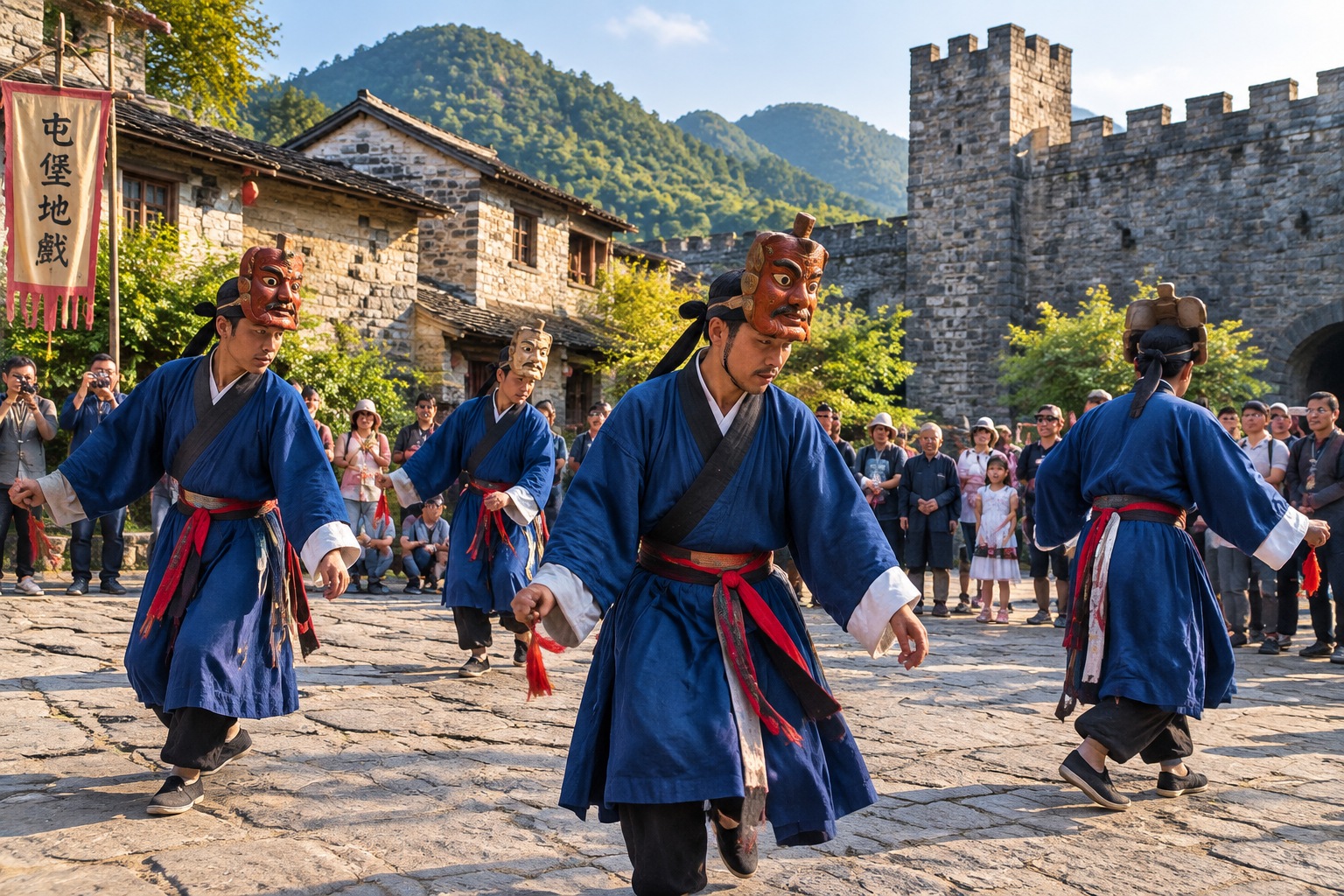

It is a late summer evening in the ancient stone village of Yunshan, near Anshun in southwest China’s Guizhou province. A small crowd has formed a rough circle in a paved courtyard. In the center, four men in blue robes and white headscarves move slowly, each with a wooden mask balanced on their forehead, their painted faces showing through below. They chant in a raw, high-pitched voice, punctuated by a few beats of a drum and a gong. Some elderly women in blue embroidered jackets watch intently; teenagers hold up their phones to record the scene.
This is Dixi, or “ground opera” — and if you have never heard of it, you are not alone. Most visitors to China go to Beijing for the Great Wall, or Xi’an for the terracotta warriors, but this ancient masked performance remains one of the country’s best-kept secrets. It has been called a “living fossil” for good reason: it carries the memory of a migration that shaped China’s southwest, and today it survives not in a museum, but in the daily rhythms of mountain villages.
What Exactly Is Dixi?
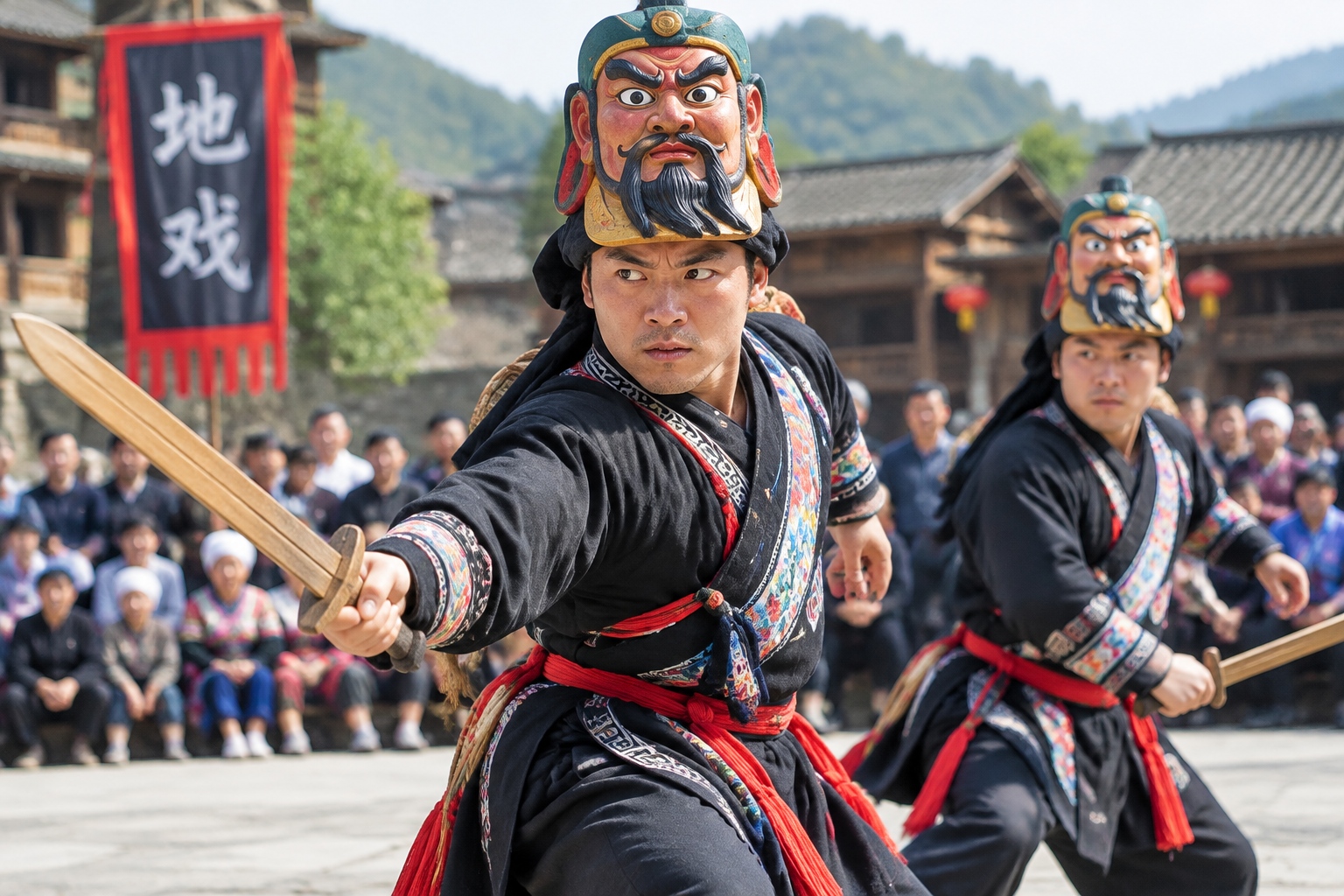
Its Chinese name, Dìxì (地戏), means “earth theater” — referring to performances that take place on the ground rather than on a raised stage. Audiences simply stand or sit around the performers, making it an intimate, open-air experience. The plays are mostly adapted from historical novels like Romance of the Three Kingdoms, the Journey to the West, and stories of the Yang family generals — epic tales of war, loyalty, and strategy.
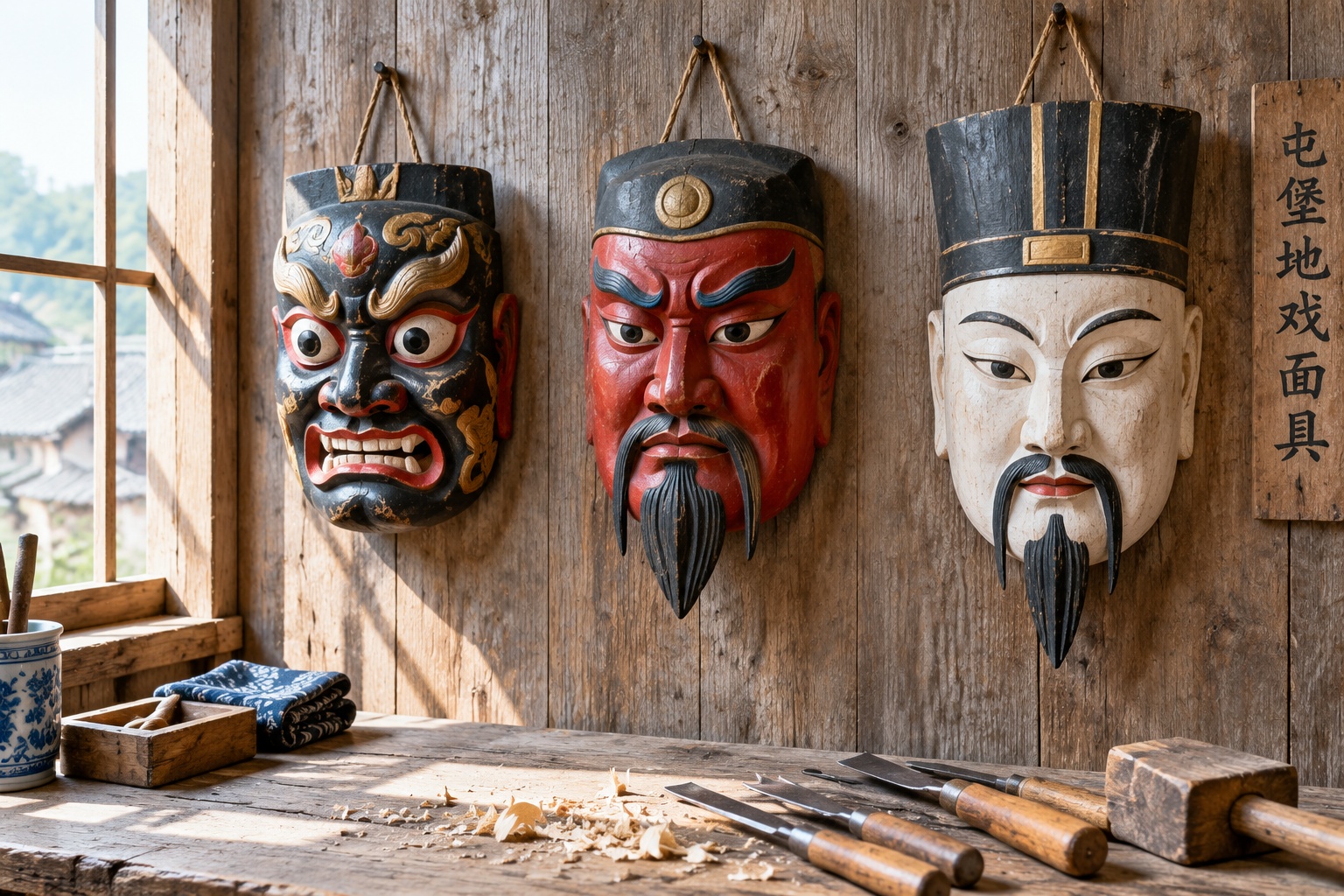
What makes Dixi visually striking is the masks. Carved from wood, painted in vivid colors — black for Zhang Fei, red for Guan Yu, white for Cao Cao — they hang on the performer’s forehead, just above the brow. Why above the face? Because in local belief, the mask is not a simple prop but a divine instrument. Once worn, the performer is said to channel the spirit of the character. Keeping the mask above the forehead leaves the performer’s own face visible, symbolizing the distance between human and deity — but also their connection.
Who Are the Tunpu People?
Dixi is the ritual theater of the Tunpu (屯堡) people, a distinctive Han Chinese subgroup living around Anshun. Their ancestors were soldiers and their families sent by the first Ming emperor, Zhu Yuanzhang, in the late 14th century to garrison the remote southwest. To defend the frontier, they built walled stone villages, planted crops, and created a self-contained society. Over time, their descendants became known as the Tunpu, meaning “garrison villages”.
Because the mountains limited contact with the outside world, the Tunpu preserved many cultural practices from their original homes in Jiangsu, Anhui, and Jiangxi. Women still wear traditional “Fenghuang” Han dresses with intricate blue and white embroidery. The local dialect retains sounds from Ming-dynasty Chinese. And their stone-built houses, watchtowers, and narrow lanes look remarkably like a medieval fortress town.
Yet the Tunpu were never isolated. Anshun is an ethnic mosaic: Miao, Bouyei, and other minority groups live in the surrounding valleys. The Tunpu traded with them, intermarried occasionally, shared festivals, and absorbed elements of their music, dance, and craftsmanship. This cultural exchange is exactly what makes Dixi so fascinating.
The Masks and the Songs
Each Dixi mask is hand-carved by local artisans, traditionally from willow or camphor wood, then layered with cloth, plaster, and mineral paints. The characters are fixed: generals, heroes, demons, and gods. The masks have exaggerated eyes and fierce expressions, designed to be visible from a distance. In some villages, carvers say they must purify themselves before carving a sacred mask, and new masks are consecrated with a ritual.
The singing is equally distinctive. Dixi uses a style derived from yiyang qiang (弋阳腔), one of the oldest forms of Chinese opera, known for its high volume, solo lead singing, and other-back repetition. In the open air, performers push their voices to carry across the village square. Performances are often loud, physical, and surprisingly athletic — the actors stomp, spin, and mimic sword battles.
Performances are tied to the lunar calendar. The most important period is the Chinese New Year, when villages call on Dixi troupes to drive away evil spirits and pray for good harvests. In some areas, performances also occur at the seventh lunar month festival, and at temple fairs or weddings. If you show up at the wrong time, you will see an empty stage. That is all part of its mysterious charm.
Where Han and Ethnic Cultures Meet
Ask a local about Dixi’s history, and you will hear about its pure Han roots. But look closer and you’ll notice the seams. The drum patterns resemble those played by Miao wooden drums. The same basic dance steps appear in festivals of Bouyei villages. Some masks, especially those of demons or spirits, show a flair that seems different from the stricter Han opera tradition. Researchers have argued that the long, daily contact between Tunpu and neighboring minority groups left a clear mark on Dixi’s rhythm and movement.
More importantly, the exchange goes both ways. In several villages near Anshun, young Miao and Bouyei men join Dixi troupes, performing Han military heroes with the same skill as their Han neighbors. Meanwhile, Tunpu women often wear silver ornaments bought from Miao silversmiths, and Tunpu festivals include performances by minority dance groups. The “living fossil” is not frozen — it has been breathing and adapting for six centuries.
Dixi Today: From Village Ritual to Heritage
In 2006, Dixi was inscribed into China’s national list of Intangible Cultural Heritage. Since then, preservation efforts have grown. Some local schools now offer Dixi classes to children. Villages have restored their troupes and costumes. And tourist sites like Tianlong Tunpu and Yunfeng Baji have begun staging regular shows for visitors — a simplified, condensed version that offers a glimpse even on non-festival days.
But heritage status comes with challenges. The most experienced performers are over 60, and like many rural areas in China, the villages are losing young people to cities. Some troupes struggle to maintain rehearsal times. Meanwhile, the tourism demand can turn a sacred ritual into a daily stage routine. Locals have mixed feelings. Some embrace the attention and income; others worry that the essence is being diluted.
Still, there is reason for hope. A new generation is rediscovering Dixi as a point of identity. In 2023, a young Tunpu filmmaker from Anshun made a short documentary about his grandfather’s mask-carving workshop, which won awards at Chinese film festivals and was watched millions of times online. Social media has turned Dixi into a star. Videos tagged #地戏 have accumulated hundreds of millions of views, introducing this ancient art to Chinese and international audiences who would never have heard the name otherwise.
How to See It for Yourself
If you want to experience Dixi, plan your trip carefully. The most atmospheric performances happen during Chinese New Year (usually late January or February) and the sixth or seventh lunar months. In the villages themselves — like Tianlong, Yunshan, Benzhai, or Jiuxi — you might stumble upon a rehearsal if you ask around. On ordinary days, the tourist towns put on short shows, often at 11 a.m. and 3 p.m. but schedules can change.
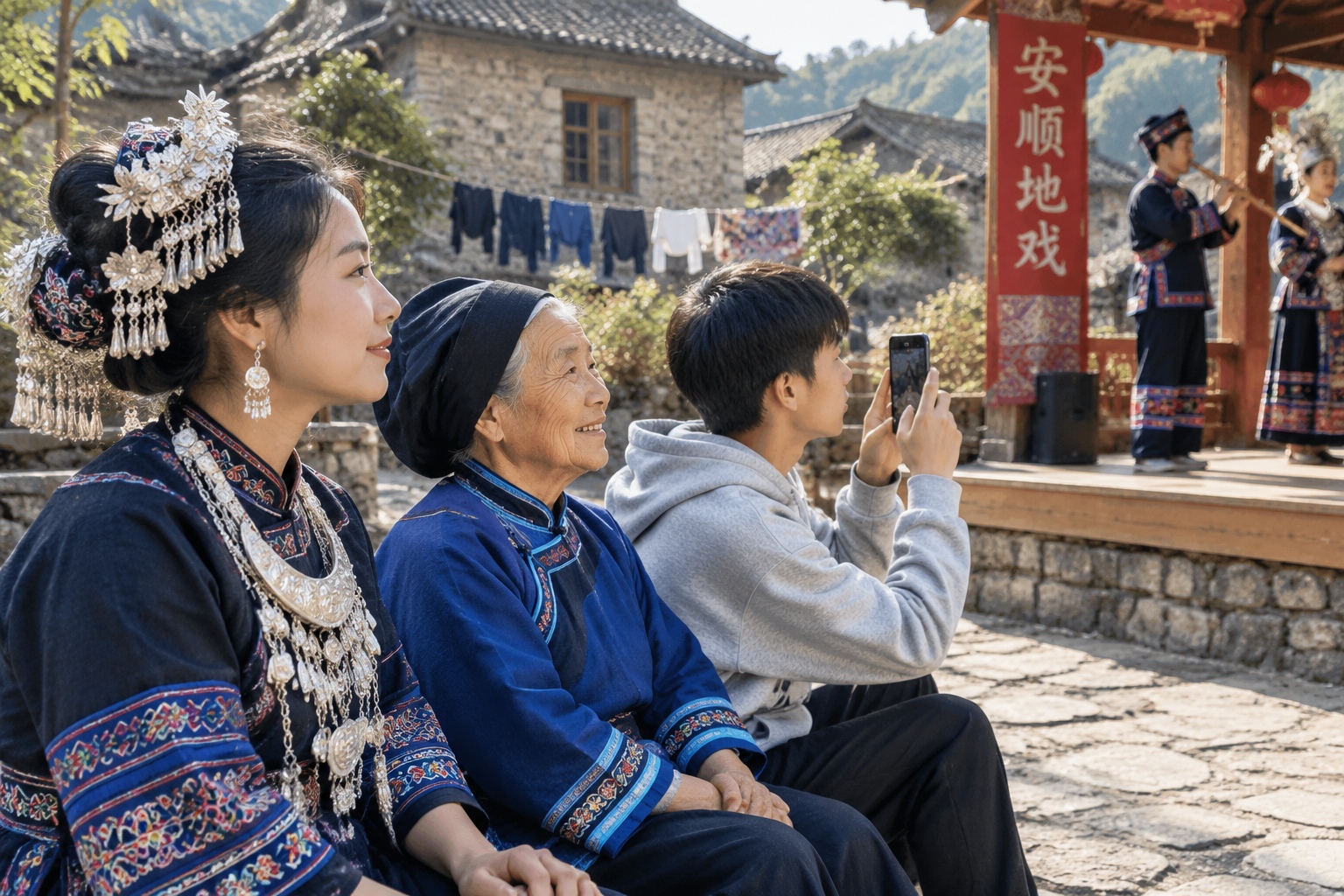
When you go, remember a few tips: stand back and let the older villagers have the front row (they take it seriously). Pay attention to the masks — each one is a hand-carved piece of history. And don’t just watch the stage; watch the audience. In one square, you’ll see a Miao grandmother, a schoolboy in a hoodie, a tour guide holding a flag, and a farmer who just walked down from the mountain. That mix is the real story — six centuries of China in a single afternoon.
Dixi isn’t easy to understand. The dialect is thick, the masks are strange, and the stories are ancient. But that is precisely why it’s worth a detour. It is one of the few places in the world where you can stand in front of a living piece of medieval theater — and see how a migration, and a meeting of cultures, becomes art.
Start the discussion at forum.chinacomes.com