

Introduction
Martin, a French graphic designer, moved to Shanghai in 2023 and opened a Douyin account to document his daily life. His first video, a morning trip to a wet market, earned 20,000 views within hours. Excited, he posted a second clip comparing French and Chinese breakfast habits. The video was taken down the next day. The platform said it ‘contained unverified information about comparative food standards’. Martin was puzzled: ‘I was just expressing my opinion.’ His Chinese friend explained: ‘Rules here are different. You can express opinions, but if they sound like facts, you need sources.’
This is what many foreigners discover only after they start creating content in China. The country has a clear regulatory framework for internet content, and while it applies to everyone, foreign creators often face extra layers of confusion. This guide walks you through the basic legal rules, platform-specific practices, and common pitfalls, so you can create without accidentally breaking the rules.

The legal foundations: not about nationality, but about platform behavior
China does not yet have a single ‘social media law’ that only applies to foreigners. Instead, a set of regulations apply to any user of online platforms. Two important ones are the Cybersecurity Law (2017) and the Measures for the Administration of Internet Information Services (2000, updated 2021). These rules set out what platforms are responsible for and what users are prohibited from doing. As a foreigner, you are treated as a ‘user subject to Chinese law’ when you create content on a platform hosted in China.
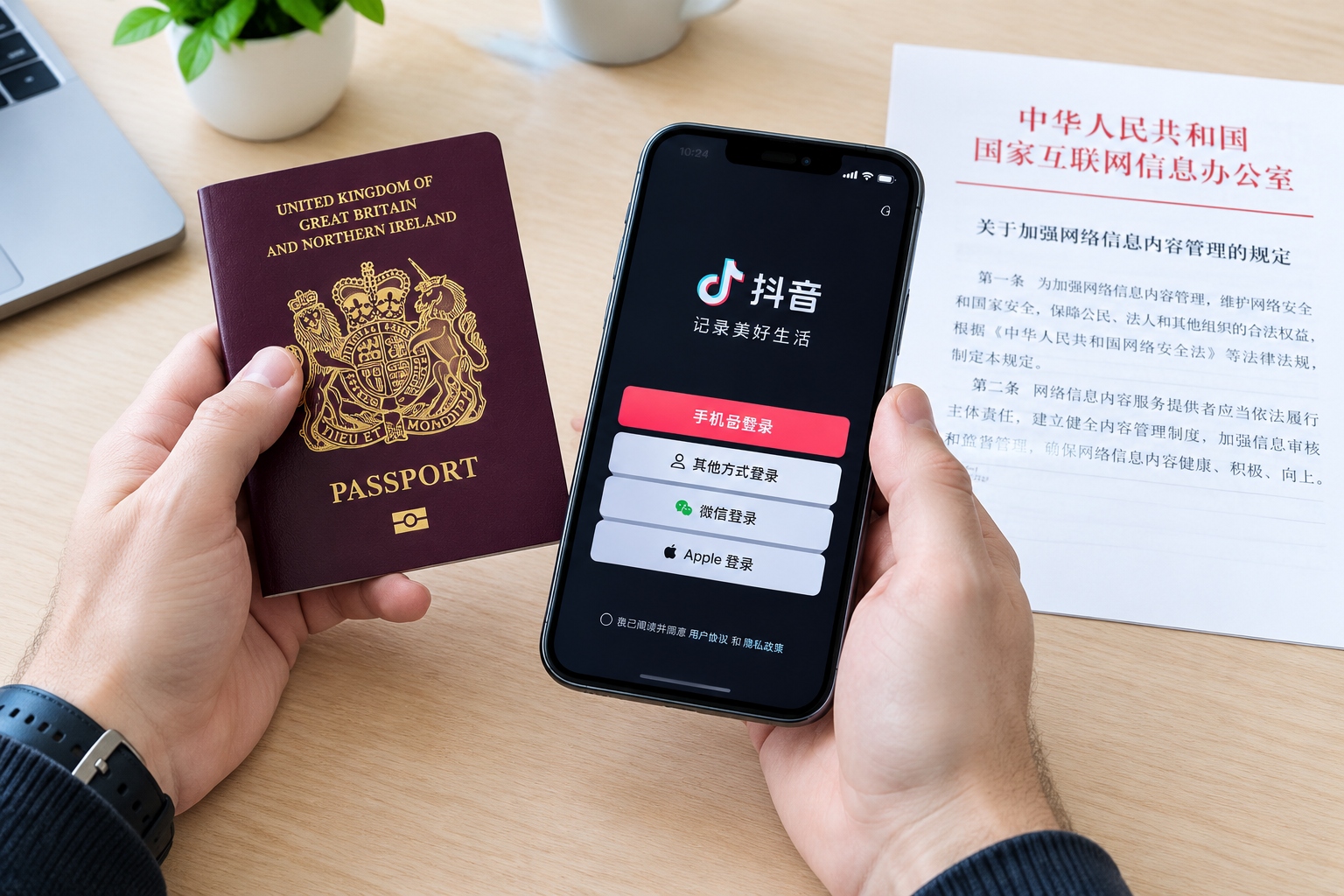
What does this mean in practice? First, every account must be linked to a real identity using a phone number and a government-issued ID. For foreigners, that usually means your passport. The verification is done by the platform, and your data is kept confidential. You cannot simply create an account without giving this information.
Second, content is monitored before and after posting. Platforms are required to remove content that violates laws, and they can ban accounts that repeatedly break rules. You will not receive a warning e-mail. The notice can come in the form of ‘limited visibility’ or a silent delete.
The content red lines: five categories that get creators in trouble
Based on the Cybersecurity Law, the Measures, and related regulations, here are the main content types you should avoid:
1. National security and political topics
Do not post content that challenges China’s sovereignty, territorial integrity, or the legitimacy of the ruling party. This includes discussing Taiwan, Tibet, or Xinjiang as independent countries. Foreign creators sometimes make jokes about communism or party leaders; that can be considered illegal under Internet Information Service rules. Even vague references can trigger a takedown.
2. News reporting without qualification
Individuals are generally not allowed to act as independent news reporters. ‘News’ includes current affairs, politics, and events that involve public opinion. Only licensed news organisations can report such content. If you are a travel blogger, you can describe what you see in your daily life, but you cannot produce ‘news-like’ reports about, say, a protest or an accident. If you cite breakdowns of current events, you should rely on official state media sources and link to them.
3. Pornography, gambling, and violence
This is straightforward. Pornography, sexual content, violence, gore, and gambling tutorials are illegal. Platforms have strict filters for such content. Even ‘suggestive’ content can be flagged under ‘vulgarity’ measures.
4. False information and rumor spreading
Do not share unverified information about health, food safety, disasters, or the economy. In 2020, a man in Shanghai posted a video claiming that the city would go into lockdown the next week, causing panic. He was detained. For creators, this means you must be careful when giving ‘tips’ or ‘advice’ that could be interpreted as facts. If you say ‘this restaurant’s oil is unhealthy’, you might need to cite a scientific study or clearly label it as an opinion.
5. ‘Illegal adverts’ and undisclosed paid promotions
China’s advertising laws require sponsored content to be clearly identified. If you recommend a product in exchange for money or free goods, you must add a ‘广告’ (advertisement) mark. This rule applies to everyone, including foreign influencers.
It is important to note that these restrictions are not always about ‘political correctness’. Many of them are similar to laws in Western countries, such as defamation and advertising disclosure rules. The difference is that enforcement is more automated in China, and the definitions of ‘rumor’ and ‘news’ are broader.
Real-name authentication: using your passport to register
Foreigners can register on most Chinese platforms with a passport or a foreign permanent resident ID card. The process differs slightly:
- WeChat/Weixin: You need a passport and a Chinese phone number. Once your account is active, you can create a WeChat Official Account (公众号). To verify individual accounts, WeChat will ask for your passport number and a live selfie. If you want to open a subscription account that sends regular articles, you will need to choose between ‘individual’ and ‘organisational’ types. Individual accounts can only have ‘subscription’ function, not ‘service’ accounts.
- Douyin (TikTok China): For Douyin, you need a phone number and passport. Video accounts with more than 1,000 followers may be requested to provide additional verification like a video of yourself reading out a code. Also, Douyin requires you to classify your account under a ‘vertical field’ (e.g., food, travel, culture). This category affects your recommended traffic and content boundaries.
- Bilibili: The platform popular with younger viewers and content about animation, gaming, and academics. Registration only needs a phone number, but to upload long videos, you need to pass a ‘community entrance test’ on site rules. Foreigners can take the test in Chinese.
One key detail: your real-name data must match the account operator. If you let a Chinese friend ‘borrow’ their ID to register, the account is legally that friend’s, not yours, and you could lose rights in a dispute. Also, if you leave China, the account remains linked to the original phone number. Keep your phone plan active to receive login verification codes.
Platform-specific rules: what differs between WeChat, Douyin, and Bilibili
Each platform has its own ‘community guidelines’, but they must align with national laws.
WeChat Official Account
WeChat is controlled and less algorithm-driven. Individual accounts can post once a day. The content is mainly text and images. WeChat’s review is known to be strict about political and how-to content. For example, you cannot publish step-by-step guides about buying real estate in China if you are not licensed. But you can share your personal experience. WeChat also has a ‘Rumor Buster’ system: if you spread fake news, your account will be forced to publish a correction.
Douyin
Douyin’s algorithm pushes videos that generate engagement. The platform encourages original, localised content. However, it uses strong artificial intelligence filters to detect ‘sensitive’ words and scenes. Foreigners often trigger flags by unintentionally showing maps, government buildings in a critical light, or even military facilities in the background. Douyin’s rules for foreign creators are the same, but the management team is visible. If your account has a blue ‘V’ badging (verified official), you can post longer videos. But blue ‘V’ for non-organisational accounts may require a larger following and additional documents.
Bilibili
Bilibili has a more niche, community-focused culture. It has an ‘anti-extra juice’ rule: no content that tries to attract attention through excessive exaggeration or ‘clickbait’, which might be popular elsewhere. For foreigners, Bilibili’s viewers often expect educational content about your own culture, not about Chinese politics. The platform does not effectively block all ‘unsafe’ content, but it monitors carefully. Bilibili requires all creators to respect ‘public order and good customs’.
A universal rule: do not outsource your content moderation. If you hire an editor, you are still responsible for what is published. Likewise, if someone posts a comment that violates law under your video, you may be asked to delete it quickly.
Working with MCN agencies: opportunities and risks
As a foreign creator, you may be approached by Multi-Channel Network (MCN) agencies that promise to grow your account. Some are legitimate, helping with editing, cross-promotion, and brand deals. But there are risks.
Compliance: who is the ‘publisher’?
If an MCN helps you create content, it may ask for your account password. Some agencies even require you to transfer the account to the agency. In China, the account is tied to the real-name identity that registered it. If the MCN operates under your name, legal responsibility remains with you. That means if an MCN posts something violating the law on your account, you are the one who faces fines or account suspension. Always require that the MCN’s proposed content is shown to you before posting.
Contracts: read the ownership and termination rights
MCN contracts in China often include ‘binary requirements’, which force you to produce a certain number of videos per week. Some contracts have liquidated damages (违约金) clauses that can make you pay hundreds of thousands of RMB if you want to leave early. Before signing, ask a Chinese lawyer to translate and explain the contract. Also check the governing law and dispute resolution: many contracts choose an arbitration committee in a city you rarely visit. It’s safer to agree on a project-by-project basis initially.
Foreigners and visas
If you are on a short-term visa (S or L visa), you are not allowed to undertake ‘activities for remuneration’. This means you cannot earn money from brand partnerships or paid subscriptions. The proper visa for paid content creation is generally a work visa (Z visa) with a local company, or a talent visa under China’s points-based system, depending on your profile. Some foreigners use ‘self-employment’ visa or set up a company, which is more complicated. In practice, many foreign vloggers start with no revenue until they get a work permit or partner with a Chinese employer.
Important: Tax is another factor. If you earn from tips or platforms, you must pay individual income tax. Platforms usually withhold tax automatically, and you can see the deduction in your payment records. If you don’t report it, future visa renewals may become problematic.
Why all this matters and how to create freely
China’s content rules are not trying to stop everyday stories of street food and beautiful scenery. In fact, the government encourages ‘telling China’s story well’ and many platforms even have special incentives for foreign creators. What helps is to keep your content in the ‘personal sharing’ zone. Describe what you see, how you feel, and encourage respectful conversations. If you stay away from news, politics, unverified claims, and paid promotion without labels, you can grow and enjoy your experience.
Martin, after learning the rules, resumed his daily videos. He now adds a simple disclaimer when he talks about cultural differences: ‘This is just my own observation.’ He also subscribes to local food-safety news and only shares official sources. His followers, both Chinese and expat, appreciate that extra care. Creating content in a new country is always a learning process. Getting to know China’s compliance rules early is the best way to create with peace of mind.
Start the discussion at forum.chinacomes.com