

Arriving in a Tuvan Village
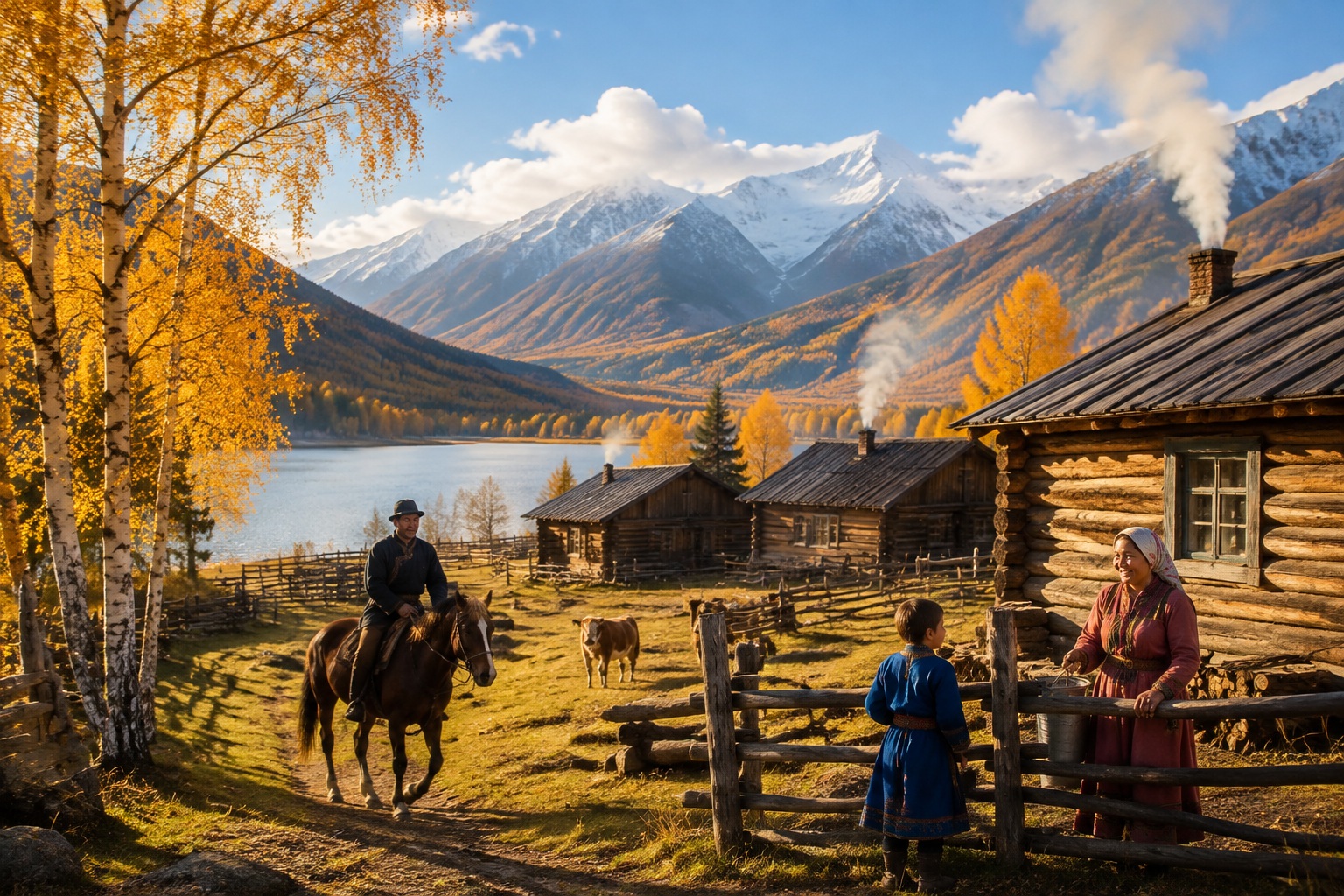
The bus drops you at a wooden gate. It’s late September, and the air smells of damp moss and pine. A young man in a puffy jacket steps forward, takes your backpack, and points to a small silver router on the wall. “Wi-Fi password is on the back,” he says. Altai is your host for the night, a Tuvan in his late 20s whose family has lived in this village for generations.
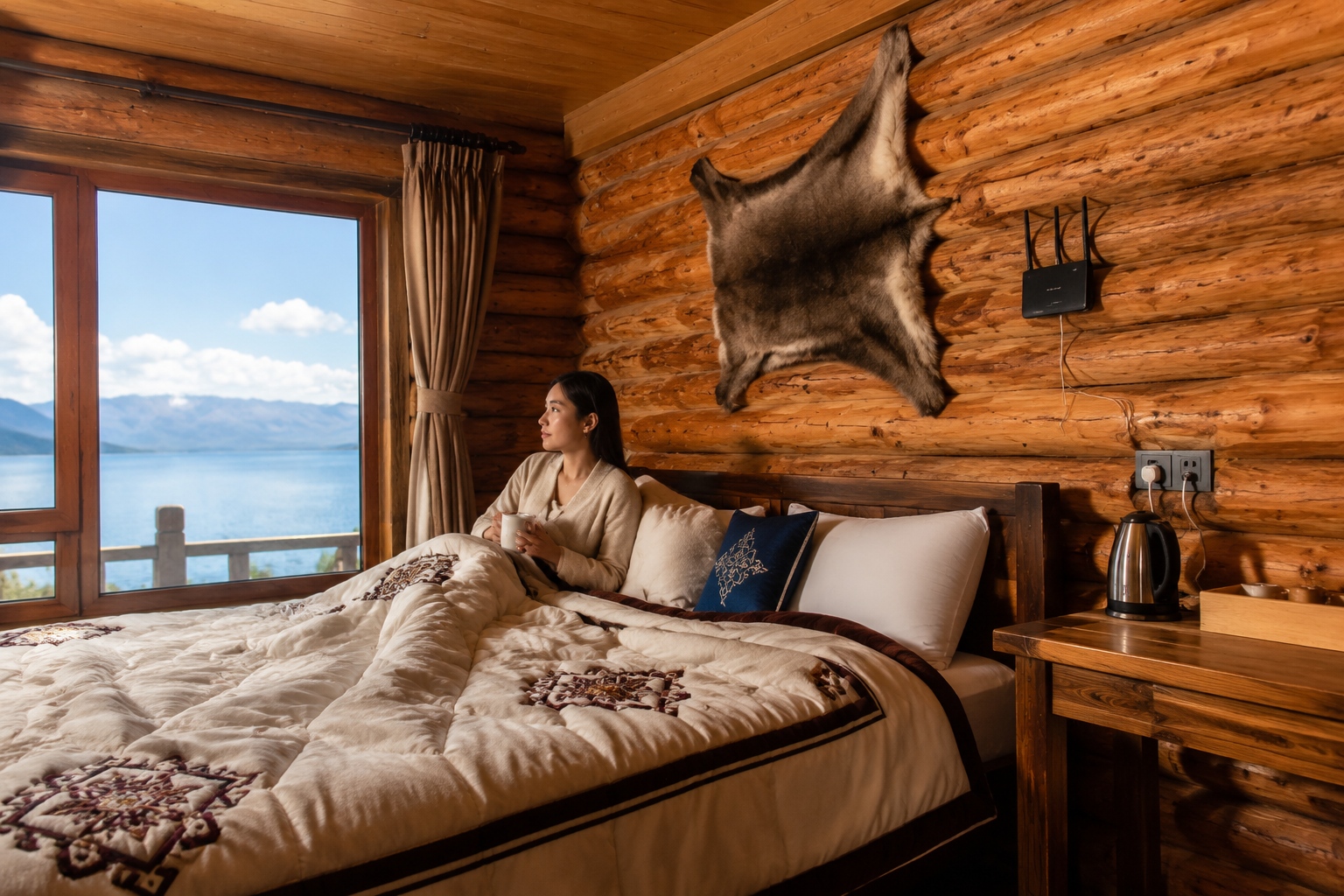
He leads you into a log cabin. The floor is heated, and the two beds are piled with quilts. There is a kettle, a box of local tea, and a balcony overlooking the lake. But what catches your eye first is something that doesn’t belong to any hotel catalog: a dark, stiff animal hide nailed to the wall above the electric sockets. “That’s from my grandfather’s hunting days,” Altai says. “He used it as a sleeping mat.”
The Tuvans of Kanas: A Brief History
You may not have heard of the Tuvans. In China, they are a small ethnic group of roughly 2,500 people, concentrated in three villages near Kanas Lake in the Altai Mountains of Xinjiang. Their language belongs to the Turkic family; their ethnic classification officially groups them as Mongols; their ancient practice is shamanism. For centuries, they lived as hunters and nomadic herders, following deer and snowcocks through larch forests.
Kanas Lake itself is a glacial fjord, 24 kilometers long, ringed by peaks that are snow-covered for six months of the year. The villages—Hemu, Kanas, and Beitum—were so isolated that a trip to the nearest town could take days on horseback. Electricity arrived in the 1990s; paved roads came later. Now, direct buses run from the regional capital Altay, and in summer, the lakeside is busy with visitors from all over China.
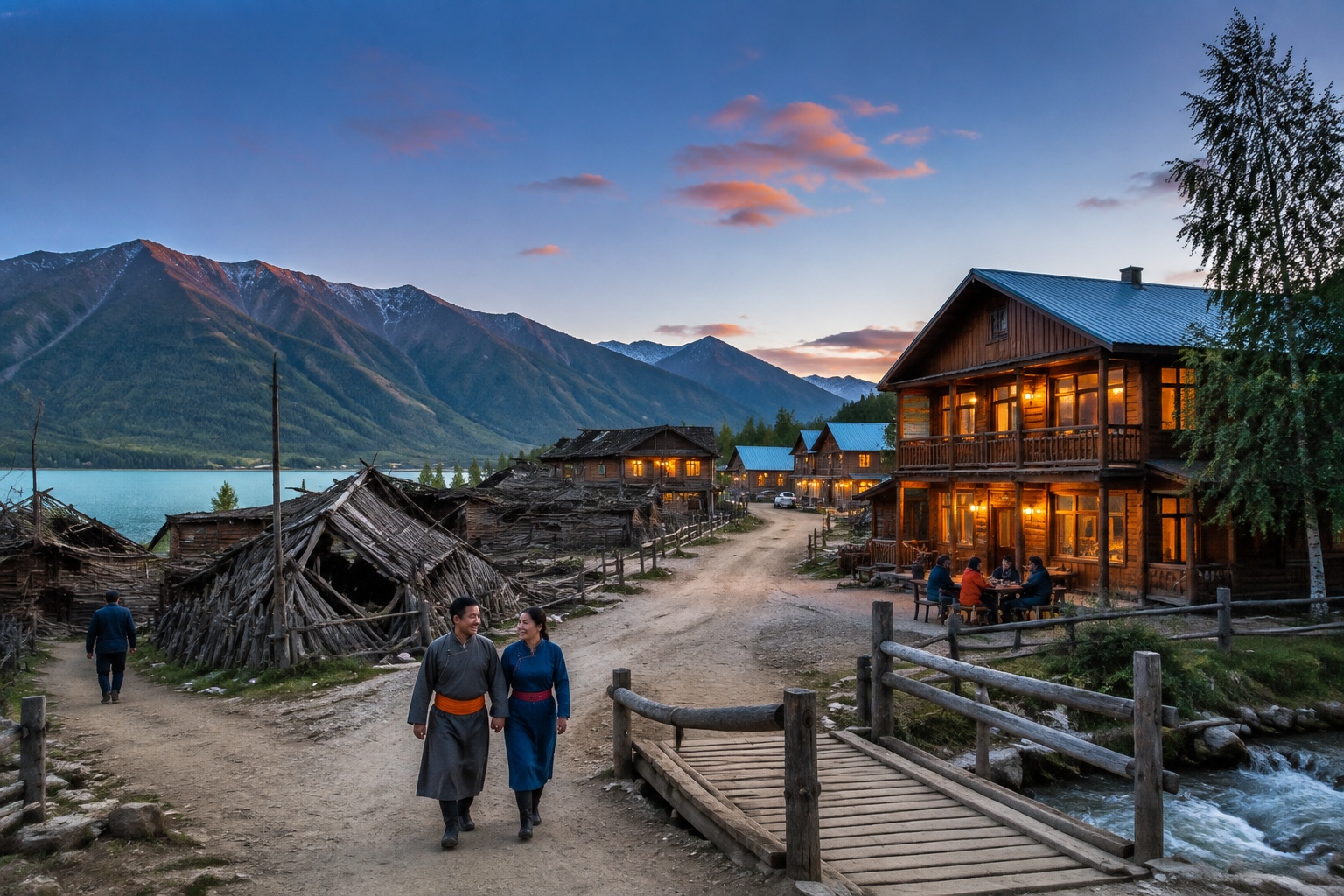
That change shows up in small but telling ways. In the old days, a Tuvan home was a berlin—a simple pyramid-shaped tent made of birch bark. Today, those homes have been replaced by log cabins with minibars and en-suite bathrooms. But the traditions haven’t vanished; they’ve been rearranged.
Guesthouse Life: Wi-Fi and Animal Skins
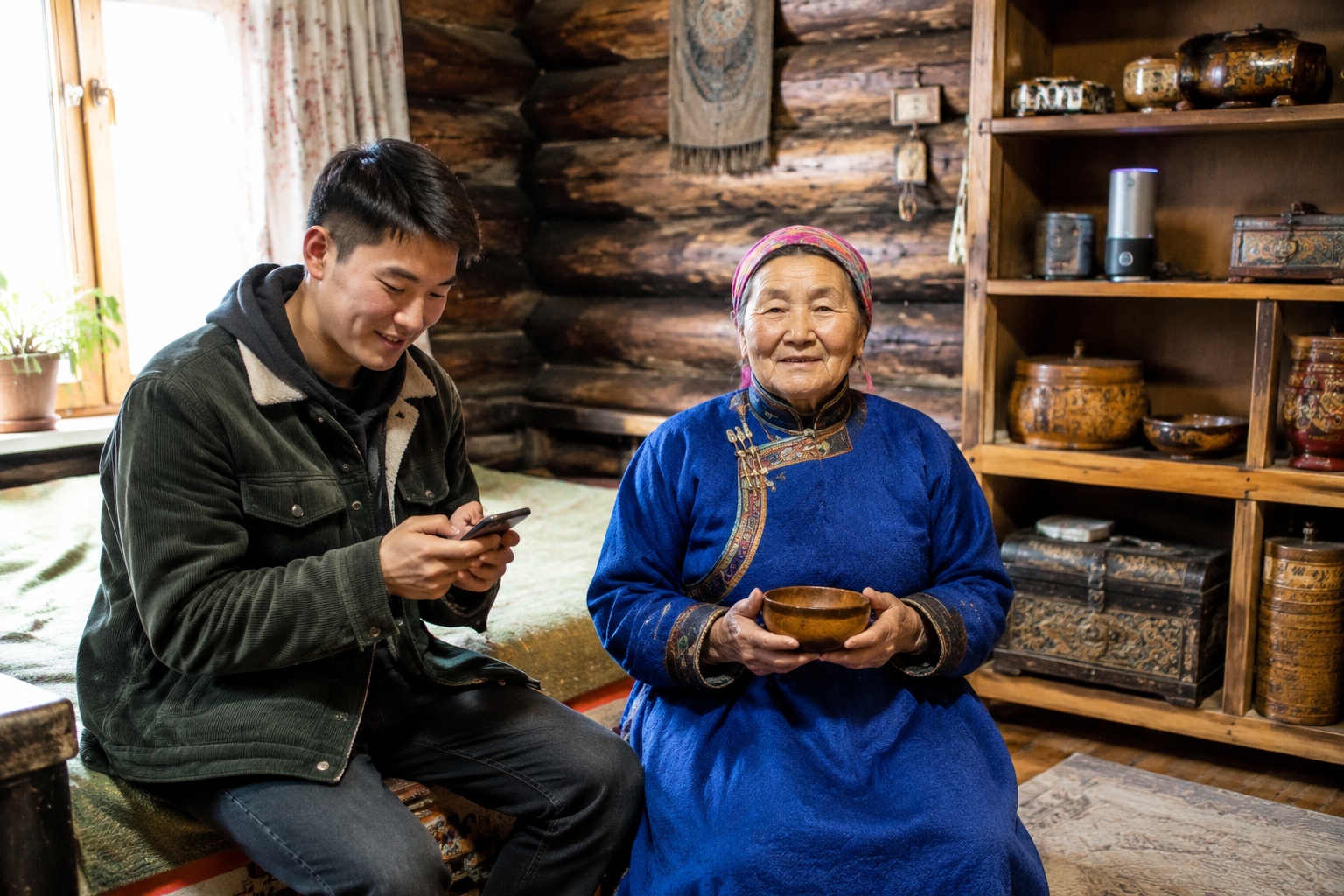
Settling into Altai’s guesthouse, you start to notice the mix. The walls are a family archive: a hand-carved wooden spoon, a horsehair fly whisk, a deep-necked mandolin called a topshuur, and that animal hide. There is also a flat-screen TV on a cabinet, a modem blinking beside it, and a portable speaker playing a low, guttural throat song—Tuvan khöömei. Altai pulls out a map of the lake and marks a hiking trail with his pencil. “If you leave at sunrise, you’ll catch the fog burning off the water.”
The modern comforts are not just for tourists. Altai’s parents live next door, in a house that’s heated by a coal boiler. “My mother still makes dried cheese,” he says, “but we also order groceries online. The drone delivers packages to the village every two days.” It’s an everyday reality that flickers across countless details: a young girl wearing a traditional robe while waiting for a delivery truck; an elderly man using a smartphone to video-call his son in Urumqi.
At the same time, the old life is within arm’s reach. Altai opens a wooden chest and brings out a pair of embroidered leather boots—his grandfather’s winter footwear. The soles are worn by decades of walking in snow. He doesn’t wear them, but he keeps them polished. “We are not performance actors,” he insists. “This is our home, and these things are our memories.”
After Dark: Music, Stories, and a Live Stream
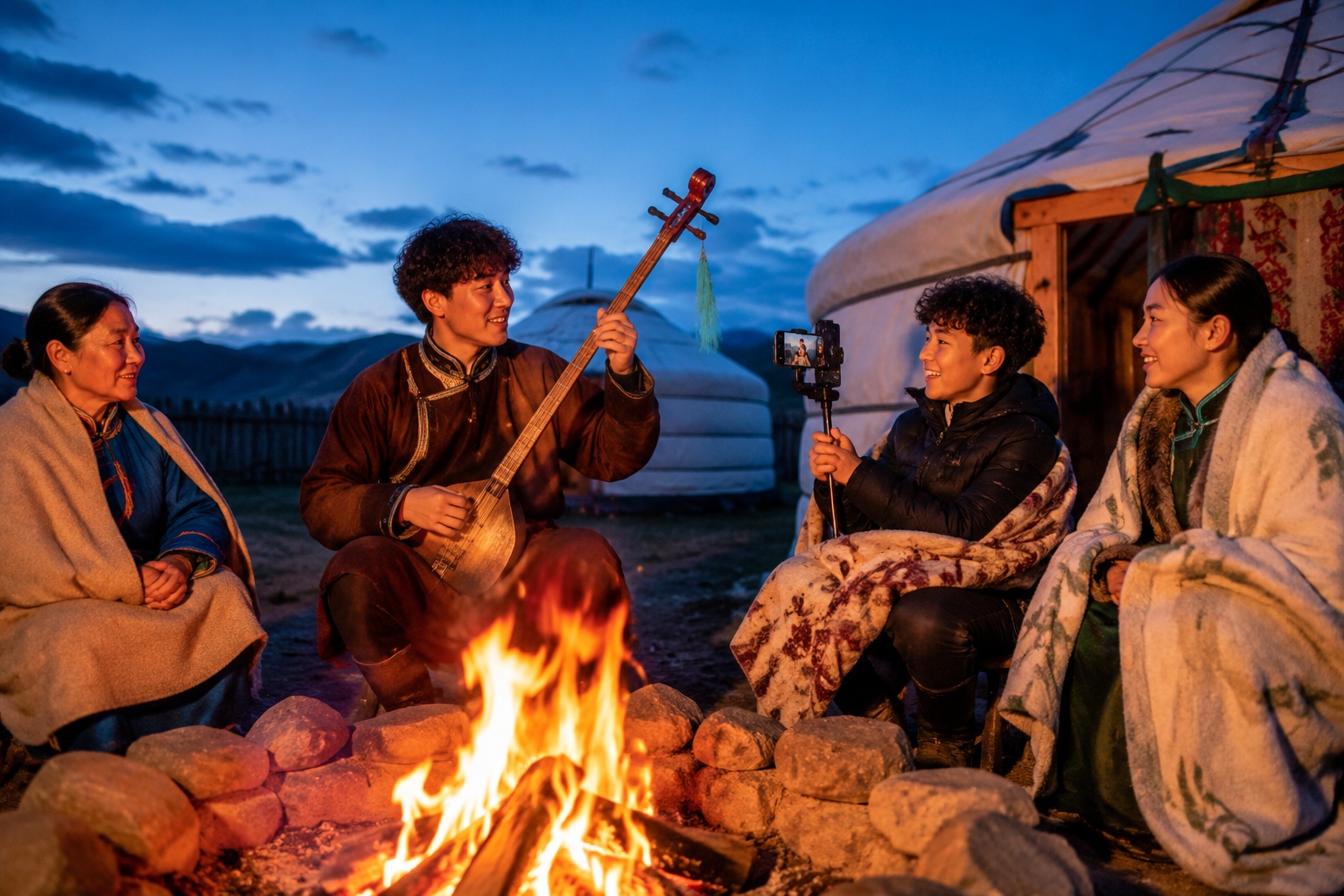
As dusk falls, Altai’s cousin Dorji sends a text: he’ll be late, he’s helping a guest with a flat tire. The fire pit in the yard is already lit. Guests from Shanghai, Beijing, and a few from abroad wrap themselves in blankets. Dorji arrives, tunes his topshuur, and plays a piece that imitates the sound of a horse galloping. Someone gives Altai’s father a nudge, and he tells a story about a snow leopard that once circled their herd. The fire crackles. A young girl pulls out her phone and starts a live stream. Within a minute, hundreds of strangers are watching a Tuvan family’s evening from their own kitchens in Guangdong.
“In my grandfather’s time, we played music for spirits,” Altai says. “Now we also play it for our guests.” He laughs. “But the spirits don’t mind.” His old dog, half asleep by the flames, raises an ear and goes back to sleep. It’s a small scene, but it captures the quiet way a culture moves between memory and convenience.
Tourism’s Quiet Transformation
Tourism has changed how the Tuvans of Kanas make a living. According to local statistics, nearly two million visitors came to the Kanas scenic area in 2023, bringing revenue that outstrips anything generated by raising cattle. In the villages, almost every family has converted part of their home into guesthouse rooms, or built a separate cabin for rent.
The impact isn’t just economic. Phone reception is now strong enough to broadcast live; younger Tuvans are learning to sing traditional songs, because their guests want to hear them. Some are even studying their ancestral language in new classes, not out of fear of losing it, but because speaking Tuvan is suddenly an attractive skill. One hotel owner told me: “We used to hide our culture to fit in. Now visitors come and ask about it. So we dust it off and it becomes something new.”
This isn’t a simple story of losing tradition. It’s more like a negotiation. When a Tuvan teenager turns on a smart speaker to play the same melody his grandmother hums, he isn’t abandoning the past; he’s making it portable. The animal skin on the wall is no longer a hunting trophy. It’s a conversation piece.
Practical Notes for Your Visit
If you’re planning to see this for yourself, here’s what to know. Kanas is open year-round, but the most dramatic months are June to September for green meadows and October for autumn colors. The nearest airport is in Altay city, a two-hour drive away. Buses and taxis regularly connect the area. You’ll need a permit to enter the scenic zone, which is easy to arrange with your guesthouse.
Where to stay: look for family-run guesthouses in Hemu or Kanas village. Most are renovated log cabins with private bathrooms. Prices range from 300 to 800 yuan per night, depending on the season. A few places still offer traditional hotpot with local lamb, though you should ask about halal choices if that matters to you.
One advice: slow down. Stay at least two nights. Walk to the lake in the evening when the day-trippers have gone. Ask your host to show you the old village, where empty wooden houses stand with the roofs caved in, only a few of them preserved as museum exhibits. You’ll see the difference between the past and the present on the same street, just as you see it on the walls of your room.
Conclusion
Back in the room, the night is cold and very quiet. The Wi-Fi works, the heater hums, and the animal skin keeps its silent watch. Two worlds share the same wall. For a traveler, it’s a simple coincidence. For the Tuvans, it’s a way of life that keeps moving forward without forgetting where it started. And in the dark, with the lake glowing outside and the temperature falling, you feel it in your bones: this is not a theme park. It’s a real place, where the past and the future happen to share a front door.
Start the discussion at forum.chinacomes.com