

A Desk That Doubles as a Film Set
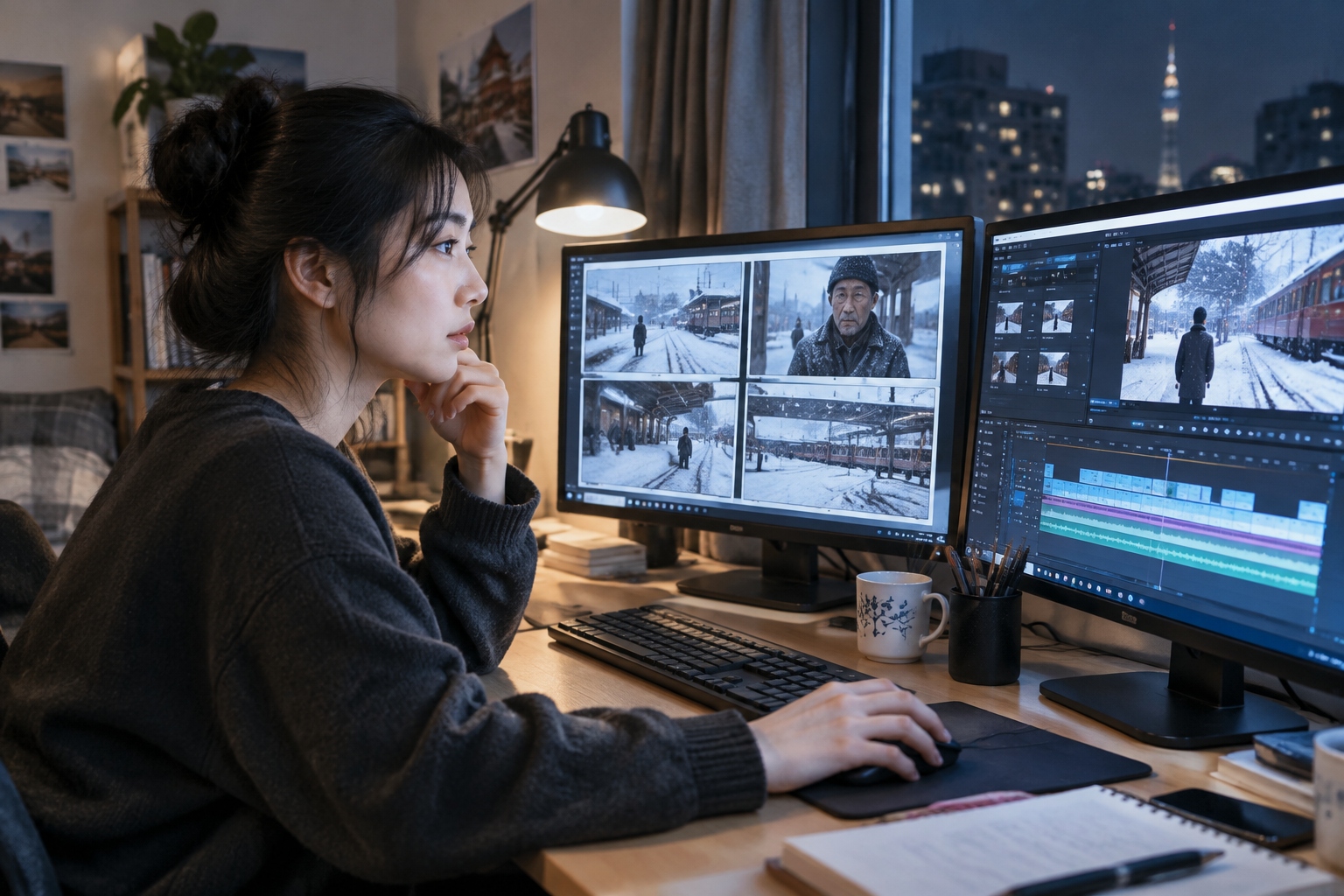
At 1:37 a.m., in a rented two-bedroom flat in Beijing’s Tongzhou district, 29-year-old filmmaker Chen Xi is not holding a camera. She holds a mug of cold tea and watches a screen split into four preview clips, each generated from a typed line. Her prompt says: “Snow on a black factory ladder, grey northeastern light, slow push-in.” She clicks one. A server on the other side of the Chinese capital returns a ten-second scene: an abandoned railway shunting yard, snow falling on rusting equipment, steam curling from a distant locomotive. No one shot this footage. No boom operator stood in the cold, no train was rebuilt and no location permit was issued.
Two years ago, Chen made a low-budget live-action short and needed a borrowed cinema camera, a volunteer crew, and an all-night bus ride to the Shanxi countryside. This time, her 15-minute fictional film about a retired railway mechanic is being assembled almost entirely on a laptop. The crew is just her. The actors are partly digital. The “set” is squeezed into a spare room with two desk lamps, fiber-optic broadband and about 2,300 yuan of AI-generation credits.
Why Some Independent Chinese Filmmakers Are Choosing AI
Chinese independent film is a struggling ecosystem. Most directors cannot get money from studios, and popular streaming platforms rarely license a movie without established stars. Even a micro-budget feature may cost hundreds of thousands of RMB once location, equipment, meals and favours to friends are counted. Distribution, especially for stories about working-class life, is narrow. Meanwhile, cloud-based generative AI tools made by Chinese tech firms such as Kuaishou and ByteDance have opened to the public. In 2024 and 2025, China’s short-video platforms filled with AI-created scenes of historical dramas, sci-fi universes and satirical comedies. Behind the viral demo clips is a quieter group of directors who are turning to AI not as an experiment but as a survival tool.
“I didn’t set out to make an AI film,” Chen said while tapping through a folder of generated clips. “I set out to tell my grandfather’s story. This was the only way I could afford to put that story in front of eyes outside my family.” The film is called “Snow-Buried Rail” and centres on a railway worker who stays one extra winter at a station that has been ordered to close. For a live-action version she would need a snowmaking crew, a cast of middle-aged actors and expensive train logistics. The AI version, she says, still requires an intense job, but it is a manageable one.
Inside an AI Film: A Step-by-Step Look
Chen’s workflow is now systematic enough to explain over tea. It is less a science experiment than an extended session of directing by remote control.
1. Writing a script by hand
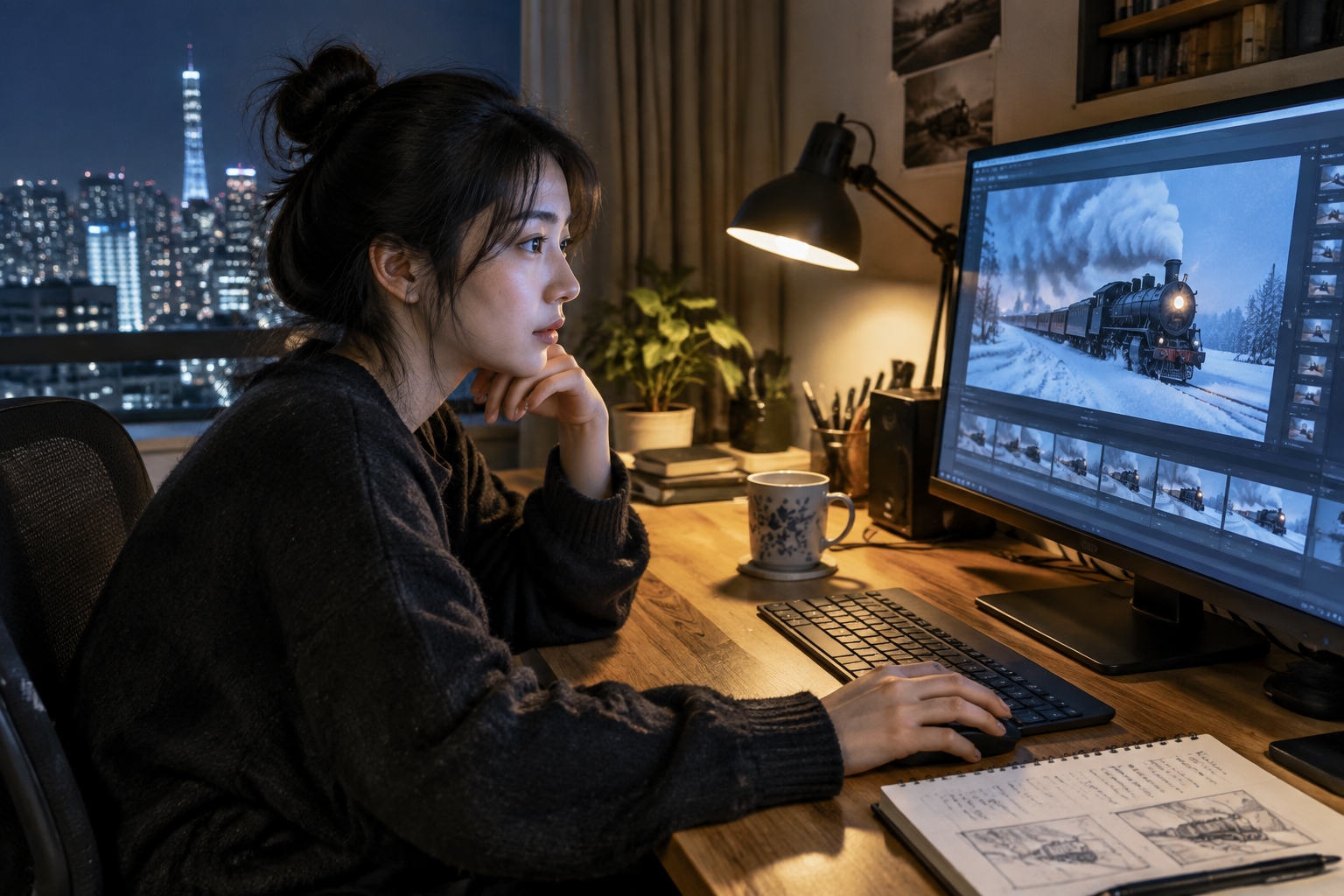
She wrote the first draft in a notebook, using dialogue she remembered from her grandfather’s old colleagues. No chatbot was used for the core story. “Large models often give you grammatically clean lines without the awkward texture real people speak with,” she says. The script was later fed into an AI assistant to create a list of every location and object needed: fifty mundane things, from a 1960s enamel mug and a signal lamp to a stove with cracked fireclay.
2. Visualising with still images
Before typing a single video prompt, Chen spent two weeks generating stills with text-to-image software. She described places in deliberately practical terms, adding seasons and light: “a wooden platform after a blizzard, long sunset, exhausted workers with Thermos bottles.” The stills became a visual dictionary, pinned to a folder and shared with two musician friends over social media. The routine helps fight a common problem of AI video: its uncanny, generic sheen. “If you spend hours choosing references,” she says, “the moving images start to feel more like memory and less like a watch advertisement.”
3. Generating short moving clips
For each shot, Chen used a Chinese text-to-video model—she alternates between Kuaishou’s Kling and ByteDance’s Jimeng—and wrote prompts as if giving technical directions to a cameraman. She includes camera movement, lens feel, weather and available actions. “Slow dolly in, cold breath visible, inside the locomotive cabin” is not a poetic device; it is prompt engineering. Most outputs are five to ten seconds, and a usable shot may require four to six tries. The failure rate remains near half, especially when characters walk or speak.

4. Building one consistent face
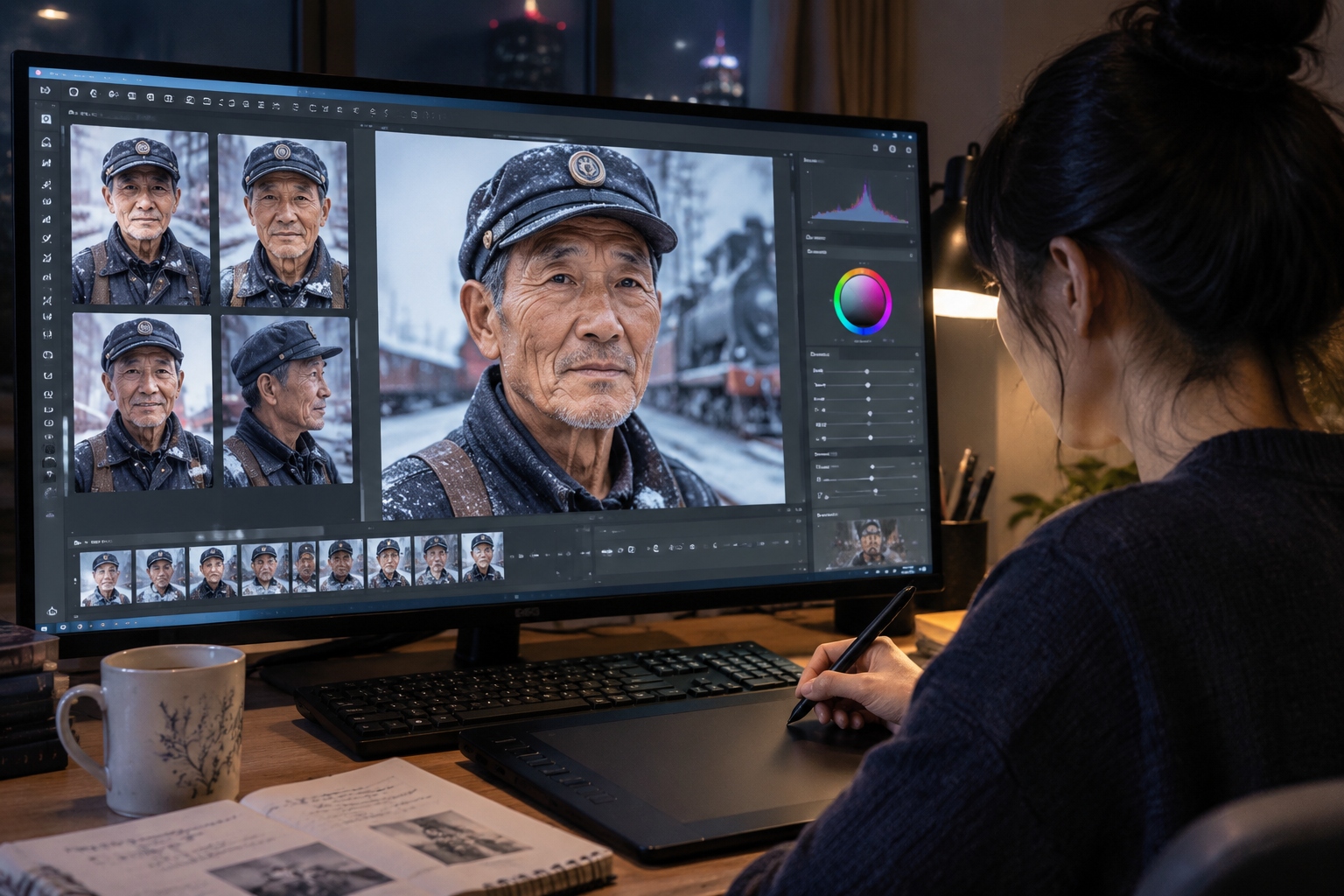
The most fragile part of a no-camera film is keeping the same person alive across cuts. Chen created a digital identity for the retired worker before shooting any motion. She generated a set of AI portraits with an unusually specific elderly face, adjusted age spots and eye shape in photo-editing software, then uploaded those stills as reference frames into the video model. The platform’s multi-image “character reference” mode helps keep the same man visible from scene to scene. It is not perfect; his jaw occasionally relaxes for no reason. But Chen says she prefers a flawed, consistent face to a cast of unrecognisable strangers.
5. Sound, music and the final human seam
The sound stage is an ordinary pair of headphones. Some sounds were created by AI: railway bell samples, boiler rumbles, wind across empty tracks. A friend played a simple melody on guitar and recorded it on a phone; Chen cleaned the room noise with free audio software. The 15-minute cut was edited in CapCut, using AI transcription and subtitles, but she marked every edit point by hand in the final week. “The less I touch the editing, the more it looks like a demo reel. The software is not the storyteller.”
What It Really Costs (and What It Doesn’t)
Chen’s cost ledger for the film lists about 2,300 yuan (about 320 dollars) in render credits, 190 yuan for extra cloud storage, and 300 yuan for a portable hard drive. A micro-budget live-action short of similar length can burn through 50,000 to 150,000 yuan without paying actors a full day rate, because transport, hotels, food and location permits add up. “The AI path is cheaper, but not free,” Chen says. “It was also not faster. If I count prompt writing, still selection, face correction and sound timing, I worked more hours than a small crew would during a week-long shoot.” What costs far less is the right to fail loudly: she can discard a shot and try another direction at 3 a.m., without asking anyone to stay overtime.
The Broken Parts: Copyright, Aesthetics, and the “AI Look”
Not everything is smooth. Chen and her peers argue about what “film language” remains when every pixel is assembled from a training dataset. “I can recognise an AI video within ten seconds,” says Wang Fei, a documentary editor who has collaborated with Chen. “There is a seductive beauty that comes from averaging. Real life is ugly and specific.” Chen admits that a few moments in “Snow-Buried Rail” still bother her: the digital old man blinks a little too evenly, and in dim light his coat shows no dust or torn threads.
There are harder problems: copyright and consent. The image models she uses were trained on large, opaque datasets; many artists think that is unfair. Chinese regulation has moved toward labelling AI-generated content so audiences know what they are seeing. Since 2023, the country’s interim rules for generative AI services have required synthetic content to be marked in certain contexts. Independent filmmakers accept the label, but worry it will add distance between their work and viewers. “I am not trying to hide that I used AI,” she insists. “I hide nothing.”
The biggest ethical question is employment. If a director can generate a passenger on a bus in seconds, why hire background actors for a day? “These tools will compress some of the most vulnerable positions,” Wang admits. Her hope is that location shooting will never disappear because “you still need a human to feel cold, and the AI will not feel the cold”—but many small crafts will shift into hybrid roles around prompt direction and data preparation.
How AI Is Changing Who Gets to Tell Stories
Beyond Chen’s apartment, the same text-to-video models are being used by museum archivists, online drama producers and a retired engineer in Chengdu who is making an animated science-fiction story about the Great Flood. This spread matters in a country where advanced filmmaking equipment has historically lived in Beijing or Shanghai. With AI, a subsidised computer club in a small city now contains a “high-end studio”. The result is a growing wave of filmmakers with very local ambitions: retelling fables about land expropriation, turning family photographs into moving memories, rebuilding rural childhoods that no longer exist.
For international audiences, this offers a doorway into Chinese stories that are neither official grand narratives nor standard festival road films. Some of these AI shorts are searching, melancholy and quietly absurd, with a texture that comes from personal references. One recent AI short, titled something like Winter That Did Not Come, imagines a village being demolished and then reshapes the family’s courtyard into a disturbed dream. The film was watched more than a million times on Bilibili before most overseas viewers began talking about Chinese text-to-video models.
Conclusion: No Camera in the Room
At 2:20 a.m., Chen is about to render the final sequence of “Snow-Buried Rail”. A steam train slowly pulls out of a station, and the screen flickers with static. The whistle is a sound clip she found after three hours of searching an open audio library. She does not care that the train exists only as pixels and mathematical probability. “A director is someone who chooses where to look,” she says. “I didn’t shoot this, but I saw it. I chose every frame.”
She may never get the financing for a live-action feature. But the film now lives on her laptop and, for now, on a small video website, carrying a voice that usually disappears before shooting begins. The future of Chinese indie cinema, she believes, will not be fully AI or fully live-action. It will be a hybrid, assembled in apartments, after day jobs, by people who no longer need a camera crew to say: I want to tell you about my grandfather’s generation.
Start the discussion at forum.chinacomes.com