

Eight O’Clock at People’s Square
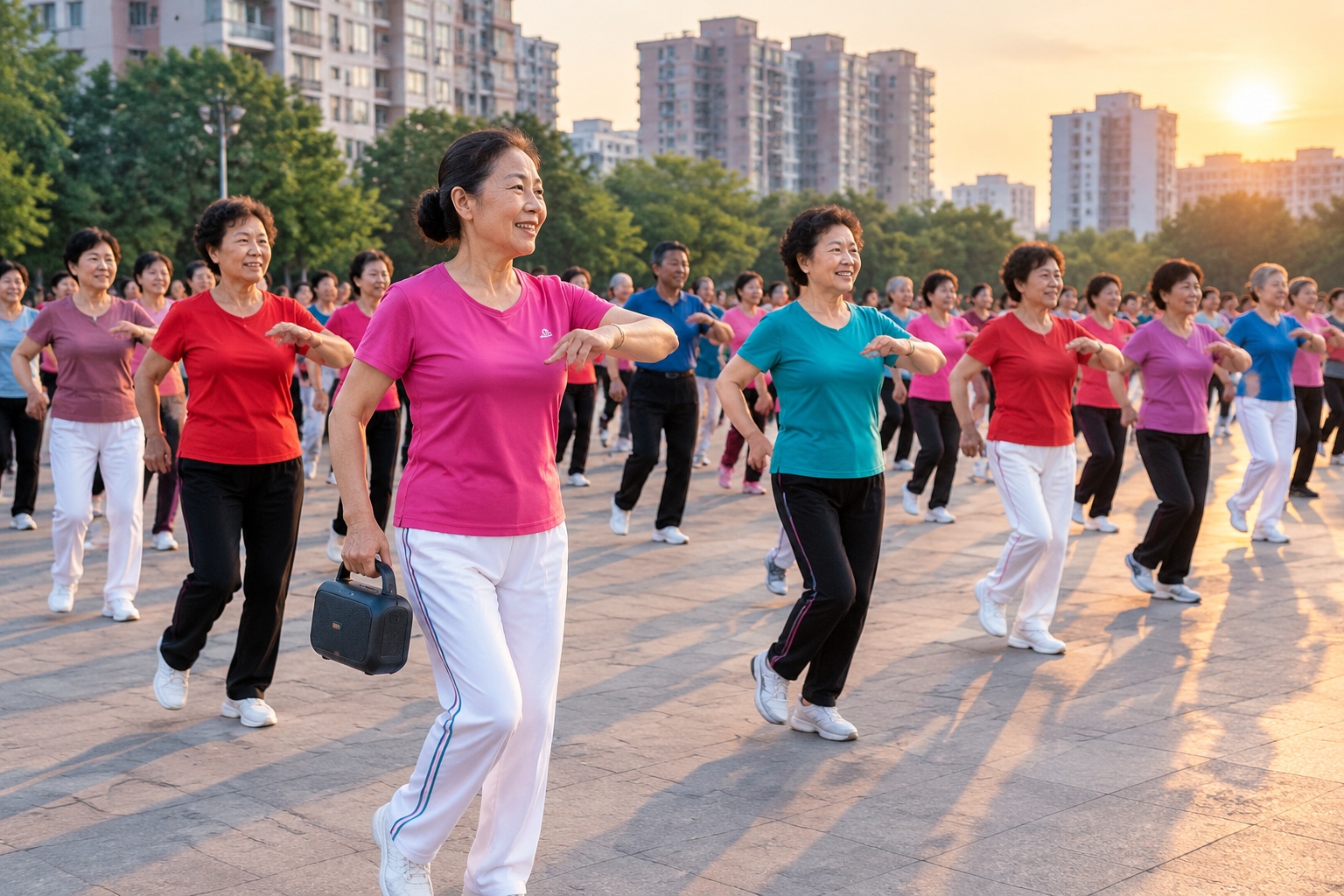
The first beat hits at exactly 7:30 p.m. from a portable speaker the size of a suitcase. Within seconds, the sound bounces off apartment building walls, mixes with the hum of traffic, and becomes something you feel in your chest more than hear with your ears.
In the center of the square, a woman in her sixties named Auntie Liu adjusts the volume knob upward, then steps into the front row of a perfectly spaced formation. Forty women — and a few men — mirror her movements. Arms rise, hips sway, feet shuffle in sync. The song is a remix of a 1980s folk melody with a four-on-the-floor beat.
This is guangchang wu — square dancing. Every evening, in almost every Chinese city, millions of mostly older adults claim public space to exercise, socialize, and perform. It’s free, it’s outdoors, and it is very, very loud.
More Than Just Exercise
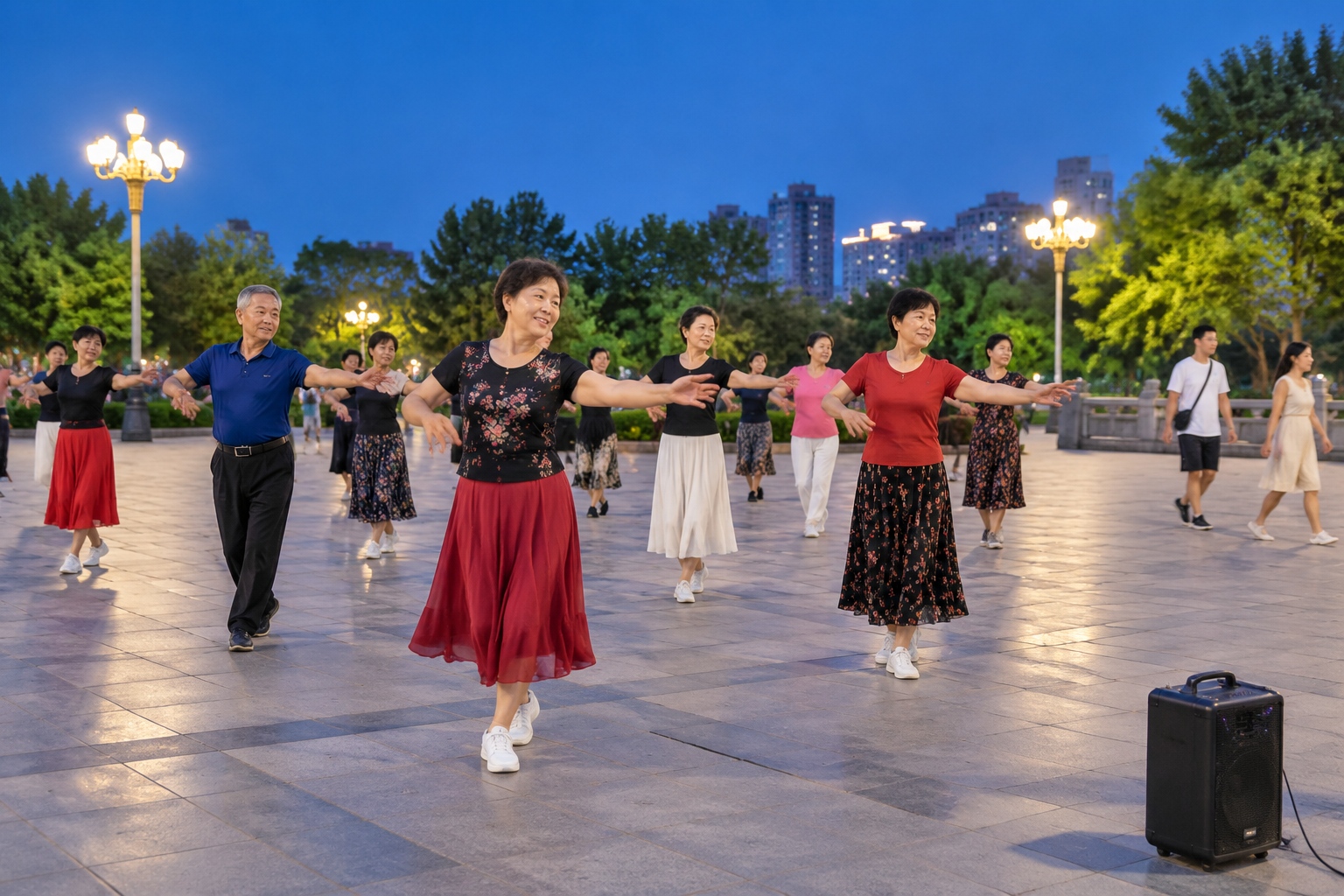
For many retired Chinese people, square dancing is the most important part of the day. It’s not really about the dance steps. It’s about having a reason to leave the apartment, a group that expects you to show up, and a few hours where life feels shared.
Take Auntie Liu, 68, a retired textile factory worker. Her husband died three years ago, and her daughter works in another city. On a typical day, she eats breakfast alone, watches TV alone, and naps alone. But at 7 p.m., she puts on her red sneakers and heads to the square. “Here I have friends,” she says. “We talk about our grandchildren, our health, the price of pork. If I miss one night, someone calls me the next morning.”
Public health researchers note that square dancing helps older adults maintain physical mobility and reduce depression risk. In a country with 300 million people over 60 — a number still growing — the dance square functions as a de facto community center, outdoor gym, and mental health clinic all in one.
A 2021 study by the Chinese Center for Disease Control and Prevention found that regular participation in group dance activities was associated with improved balance, lower blood pressure, and better self-reported well-being among people aged 60 to 80. The benefits are real. But so are the complaints.
When the Music Never Stops
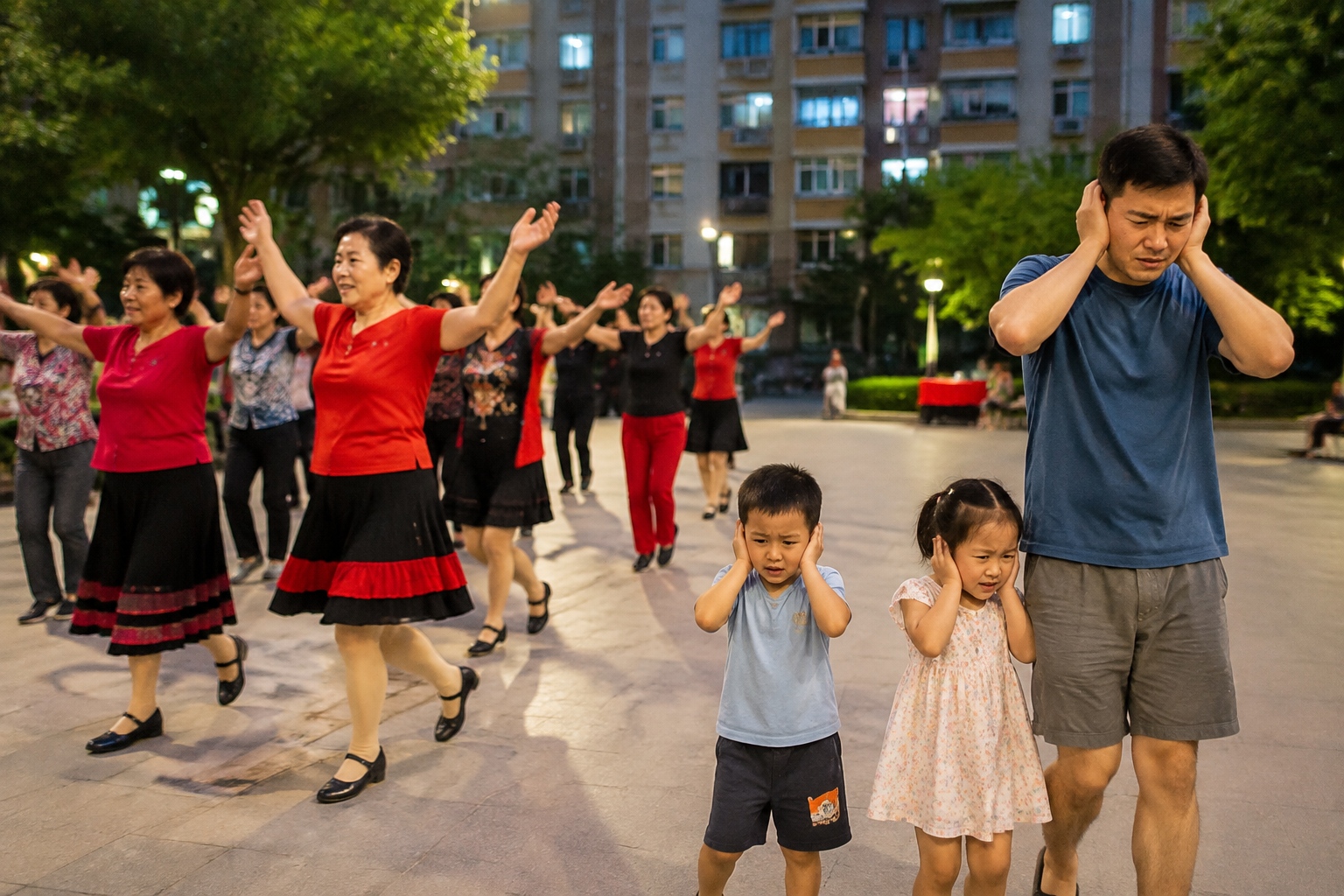
Not everyone loves the beat. In 2023, a noise complaint hotline in Wuhan received over 1,200 calls about square dancing in a single summer month. Similar numbers appear in cities from Chengdu to Harbin.
The conflict is straightforward: elderly dancers want loud music to feel the rhythm and energize their movements. Nearby residents — many of them young families with children, or office workers who need sleep — want quiet. The two needs collide every evening at close range.
In some neighborhoods, the dispute escalates. A man in Changsha once threw water bottles at a dance group. A driver in Shenzhen sounded his horn repeatedly into a crowd of dancers. A neighborhood committee in Beijing tried to charge dancers a small fee for using loudspeakers, which led to a standoff.
The issue is not just noise level. It’s about who owns the little public space that Chinese cities provide. Parks, plazas, and empty lots are scarce. When a group of 50 dancers claims a square from 7 to 9 p.m., there’s not much room left for skateboarders, street basketball players, or children learning to ride bikes.
Zhang Wei, a 34-year-old father of two in Nanjing, says: “I’m not against old people exercising. But the sound goes right through our walls. My kids can’t concentrate on homework. I asked them to turn it down maybe ten decibels. The answer was: ‘We were here first.'”
Negotiating the Night
In the past few years, many cities have moved from confrontation to compromise. Some parks now designate specific “dance zones” with sound barriers. Others have installed noise meters that show decibel levels in real time. A few districts in Shanghai and Hangzhou introduced a “noise budget” system: each dance group registers a time slot and a maximum volume, and a joint team of residents and volunteers monitors compliance.
Technology has helped. Some groups now use wireless headphones, dancing to music that only they can hear. It looks odd from a distance — a row of people moving in silence — but it solves the noise problem completely. A pilot program in Shenzhen found that over 80% of residents supported the headphone approach, and the number of complaints dropped to nearly zero.
Still, many dancers resist. “What’s the point of dancing together if we can’t hear the music together?” asks Auntie Liu. “Sharing the sound is part of sharing the moment.”
That sentiment points to a deeper truth: square dancing is not just a hobby. It is an act of public presence by a generation that often feels invisible. For many older Chinese, this is the one place where they are seen, heard, and counted.
A Changing Chorus
China’s demographics are shifting toward even more older adults. By 2035, one in three Chinese will be over 60. The need for accessible, affordable social activities for seniors will only grow.
At the same time, the square dancing generation itself is changing. The current core dancers were born in the 1950s and 1960s. They grew up with collective culture, and synchronized movement feels natural. The next generation of retirees — those in their 50s now — have different memories. They are more individualistic, more tech-savvy, and less likely to follow a uniform routine.
Already, new forms are emerging. Some groups mix waltz, tango, and even hip-hop moves. Others add aerobic steps or national-style dance. In Chengdu, a group of women in their 50s performs choreographed routines to K-pop, complete with matching T-shirts and a camera drone — not for health, but for their own video channel.
The bass-heavy speakers may give way to Bluetooth earphones for some, while others may move indoors to rented studios. But the underlying need — for connection, movement, and a place in public life — will remain.
Noise, Belonging, and the City
Standing at the edge of the square at 8:45 p.m., watching the final song of the evening, you hear the music fade and the chatter rise. Dancers wipe sweat, exchange phone numbers, and promise to meet tomorrow. Some walk home alone, but many walk together.
The question of whether square dancing is the world’s noisiest hobby misses the point. It is loud because people are alive, together, and claiming their right to exist in a city that often rushes past them. The real problem is not the noise. It is how a rapidly urbanizing society learns to share its space across generations.
For now, the music plays on. At 9:00 p.m., Auntie Liu packs her speaker, gives one last look at the empty square, and heads toward the apartment block. In twelve hours, she will be back.
Start the discussion at forum.chinacomes.com