
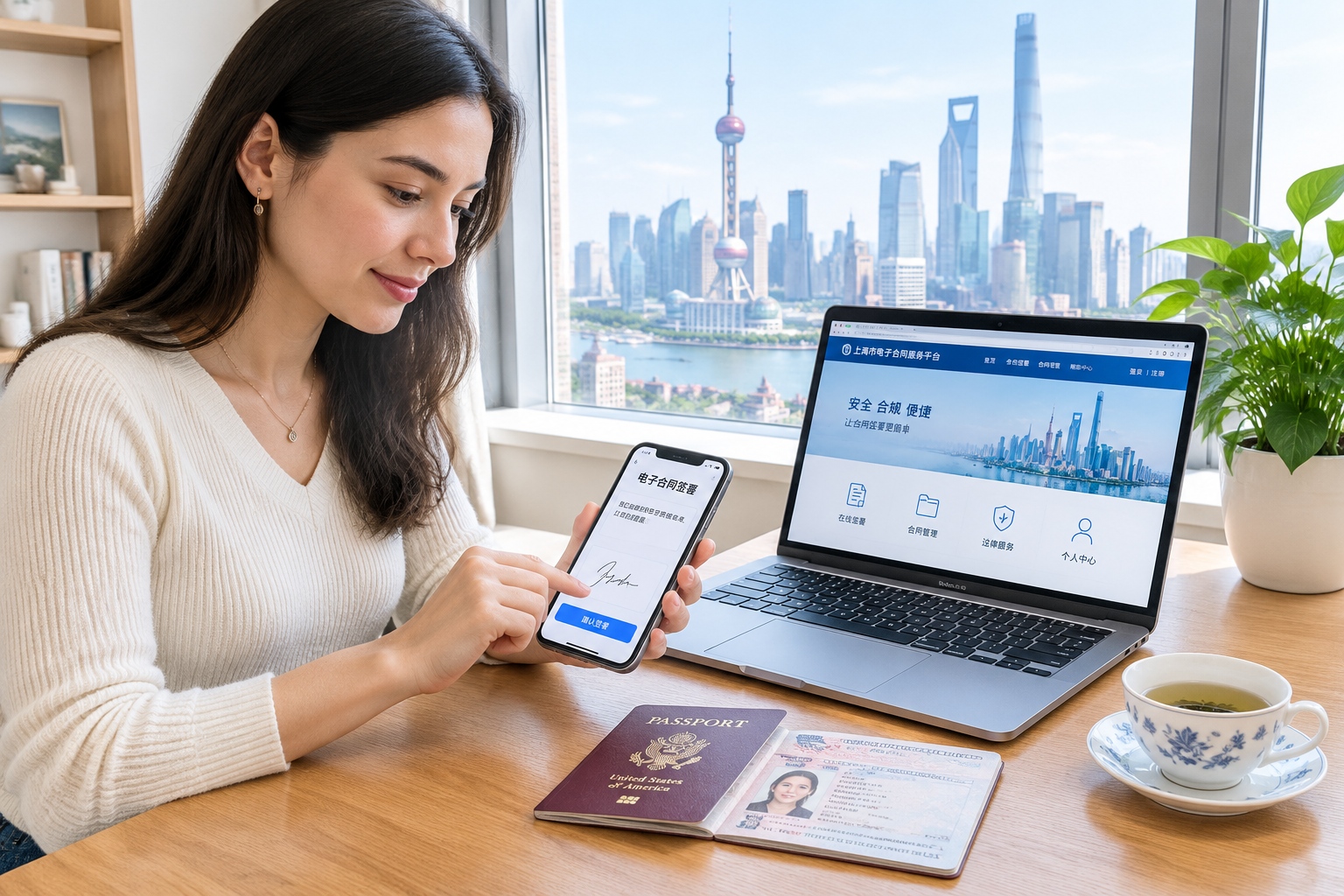

Meet Sophie’s Lease Renewal Headache
Sophie, a French product designer, has been living in Shanghai for two years. When her lease comes up for renewal, her landlord sends the new agreement through a link on WeChat. Instead of a paper document, she sees an electronic contract that she must tap to sign on a Chinese app. She wonders, ‘If I sign this online without using a pen, is it legal? And I’m a foreigner – can I go through the proof-of-identity process with my passport?’
The answer to both questions is yes, provided the e-signature is ‘reliable’ under Chinese law. China has a well-defined legal framework for electronic signatures, and you don’t need a Chinese ID card to use it. But there are important steps to follow and pitfalls to understand.
What the Law Says: The 2005 Electronic Signature Law
China’s Electronic Signature Law (电子签名法) took effect in April 2005 and was amended in December 2019. It says that a reliable electronic signature is no less valid than a handwritten one.
That is the headline. In practice, ‘reliable’ is defined by four conditions:
- It can uniquely identify the signer.
- It was created by the signer personally.
- Any change to the signature after signing is detectable.
- Any change to the text of the contract after signing is detectable.
These conditions show why Chinese courts accept platforms that combine password authentication, face recognition, digital certificates and timestamping. They also show why a simple email signature like ‘/s/ John’ is not enough – it does not satisfy the condition that future changes to the file remain visible.
The law also tells you which contracts stay on paper. Under the revised Article 3, e-signatures cannot be used for documents related to marriage, adoption, inheritance, or where another law requires paper. For example, a prenuptial agreement or a will cannot be drawn up through an e-signing app. It may still be risky to use them for some government procedures such as applying for a residence permit. For the typical contracts that expats sign – employment, rental, consulting, service – a reliable e-sign is fully accepted.
Note: In the original version of the law, contracts for transferring real estate were excluded. That restriction was removed in 2019, so an electronic purchase agreement for a property is now potentially valid. However, the actual land registry process in most cities still requires you to appear in person and sign paper forms. So treat e-signatures as legal for the commercial part, but always confirm with the local real estate registration office about their remaining formalities.
Choosing the Right E-Signature Platform
When you sign in China, you will almost always use a platform approved and widely accepted by Chinese businesses. The main players are e签宝 (eSign), 法大大 (Fadada), and 上上签 (SigningCloud). These are companies that provide identity authentication, contract storage, and digital certificates issued by China’s licensed certificate authorities.
How does it work from an outsider’s perspective? The sending party (an employer, a landlord) creates a contract on the platform, then invites you by email or SMS. You click a link that opens an app or web page. There’s no need to set up a Chinese bank account or own a Chinese social credit account.
Can foreigners use international platforms like DocuSign or Adobe Sign? Technically, yes – you may be able to draw a digital signature. But that signature won’t be accepted as a reliable electronic signature in Chinese courts, because the underlying identity verification is not linked to a Chinese-licensed certificate authority. If the other party is entirely outside China and no aspect of the contract will be enforced in China, DocuSign might work fine. For anything that may go to a Chinese court or administrative agency, stick to a Chinese platform.
A quick way to tell if a platform is legitimate: it will issue a digital certificate for each signer and generate a report that includes timestamps and a verification URL. Chinese platforms make this standard. You’ll also see the contract stored with a unique file hash.
How to Sign as a Foreigner: Step-by-Step
Most e-signing platforms in China ask for the same steps. The process is designed to work for any holder of a valid foreign passport. Here is what to expect.
- Download or open the platform – You’ll get a prompt from the sender. On a desktop, it’s usually a URL like an esign link; on mobile, you may be asked to download the app. Install it and open the invitation.
- Register with a mobile number or email – Use an active email or a mobile phone number that can receive texts. Chinese platforms usually accept foreign phone numbers going through a verification SMS. If you are outside China, disable any spam filter and confirm that your phone has international roaming enabled for SMS; otherwise the code will never arrive.
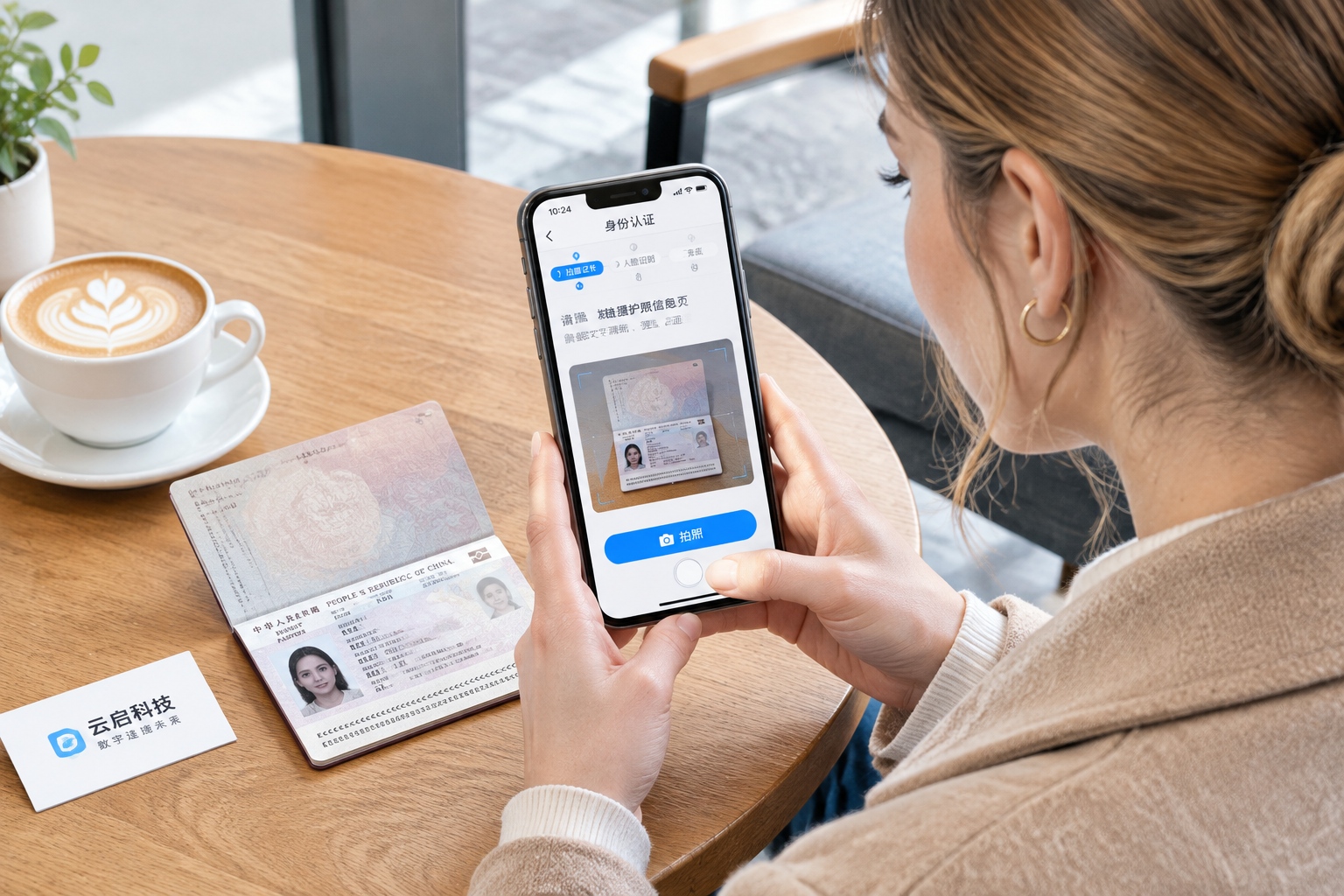
- Upload your passport – Take a clear photo of the page that has your photo and personal details. Some platforms will ask you to place the passport within a frame and then run OCR to read your name and passport number. Check that the recognized characters match exactly – typos on a legal contract can be a headache.
- Face recognition – You will be asked to align your face with an oval on the screen. In the next step, you may have to blink, nod, or move your head in a certain direction. This is to confirm a human being is really signing. If you wear glasses, remove them. Try to be in a room with even lighting. Some platforms also serve the majority of foreigners using AI, so accents or speech are not a problem if you use face-only liveness.
- Choose your signature – You can draw your name with a finger or mouse, or type your name and the system creates a signature image. This is simply for display. What matters is the digital certificate that gets attached behind the scenes.
- Receive a second verification code – Just before the final signing, the platform sends a one-time code to your phone (or asks for one more rapid face scan). This second factor confirms that the previous steps were actually done by you, not by a stolen photo or passport scan.
- Download the signed PDF – After all parties sign, the platform produces a PDF with visible time stamps and a green check icon. Download the document immediately. Better: download it once to your computer, once to your email, and once to a cloud drive – but keep the original file unmodified.

Evidence Value and What to Keep
If a dispute arises, your electronic contract is admissible as evidence. Chinese courts have been very familiar with e-contracts since 2013, and platforms are routinely used by banks and large firms. But being admissible is not the same as being convincing. You must prove that the file you show in court is the original one and was not changed after signing.
To do that, the platform gives you three pieces of supporting data:
- The final PDF which contains a digital certificate and a visible timestamp.
- A signing record accessible on the platform’s website or via an API; it shows the time, IP address, and identity certificate of each signer.
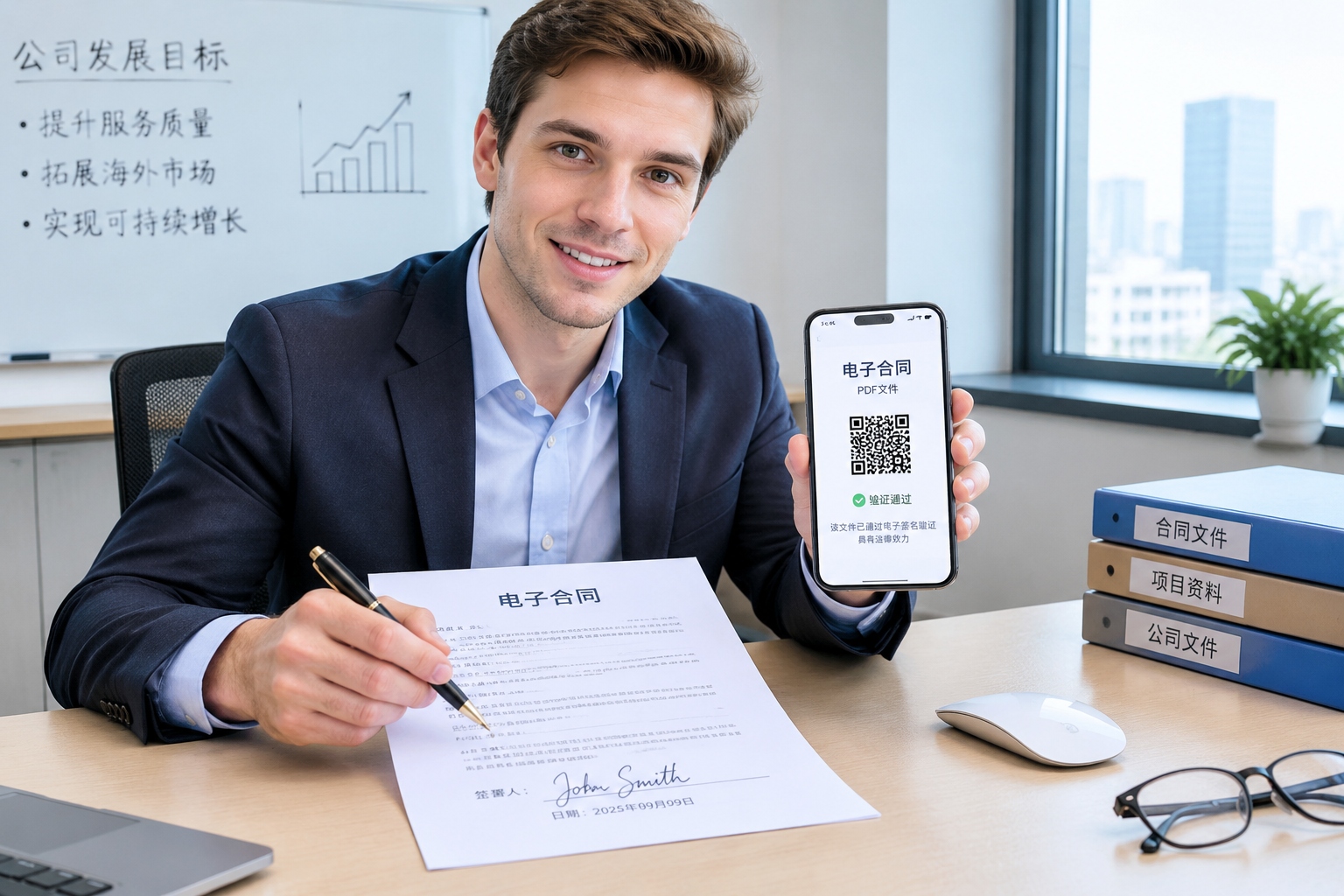
- A verification URL or QR code printed into the PDF. A judge, a notary, or the other party can enter that URL on the platform’s site and see whether the current file matches the original.
If you are handling a high-value contract, you can go to a notary office in China and ask for an electronic notarization. The notary will verify the PDF with the platform and issue a notarial certificate. This step is not required for everyday leases or employment agreements, but it is wise for a commercial deal above several hundred thousand RMB. Similarly, if you fear tampering, you can request a judicial appraisal from institutions designated by the Supreme People’s Court.
What about simply printing the PDF and saving it at home? A printout is not the digital original. Courts rely on the hash of the electronic file to confirm originality, so keep the exact electronic file. That means don’t extract text, don’t re-save with a different version of the software and don’t upload it to your scanner with additional comments. Preserve the exact file downloaded from the platform. When you need to show it, use the saved file or the platform’s online version, not just a paper copy.
Practical Caveats for Foreign Signers
Contract language and your rights
Most e-signed contracts are in Chinese. The key clauses (wages, notice periods, rent, duration, approval of drawings, etc.) are often dense legal language. If you aren’t comfortable reading Chinese, do not hesitate to ask for a bilingual version with an agreed language priority. In a dispute, the Chinese version usually governs, unless the contract clearly says both versions have equal weight and all differences are resolved against the site of the contract.
Regional differences for rental and labor registration
While electronic contracts are legally valid across all of China, some local authorities still ask for a paper copy for filing. For example, in Beijing and Shanghai, the housing authority offers an online platform for lease registration, and an e-signed lease PDF is usually acceptable. In smaller cities, you may need to print out the lease and bring it to the district government service hall. Likewise, some HR sub-offices for work permits may prefer to see a stamped paper employment contract. Keep a paper printout with signatures from all parties as a fallback, even if you signed electronically. It is not a legal requirement but it saves trouble.
Avoid fraud and phishing
Since the message came through WeChat or email, it is possible that someone is pretending to be a company to lure you into signing a false contract. Always verify the domain name and the platform app. Trusted Chinese platforms use domain names ending in .com or .cn that can be looked up quickly. If the person sends you a suspicious link that asks for passport photos and then asks for money or bank details, stop and call the company directly. Also verify that the contract matches what you have discussed – e-signing is quick, and you should read every line before tapping.
Your ID numbers on the contract
If you live in China, your employer or landlord may require your foreigner’s permanent resident ID (外国人永久居留证) if you have it, or your passport number, or your tax ID if you are employed. Make sure the number on the contract matches the number on the ID you used in face verification – some platforms may write your name in a different order (surname first or last), so check carefully that both the name and the number are correct.
Bottom Line: Sign with Confidence, but Not Blindly
China’s legal system treats reliable electronic signatures with as much respect as a handwritten signature. As a foreigner, you can use a Chinese e-signature platform with your passport, and you can do the whole process remotely. The key is to choose a well-known Chinese platform, complete the identity verification properly, and keep the signed PDF and verification data safe. If you do that, your electronic contract will hold up in Beijing, Shanghai, or anywhere else in China.
Start the discussion at forum.chinacomes.com