
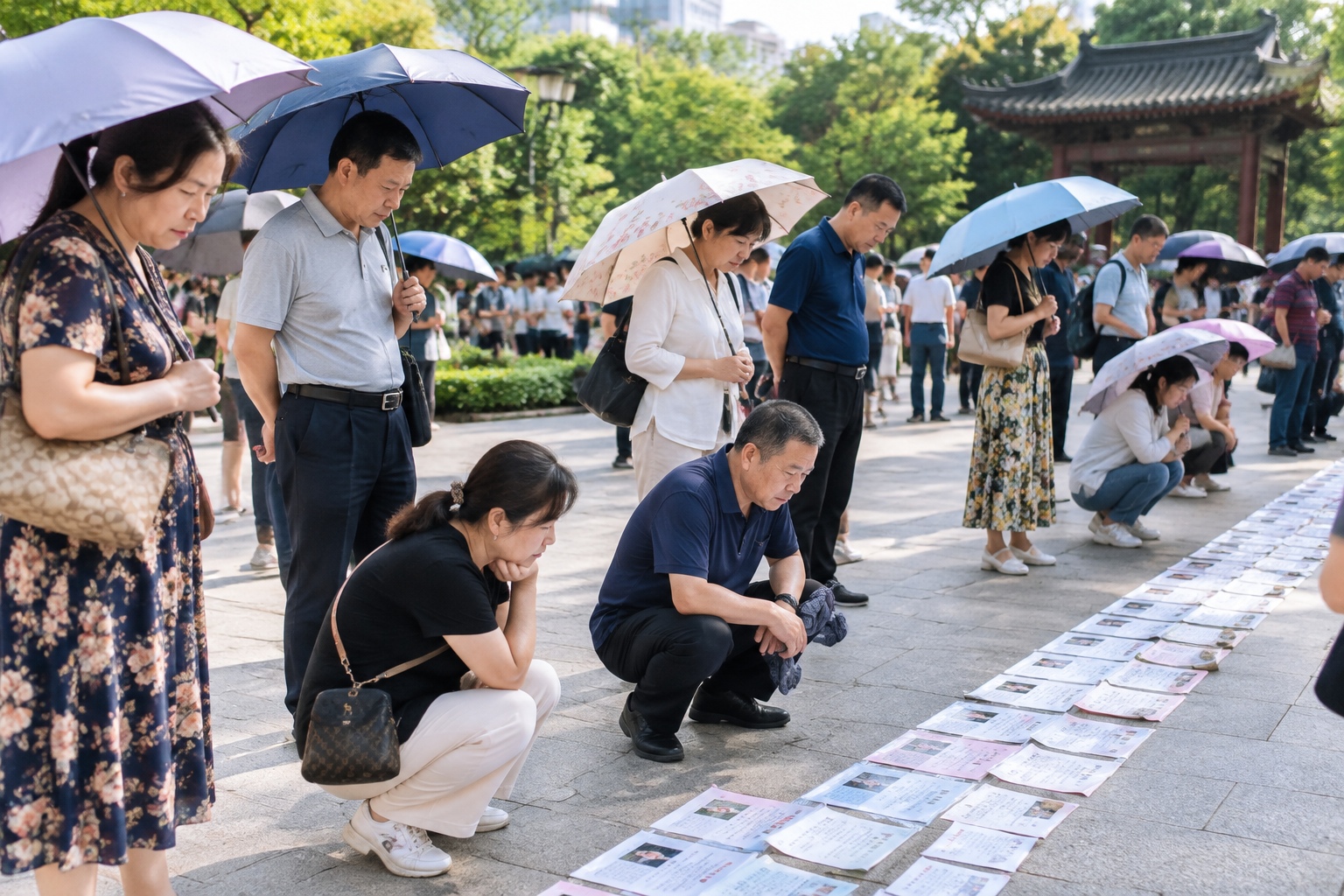

A Saturday Morning in People’s Park
At 8 a.m. on a Sunday, the sun is already burning through the haze over Shanghai’s People’s Park. Inside the north gate, a group of middle-aged men and women huddle under the trees, some holding umbrellas, others fanning themselves with sheets of paper. The paper is not a newspaper or a pamphlet—it’s a résumé. “Female, 32, master’s degree, bank manager, 165cm, single. Seeking a partner with stable income and property.”
This is one of China’s most famous “matchmaking corners,” where parents take over a public park every weekend to find a spouse for their adult children. The rules are simple: parents display biographical sheets, chat with each other, exchange phone numbers and photos, and negotiate marriage terms like brokers at a trade fair. On any given weekend, hundreds of such sheets are laid out on the ground, taped to umbrellas, or hung from tree branches, forming a peculiar landscape of personal data and social expectation.
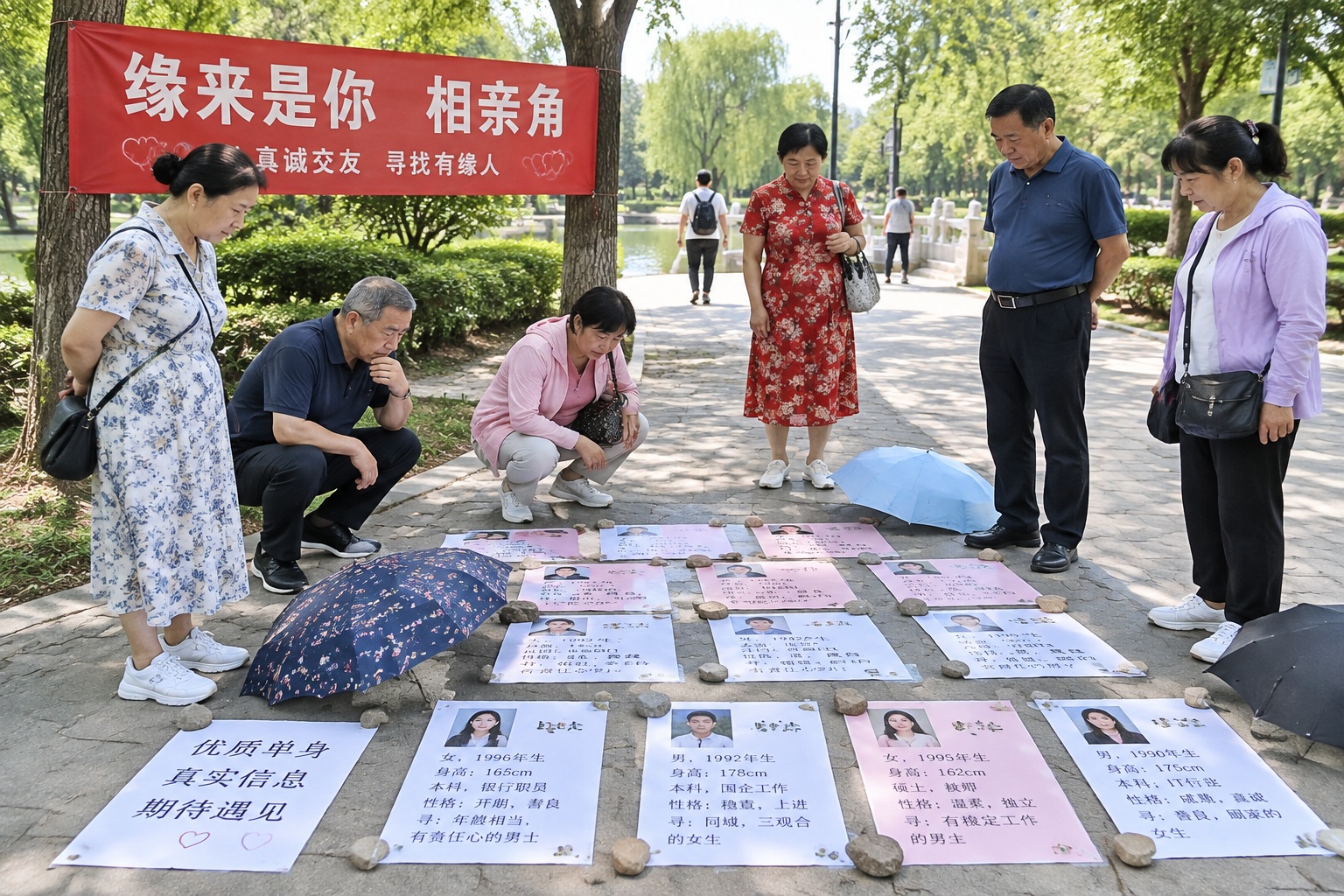
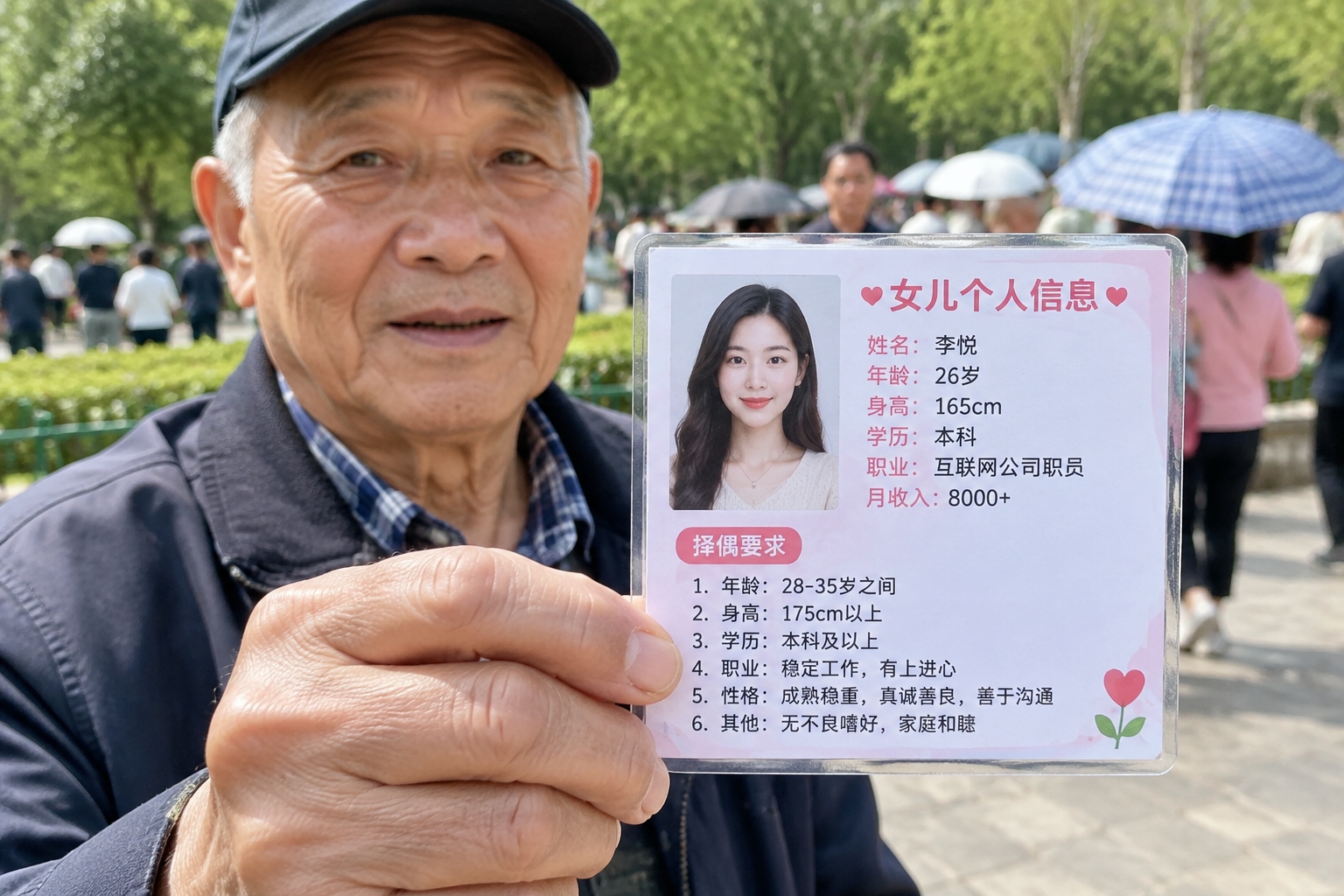
At 65, Auntie Wang has been coming here for over a year. She holds a laminated card that reads: “Male, 31, engineer, 178cm, master’s degree, bought apartment in Pudong. Stable job. Looking for a girl under 28, from a similar family background, with a decent job.” Her son, she says, is too busy to come himself. “He’s always working overtime. I have to do this for him,” she tells me, wiping sweat from her forehead.
Who Are the “Leftover”?
The phrase “leftover” (剩男剩女) is a loaded term in Chinese. It refers to men and women who have passed what society considers the ideal marriage age—roughly 27 to 30 for women, and 28 to 35 for men. The term was popularized by official media in the late 2000s, often framed as a “social problem” caused by pickiness, narcissism, or wrong attitudes. In Chinese, it carries a stigma of being “discarded” from the marriage market, as if a person’s value diminishes with age.
The label hits women harder. While “leftover men” are often blamed for lacking economic resources, “leftover women” are stereotyped as too educated, too independent, or too demanding. A woman over 30 with a master’s degree might hear, “You’re too smart—no man will want you.” Men, on the other hand, are told to “settle down” but also to “buy a house first.” These stereotypes create a double bind that leaves many young people feeling blamed no matter what they do.
The Price of Marriage
Behind these matching sheets lie deeper structural pressures. Housing is the most obvious one. In major Chinese cities, an apartment is often a prerequisite for marriage, especially for men. A 31-year-old man without a property may find himself eliminated from the race even before the first conversation. According to a survey by a major real estate platform in 2022, more than 60% of single respondents in first-tier cities said they would postpone or abandon marriage if they couldn’t buy a home. In Shanghai, the average new-home price exceeded 60,000 yuan per square meter in 2023, meaning a modest 70-square-meter apartment costs over 4.2 million yuan—roughly $580,000. Meanwhile, the annual disposable income per urban resident was around 80,000 yuan (about $11,000).
Then there’s the bride price, or “caili” (彩礼), a customary payment from the groom’s family to the bride’s family. While it has ancient roots, in recent decades it has ballooned into an enormous burden. In some rural provinces like Jiangxi, Henan, and Gansu, the going rate can exceed 100,000 yuan (about $14,000), sometimes far more, not counting a house and a car. For a young man from a poor family, this can mean years of debt and crushing pressure. Reports of suicides over bride prices have appeared in local media, and the government has tried to crack down on the practice, but with limited success.
China’s skewed sex ratio also makes the market more competitive for men. Due to the one-child policy and a cultural preference for sons, the 2020 census showed a birth ratio of 111.3 boys for every 100 girls, translating into a surplus of about 30 million men in the adult population. In the marriage market, this means many rural, low-income men are effectively priced out of finding a bride. Some village officials have organized “matchmaking exchanges” with distant regions to bring in prospective wives, but these are often controversial and sometimes end in trafficking cases.
Parents at the Front Line
Auntie Wang, the mother of the engineer, admits that the process is humiliating. “You feel like you’re selling your child. But what else can we do? The young people are too busy to look.” Her son, 31, earns a respectable salary but works long hours. She has interviewed at least twenty girl candidates this year, but none have matched. “One girl was 169cm, but her family asked for a 200,000 yuan bride price. We have a house, but no way can we give so much cash.”
Across the park, 57-year-old Sun is pacing with a laminated profile of his daughter, a 29-year-old nurse. He tells me his daughter is “perfect but single.” When I ask if she knows he is here, he waves his hand: “She resists it. But she’ll thank me later. Women age quickly; in five years, no one will want her.” His tone is matter-of-fact, almost businesslike, but there is a hint of worry underneath.
Nearby, a younger woman, 34-year-old Chen, stands beside her mother, who is engaged in a heated negotiation with another parent. Chen looks at her phone, occasionally rolling her eyes. “I only came because she promised to stop nagging if I did,” she whispers. “I don’t believe in this. If I meet someone, I meet them. If not, I’m fine alone.” Her mother, overhearing, shoots her a look and turns back to the conversation. Chen shrugs and goes back to her screen.
A New Generation Pushes Back
Chen is not the only one. Liu Yang, a 30-year-old IT engineer who visited the corner alone, says he came out of curiosity. “My mom keeps telling me to come. But I’m not going to let my parents pick my wife. I’d rather stay single than marry someone I don’t love.” He looks at the dense crowd of umbrellas and adds, “This system treats people like products. It’s not how I want to live.”

His sentiment is spreading. According to a 2022 survey published by the journal Population Research, nearly 30% of Chinese unmarried adults said they were “not willing” or “very unwilling” to get married. The term “sheng nu” has been reappropriated by some young women as a badge of independence, not shame. Online communities like “women who live alone” flourish, sharing tips on decorating a small apartment, cooking for one, and raising a pet instead of attending blind dates. The “single economy” has become a notable market force, with single-serving products and services thriving.
In cities like Shanghai and Beijing, the age of first marriage has risen to 30 for women and 32 for men, according to official statistics. More young people are choosing to cohabitate, or simply to not marry at all. The government has tried to encourage marriage and childbirth through policy shifts, such as the lifting of the three-child limit and the promotion of marriage-friendly services, but the cultural and economic obstacles remain high.
Under the Umbrellas
Back in the park, the morning sun gives way to clouds. A sudden drizzle sends parents scrambling to cover their sheets with plastic bags. The matchmaking corner is a living portrait of a society in transition—caught between centuries-old traditions and the realities of high-cost urban life. For the parents, marriage is a duty; for their children, it is a choice—or a luxury they cannot afford.
As the afternoon fades, Auntie Wang packs up her son’s laminated resume. No new matches today. She sighs but says she’ll be back next weekend. “What else can I do?” she asks, more to herself than to me.
Start the discussion at forum.chinacomes.com