


The Guitar at the Edge of the Rice Terraces
The first thing you notice about Xiao Li is the tattoo of a mic stand on his left forearm. The second is the worn-out acoustic guitar leaning against the reception desk of his guesthouse, where he’s just taken a booking from his smartphone. Outside, layered green terraces stretch down the mountainside, and morning mist curls past the wooden balconies.
Xiao Li is 32. He grew up in this Hani village in Honghe, Yunnan Province, and for eight years he chased a music career in Kunming and Beijing. Today he’s the owner of a small guesthouse called “Terraces and Sound” – and the lead singer of a local rock band that mixes Hani folk melodies with electric guitar riffs.
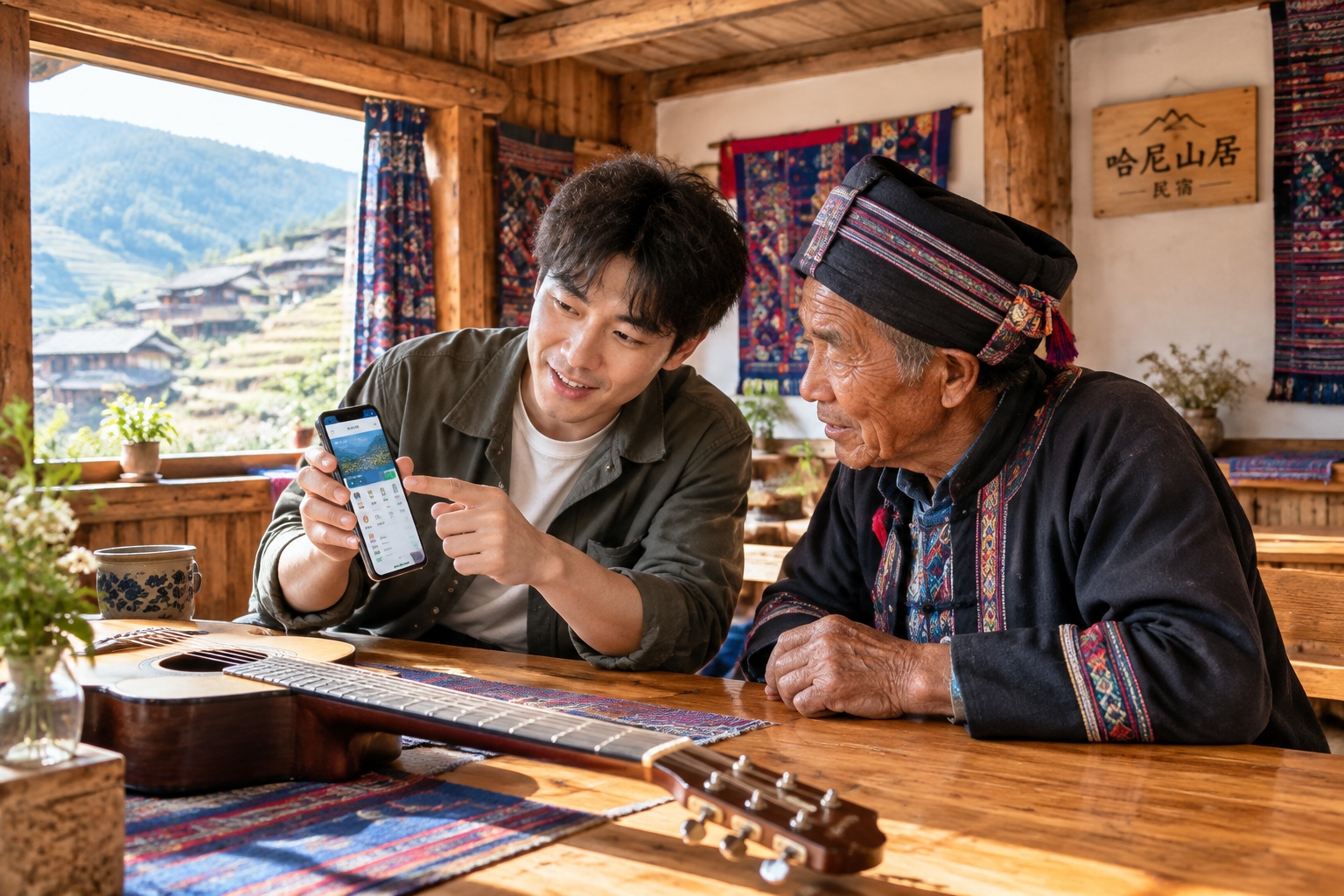
To many overseas visitors, this combination feels unexpected. You come to a remote UNESCO World Heritage site expecting timeless scenery and traditional farming, and you find a guy who used to play smoky clubs in Beijing, now hosting travelers and teaching his neighbors how to use WeChat to sell their rice online.
A UNESCO Site That Still Has Living Culture
The Hani Rice Terraces in Honghe were listed as a UNESCO World Heritage Site in 2013. They aren’t just beautiful – they’re an agricultural system built over 1,300 years by the Hani people, who carved mountainsides into stepped fields for planting rice. Water flows from the forest at the top, through villages, then down to the terraces, in a sophisticated, community-managed irrigation system.
But unlike many heritage sites that become open-air museums, this one is still very much alive. Roughly 200,000 people farm these terraces today, growing red rice as their ancestors did. When the government invested in tourism infrastructure a decade ago, it did so carefully: villages built guesthouses, but with rules to preserve wooden facades and traditional layouts.
Still, young people were leaving. As in many rural parts of China, better jobs and livelier cities pulled the youth away. Then something interesting started happening. The same digital tools that made city life convenient – mobile payments, short-video platforms, online booking systems – made it possible for them to return and build businesses from home.
From City Rock Star to Village Host
Xiao Li is part of that reverse migration. He left for Kunming at 18 to study music, then spent years in Beijing bars, playing original songs that nobody really knew. “I wasn’t famous,” he says with a grin. “My mom kept asking me to come back and farm.”
The turning point came in 2019, when his father fell ill during the rice-planting season. Xiao Li returned home for a few weeks, and discovered that tourists were often disappointed by the lack of places to stay – especially foreigners who wanted to learn about Hani culture, not just take selfies.
So he converted part of his family’s house into a six-room guesthouse. He painted the walls with murals relating to Hani legends, kept the traditional smoke-dried wood beams, and installed fast Wi-Fi. He put up listings on Ctrip and Booking.com, and started a short-video account showing daily life in the terraces – sometimes with an acoustic cover of a Hani lullaby.
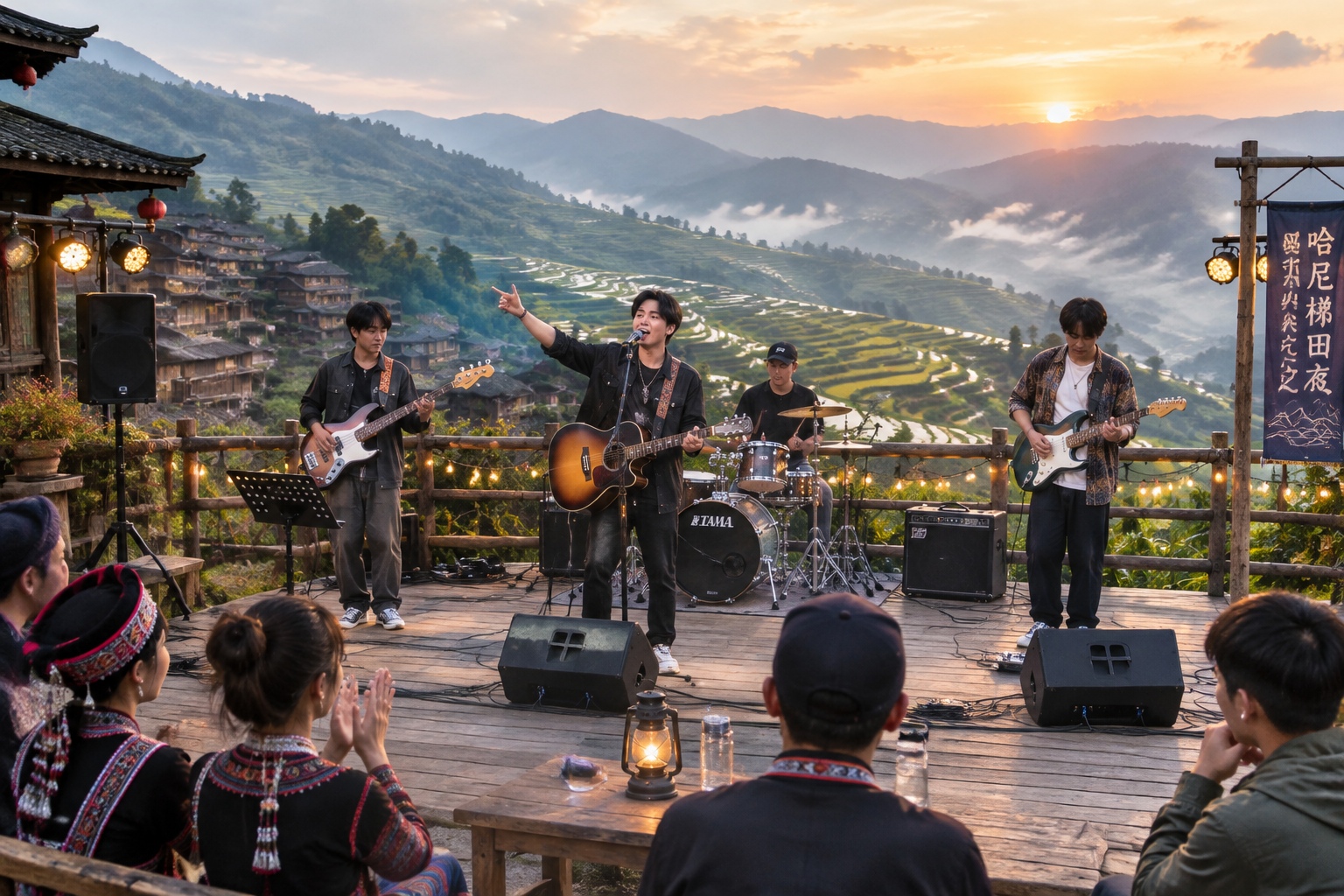
“Running a B&B is like being a frontman,” Xiao Li laughs. “You welcome the crowd, keep the energy high, and make sure everyone goes home happy.” But it’s also full of chores he never expected: laundering sheets, cleaning toilets, and negotiating with suppliers for better prices on vegetables.
A Different Kind of Rural Retreat
What makes his guesthouse stand out isn’t just the music. Xiao Li serves meals that his mother cooks – Hani specialties like purple rice, smoked pork, and pounded taro with fermented soybeans. He organizes visits to the terraces with local farmers, who explain the irrigation system and the rituals tied to rice planting. On weekends, he invites his bandmates to play under the stars, usually with the terrace lights twinkling below.
For guests from Europe or North America, this feels like a blend of a country inn and a cultural exchange program. “In many places, heritage is something you look at through glass,” says a guest from Germany named Anna. “Here, you’re living inside it.”
The digital layer is also striking. Payment is via WeChat or Alipay; Xiao Li’s entire business runs on a phone. He posts a video of the morning mist rolling over the rice terraces, and by evening, bookings fill up. This is a type of rural economy that many Western travelers haven’t seen – where traditional life and cutting-edge tech coexist seamlessly.
Why This Works: China’s Rural Revival
China’s push for “rural revitalization” is more than a slogan – it involves concrete investments in transport, internet, and water systems. In Yunnan, highway tunnels now cut travel time to the terraces from days to a few hours. High-speed rail brings visitors from Kunming to nearby stations. And every village has 4G coverage, allowing a B&B owner to live-stream his rice harvest to hundreds of thousands of viewers.
But infrastructure alone doesn’t explain the return of young creatives. Government subsidies and low-interest loans help young people start rural businesses. Collective village ownership means that land and traditional houses can be developed communally, sharing profits among residents. So a guesthouse isn’t just an individual enterprise – it’s part of a larger social fabric.

This is starkly different from much of rural Europe, where small villages often rely on tourism but struggle with aging populations and fragmented ownership. Here, a village cooperative can pool resources to build a parking lot, train homestay hosts, or set standards for waste management. It’s messy at times, but it has kept the community alive.
Music and Rice: The Rhythm of a New Generation
For Xiao Li, the guesthouse is also a stage for cultural reconnection. He learned Hani folk songs as a child but only truly understood them when he started playing them on guitar. “The old songs were about planting rice, rowing water, and missing your lover,” he says. “They have this uneven rhythm, like walking on mountain paths.” Now his band, “Mountain Water Band,” fuses these melodies into rock songs. They even wrote a song titled “Rice Terrace Blues.”
This blending of generations is everywhere. A neighbor who grows red rice sometimes comes to the guesthouse to teach guests how to play the ba wu, a traditional Hani bamboo flute. A young woman who studied design in Shanghai has created a brand of T-shirts using Hani embroidery patterns. The rock band and the flute teacher aren’t opposites – they’re both expressions of the same living tradition.
What Visitors Can Learn
If you’re planning a trip to Yunnan, a stay in the Hani Rice Terraces offers something beyond postcard views. Take the time to walk along the ridge paths, eat local meals cooked with firewood, and listen to a performance that mixes rustic beats with electric ones. Ask your host about the history of the rice terraces, and you’ll hear stories of droughts, harvests, and the spirit of the water god.
It’s not all romantic. Tourism brings crowds, trash is a concern, and young people still battle with inconsistent electricity during storms. But these are the growing pains of a place that is changing fast. What moved me most was seeing Xiao Li sing an old Hani prayer in his bar, his voice thick with emotion, while outside the rice terraces glistened under the moon. For a moment, the past and the future seemed to be holding hands.
The Terraces Sing a New Song
Back in the guesthouse lobby, the guitar is still leaning against the desk. Xiao Li’s next performance is on Saturday. He’ll play a mix of Hani folk and original rock, and his mother will probably be in the kitchen, preparing smoked pork for guests who came from halfway around the world. “I don’t miss the city,” he says. “Here, every day is the real thing.”
For overseas readers, his story might feel like a lesson in how heritage can be protected not by freezing it in amber, but by allowing new life to flow through it. The Hani rice terraces, built by thousands of hands, are now being shaped by a young man with a guitar – and that, perhaps, is the most hopeful sign of all.
Start the discussion at forum.chinacomes.com