
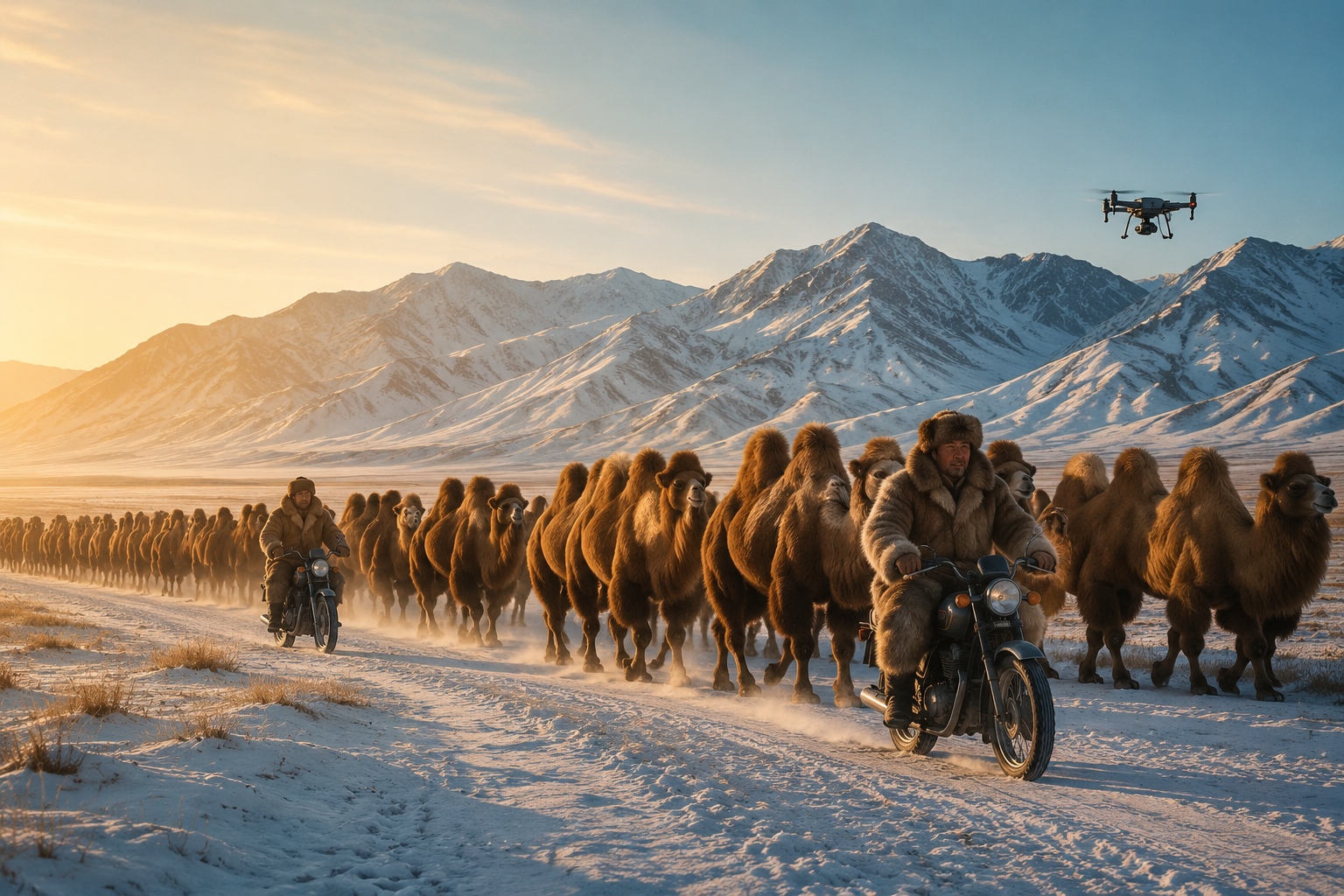

At 7 a.m. in Altay, a region in China’s far northwest, the temperature is minus 20 degrees Celsius. A line of Bactrian camels stretches across the snow, their breath turning to ice crystals in the sharp air. It’s a scene of ancient nomadic life — except for the muffled sound of engines. The herders are not on horses. They are riding motorcycles, and a small drone hovers above the herd, recording every move.
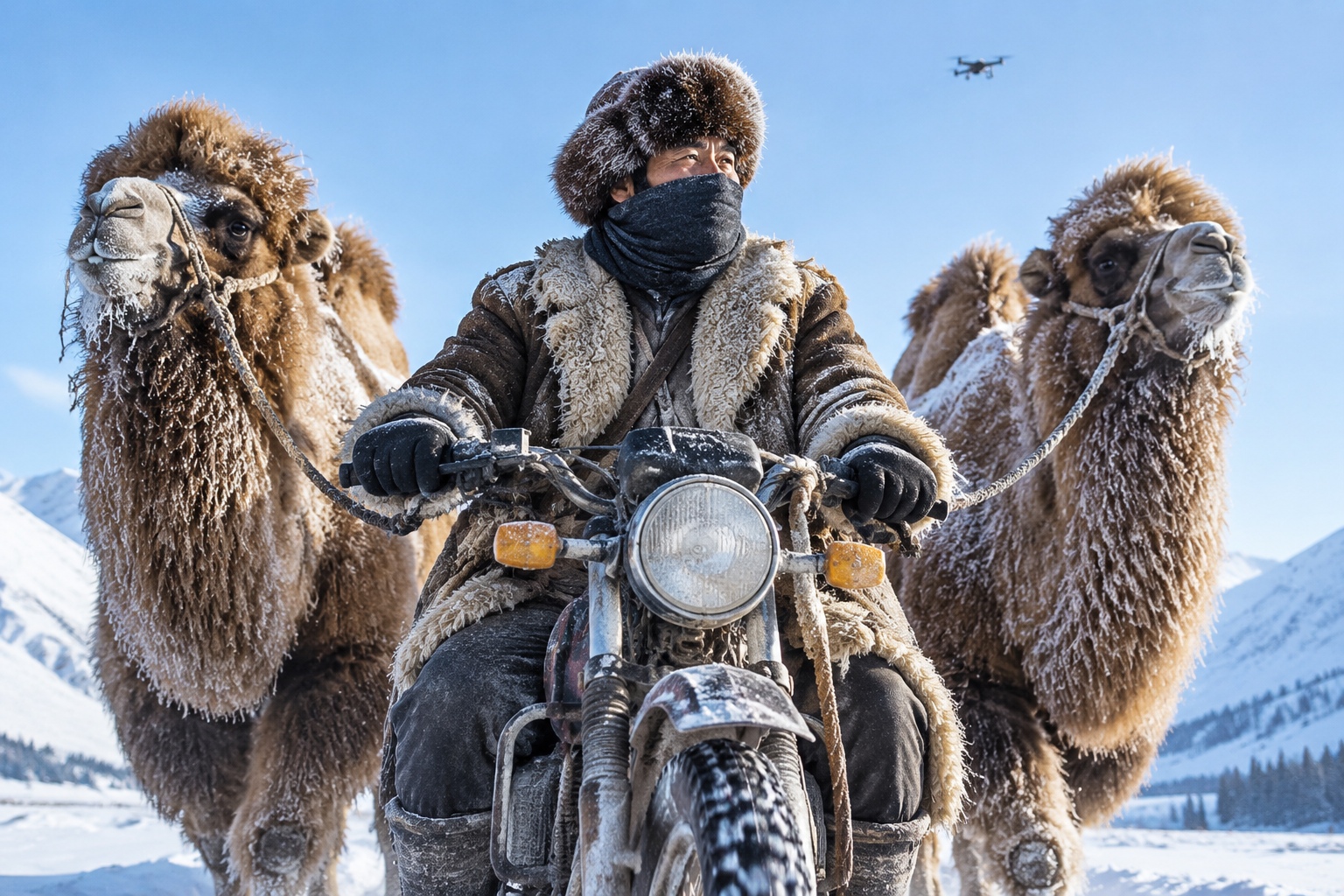
A Timeless Scene, Reimagined
Altay is a vast area in northern Xinjiang, bordered by Mongolia, Russia, and Kazakhstan. For centuries, its herders have practiced seasonal migration, moving livestock between summer and winter pastures. The winter migration, in particular, is a survival test. Families pack their belongings, load camels with supplies, and travel for dozens or even hundreds of kilometers to reach a warmer valley where animals can graze through the harsh months.
On this year’s journey, a group of more than two hundred camels was led by three herders on motorcycles and two on horseback. The camels knew the route, but the herders had to keep them on track, especially at junction points and river crossings. It’s a dance of instinct and control that looks chaotic to an outsider, yet follows a logic developed over generations. The migration is still practiced by thousands of herding families in Altay. For them, it is not a tourist show, but the foundation of their economy. In recent years, local authorities have built rest stations and hay supply points along the traditional routes, making the journey safer for both people and animals.
Why Leave the Horse Behind?
The change from horses to motorcycles didn’t happen overnight. It began in the late 2000s, when rural roads in Xinjiang were expanded and Chinese brands like Lifan and Zongshen became common in remote townships. For herders, the appeal is straightforward: speed and endurance. A horse can cover about 50 kilometers in a day if pushed, but a motorcycle can do the same before lunch. That speed matters in winter, when a sudden snowstorm can trap a herd in a deadly pass.
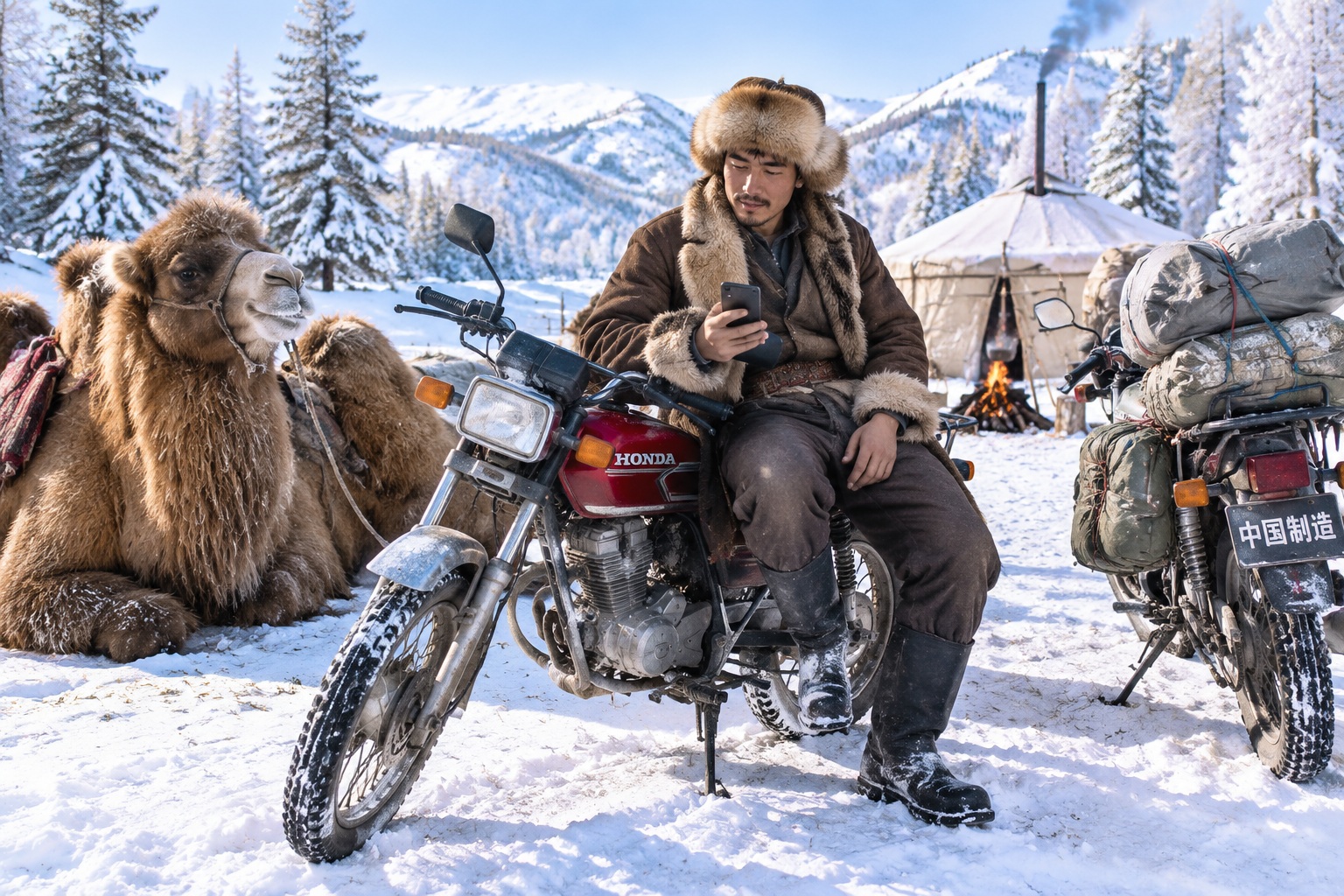
Saylik, a herder in his late 40s from Fuyun County, explained over tea at a rest stop. “Twenty years ago, I used to ride a horse for hours just to move one stray camel back to the group. Now with a motorcycle, I’m there in ten minutes. It’s not that we don’t love horses—I still keep two at home. But for working, the motorbike is better.”
The economics also favor the switch. A new motorcycle costs around 10,000 yuan (about $1,400) and can be maintained for a few hundred yuan a year, while a good horse can cost twice that price to feed and stable. Plus, they carry more. Wrapped in layers of thick sheepskin coats, herders can strap several days of food, cooking pots, and insulation boards onto the back. One herder, Bieke, said he even packs a portable solar charger and a power bank to keep his phone and drone battery alive.
Drones: Eyes in the Sky and Views for All
The drone, in fact, has become the most talked-about addition to the migration. Small consumer models, starting at just a few hundred dollars, are now seen in the hands of younger herders. They use them to scan the terrain ahead, count animals, and spot sick or injured camels that may be hidden by trees. “A drone is like an extra horse that can fly,” Bieke joked.
Drones also help avoid breakdowns. If a motorcycle stalls in deep snow, the drone can guide others back to help, instead of searching blindly.
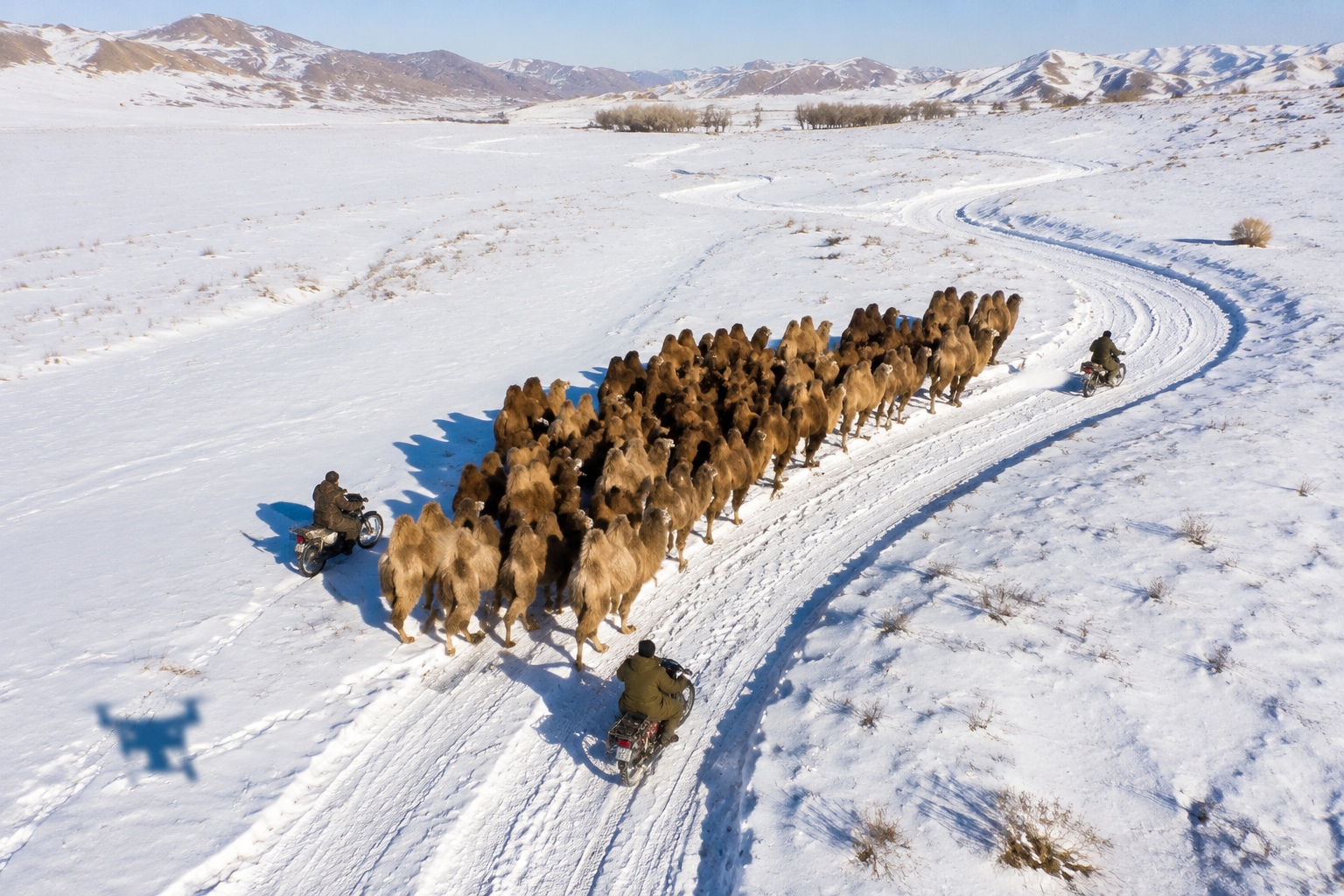
But the drones are also doing something nobody expected. They are bringing the migration to the rest of the world. Bieke first posted a short clip from last winter’s migration on Douyin, China’s version of TikTok. The footage showed camels marching along a snow-covered ridge while a motorcycle weaved between them, with the drone’s shadow visible on the snow. Within a week, it had been viewed millions of times.
Comments flooded in from across China and beyond. Some viewers said they never knew such a scene existed. Others compared the view to a nature documentary. A handful of them later booked trips to Altay to see the migration in person, welcomed by local tourism companies that now offer safe, supportive watching experiences.
A Living Tradition, Not a Museum Piece
It would be easy to romanticize the winter migration as a throwback to a simpler time. But Saylik is quick to correct that view. “Cattle and camels are our livelihood. We don’t migrate to preserve culture; we migrate because it’s the best way to raise our animals. If a machine helps us do that better, we use it. That doesn’t mean the tradition is lost.”
Tradition, he argues, isn’t about the tools. It’s about the relationship between people, animals, and land. In that sense, the migration still follows ancient patterns. The timing is set by the weather and the animals’ needs. The routes are the same as those used by his grandfather and great-grandfather. The camels still lead the way, and the herders still feel the same cold, exhaustion, and pride at the end of the journey. The landscape of Altay is unforgiving, but for centuries it has sustained people who respect its limits.
What has changed is that this winter journey is no longer a closed event. Thanks to motorcycles, drones, and the internet, people in other provinces and other countries can follow along. The reaction is often surprise: the scene looks both familiar and something out of a different world.
As the sun begins to set, the first group of camels arrives at the winter pasture. Saylik pulls off his helmet, lights a cigarette, and looks at the drone that’s filming the final stretch. “Tomorrow we will start building a new sheep pen. And we’ll probably share some clips of that too,” he says with a tired smile. Then he turns back to the animals, and the long night work begins.
Start the discussion at forum.chinacomes.com