
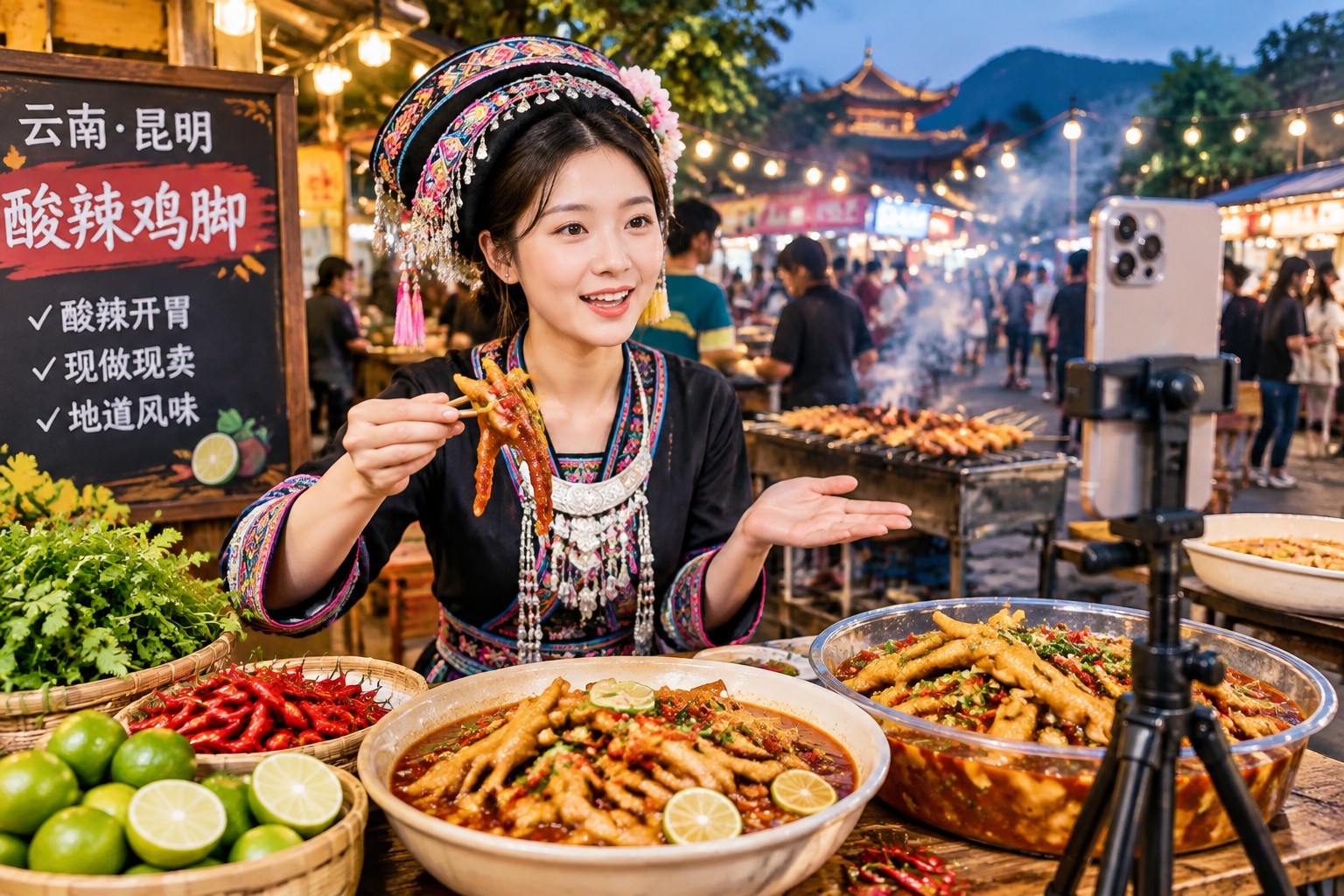

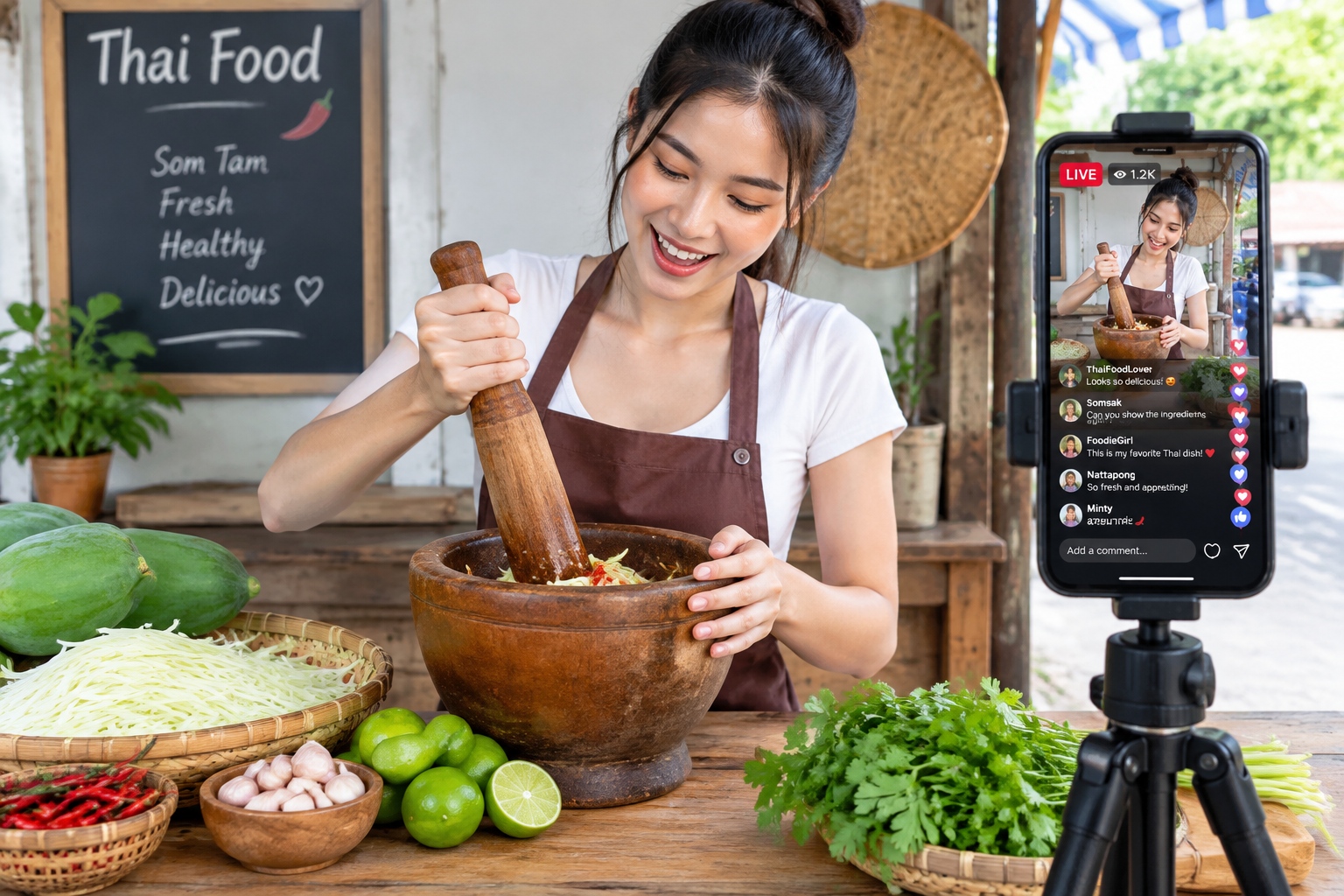
At 9 p.m., the night market in Kunming is a cloud of grill smoke and chatter. I’m standing at Yuying’s stall, watching her pound green papaya in a wooden mortar with a rhythm that feels almost musical. Her phone is propped on a small tripod, and the live-stream comments are rolling by faster than I can read.
“Come on, spice lovers! This is our family’s own chili paste from Xishuangbanna. You can’t find this heat anywhere else,” she says into the camera, flashing a smile that’s equal parts saleswoman and storyteller.
Yuying is 27, a Dai woman who grew up in a stilt bamboo house deep in the rainforest of Xishuangbanna, the southernmost prefecture of Yunnan Province. Now she is one of the most recognizable faces in Kunming’s night market food scene—a Dai streamer who has turned her sour-and-spicy heritage into a digital livelihood.
From a Bamboo House to a City Stall
Yuying’s hometown is Ganlanba, a Dai village near the Lancang River. She remembers the mornings when mist layered over the rice fields and her grandmother would boil water to brew tea from the garden. “Our house was like everyone else’s—made of wood and bamboo, raised on stilts. The kitchen smelled of lemongrass, galangal, and our fermented fish sauce. We didn’t call it ‘Dai cuisine’ then. It was just home.”

When she turned 18, she left for Kunming, like many young people from rural Yunnan, to find work. Her first jobs were ordinary: waitressing, then selling clothes at a market stall. But something was missing.
“I loved the city, but I missed the taste of my village. When you’re homesick, you eat. But the food in Kunming wasn’t sour enough, not sharp enough. So I started cooking my own Dai snacks at home,” she says.
In 2021, a friend suggested she try selling Dai-style chicken feet at the night market. She borrowed a small cart, made a batch of her grandmother’s recipe—pickled chicken feet flavored with lime, chili, garlic, and coriander—and sold out in two hours.
The first night changed her life. “I made 400 yuan in two hours. That was more than I used to make in a day of selling clothes. I thought: this is it.”
But she was also nervous. The night market is a tough place. Every few meters, there’s a grill, a noodle stall, or a fruit shake vendor, all competing for the same hungry tourists and office workers.
“I was new. I didn’t have a regular customer. People would walk past my tiny cart. So I had to make myself stand out.”
The Live-Stream Leap
One evening, a customer asked if they could watch her make the chili paste. She pulled out her phone, opened a live-streaming app, and started talking. It was less about selling, more about showing.
“The first stream was shy. I didn’t know what to say. But people loved the sound of the pounding. It’s very satisfying, like ASMR,” she laughs.
That first stream attracted 200 viewers. Within three months, her audience grew to tens of thousands. Today, she has 280,000 followers across two platforms.
Her formula is simple: she prepares every dish live, talks about the ingredients and the Dai culture behind them, and answers questions in real time. “Why is this chili so red?” “What is that green leaf?” “How do you make the fish sauce?” She explains everything, sometimes repeating the same answer ten times for new viewers.
The live stream is now a window into her life. On some nights, she wears a traditional Dai skirt with a silver belt. On others, she teaches viewers to wrap rice cakes in banana leaves. She shows them how to use a mortar and pestle the way her grandmother did.
“People aren’t just buying food. They buy the story. They want to know what it’s like to live in a bamboo house, to pick mangoes from the tree, to go to a Dai water-splashing festival,” Yuying says.
One of her most memorable moments came during last year’s water-splashing festival. She set up her phone outside her village home, and her mother and aunt joined the stream, laughing as they splashed water and made a huge pot of tamarind hot pot.
“People from Bangkok and Melbourne were watching. They said they had never seen a real Dai festival. It made me realize I’m not only selling food—I’m sharing a whole culture.”
Sour and Spicy, Sweet and Bitter
The Dai flavor profile is often described as sour and spicy, but Yuying says it’s more complex. “Sour from lime and tamarind, spicy from bird’s-eye chilies, but also bitter from certain herbs and sweet from palm sugar. It’s like life—you need all the tastes.”
That philosophy carries her through the ups and downs of being a streamer-seller. There are good nights, when she clears a thousand yuan in profit, and bad nights, when only a few people wander by. There are days when the internet connection fails, or the supply of fresh lemongrass runs out.
“You can’t control everything. Sometimes I’m tired and want to go home. But then a comment pops up: ‘I tried your recipe, my whole family loved it.’ That brings me back,” she says.
She also faces practical challenges. Night market licenses are not always easy to renew, and competition has increased, with many copycat stalls appearing. Her response is to lean deeper into authenticity.
“I don’t sell frozen imported chicken feet. I buy fresh ones every morning. My chili paste is made by my aunt in Xishuangbanna and sent to me by bus. That’s not scalable, but it’s real. My viewers know it.”
Running a stall in a night market means long evenings and late nights. She starts preparing ingredients at 2 p.m., arrives at the market by 6 p.m., and often stays until midnight or later. Her hands are permanently stained with chili oil, and she jokes that she can’t feel her tongue anymore after years of tasting.
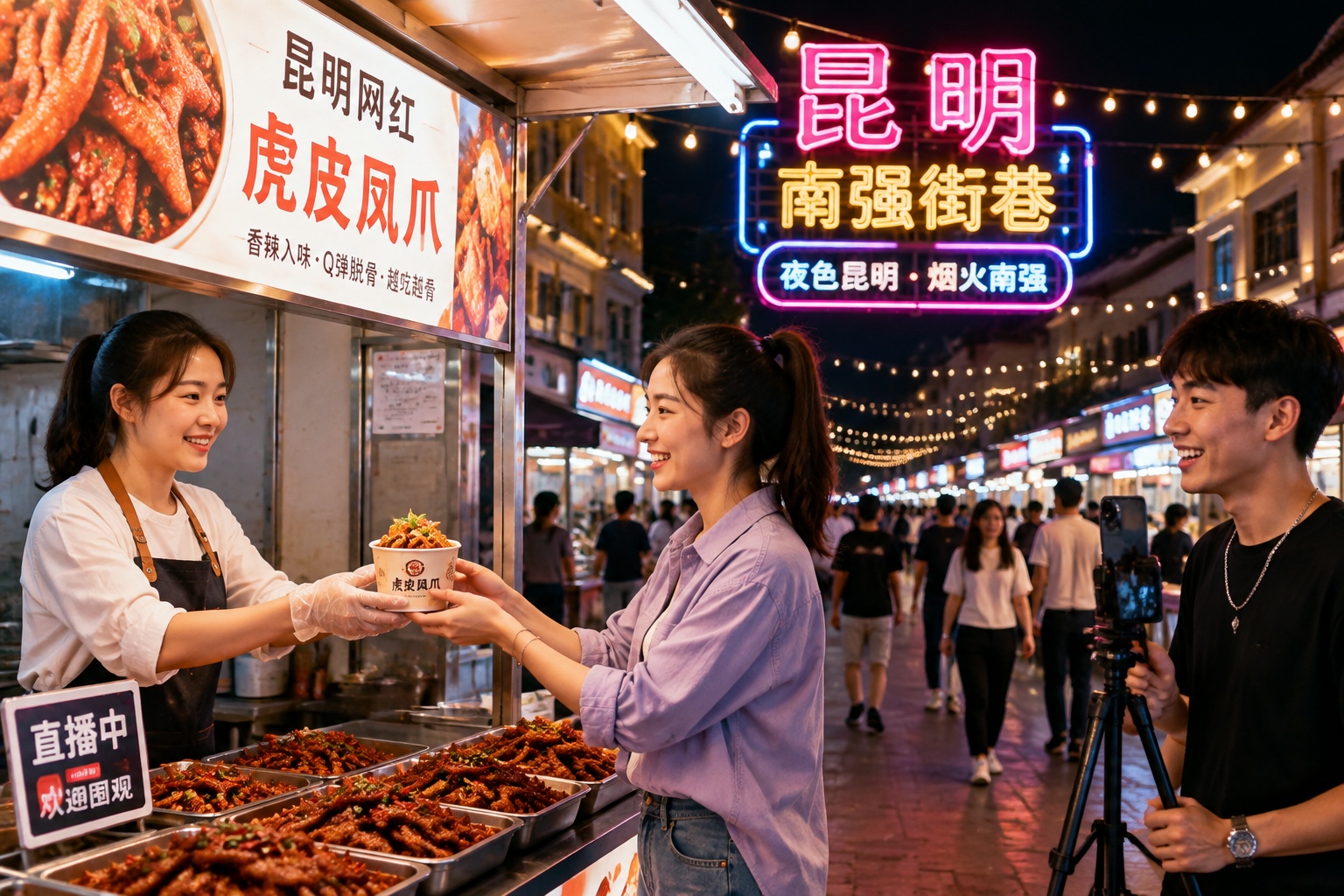
But the sour and spicy life also has sweet moments. She has a loyal group of followers who come to the market just to meet her in person. Some bring gifts—a bag of mangoes, a handwoven scarf. Others simply want to take a selfie with her.
“There’s a lady who watches my stream every single night. She is a nurse who works the night shift. She says my voice is like a lullaby after a tough day. That touches my heart.”
Bringing Dai Culture to the World
Yuying has become an accidental cultural ambassador. Her streams often feature Dai language phrases, traditional clothing, and explanations of festivals like Songkran (the water-splashing festival). She’s noticed that many overseas Chinese viewers tune in.
“I have viewers from Thailand, Laos, the U.S., Australia. They say it reminds them of their own food or their grandmother’s kitchen. It’s a way to connect people, even across borders.”
She has also started a small online shop selling dried spices and sauces. But her main stage remains the live stream, where she embodies a blend of tradition and modernity.
She is careful not to oversimplify her culture. “Dai culture is not just about costumes and food. It’s about respecting nature, living slowly, and cherishing family. I want to show that too.”
That respect is visible in how she sources her ingredients. She knows the farmers who grow her herbs, and she pays them fairly. She avoids using harmful preservatives, even if it means shorter shelf life.
“I’m not a big company. I’m just one person trying to keep a tradition alive. If I do it well, maybe the tradition will live on through me.”
Looking Ahead
Yuying dreams of opening a small Dai food restaurant in Kunming, with a wall of photographs from her village. She also hopes to return to Xishuangbanna someday, not to escape the city, but to build a bridge between her two lives.
“The city gives me opportunity, but the village gives me taste. I want both,” she says with a smile.
She doesn’t have a grand five-year plan. Instead, she focuses on each night’s stream, each batch of chili paste, each new follower who says, “I never knew Dai food was this good.”
As the night market winds down, she packs up her mortar and pestle, wiping the stall clean. On the way home, she passes a street tree and pauses to look at the moon.
“See this moon? Same moon over my village. In the bamboo house, my mother is probably sleeping already. Tomorrow, I will call her and tell her about tonight’s stream.”
Her story is not a rags-to-riches fairy tale. It’s a story of how a young woman took a familiar taste, turned it into a living, and in doing so, reminded people that the most ordinary things—a pounding sound, a sharp chili, a lime leaf—can carry the deepest sense of home.
Start the discussion at forum.chinacomes.com