
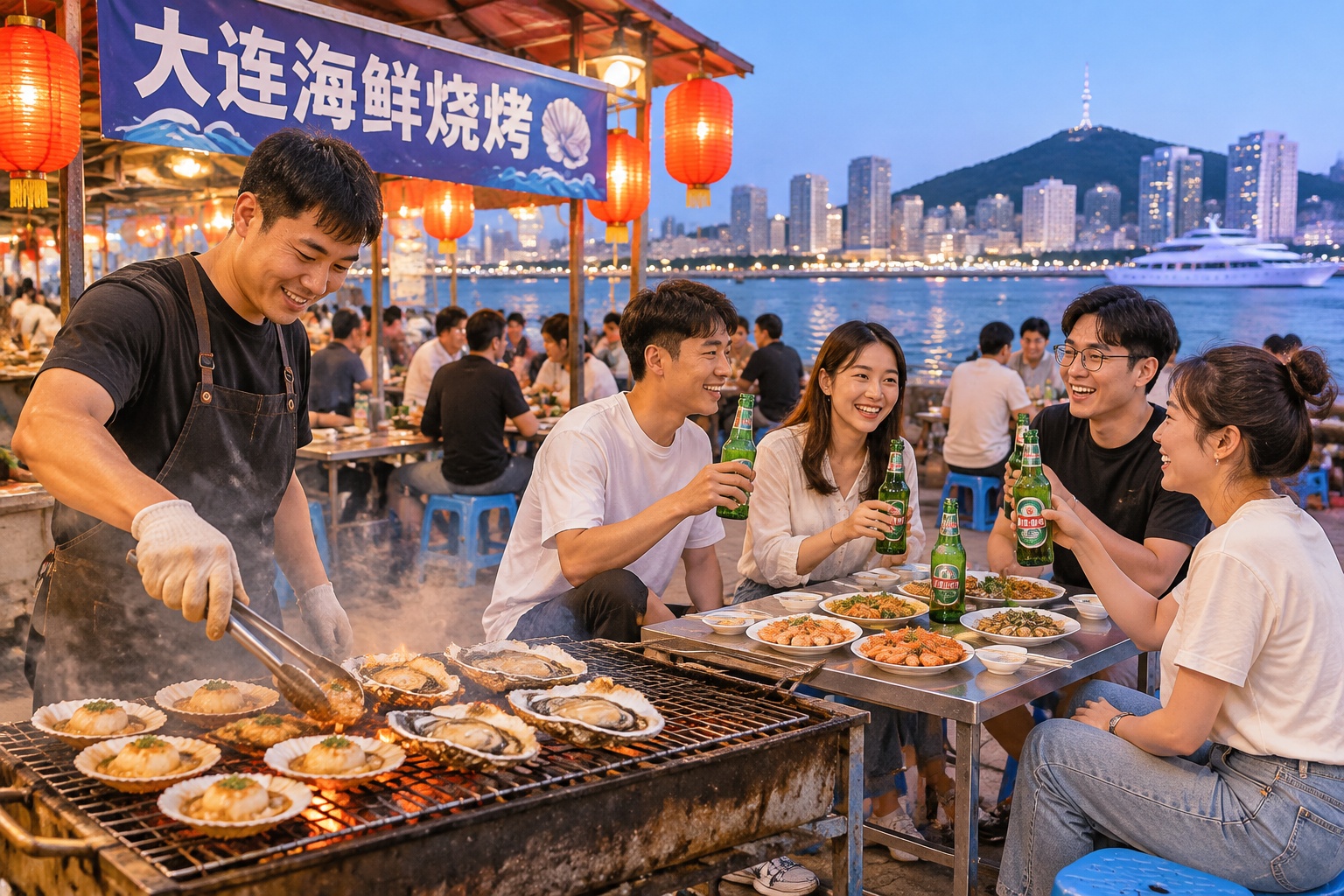

The Smell of Summer: Charcoal, Sea Breeze, and Laughter
At 7:30 PM on a Saturday in July, the air around the Heishijiao (Black Reef) beachfront in Dalian is thick with the smell of charcoal smoke, grilled squid, and the salt of the Yellow Sea. I walk past a row of makeshift stalls where families, university students, and office workers sit on low plastic stools around small folding tables. On each table sits a small charcoal grill—no bigger than a shoebox—piled with scallops, oysters, shrimp, and whole fish, all sizzling in garlic butter and chili oil.
A young woman in a summer dress, Ms. Li, tells me she comes here every Saturday after work. “It’s our way to decompress,” she says, fanning the flames with a paper plate. “We don’t need fancy restaurants. We just need good seafood, cold beer, and friends.” Her friend, a software engineer, grins as he flips a skewer of grilled squid. “This is the real Dalian nightlife.”
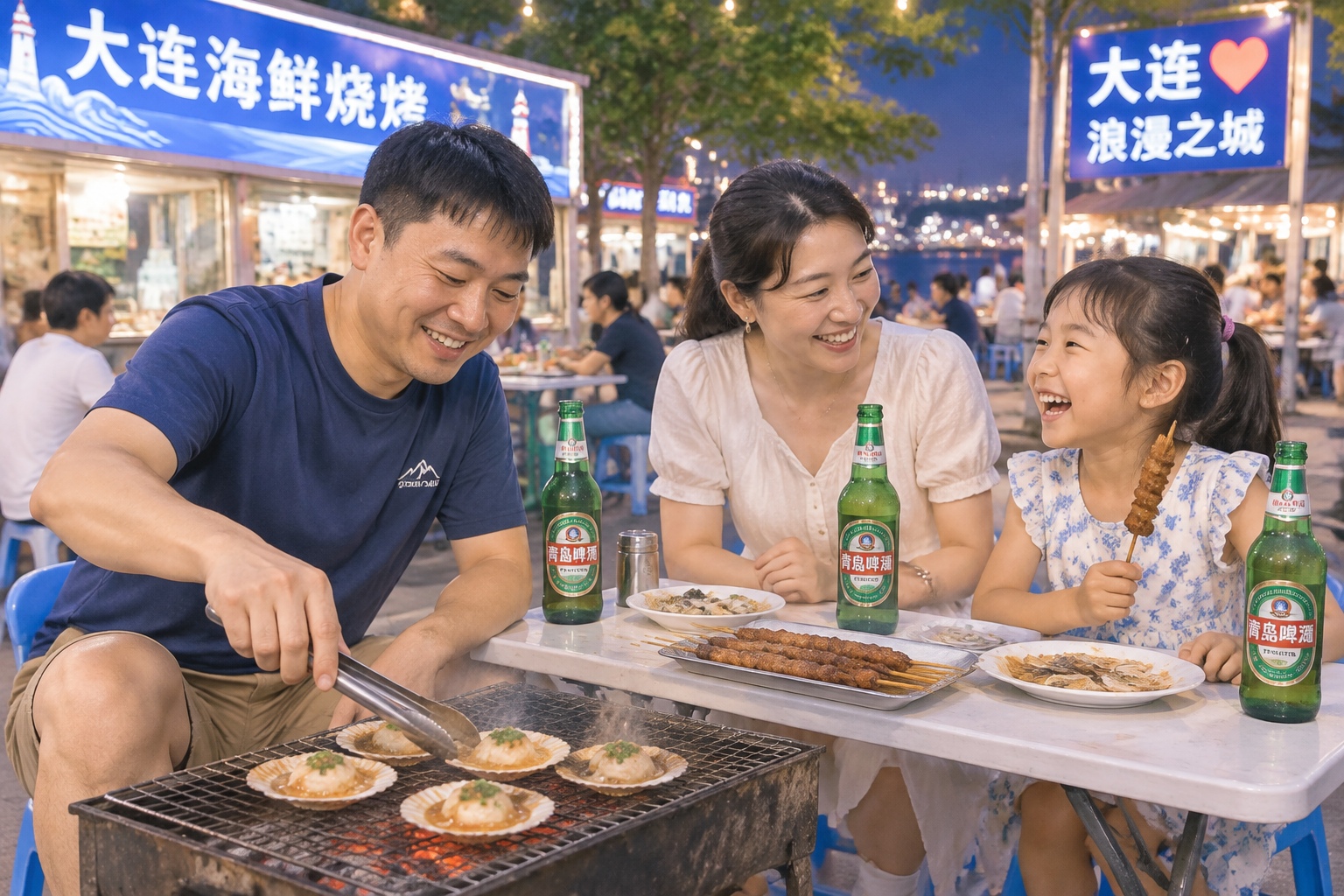
Why Seafood BBQ Is the Heart of Dalian’s Night Economy
Dalian, a coastal city at the southern tip of China’s Liaodong Peninsula, has long been known for its deep-water port and fishing industry. But in recent years, the city’s night economy (夜经济) has turned its seafood culture into a major driver of local life and tourism. The concept, promoted by Chinese cities to boost evening consumption, here takes on a distinctly local flavor: food stalls, open-air markets, and pedestrian streets that come alive after sunset.
According to the Dalian Municipal Bureau of Commerce, the city now boasts over 20 night market zones, many of which are centered around seafood BBQ. The most famous include Zhongshan Square Night Market, Xi’an Road Pedestrian Street, and the Fishing Port Night Bazaar in Ganjingzi District. Combined, these areas attract more than 100,000 visitors on a typical summer weekend night.
But the numbers only tell part of the story. For locals, seafood BBQ is not a tourist trap—it’s a daily ritual. “I’ve been grilling here for 15 years,” says Mr. Wang, a 52-year-old vendor who runs a stall called “Wang’s Fresh Catch” near the Xinghai Square. His face is permanently reddened by the heat of the coals. “In summer, I start at 4 PM and work until 2 AM. The best part is when regulars come back with their kids. They remember me from when they were single.”
What’s on the Grill: A Taste of Dalian’s Waters
The menu at a typical Dalian seafood BBQ stall is a lesson in local marine biodiversity. The most popular items are:
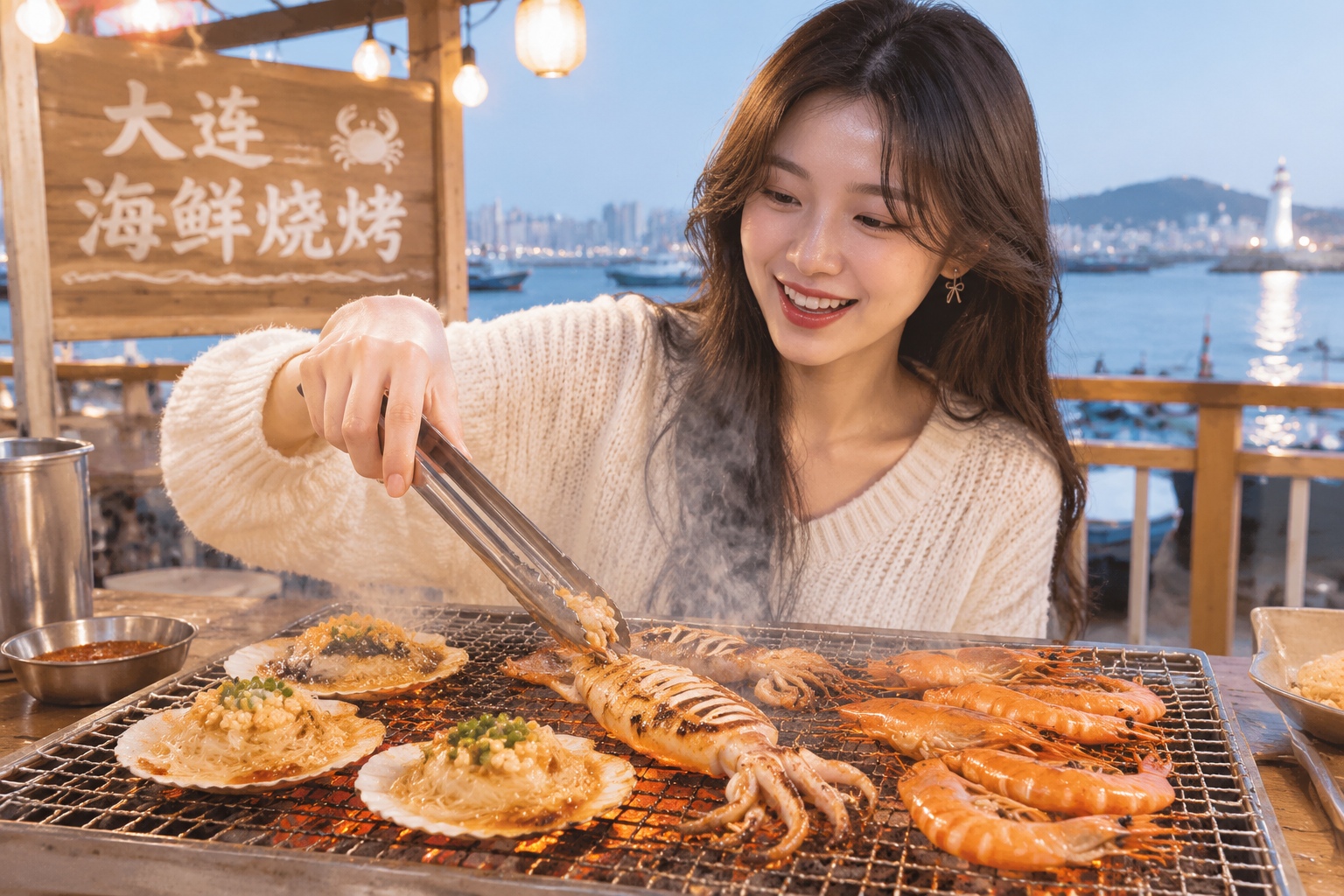
- Grilled scallops (烤扇贝, kǎo shànbèi) – large, fresh scallops cooked in their shells with minced garlic, vermicelli noodles, and a drizzle of soy sauce. The meat is sweet and tender, the garlic crust golden and crispy.
- Spicy grilled squid (辣烤鱿鱼, là kǎo yóuyú) – whole squid or skewers, basted with a spicy-sweet sauce and charred over the fire until the edges curl into crispy bits.
- Grilled oysters (烤生蚝, kǎo shēngháo) – similar to scallops but with a brinier, more mineral taste. Often served with a squeeze of lemon or a dab of wasabi.
- Grilled whole fish (烤鱼, kǎo yú) – local species like yellow croaker or flounder, seasoned with cumin, salt, and chili flakes, grilled until the skin is crackling and the flesh flakes apart.
- Grilled shrimp (烤大虾, kǎo dàxiā) – jumbo prawns, shell-on, salt-grilled or butter-garlic style.
Each stall has its own secret marinade—a blend of soy sauce, oyster sauce, garlic, and Chinese five-spice that is passed down through families. “The key is the freshness of the seafood,” says Mr. Wang. “I buy from the fishing port every morning. If it’s not fresh, no amount of sauce will save it.”
And no meal is complete without a bottle of cold Dalian beer (Dalian Beer, a local lager) or a glass of baijiu (distilled grain liquor) for those who prefer stronger flavors. The combination of cold beer and hot, spicy seafood is a sensory experience that keeps people coming back night after night.
Night Economy: More Than Just Food
Dalian’s night economy extends beyond the BBQ stalls. The city has invested in transforming its waterfront areas into pedestrian-friendly zones with live music, street performances, and pop-up art markets. The Dalian International Beer Festival, held every August near the coast, draws hundreds of thousands of visitors from across China and abroad. But the everyday nightlife is less about spectacle and more about community.
After dinner, families often stroll along the Binhai Road (Coastal Road), a 40-kilometer scenic route that hugs the cliffs and offers panoramic views of the sea. Young couples rent tandem bicycles. Children play with glow sticks. Retired men set up portable chess tables on the sidewalk. In the summer, the city’s public squares—like Xinghai Square, one of the largest city squares in the world—turn into open-air gathering spots where people fly kites, dance in groups, or simply sit on the steps and watch the crowds.
This kind of public life is not accidental. In 2023, the Dalian municipal government launched a “Night Dalian” action plan to upgrade infrastructure, extend public transport hours, and relax street vending regulations. The goal was to create a safe, vibrant, and accessible night environment. According to local media, police patrols are increased, and hygiene inspections are carried out regularly to ensure food safety. The result is a nightlife that feels both lively and orderly.
“Before, the night market was a bit chaotic,” recalls a taxi driver, Mr. Chen, who has lived in Dalian for 30 years. “Now, there are designated zones, portable toilets, and trash bins everywhere. It’s cleaner, but still has that rough edge.” He points to a stall selling grilled skewers. “That’s the charm. It’s not too polished. It’s real.”
How Ordinary People Feel the Changes
For many locals, the rise of the night economy has meant new opportunities. Ms. Zhang, a 28-year-old former factory worker, now runs a small grilled scallop stall at the Donggang Night Market. She learned the technique from her mother-in-law and started three years ago. “I used to work 12 hours in a factory for 3,000 yuan a month,” she says while deftly flipping scallops. “Now, I can earn 8,000 to 10,000 yuan in a good summer month. And I’m my own boss.”
On the customer side, rising disposable incomes have made eating out more common. A meal for two at a seafood BBQ stall typically costs between 80 and 150 yuan (about USD 11–21), making it affordable for most urban workers. “It’s not a luxury,” says Mr. Li, a 35-year-old accountant. “It’s just a normal part of summer. My wife and I come here two or three times a week.”
Yet, not everything is perfect. Some residents complain about noise and smoke from the stalls, especially those located near apartment buildings. The city has tried to address this by moving the most popular night markets to designated areas away from residential zones. There is also a growing awareness of overfishing, with some environmental groups calling for more sustainable seafood choices. But for now, the overwhelming sentiment among Dalian residents is pride in their culinary heritage and the social life it supports.
Conclusion: A Summer Night in Dalian, Through One Plate of Scallops
If you visit Dalian in July, find a seat at the Fisherman’s Wharf night market. Order a plate of grilled scallops, a cold beer, and just sit. Watch the families, the couples, the old friends reunited. Listen to the hiss of the grill, the clink of beer bottles, the laughter that rises above the traffic. In that moment, you’ll understand why this city comes alive after dark—not because of any government policy or marketing campaign, but because of a simple, ancient pleasure: sharing good food with people you care about, under the stars.
That is the true engine of Dalian’s night economy. It’s not the statistics. It’s the smell of the sea and the garlic, the warmth of the coals on a cool evening, and the feeling that, for a few hours, the only thing that matters is the next bite.
Start the discussion at forum.chinacomes.com