
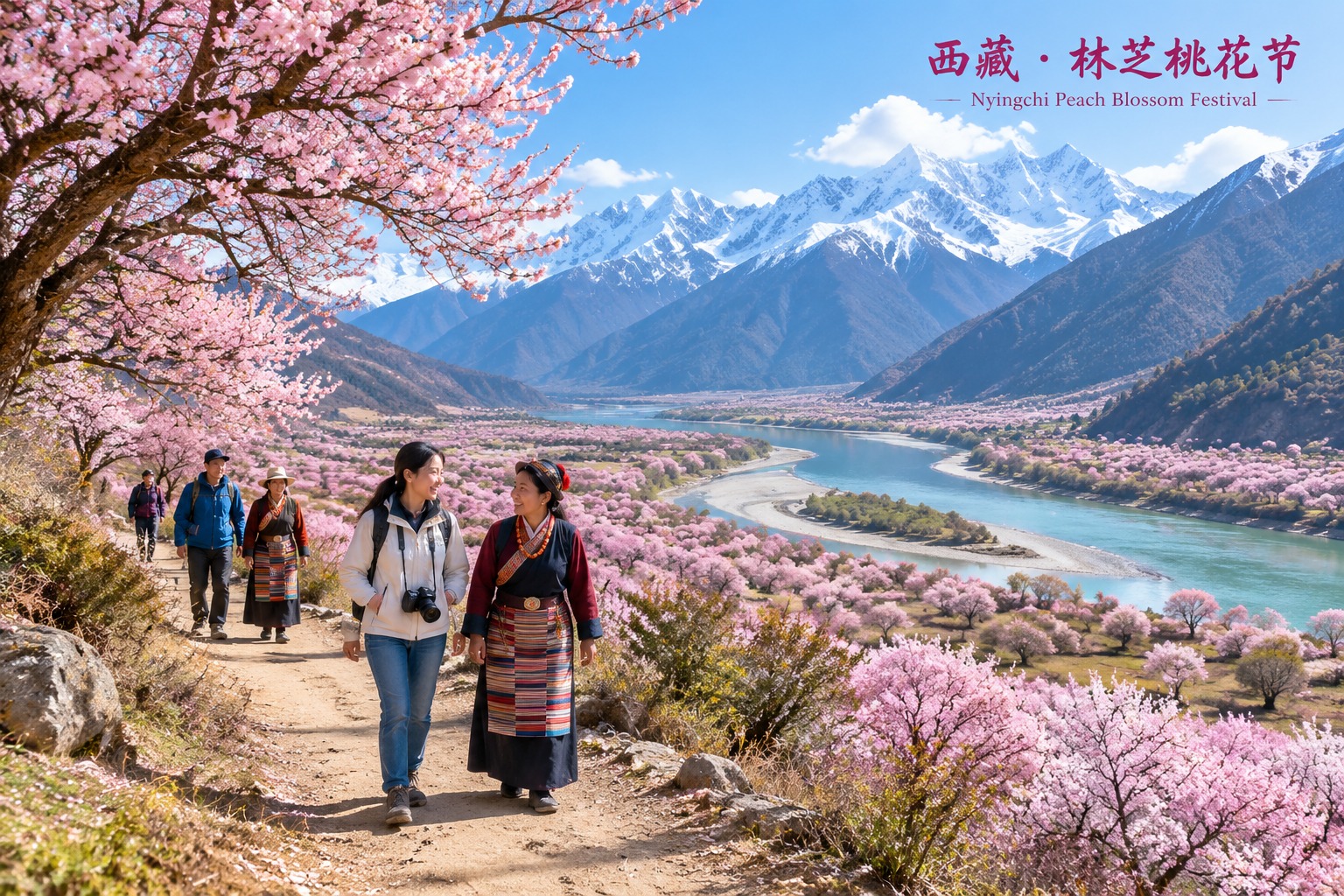

The first thing you notice in Nyingchi in late March is the color. Not the sterile white of snow mountains, but a soft, overwhelming pink that covers the slopes like a slow wave. The Yarlung Tsangpo River cuts through the valley, and along its banks, thousand-year-old peach trees stretch their branches over the water. Tourists from Beijing, Shanghai, and Chengdu step off buses, phones raised, trying to capture a scene that seems almost too perfect.
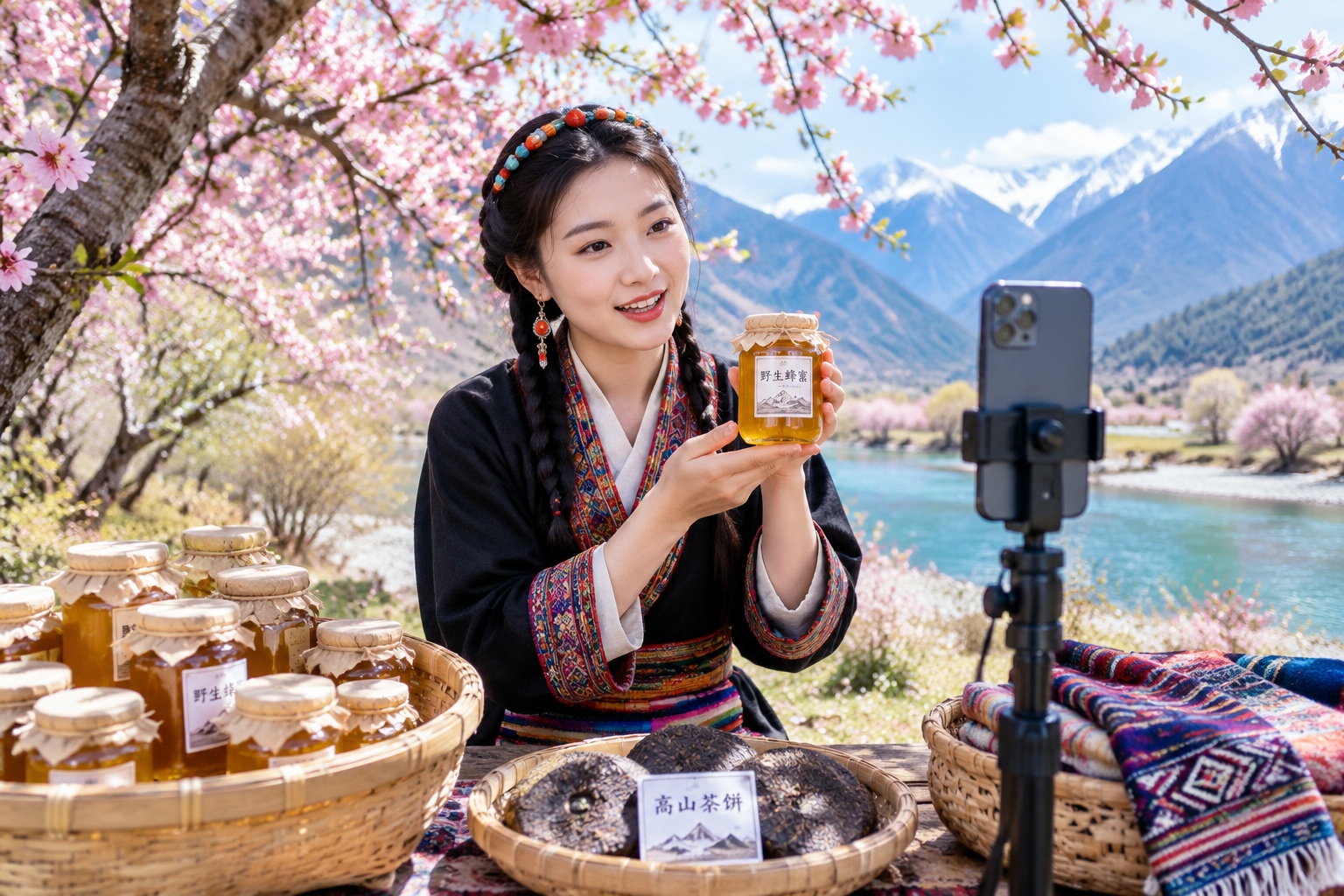
But this is not a painting. It is a workday for many local people, including a 26-year-old Monba woman named Yudron. I met her on a sunny afternoon beside the river, under a canopy of blossoms. She was balancing a smartphone on a small tripod, adjusting the light, and talking calmly to a live audience that would soon reach over 1,500 viewers.
A Valley Turned Pink
Nyingchi lies in the southeastern corner of the Tibet Autonomous Region, lower and wetter than the high plateau of Lhasa or Mount Everest. Its elevation around 2,800 to 3,200 meters gives it a mild climate, dense forests, and a nickname: “the Switzerland of Tibet.” Wild peach trees grow naturally here, some said to be hundreds of years old. Every spring, from late March to mid-April, they turn the entire valley into a giant garden.
The Nyingchi Peach Blossom Festival, launched in 2002, has grown into one of China’s most famous spring events. In normal years, it attracts hundreds of thousands of domestic tourists. Local authorities close some roads for pedestrian trails, organize concerts and photography competitions, and encourage villagers to turn their homes into guesthouses. It is a major economic boost for an area that historically relied on agriculture and logging.
But the flowers fade in about three weeks. The festival ends, the tourists leave, and the valley slips back into quiet. For decades, that was the rhythm of life. But now, a new wave of young people like Yudron are trying to change the rhythm—not by leaving, but by using their phones to sell the valley itself, even when the petals are gone.
Meeting Yudron, a Monba Girl with a Dream
Yudron belongs to the Monba (门巴) ethnic group, one of China’s smallest minority communities. Fewer than 10,000 Monba people live in the country, mostly in the forested regions of Mêdog and Nyingchi. For centuries, they were isolated by steep mountains and dense jungle. They developed a distinct culture: homes built from bamboo and wood, clothing woven from nettle fiber, and a deep knowledge of wild herbs and honey.
When Yudron left for college in Lhasa, she studied tourism management. But instead of finding a job in the capital, she moved back home after graduation. “At first my parents thought I was crazy,” she said with a laugh. “We have no paved road to the village. The courier only comes every two weeks. How can you sell anything online?”
But she had a plan. First, she used her savings and a small government loan to buy a smartphone with a good camera, a ring light, and a solar charger. Then she spent six months learning how to shoot and edit short videos by watching free tutorials on the same apps she wanted to master. She practiced on her mother’s weaving and her father’s honey jars, repeating takes until the light and angle felt right.
Her breakthrough came two years ago, when she posted a short video of the peach blossoms framing her mother’s hands as they worked a loom. The video was shared widely in China; people wrote comments asking where they could buy the cloth. Yudron realized that the festival was not just about landscapes—it was a potential launchpad for a genuine online brand.
By the time I met her, she had a live-stream routine that was deceptively simple. She picks a spot with the most striking blossom backdrop, sets up her phone, and starts talking. She shows the river, the mountains, the wild bees flying around the hives. She answers questions about taste and shipping. Every few minutes, she brings out a product: wild honey in glass jars, dark compressed tea cakes, hand-woven bookmarks, and wool socks dyed with plant colors.
Her viewers are a mix of urban professionals and curious consumers from all over China. Some have never heard of the Monba people; others are returning customers who trust the quality. Yudron carefully lists the batch number of each honey jar, so buyers can trace which mountain slope it came from. She also explains that the honey is not pasteurized and may look cloudy—a natural sign of raw honey.
E-Commerce in the Margins
Live-stream shopping is a massive force in China. In 2023, the country’s live-stream e-commerce market reached over 4.5 trillion yuan (about $620 billion), with millions of sellers using platforms like Douyin, Taobao Live, and Kuaishou to reach consumers. But most of those sellers are in cities. In remote regions like Nyingchi, the infrastructure is thinner, and the skills are just beginning to emerge.
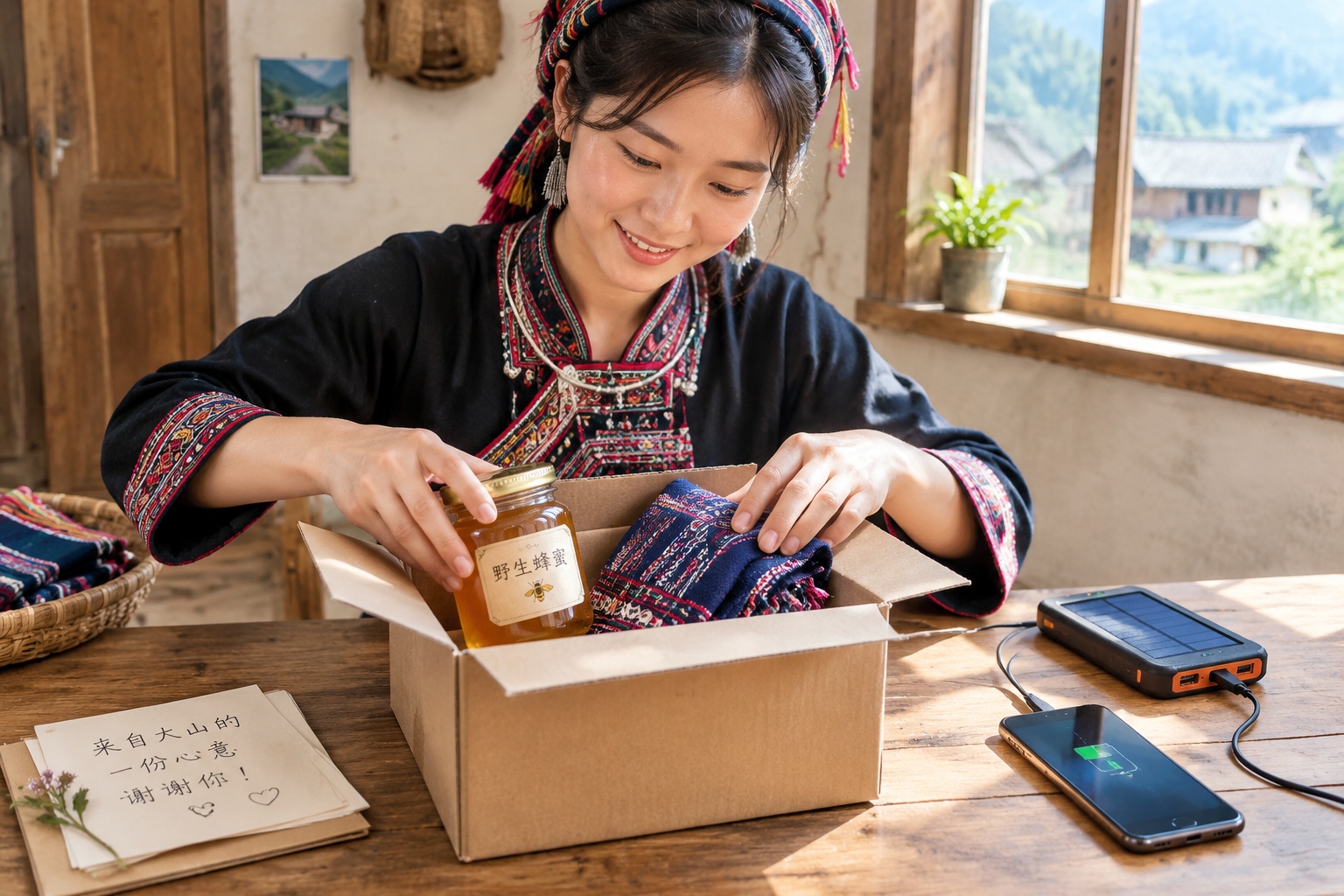
For Yudron, the greatest challenge is logistics. The nearest town with reliable courier service is more than two hours away by car. During the festival, she collects orders throughout the day, then drives to a small logistics station in the county town before it closes at 6 p.m. Honey is heavy and fragile; packaging must be strong. Shipping costs can eat into profits, especially for small items like tea and weavings. She estimates that out of every 1,000 yuan she earns, about 200 goes to shipping and packaging.
Still, the online business has more than doubled her family’s income. During the festival month, she can earn up to 8,000 yuan—a significant amount for a rural Monba household. More importantly, the orders continue even after the blossoms fade, because many customers return for her products. The festival becomes a gateway, not the whole destination.
A Sustainable Future, Rooted in Tradition
Yudron is careful not to let her success damage the environment that supports it. She refuses to sell more honey than the bees naturally produce, even when demand is high. She asks her father to limit how many wild hives they collect from, leaving enough for regeneration. She also uses recyclable packaging and writes a note by hand for every order—a personal touch that she believes distinguishes her from larger sellers.
“The peach forest is not empty scenery,” she said, gesturing to the branches above us. “It is the home of our honeybees, the shade for our tea trees, and the reason tourists come. If we want to live here for another generation, we have to love it in practice, not just in our words.”
Her approach is aligning with a broader trend in Tibet. The regional government has been promoting “ecological civilization” and green development, encouraging income projects that do not harm the fragile highland environment. In Nyingchi, solar panels are increasingly common on the roofs of farmhouses, and electric scooters are slowly replacing gasoline motorcycles on village paths. Yudron’s solar charger is a small symbol of this shift—she can stream for hours without drawing on the power grid, which is still weak in her area.
Her success is also inspiring other young Monba. Two cousins have started their own live-stream channels, focusing on mushroom picking and handmade soap. The county government runs a weekly e-commerce workshop, teaching basic video editing and online sales. On a weekend in March, the workshop had more participants than chairs; dozens of young people stood by the door, phones in hand.
How to See the Festival
If this story makes you want to see the pink valley for yourself, here is what you should know. The festival usually runs from around March 20 to April 15, with peak bloom varying by altitude. The classic viewpoints are near Gangtok Monastery, the Drakar Village terraces, and the river bends around Pai Township (派镇). The best time is the mid-week when tour buses are fewer, and early morning offers the softest light.
Getting there is easier than you might expect: Nyingchi Mainling Airport receives daily flights from Chengdu and Xi’an, and the Lhasa-Nyingchi railway took its first trains in June 2021. Once in Nyingchi, you can hire a car or join a tour group; many villagers now rent out rooms in their guesthouses, which include family meals and a chance to try Monba steamed buns and locally grown buckwheat noodles.
But when you stand among the blossoms, remember that you are not just looking at nature. You are looking at a living economy. The girl with the phone tripod might be a grandmother who used to gather firewood, or a twenty-something who studied in the capital and chose to return. The colors you see are not static; they are the backdrop for a generation trying to build a digital bridge across some of the most rugged land on Earth.
As the sun began to slide behind the glacier peak, Yudron wrapped up her live stream with a Monba farewell song. The camera panned slowly to the river, and then she signed off. She had sold all of that day’s honey and had a stack of orders she needed to pack before nightfall. She smiled, tucked her solar charger into a hand-woven bag, and walked back to the village.
I watched her go, and I remembered something she said earlier: “People think the flowers last only three weeks, but the seeds they plant in memories last much longer.” For Yudron, the seeds are real, and they grow into business, hope, and a future that she is choosing to build in the mountains she calls home.
Start the discussion at forum.chinacomes.com