

Introduction
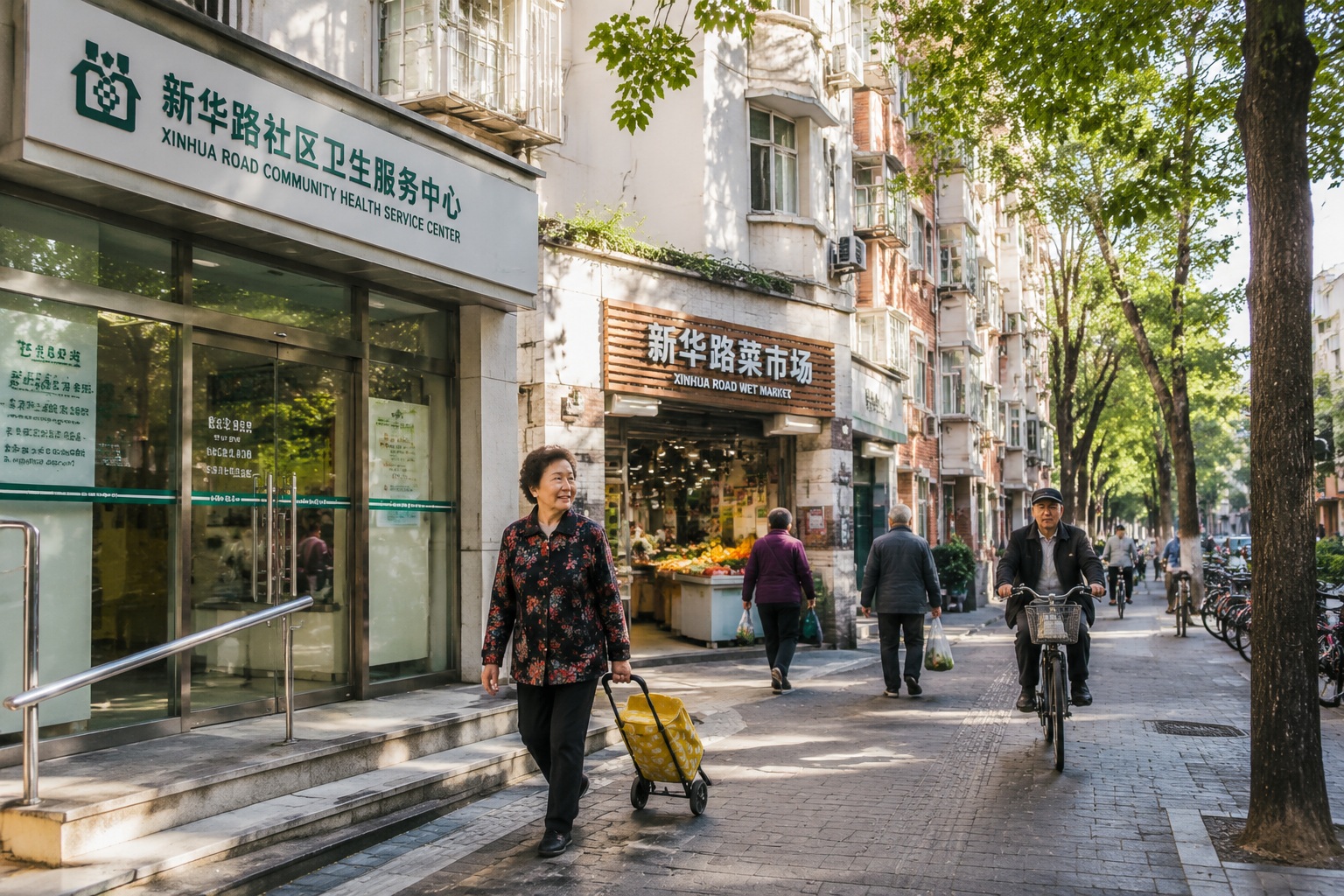
At 7 a.m., Grandma Chen pulls a small yellow shopping cart through the gate of her apartment complex in Xinhua Road, a leafy residential area in Shanghai’s Changning District. She walks five minutes to the wet market, buys a bunch of bok choy and a piece of tofu. Then she stops by the neighborhood health station to pick up her blood pressure medicine. By 8 a.m., she is home. The whole trip takes less than an hour and never requires crossing a busy road.
For Chen, this is just ordinary life. But for urban planners around the world, it is a textbook case of the “15-minute city.” That concept, popularized by French urbanist Carlos Moreno, says that every resident should be able to reach most daily necessities—work, groceries, healthcare, education, and leisure—within a 15-minute walk or bicycle ride from home. It promises fewer carbon emissions, less wasted time, and a stronger sense of community.
In Shanghai, this idea went from academic theory to official policy years ago. The city government calls it the “15-minute community life circle.” It’s not a single grand project, but a quiet transformation taking place across thousands of neighborhoods. Today, it is less a planner’s slogan and more a daily reality for millions of people.
What Is a 15-Minute City?
In 2016, Shanghai surprised many urbanists by publishing a planning guideline for “15-minute community life circles.” That was before the phrase became a global buzzword in the wake of the pandemic. The idea is simple: each residential neighborhood should have not just homes, but also a mix of services, public spaces, and workplace opportunities. A resident should be able to find everything from a bank to a barber shop within about a kilometer of their door.
What makes Shanghai’s approach stand out is not the concept itself—many cities have similar ideas—but the scale and the machinery behind it. In Shanghai, the community life circle is not left to chance. District governments identify service gaps, find space, and fund projects. Neighborhood committees collect resident opinions. The result is a dense network of everyday places that makes the 15-minute promise feel real.
Inside a “Life Circle”
Take the Xinhua Road area as an example. This is not a shiny new district. It was built in the 1950s, and many apartment blocks are aging. Yet in recent years, it has become a laboratory for how to retrofit a 15-minute city into a mature urban fabric.
The Wet Market
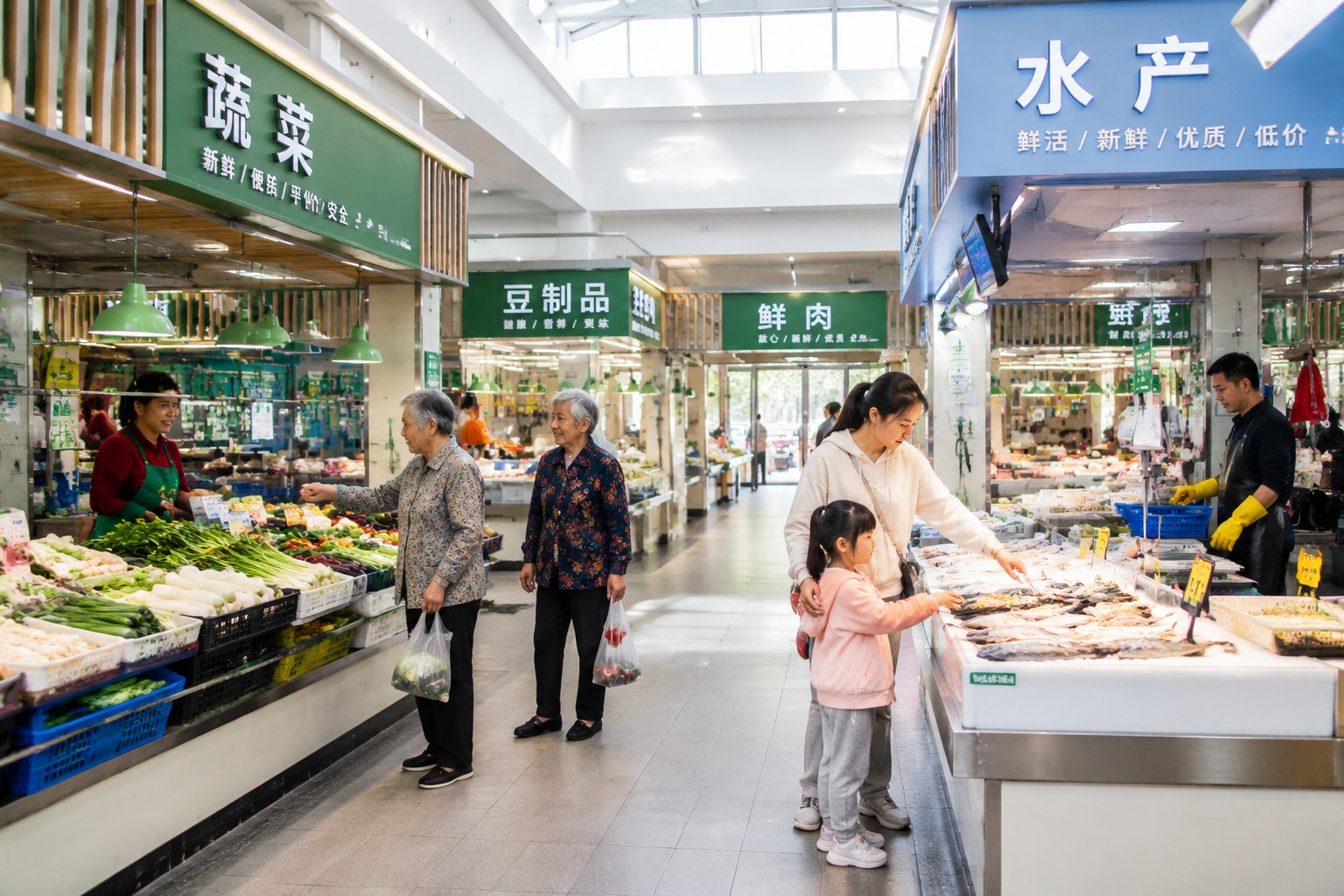
The neighborhood wet market used to be a temporary open-air space, noisy and cramped. After renovation, it is now a clean, well-lit building. Vendors sell fresh produce, meat, seafood, spices, and even ready-made snacks. Upstairs, there is a community canteen where retirees can get a hot meal for less than ten yuan (about 1.20 euros). On any workday, you will see elderly people playing chess at the tables outside.
The Health Station
Just across the street, a community health station has become an anchor. It does not do major surgery, but it handles common illnesses, vaccines, chronic disease management, and traditional Chinese medicine. For many seniors, this is far more convenient than a big hospital. They can walk over, talk to a doctor who knows their history, and pick up prescriptions without a long bus ride. In a city with a rapidly aging population, this quiet service matters.
School and Kids
The local primary school is within walking distance for most families. In the past, streets around the school were often clogged with cars. Now, nearby roads have wider sidewalks, raised crosswalks, and slower car traffic. Many parents say they feel more comfortable letting their children walk to class alone. After school, the community library and a children’s playroom offer a safe place to wait for working parents.
Street Redesign: Making Walking Attractive
A 15-minute city is not just about putting shops near homes. It’s about making streets feel safe and pleasant enough that people choose to walk or bike. That requires hard choices about road space.
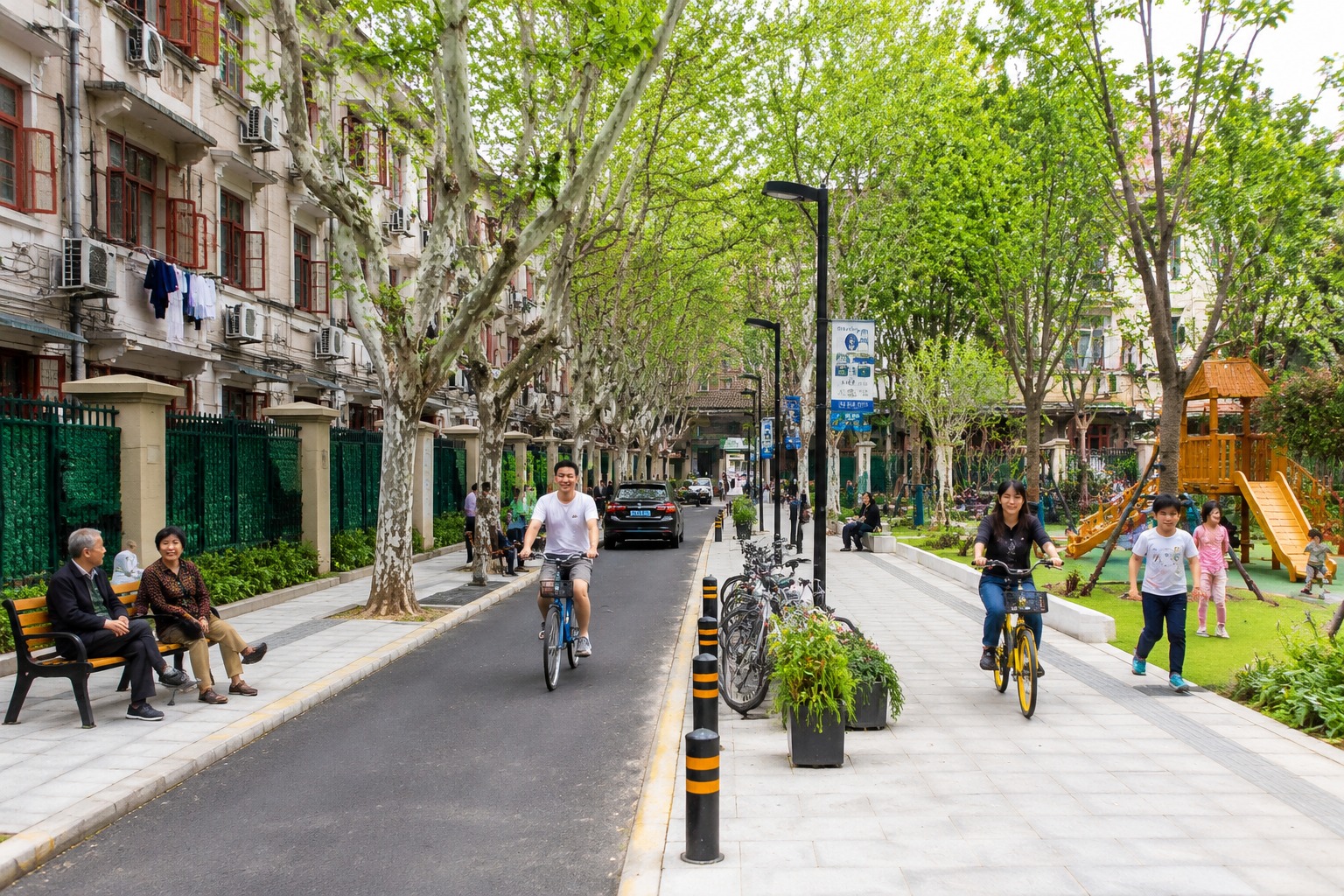
In Xinhua Road, planners gradually narrowed motor vehicle lanes and removed some parking spots. Benches, bike racks, and small gardens took their place. A few streets have become “slow priority” zones, where cars must yield to pedestrians. The neighborhood feels calmer. Even on a weekday afternoon, you will see cyclists and walkers, not just parked cars.
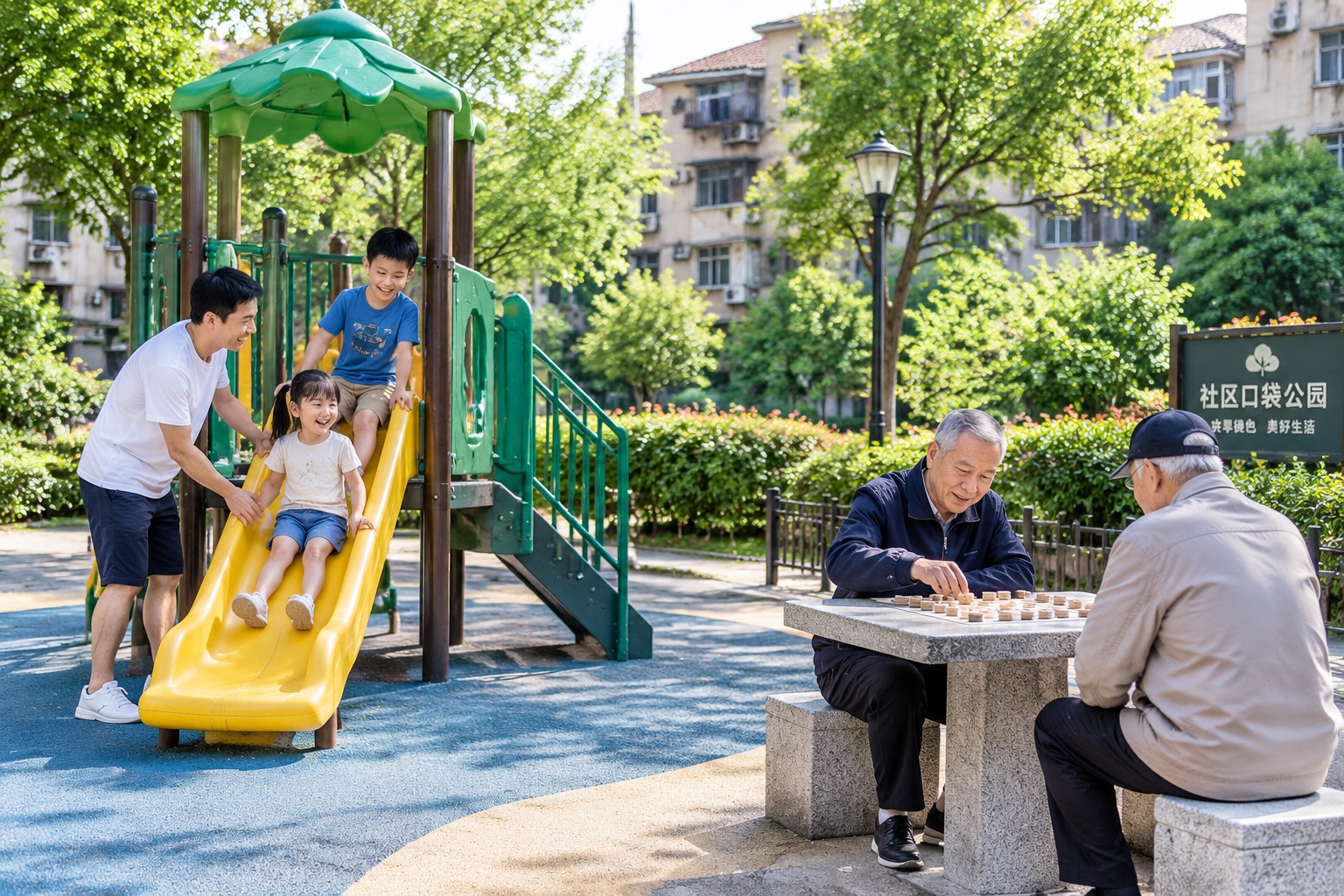
Shanghai has been doing this across the city. Thousands of roadside parking spaces have been removed in central districts. Old concrete walls around residential compounds are being opened up. The official “Beautiful Homes” programme encourages communities to turn private lawns into public pocket parks. Today, Shanghai has more than 400 pocket parks, and the number is still growing.
None of this happened overnight. It is the result of years of incremental change. But taken together, the effect is significant. Walking and cycling in central Shanghai have become noticeably more comfortable. In some districts, non-car trips now account for more than half of all daily movements.
A Resident’s View: Convenience Changes Habits
What does this mean for ordinary people? I spoke with Wang Lei, a 38-year-old father of two who moved to Xinhua Road two years ago. “Before, our weekend routine was: drive to a shopping mall, park, shop, eat, drive home,” he told me. “Now, we often just walk out to the market or the park. The kids play while I grab a coffee at the corner café. We don’t need to plan our weekends anymore.”
His wife, a school teacher, uses the community gym three times a week. “It’s small, but it has everything I need. I don’t want to spend an hour commuting to a big fitness club.”
Wang also remembers a night when his son had a fever. “We walked to the health station and saw a doctor in 20 minutes. In a big city, that’s incredibly convenient.”
Of course, not everyone is happy. Some drivers complain about slower traffic. A small shop owner told me that the street restrictions made it harder for delivery trucks, forcing him to change his business model. There are trade-offs, and not all are positive. But for many residents, the benefits are visible in daily life.
Is Shanghai’s Model Replicable?
Could this work in other countries? The answer depends on local conditions. In sprawling North American suburbs, it is much harder because density is low. But in high-density cities, the 15-minute city is almost natural. When many people live close together, shops and clinics can thrive within walking distance. Chinese cities like Beijing, Chengdu, and Hangzhou are already borrowing Shanghai’s idea.
What makes Shanghai special, though, is the government’s ability to coordinate. Community life circles are planned from the top down, with district-level budgets and clear goals. Land acquisition and funding are easier when the state controls much of the real estate landscape. The trade-off is that top-down planning can sometimes ignore local needs. Shanghai has tried to fix that by asking residents to vote on which facilities to add. In one district, people chose a children’s playground over a parking garage. It’s not perfect democracy, but it is a sign that planning is slowly becoming more responsive.
There are also limits. Land is extremely expensive, and not every neighborhood has space for a gym or a park. The model works best in residential areas, not in industrial zones or new towns still under construction. And for the millions of workers who commute to the city center, the 15-minute city doesn’t reduce their commute. That is a bigger problem that no city has fully solved.
Conclusion
The 15-minute city in Shanghai is not a utopian fantasy. It is an everyday experience: a grandmother buying fresh vegetables, a father taking his kids to a pocket park, a young office worker getting a health check-up during lunch. All of this happens within minutes of home.
Shanghai has turned a global idea into a municipal policy, and then into real places. It is not perfect, and it is still evolving. But it offers a useful lesson: the future city is not always about flying cars or giant skyscrapers. Sometimes it is simply about making the walk to the market as pleasant as possible.
Start the discussion at forum.chinacomes.com