
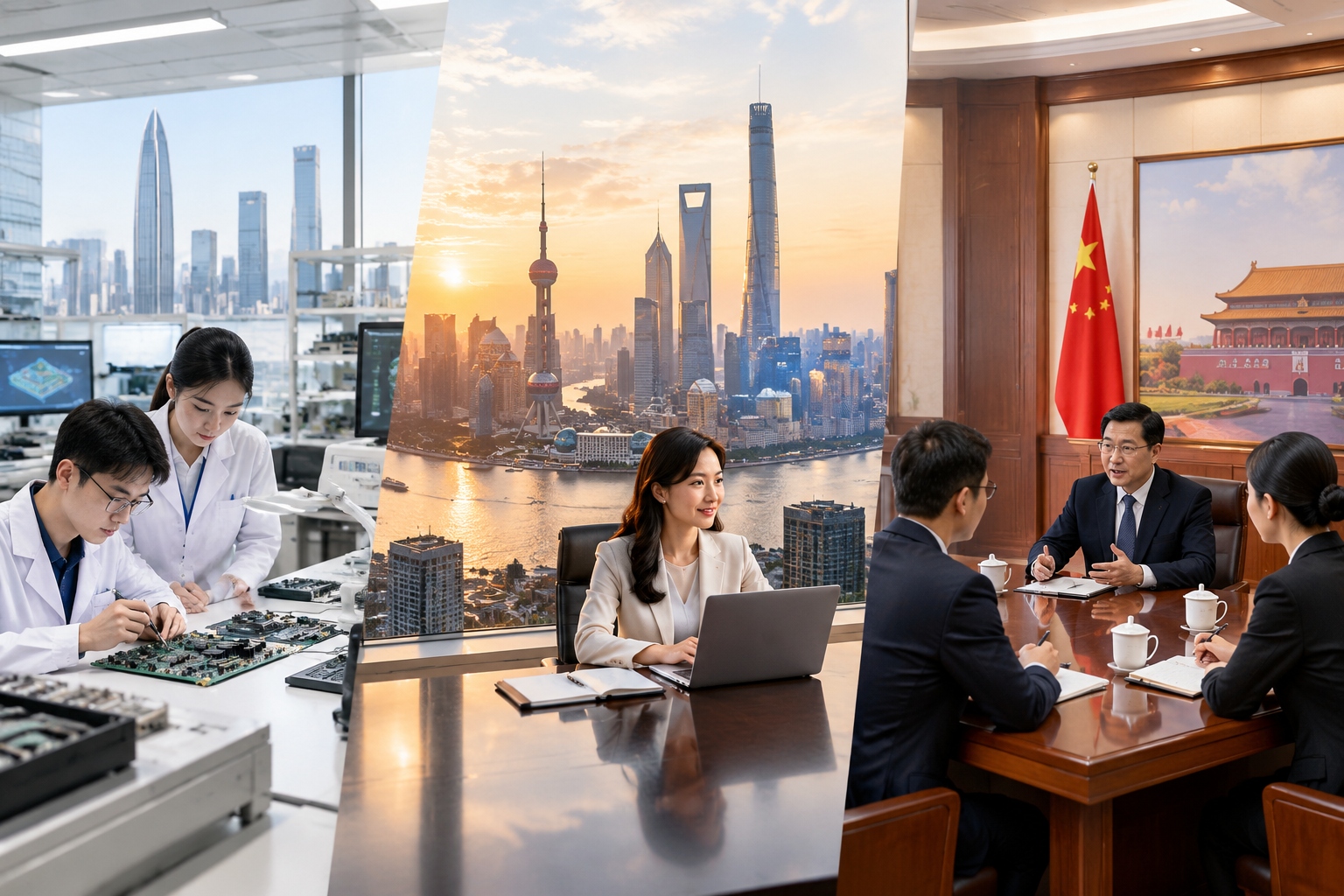

Which Chinese City Should Be Your First Base?
Imagine a mid-sized German sensor manufacturer that has finally set its eyes on China. The founder spends two days in Beijing meeting potential state customers, flies to Shanghai for an investor lunch, then takes the high-speed rail to Shenzhen for a two-day factory visit. The itinerary sounds like a typical first trip to China. But the question it raises is one that many foreign companies underestimate: where should you actually set up your China entity? Beijing, Shanghai, and Shenzhen are not interchangeable versions of the same market. They have different companies, different regulators, different consumer bases, and different costs of doing business.
This article is a decision guide for founders and executives who want to stop guessing and start comparing. We will look at what each city does best, what industries they naturally attract, and the practical trade-offs you need to examine before signing an office lease.
Shenzhen: The Hardware and Prototyping Capital
Shenzhen sits directly north of Hong Kong in the Pearl River Delta, one of the densest manufacturing grids in the world. For decades it was known as a city of assembly lines, but after 2010 it deliberately moved up the value chain. Today, Shenzhen is the center of China’s consumer electronics, drone, robotics, and electric vehicle supply chains.
The advantage here is speed and density. Inside a 40-minute drive from the city center, a product developer can find an aluminum case workshop, a PCB fab, a battery pack developer, and an industrial design studio. Components from capacitors to AI camera modules are sold by the thousands in Huaqiangbei, the electronics district whose market stalls function like a live search engine for parts. Foreign hardware founders often notice that their product cycle in Europe or the US takes two weeks for a new prototype; in Shenzhen, it can take two days.
Shenzhen’s municipal government is described by many expat founders as pragmatic and efficient. Companies in designated high-tech parks can access rent subsidies, tax rebates for R&D, and faster property and visa processing. Grade-A office space costs less than in Beijing or Shanghai, and the average age of the city’s workforce is younger. The trade-off is that Shenzhen has fewer deep-tech research labs and less of a relationship-driven political culture than Beijing. If your product is more algorithmic than physical, you may find that Shanghai or Beijing is a better match.
Best for: hardware, consumer electronics, IoT devices, intelligent manufacturing, EV components, and fast-moving industrial innovation.

Shanghai: The Financial and Consumer Gateway
Shanghai is China’s largest city and the financial capital. It contains the country’s biggest stock exchange, the most foreign bank branches, and the highest number of regional headquarters for global multinationals. For companies in fintech, asset management, insurance, and other regulated financial services, Shanghai is the clear first choice. The Shanghai Free Trade Zone also simplifies cross-border fund flows and allows foreign-owned financial institutions to launch with fewer joint-venture requirements.
Beyond finance, Shanghai is the most powerful consumer-marketing city in China. International retail and luxury brands use Shanghai as a test bed for new products. The city’s middle and upper classes have high purchasing power, and its media, creative, and influencer ecosystems make it the place where national trends are set. It is also China’s most livable city for expats and their families, with English-friendly services, international schools, and a dense social calendar.
The biggest downside is cost. Office rents and expat housing in central Shanghai are among the highest in Asia. Professional talent is deep but salaries reflect the competition. Still, for many service and consumer businesses, the higher overhead pays off in faster access to clients and investors.
Best for: fintech, asset management, private banking, high-end retail, consumer packaged goods, healthcare, professional services, and companies looking to raise capital from international investors.

Beijing: The Policy and Research Powerhouse
Beijing is China’s political and administrative center. The central government ministries, major state-owned companies, and industry regulators are based here. If your business requires licenses, tends to public procurement, or depends on national standards, being located in Beijing gives you the chance to build personal relationships with the people who shape the rules.
Beijing is also the strongest R&D and academic center in the country. Tsinghua, Peking, Beihang and other top universities feed a deep talent pool of AI engineers, data scientists, and biomedical researchers. ByteDance, Baidu, and dozens of AI unicorns have headquarters in Beijing because of this density. For foreign technology companies, Beijing often works better than Shanghai for research partnerships with universities and government-backed innovation parks such as Zhongguancun.
The regulatory environment in Beijing is more complex. A heavier bureaucratic footprint means more permits and slower processes for some types of foreign investment. Costs for office space, travel, and housing are close to Shanghai without the same level of international lifestyle. On the other hand, you get quicker access to policy intelligence and the earliest signals of sector changes.
Best for: AI, big data, cybersecurity, biotech and pharma with regulatory exposure, government-supported projects, new energy policy research, and China headquarters for companies with a large state-owned enterprise customer base.

How to Match Your Industry with the Right City
Your industry should guide the choice, but you can also think about the stage of your company. A hardware startup at prototype stage should go to Shenzhen. A growth-stage fintech looking for license and regional partnerships should be in Shanghai. An AI company that expects to work with national industrial parks and ministries will need a Beijing presence.
- Supply-chain and hardware companies: Shenzhen first, but look at Dongguan and the rest of the Greater Bay Area for factories.
- Financial services and wealth managers: Shanghai. The infrastructure and regulatory familiarity are unmatched.
- Government-facing software and policy-sensitive tech: Beijing. Your sales cycle may require a local team near key decision-makers.
- Consumer brands and retail: Shanghai for market research and brand kickoff, with a second operational hub in Guangzhou or Shenzhen for southern China.
- Biotech and medical devices: Beijing for research partnerships; Shanghai for clinical trials and later commercialization through the free-trade zone or Zhangjiang Hi-Tech Park.
- Renewable energy and EV supply chain: Shenzhen and surrounding Pearl River Delta cities for production, with the possibility of a Shanghai office for global capital and shipping.
Also consider your team’s lifestyle. If your senior recruits are international professionals with partners who want a cosmopolitan environment, Shanghai has an advantage. If your company hires mostly Chinese engineers from across the country, Shenzhen and Beijing offer different kinds of attractions—Shenzhen’s warm climate and innovative energy versus Beijing’s academic and cultural prestige.
Comparing the Three: Costs, Talent, and Red Tape
To make this comparison more concrete, here are a few key factors:
| Factor | Shenzhen | Shanghai | Beijing |
|---|---|---|---|
| Core strength | Hardware supply chain | Finance / consumer market | Policy / R&D |
| Office cost (Grade-A) | Low to medium | High | High |
| Expat friendliness | Good | Excellent | Medium |
| Top-tier university talent | Medium (many imported) | High | Very high |
| Government relationships | Pragmatic local | Standardized | Critical and deep |
| Typical visa/work permit speed | Fast | Fast | Moderate |

Note that these are general patterns, not fixed rules. Shenzhen, for example, has been building universities at a rapid pace, while Shanghai has launched a more aggressive AI policy in recent years. Your specific district, industrial park, and company profile all matter.
First Steps and Official Channels
After you have shortlisted a city, reach out to the official investment promotion body before hiring any local consultant. Their services are usually free and often include introductions to suitable industrial parks.
For Shenzhen, contact the Shenzhen Investment Promotion Bureau. In Shanghai, look for the Shanghai Foreign Investment Promotion Center. In Beijing, the Beijing Investment Promotion Service Center provides advisory support. For national-level policy frameworks, check the official website of China’s Ministry of Commerce here.
It is always a good idea to spend a week visiting each candidate city, especially in the areas where you plan to set up. Talk to peers in your industry and ask about the texture of doing business—how fast banks open accounts, whether senior staff respond to recruitment calls, and how you feel walking out of the office. Data matters, but your own experience in each city can be just as convincing.
Final Advice: Choose the Ecosystem, Not the Skyline
China is full of too much one-size-fits-all advice. Some people will tell you Shanghai is the only city international business can trust. Others will insist Shenzhen has already overtaken it. The answer depends on your product, your customer, and your ambition.
A physical product company needs Shenzhen’s supply chain. A financial firm needs Shanghai’s network. A technology company selling into regulated industries needs Beijing’s political access. If your company is large enough, you may eventually need an office in more than one city. But even then, it makes sense to choose one main base that defines your growth strategy and your team culture.
The skyline is not what will help you succeed. The right ecosystem is.
Start the discussion at forum.chinacomes.com