
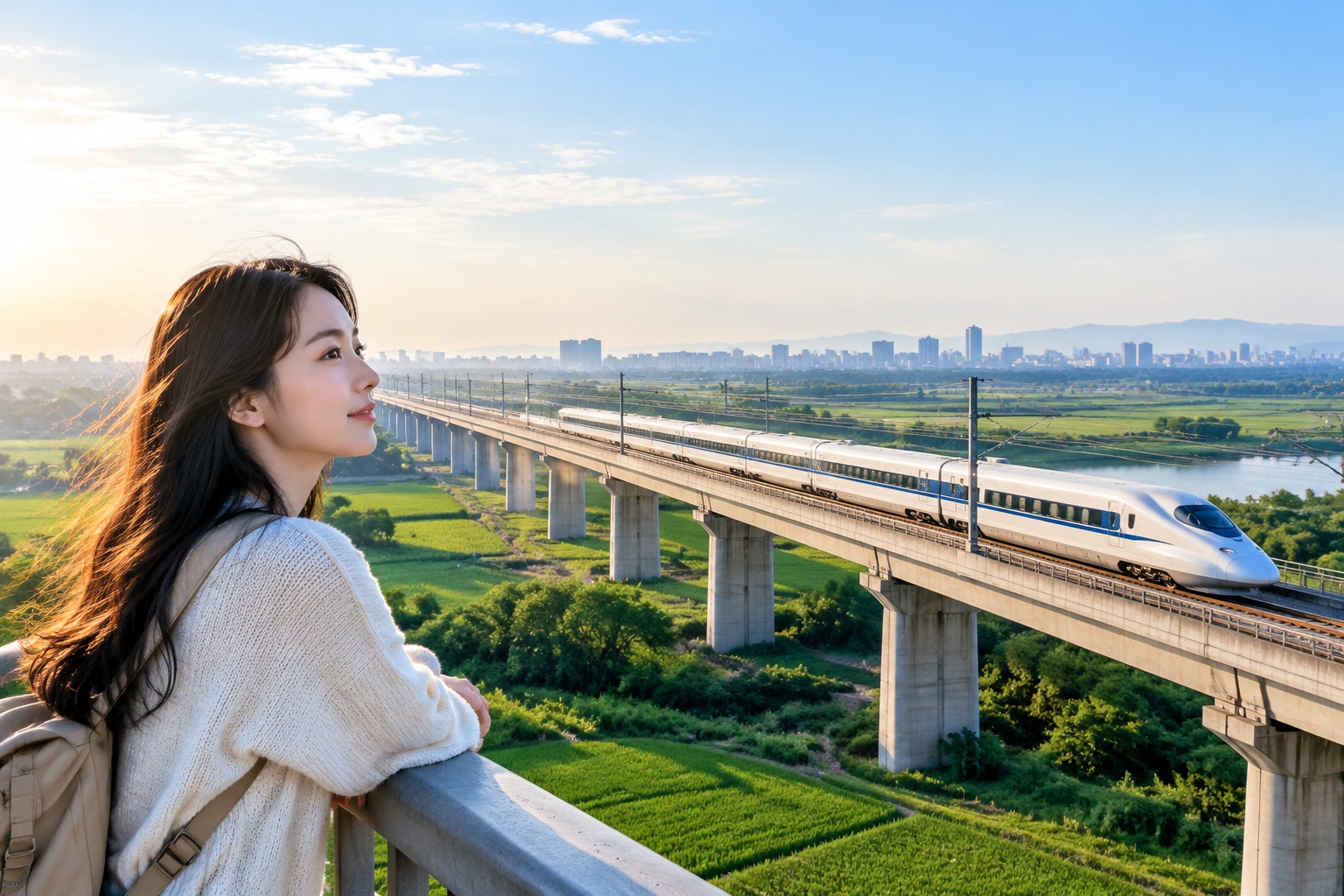

Four hours in Korea, four hours in China
Four hours on a Korean train takes you from Seoul to Busan — 423 kilometers, the full length of the country’s busiest corridor — and leaves time to spare. Four hours on a Chinese high-speed train takes you from Beijing to Shanghai: 1,318 kilometers, with the afternoon still ahead of you.
That gap is a good place to start on a question that comes up constantly in English-language forums and YouTube comment sections: how big is China, really?
Two numbers do most of the work. China’s land area is about 93 times South Korea’s. Its population is roughly 27 times larger. Both are easy to type and almost impossible to picture, so here is what they look like on the ground.
93 times the area — and why that undersells it
South Korea covers about 100,200 square kilometers. China covers about 9.6 million — or 9.3 million if you count dry land only, excluding lakes and inland water. That narrower figure is where the 93 comes from; use the larger one and you get 96.
Neither number means much until you break it up. Xinjiang, in the northwest, is 1.66 million square kilometers, more than 16 South Koreas. Inner Mongolia is 1.18 million, about 12. Sichuan, known abroad mainly for pandas and chili oil, is nearly five times the size of South Korea.
Then there is Hulunbuir, a single prefecture-level “city” in Inner Mongolia: 263,000 square kilometers, two and a half South Koreas, and about 2.2 million people — fewer than live in Busan. In China, a city can mean a place with the area of a mid-sized European country and the population of a small one.

The dimensions matter too. China runs about 5,200 kilometers east to west and 5,500 north to south. South Korea is roughly 400 kilometers end to end. Leave Seoul at dawn heading south and you reach the coast before lunch. Leave Shanghai at dawn heading west and you are still in China when the sun goes down.
China also spans five geographic time zones and officially uses one. In winter, the sun rises in Kashgar around 10 a.m. — on the same clock as Beijing.
27 times the population — the least interesting of the three
China has about 1.41 billion people; South Korea has about 51.7 million. That ratio tells you almost nothing about how the country actually works.
The cities tell you more. Chongqing, a municipality in the southwest, has roughly 32 million residents — about 60 percent of South Korea’s population inside one administrative unit. Shanghai has around 25 million. Beijing, Chengdu and Shenzhen are each above 17 million. Guangdong province, home to Shenzhen, Guangzhou and Dongguan, holds about 127 million people. Shandong holds about 101 million.

The “100 cities” claim, checked
A version of this comparison circulates widely on Chinese and Korean social media: that more than 100 Chinese cities have populations larger than South Korea. That specific claim is false. No Chinese city has 51 million residents. Chongqing, the largest, has 32 million, and it is a sprawling administrative region rather than a dense urban core.
The true version is still striking. China has more than 100 cities with urban populations above one million. Around 22 have urban populations over five million, and seven — Shanghai, Beijing, Shenzhen, Chongqing, Guangzhou, Chengdu and Tianjin — are above ten million. South Korea has roughly a dozen cities over one million, and only Seoul clears ten million.
So the honest rendering of the viral stat is this: China has about ten times as many million-person cities as South Korea, and seven times as many ten-million-person cities. Nothing needs to be exaggerated.
Two Chinese provinces that are, economically, Koreas
Guangdong’s GDP was about $1.9 trillion in 2023, slightly more than South Korea’s roughly $1.7 trillion. Jiangsu, next door, produced about $1.8 trillion. Two provinces, each carrying roughly the economic weight of a G20 country that exports cars, memory chips and pop music.

What size does to ordinary life
Scale here is not an abstraction. It shows up in logistics.
China’s high-speed rail network passed 48,000 kilometers in 2024 — long enough to circle the planet once with thousands of kilometers to spare. South Korea’s KTX network is around 1,100 kilometers; its entire rail system, freight included, is roughly 4,000. China’s full rail network is about 160,000.
Retail works the same way. Same-day delivery covers several hundred cities; a package bound for a county in Qinghai can take four days. A brand can be a household name nationally and nearly invisible in half the country.
Education is where the numbers turn personal. About 13.4 million students sat the gaokao, the national college entrance exam, in 2024. South Korea’s equivalent is taken by roughly 500,000. Because universities admit by province, the score that gets a Beijing student into a top school may not be enough for a student from Henan, where competition is far denser. Scale does not distribute its costs evenly.
Even the weather refuses to be national. In January, Harbin can sit at minus 25 Celsius while Sanya, on the southern island of Hainan, is at 25 above — a 50-degree spread inside one country, on one day.
Where size is a problem, not a boast
None of this is a scoreboard. Some of China’s hardest problems are also problems of scale.
Income gaps between provinces are wider than the gaps between many neighboring countries. Shanghai’s GDP per person is roughly four times Gansu’s, a province in the northwest. Hospital quality, school funding and public services vary enormously along the same line, which is a big part of why migration inside China has been so large: hundreds of millions of people have moved from inland provinces to coastal factories and construction sites over four decades.
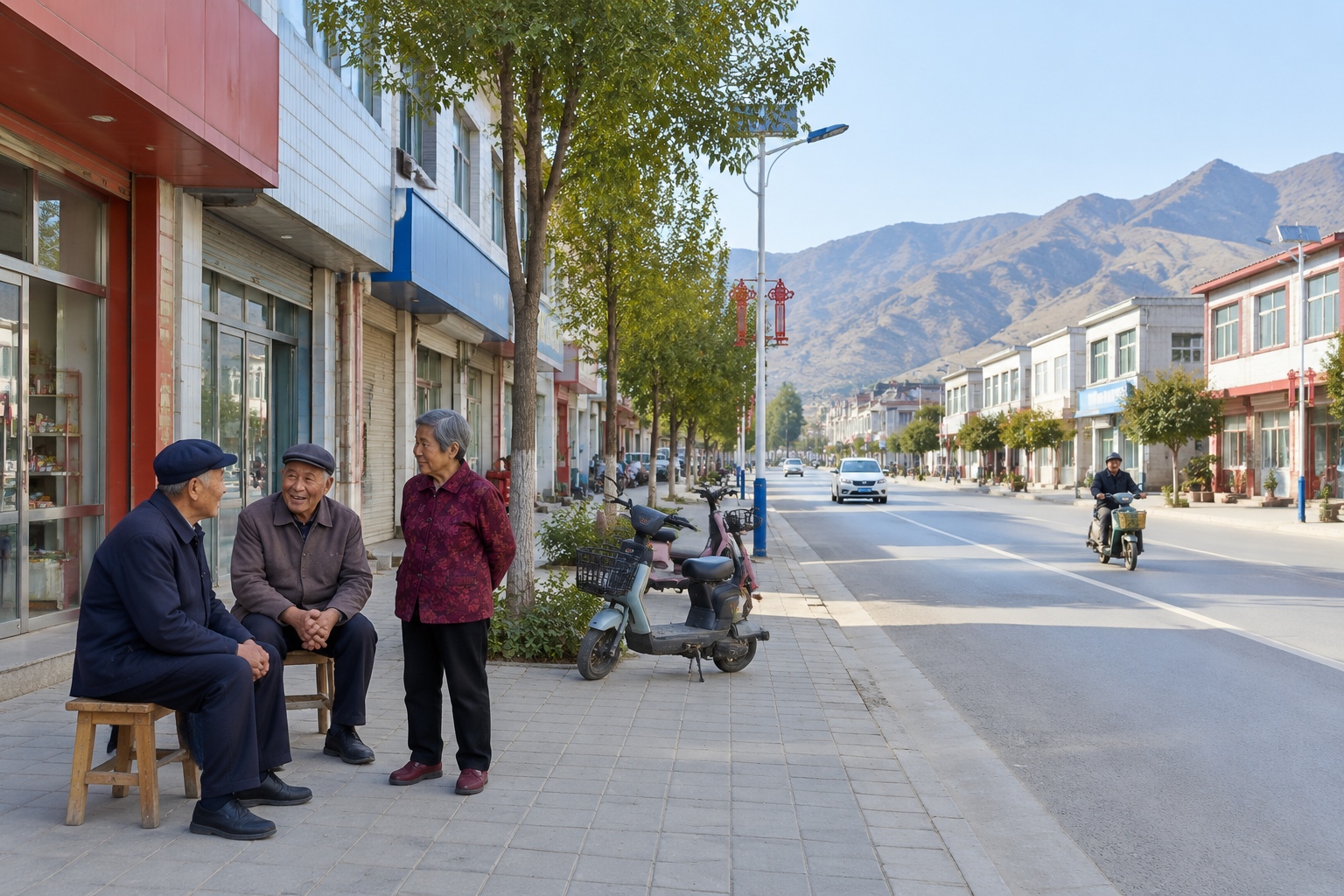
Then there is age. China had about 310 million people aged 60 or over at the end of 2024 — more than 22 percent of the population, and a group larger than the entire population of any country except India and China itself. Funding pensions and elder care across 34 provincial-level regions, some wealthy and some not, is a coordination problem with no small-country precedent.
This is also why Chinese policy so often arrives as a pilot: a reform is tested in a handful of cities, adjusted, then widened. And it is why a national average — average income, average test score, average anything — frequently describes no place that actually exists.
How to read the next “China” headline
The numbers 93 and 27 are not really about winning an argument. They are a calibration tool.
Next time you read that “China’s youth unemployment is X” or “Chinese consumers are doing Y,” ask where the sample came from. A story built on Shanghai and Shenzhen is a story about roughly 40 million people — a real place, but not the country. A story built on a county in Guizhou is also a story about China, and it will look nothing like the first one.
South Korea is a useful yardstick precisely because it is small enough to hold in your head: 51 million people, 100,000 square kilometers, one language, one time zone. China is what happens when you multiply that by 27 and by 93, then add deserts, tropics, several languages spoken by millions of people, and provinces whose economies are the size of countries.
The size itself is not the story. What it does to averages is.
Start the discussion at forum.chinacomes.com