
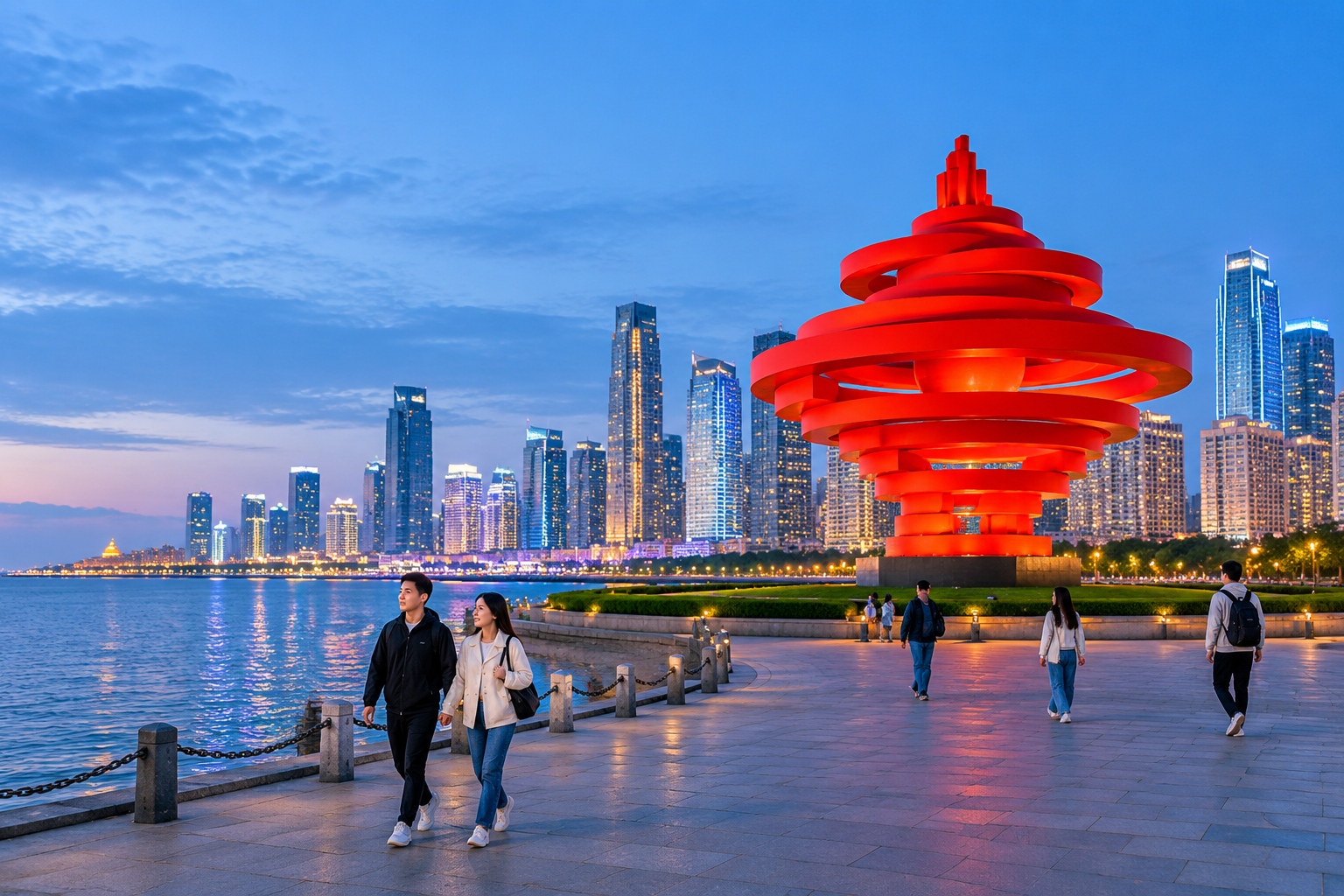

6:40 a.m. on the Qingdao Waterfront
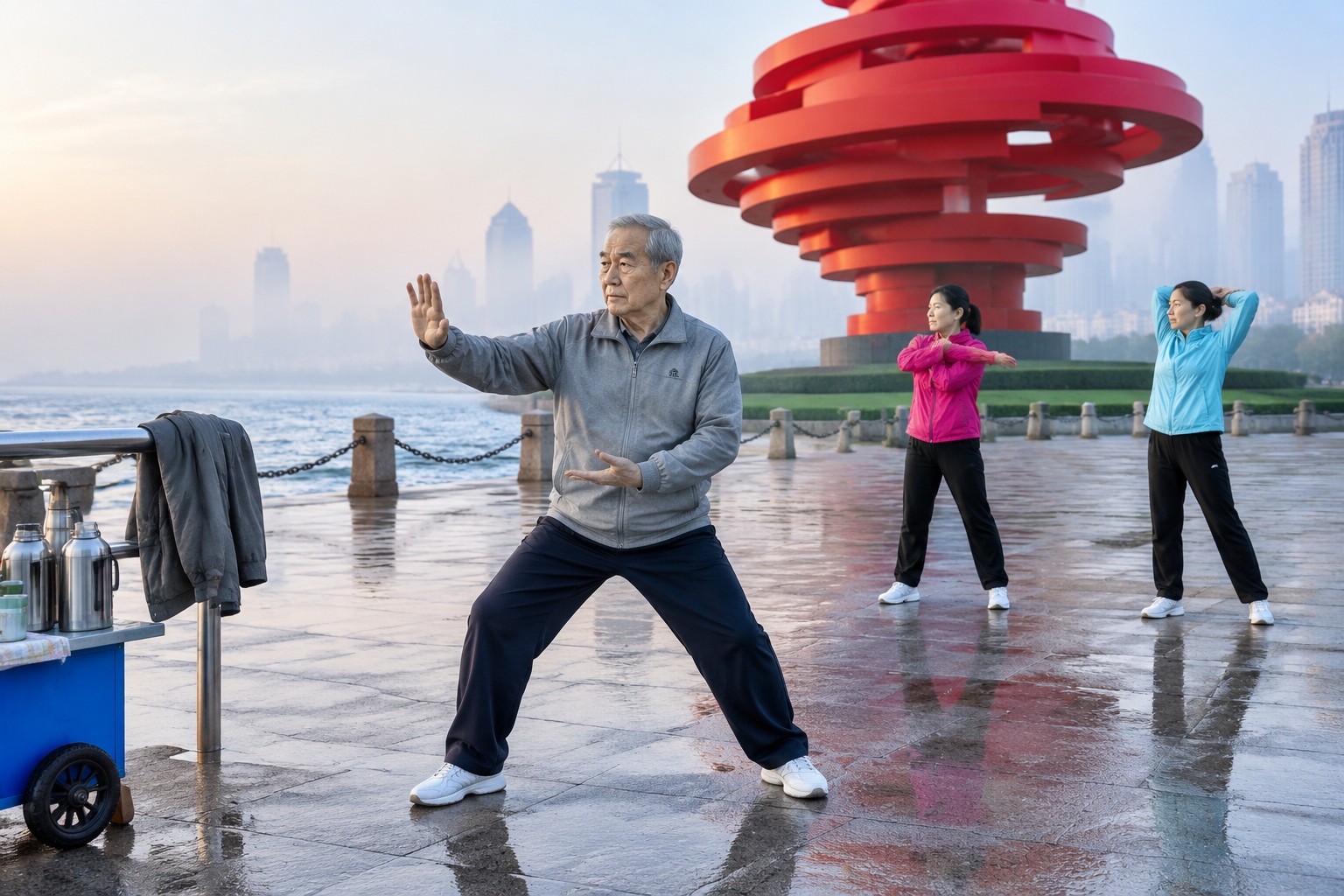
Late-spring fog rolls in off Fushan Bay most mornings, and it does something useful to a landmark: it quiets it down. At 6:40, May Fourth Square is mostly water, pavement and the sound of the sea hitting the seawall. The big red sculpture in the middle of the plaza — a spiral of steel ribbons that everyone here calls “The Wind of May” — has no queue of photographers around it yet. Two women in matching windbreakers stretch at its base. A man in his seventies has hung his jacket on the railing and is halfway through his taijiquan routine, facing the water.
By eight, tour buses start unloading. By eleven, the same patch of pavement is crowded with people holding phones up, trying to fit the sculpture and the bay into one frame. That is the double life of a memorial square on China’s coast: for a few hours a day it belongs to the people who live within walking distance; for the rest of it, it belongs to everyone else.
Why a May Fourth Square Stands in Qingdao
Outside China, the May Fourth Movement is usually summarized as “student protests, 1919.” The Qingdao part tends to get left out, which is strange, because Qingdao is the reason the protests happened.
Germany had held Qingdao as a leasehold since 1898. Japan took the city in 1914, early in World War I. When the fighting ended, China expected the Paris Peace Conference to return the former German rights in Shandong — Qingdao included — to Chinese administration. Instead, the conference decided those rights should go to Japan.
When that news reached Beijing, students marched on May 4, 1919. One of the slogans named this city directly: “Return Qingdao to us.” The protests spread into a national movement, and the Chinese delegation in Paris ultimately refused to sign the treaty. Qingdao came back under Chinese administration in 1922.
The square itself is far younger. This stretch of waterfront was rebuilt in the mid-1990s as part of a coastal road and park project, and the square opened around 1997 with the sculpture as its centerpiece. So it isn’t a monument to an abstract date. It marks a specific argument about who had the right to decide what happened to a piece of coastline.
Reading “The Wind of May” From Three Angles
The sculpture stands about 30 meters tall and 27 meters across, and weighs something in the neighborhood of 500 tons — different plaques and brochures give slightly different figures, but nobody standing under it is doing the math. It is made of steel painted a saturated red, shaped into ribbons that twist upward: a flame pulled into a spiral, or a fistful of wind caught mid-motion.
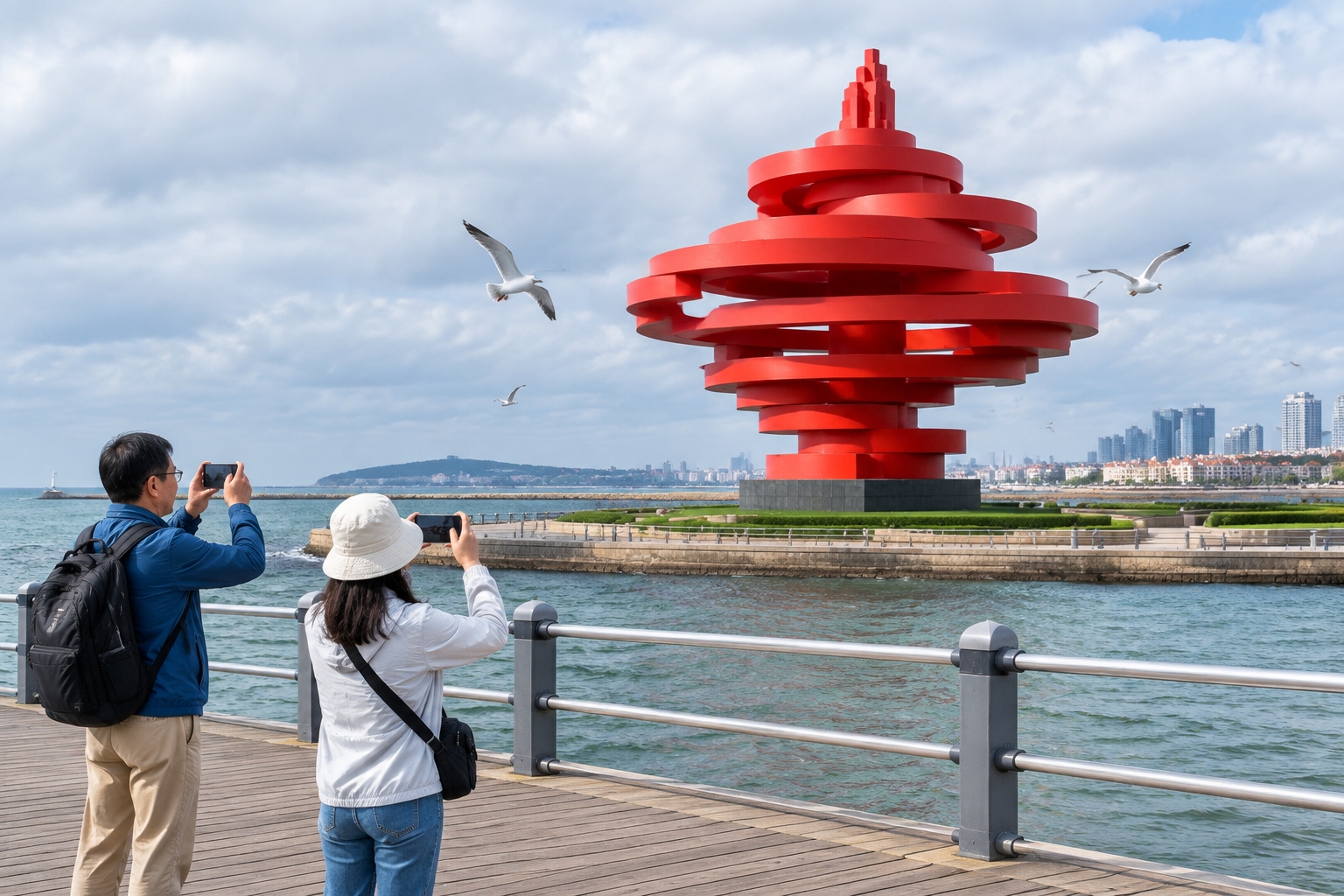
Approach from the north, walking down toward the sea, and it reads as an arch. Move east along the water and it turns into a wave about to break. Stand directly beneath it, look straight up, and it becomes a corkscrew of red metal and grey sky, with seagulls crossing the gaps.
The title says wind, but wind is invisible. What has actually been built here is the shape wind leaves behind — motion that has already happened. That is an unusual thing to put at the center of a memorial, and it is why the sculpture works. It does not tell you what to feel. It just keeps turning.
The Square Belongs to Different People at Different Hours
Morning is for bodies in motion. Taijiquan and sword practice near the sculpture, older couples walking laps, a few men doing pull-ups on the low bars by the lawn, someone with a portable speaker playing something halfway between opera and karaoke. Vendors with thermos carts sell soy milk. The seagulls that spend winter around Qingdao’s waterfront are mostly gone by May, but a few stragglers still work the rocks below the seawall.
Midday belongs to visitors. Wedding photographers pose couples against the red steel; tour groups in matching hats line up for the classic angle from the north side — sculpture on the left, bay on the right, sailboats in the middle distance if they are lucky.
Evening is family time. Strollers, scooters, children chasing each other around the lawn, retired men fishing off the rocks with long rods. One evening in late April, a woman pushing a stroller stopped next to me and said, mostly to the baby, “Look, the lights.” It was not dark yet. The high-rises around Fushan Bay were only starting to glow.
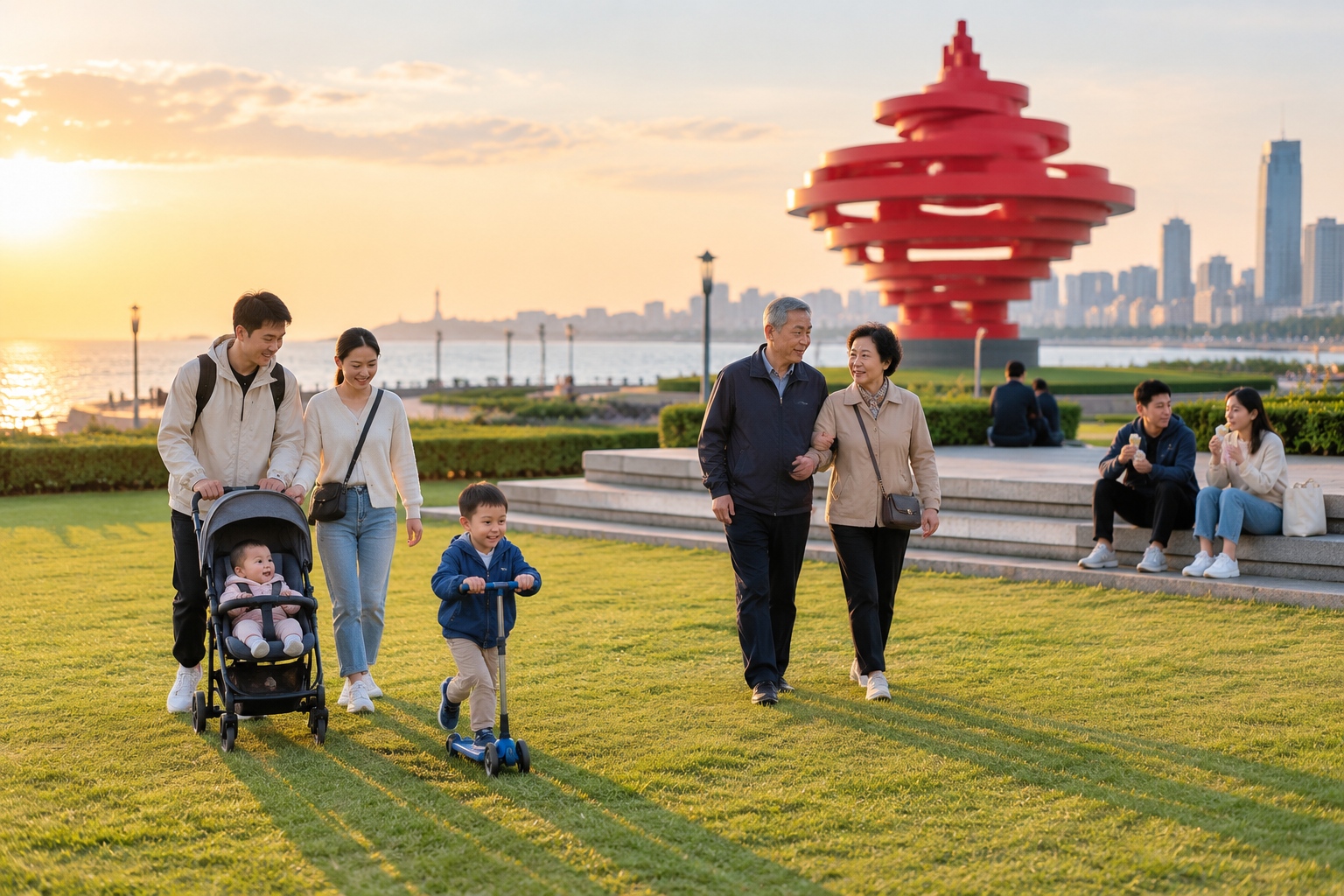
The square has no ticket gate, no closing time and no fixed route through it. People cut across it diagonally, sit on the steps, eat sunflower seeds, argue about basketball. The memorial and the picnic coexist, and nobody finds that odd.
The Part Most Photos Miss
Walk down the steps on the sea side of the plaza and the square changes character. At low tide, people come down to the rocks with plastic buckets — mostly older women, occasionally a teenager filming for a short video — and pick seaweed and small shellfish off the stones. The water smells of salt and diesel from the fishing boats further along the coast. Above them, the sculpture throws a spiral shadow onto the pavement, and the shadow moves through the afternoon like a slow clock hand.
Walking East to the Olympic Sailing Center
The best way to understand how this part of Qingdao fits together is to walk it. Start at the square, follow the wooden boardwalk east along the shoreline, and keep the water on your right. You pass Music Square, then the rocky slope of Yan’erdao Hill Park, then the marina.
The whole route to the Olympic Sailing Center is roughly three kilometers — forty minutes at a stroll, longer if you stop, which you will. The sailing center hosted the 2008 Olympic sailing events; today it is a working marina with cafes, restaurants and a long breakwater that people walk out onto for the sunset. On weekend evenings, the towers around the bay run a synchronized light show. The schedule shifts with the season, so check locally rather than trusting a screenshot from last summer.
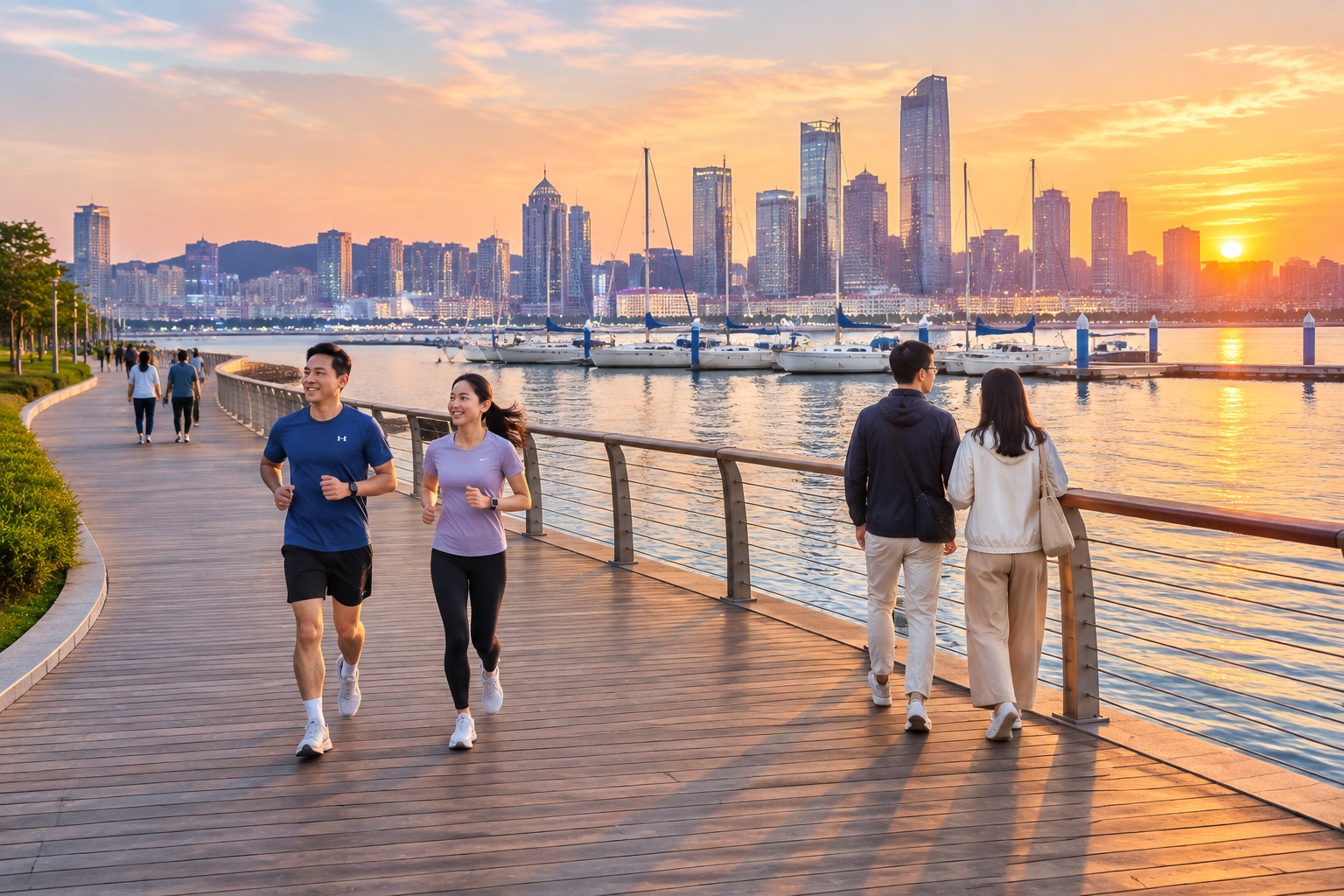
What you notice on the walk is how continuous the public space is. The square, the boardwalk, the parks and the marina all connect. Memory here is not stored behind a fence. It is threaded through the route people use to get from breakfast to the ferry.
What This Kind of Place Actually Does
Coastal cities in China each handle their history differently. Some put it in a museum with a ticket window, some in a street name, some in a park that doubles as a running track. May Fourth Square is the third kind: a place where a national argument and a Tuesday morning jog occupy the same square meters.
That is the part that does not fit into a slogan. A memorial usually asks you to stand still and receive a message. This one is arranged so that a retired teacher in her sixties doing her stretches, a toddler on a scooter, a student on a video call with a friend abroad and a tourist from Chengdu taking her fourth selfie can all be there at once, doing unrelated things, without any of them being wrong about what the place is for.
If you come, come twice: once at 7 a.m., when the fog is still on the water and the square belongs to the neighborhood, and once at 8 p.m., when it belongs to everyone. The sculpture looks different both times. So does the city.
Practical Notes
- Getting there: Qingdao Metro Lines 2 and 3 both stop at May Fourth Square station. Several city buses run along Donghai West Road.
- Best hours: 6:30–8:30 a.m. for the local scene; after 7 p.m. for the lights and the sea breeze.
- Bring a layer: the waterfront is noticeably cooler and windier than inland neighborhoods, even in summer.
- Walk it: the boardwalk east to the Olympic Sailing Center takes about 45 minutes at an easy pace. Flat, paved and stroller-friendly.
- Nearby: Yan’erdao Hill Park, just east of the square, has a short hill trail with a wide view back over the bay — usually far fewer people than the square itself.
Start the discussion at forum.chinacomes.com