
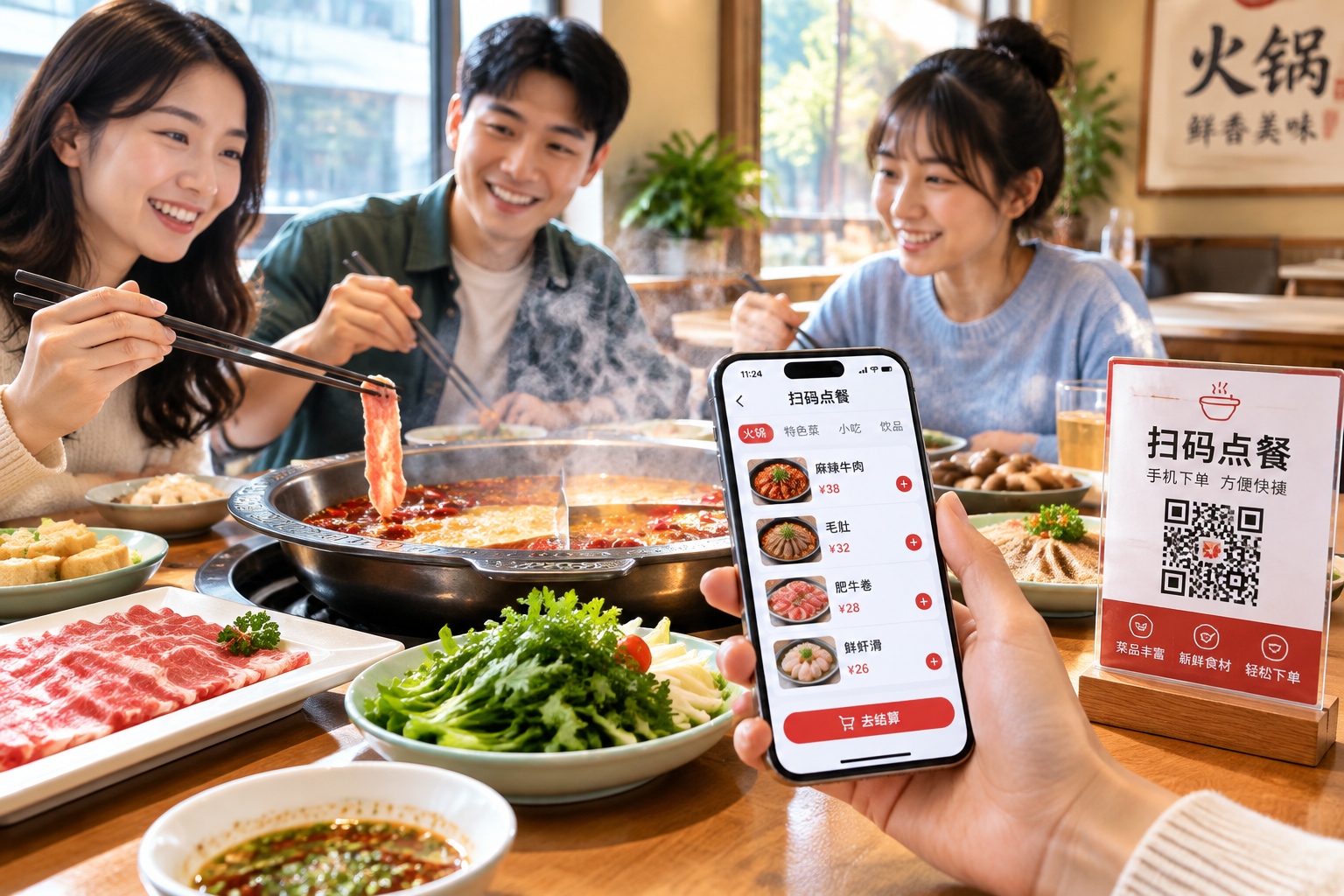

It Starts with a QR Code
The first thing you notice when you sit down at a restaurant in China is that the menu isn’t on the table. It’s on your phone. A small QR code stands propped against the soy sauce bottle. You scan it with WeChat or Alipay, and the menu appears in Mandarin — photos included. Sometimes there’s an English toggle, but often there isn’t.
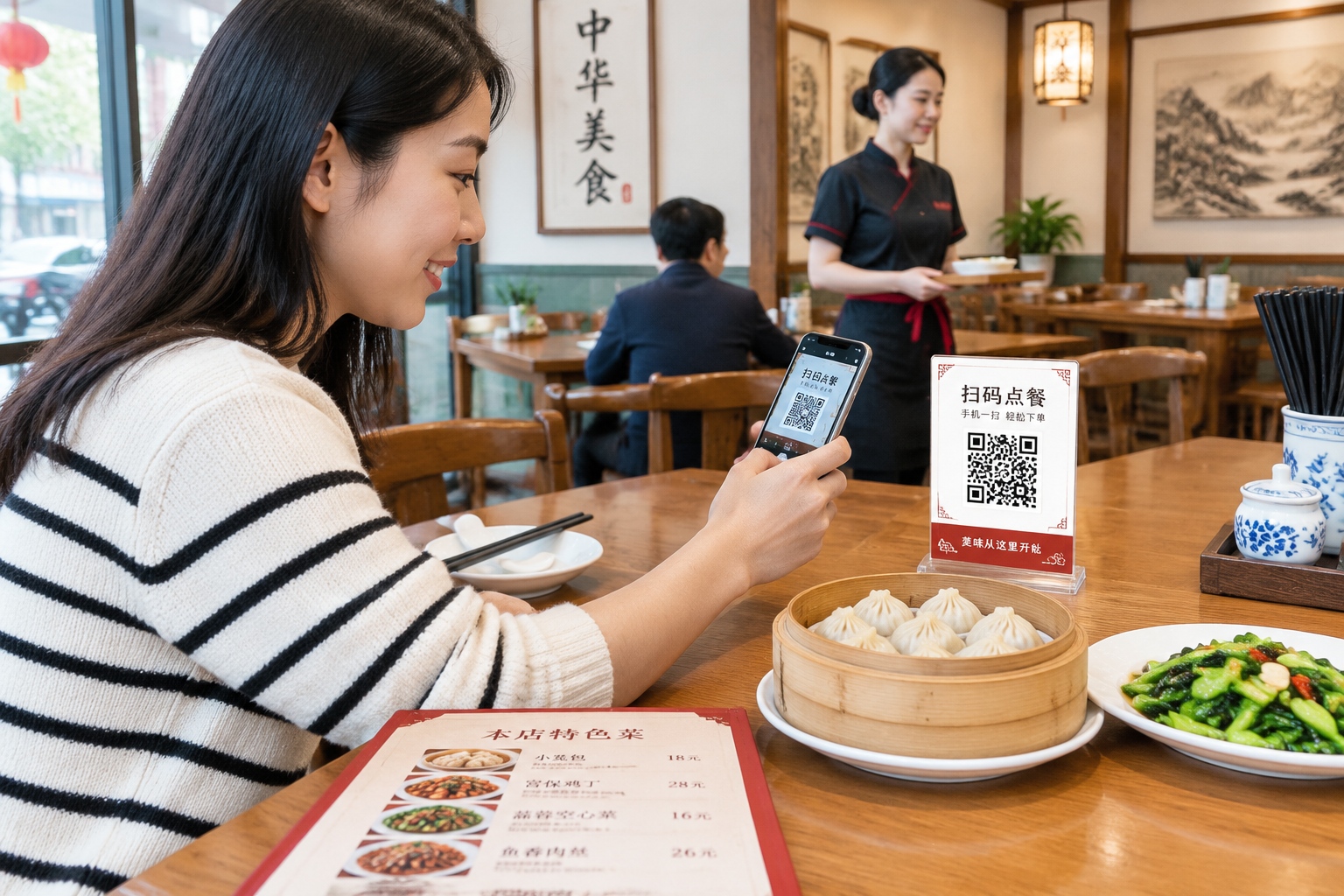
Don’t panic. I’ve been there, and after years of ordering meals across China, I can tell you: a little preparation goes a long way. Let me walk you through how real people here order food, what to look for on a Chinese menu, and how to make sure your dietary needs are actually understood.
The Apps That Run China’s Food Scene
If you’re going to eat in China — whether in a restaurant or at home — you’ll quickly meet two apps: Meituan and Dianping. Actually, they’re sort of one ecosystem now, but they do different jobs.
Meituan: The Delivery King
Meituan (美团) started as a group-buying site and became the country’s largest food delivery platform. Think Uber Eats but bigger, faster, and more embedded in daily life. You order, a motorbike courier picks it up, and within 30 to 45 minutes, hot food arrives at your door. For foreigners with limited Chinese reading skills, the app does offer English-language versions in major cities. But here’s a trick: open the Chinese version and use the photo menus. The pictures are usually identical to what you’ll get.
Meituan is also useful when you’re actually in a restaurant. If a place is packed and the waiters are too busy to explain, you can often search for the restaurant inside Meituan and look at dishes reviewed by other diners. Photos will show you what to expect, and you’ll see the most popular items highlighted.
Dianping: The Yelp of China
Dianping (大众点评) is the review site that locals consult before choosing a restaurant. It’s like Yelp, but with a stronger focus on food. You can search by neighborhood, cuisine, or budget. Ratings run from 1 to 5 stars, but a 4.5 in China is actually very good. If you see a restaurant with 4.2 or higher and a queue out the door, you’re in for a good meal.
Dianping also shows average cost per person — useful for budget planning. And it’s not just for deciding where to eat; inside a restaurant, you can search the menu in Dianping and scroll through dishes sorted by popularity. I’ve lost count of how many times I just pointed at an unfamiliar dish on my screen and said, “This one, please.”
How to Order at a Sit-Down Restaurant
When you’ve chosen a restaurant, here’s the typical flow:
- Find your table. If there’s no hostess, grab an empty table. It’s normal to share tables in busy places.
- Scan the QR code on the table to pull up the menu.
- Choose your dishes. If the menu is all in Chinese, use the translation tips below.
- Order by tapping “Order Now” (下单) or calling a waiter over. In some places, you just confirm on your phone and the kitchen gets it directly.
- Pay — usually by scanning the same QR code or heading to the counter. Don’t expect a bill to be presented at the table.
One more tip: in many hotpot restaurants, you order raw ingredients separately, and the broth base comes first. Your phone will let you choose the spice level — be honest about your tolerance. “不辣” means no spice, but if you pick “微辣” (mild), you may still end up sweating. When in doubt, tell them “la, but very little.”
Decoding the Chinese Menu
Chinese menus can look overwhelming, but they’re actually organized by cooking method or ingredient. Here’s a simple cheat sheet:
Common dish categories you’ll see
- 热菜 (rè cài) — hot dishes. This is the main course section.
- 凉菜 (liáng cài) — cold dishes. Think salads, pickled vegetables, sliced beef.
- 主食 (zhǔ shí) — staple foods. Rice, noodles, dumplings, buns.
- 汤 (tāng) — soups.
- 海鲜 (hǎi xiān) — seafood.
- 蔬菜 (shū cài) — vegetables.
- 肉 (ròu) — meat, often split into pork (猪肉), beef (牛肉), lamb (羊肉), chicken (鸡肉).
Many dishes are named after their main ingredients or cooking techniques. For example, kung pao chicken is 宫保鸡丁 (gōng bǎo jī dīng) — chicken with peanuts and chilies. Mapo tofu is 麻婆豆腐 (má pó dòu fǔ) — tofu in a spicy sauce with minced meat. If you see the word “辣” (là) on the menu, it’s spicy. “不辣” (bú là) means not spicy.
The pointing method still works
Even if you can’t read a single character, you can always point at a photo. Menus without pictures exist, but most casual restaurants include images. For fancy places that don’t, ask for “带图菜单” — menu with pictures. Or search the restaurant on Dianping and show a photo of a dish to your waiter. Ninety percent of the time, they’ll nod and say yes.
Using Your Phone to Translate Menus
Translation apps have gotten dramatically better. The two I recommend are Google Translate and Baidu Translate. Both have a camera mode: point your phone at the menu, and it overlays translations in real time. It’s not perfect, but you’ll get the gist. For example, a menu might reveal “Sichuan pepper spicy chicken” — which is enough to know it might numb your mouth.
One caution: camera translation sometimes misfires on character-heavy menus or fancy calligraphy. Download the offline pack for Chinese before your trip, because restaurant Wi-Fi isn’t always reliable.
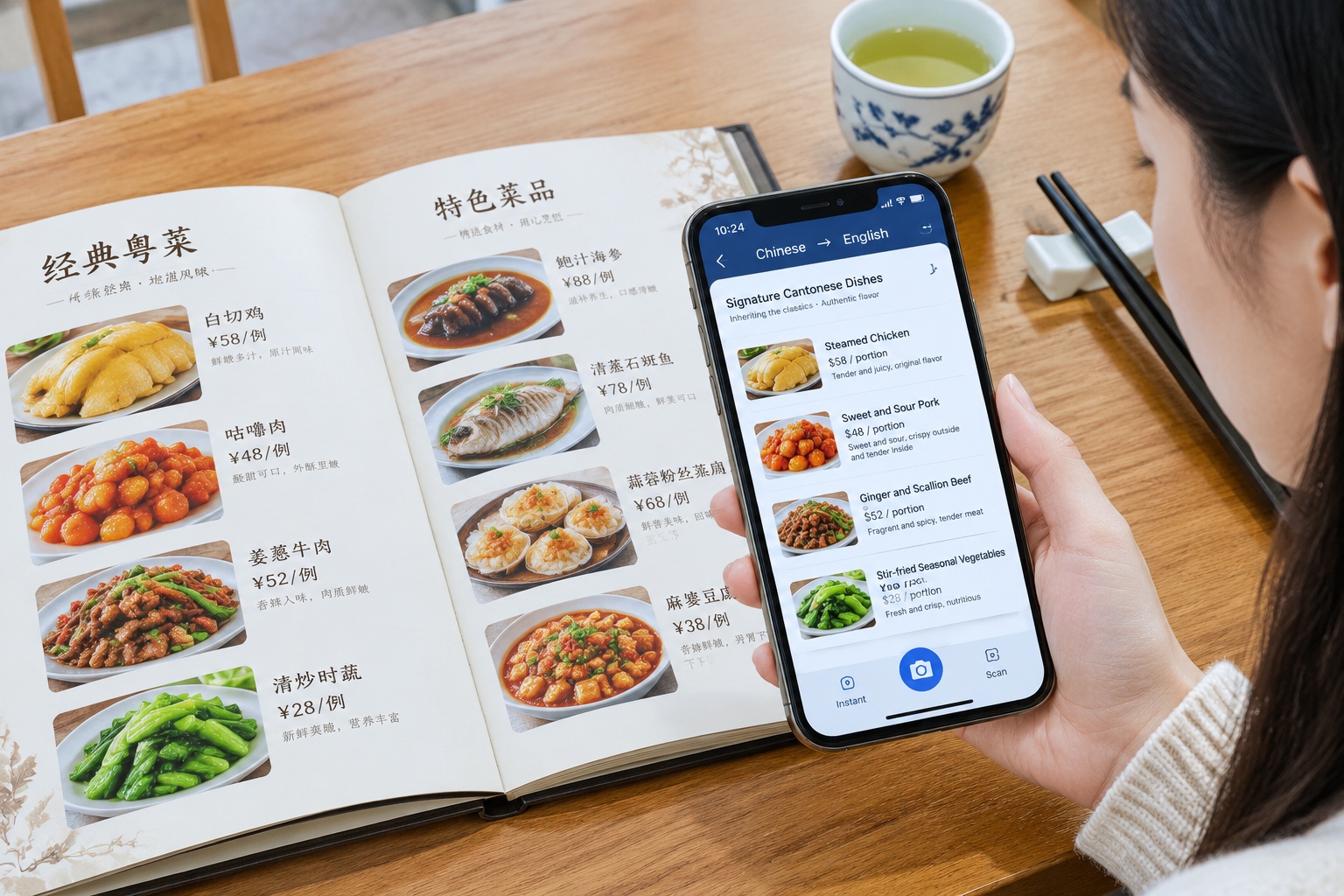
Another trick: save screenshots of common characters like 辣 (spicy), 香菜 (coriander), 葱 (scallion), and 糖 (sugar) so you can quickly scan a menu. This may sound like homework, but trust me — it’s more fun than you think, and it gets you a better meal.
Communicating Dietary Needs
Now, the important part. If you have food allergies, a vegetarian diet, halal requirements, or just personal dislikes, you need to know how to say them clearly.
Allergies
Allergies are the trickiest because cross-contamination is common in Chinese kitchens. If your allergy is severe, I strongly recommend carrying a printed card in Chinese with your specific allergen and a warning. You can show it in restaurants. Also, be aware of hidden ingredients: peanut oil is widely used, and soy sauce is in almost every cooked dish. Some people with gluten sensitivities can struggle with soy sauce, which contains wheat.
Here are useful phrases to save:
- 我对___过敏。 (Wǒ duì ___ guòmǐn) — I’m allergic to ___.
- 请不要放___。 (Qǐng bú yào fàng ___) — Please don’t put ___.
- 这菜里有没有___? (Zhè cài lǐ yǒu méi yǒu ___) — Does this dish contain ___?
Fill in the blank with: 花生 (peanut), 坚果 (tree nuts), 虾 (shrimp), 蟹 (crab), 鸡蛋 (egg), 牛奶 (milk), 麸质 (gluten).
Vegetarian and vegan
Vegetarianism is understood in China, but loosely. “Vegetarian” might mean “no meat” but still include fish sauce, oyster sauce, or chicken stock. For strict vegetarians or vegans, you need to be very explicit. Use this phrase:
我吃素,不吃肉,也不吃鱼和海鲜。 (Wǒ chī sù, bù chī ròu, yě bù chī yú hé hǎi xiān.) — I’m vegetarian, I don’t eat meat, fish, or seafood.
请不要放猪油。 (Qǐng bú yào fàng zhū yóu.) — Please don’t use lard. 请不要放肉汤。 (Qǐng bú yào fàng ròu tāng.) — Please don’t use meat stock.
In many cities, there are dedicated vegetarian restaurants called 素菜馆 (sù cài guǎn). Buddhist restaurants often have exquisite fake meat dishes made from tofu and mushrooms.
Halal
For Muslim visitors, finding halal food is not difficult. China has a significant Muslim population, and many cities have halal restaurants, often marked with the Arabic word حلال or Chinese characters 清真 (qīngzhēn). These restaurants are easily found on Dianping by using the search filter for 清真. Also, look for neighborhoods like Beijing’s Niujie, Xi’an’s Muslim Quarter, or Urumqi, where halal food is the norm.
Inhalal restaurants, you can say:
我是穆斯林,不吃猪肉。 (Wǒ shì mùsīlín, bù chī zhūròu.) — I am Muslim, I don’t eat pork.
这里是不是清真的? (Zhèlǐ shì bú shì qīngzhēn de?) — Is this halal?
Most non-halal restaurants will also label pork dishes with a red 猪 icon. If you’re unsure, ask for 牛肉 (beef) or 羊肉 (lamb) dishes instead.
No-Menu Restaurants: Communicating with Points and Gestures
Some of the best food experiences in China happen in restaurants that don’t have a menu. You might walk into a fishing place near a lake, or a hotpot joint famous for a signature broth. You’ll see a counter with fresh ingredients — fish, vegetables, meat — and you simply choose what you want.
Here’s what to do:
- Point and choose. At the counter, point at a piece of fish or a bundle of greens. Nod at a count, or use your fingers to indicate how many.
- For hotpot or skewer restaurants, grab the items yourself. In many skewer places, you take a basket and pick raw food from refrigerated shelves. The staff will cook them for you. It’s interactive and fun.
- Cook your own food on a tabletop stove in places like hotpot or Korean-style BBQ. If you don’t know how long to cook something, watch nearby tables or just ask, “多少时间?” (duōshǎo shíjiān?) — how long?
Remember that smiling and pointing go a long way. Waiters are generally helpful and patient, especially if you’re clearly making an effort.
Payment and Tipping Etiquette
Almost everything in China’s food scene runs on mobile payment. WeChat Pay and Alipay are ubiquitous. Foreign visitors can link an international credit card to these apps or use a travel card, but it’s not always straightforward. Carrying some cash as a backup is wise because a few small eateries may not accept cards, though most accept QR scans.
When you’re scanning the QR code at your table, you’re often paying via a payment app. Some restaurants will also hand you a payment slip or print a mini receipt with a QR code. You scan, type the amount, enter your password, and you’re done.
Do you tip?
No. Tipping is not customary in China. At high-end restaurants, a service charge may be added, but otherwise you pay exactly what’s on the bill. Leaving a tip is unnecessary and might even be chased after you because waiters will think you forgot your money.
One exception: some luxury hotels and Western-style restaurants in big cities might be used to tips from foreigners, but there’s still no expectation. Don’t feel pressured.
Feeling Hungry Yet?
Ordering food in China is more than just feeding yourself — it’s your doorway into everyday life. Once you learn to use the apps and understand basic menu logic, the whole country opens up.
Start with a walk through a local food market. Then find a corner restaurant with an old photo of the owner and a queue outside. Pull up Dianping, order what everyone else is eating, and let that first steam of a hand-pulled noodle bowl or sizzling dumpling plate introduce you to China the way locals know it.
If you’re still nervous, remember this: the same world that seems full of unknown dishes is also full of patient waiters and helpful customers. A smile, a pointing finger, and a willingness to try — that’s all you need.
Good luck, and 请慢用 — please enjoy your meal.
Start the discussion at forum.chinacomes.com