

Exit B, Canton Tower Station: The Ten Minutes Before the Lights Come On
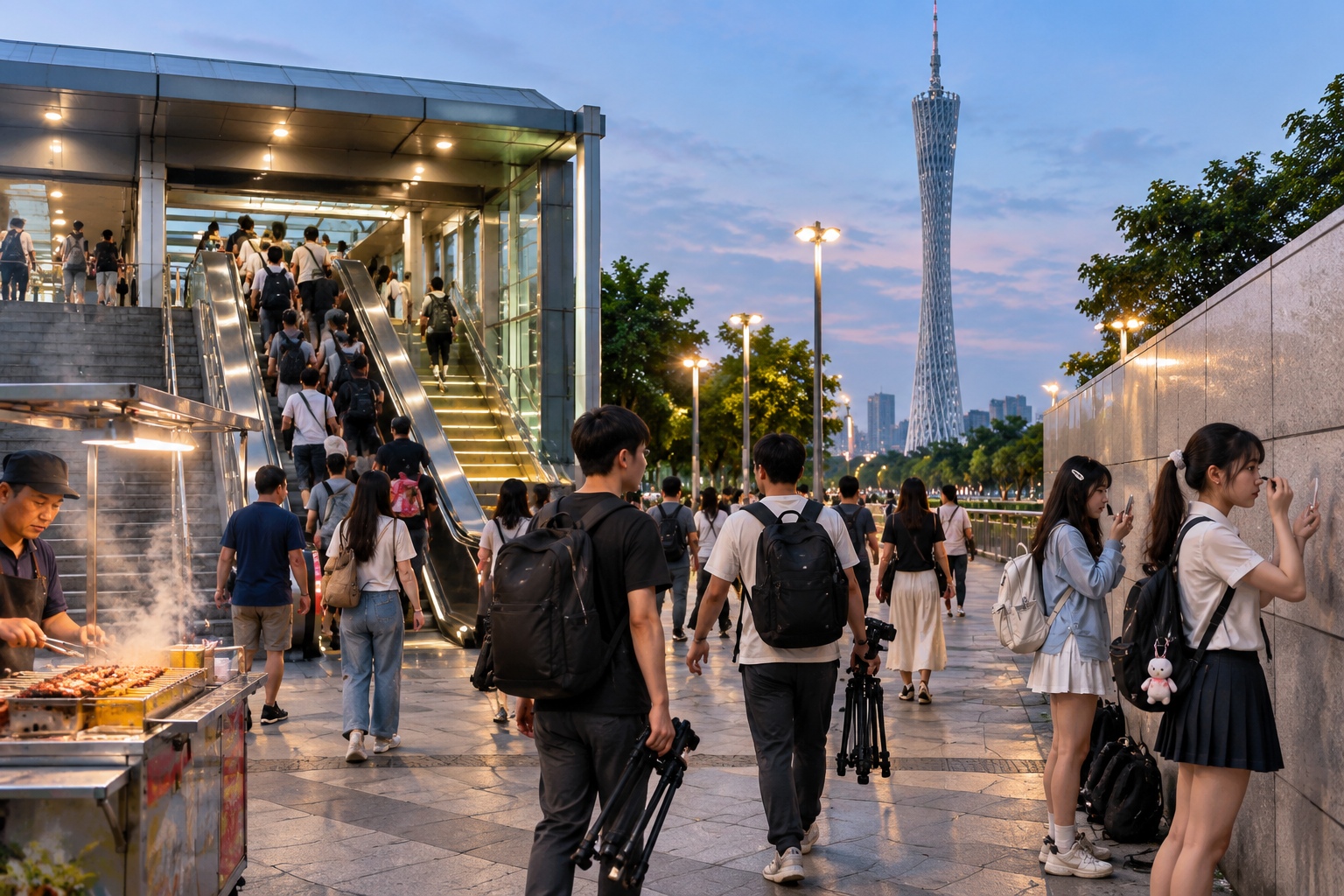
At 6:40 on a Tuesday evening, Exit B of Canton Tower Station is a bottleneck. Half the people riding up the escalator are carrying tripods. The air smells of wet pavement, diesel from the bus lane, and grilled squid from a cart parked where it probably shouldn’t be. Two teenage girls are doing each other’s makeup against the tiled wall. Everybody is facing the same direction.
The tower is still dark. Six hundred meters of grey steel lattice stands on the south bank of the Pearl River like something that hasn’t been plugged in yet. Nobody leaves. Nobody is looking at their phone.
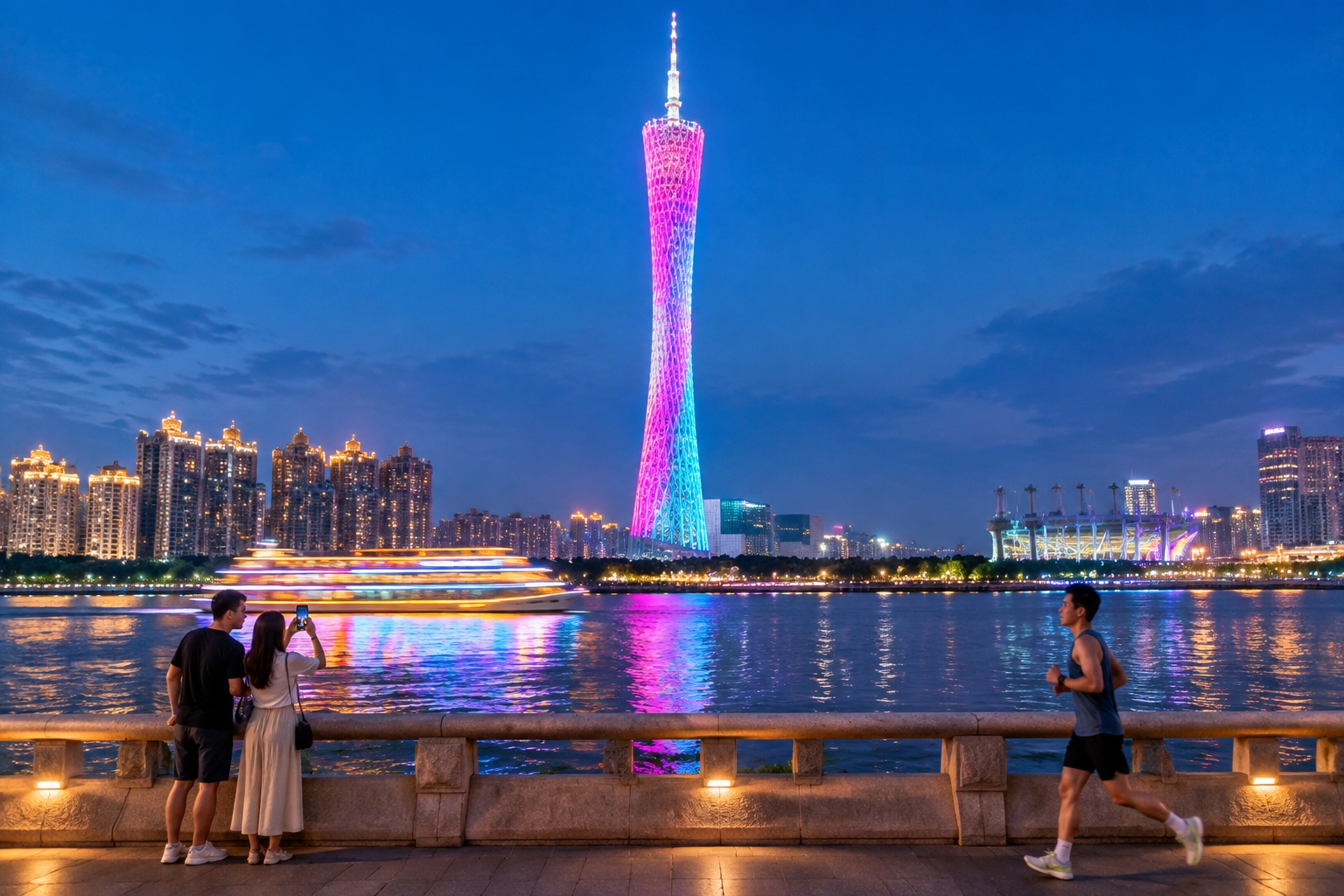
At 6:52 the lighting rig starts at the base and runs upward, ring by ring, and finishes at the antenna in about nine seconds. There is an audible reaction from the crowd — not applause, more like a collective breath. The man standing next to me says something to his wife in Cantonese and she laughs at him. This happens every single night. They still came out to watch.
Why a City Calls 15,000 Tons of Steel ‘Slim Waist’
Canton Tower opened in 2010, in time for the Asian Games, designed by the Dutch firm Information Based Architecture with engineering by Arup. Structurally it is a hyperboloid: two ellipses, one rotated against the other, wrapped in a diagonal grid of steel columns and rings. The narrow point — the waist — sits a little above the middle, and that one detail is why the whole city calls it 小蛮腰, ‘little slim waist’.
The nickname is older than the tower. It comes from a Tang dynasty line attributed to the poet Bai Juyi, describing the waist of a dancer. Applying a 1,200-year-old compliment to a piece of modern engineering is a very Guangzhou move: affectionate, slightly mocking, and completely unserious about its own seriousness.
What’s Actually Up There
Three things are worth the money, and none of them are cheap.
The observation decks on floors 107 and 108 sit between roughly 428 and 433 meters. This is the version most visitors buy, around 150 yuan. Above that, the outdoor 488 Look Out puts you on the roof with wind in your ears for about 228 yuan — the view is better mainly because the glass goes away.
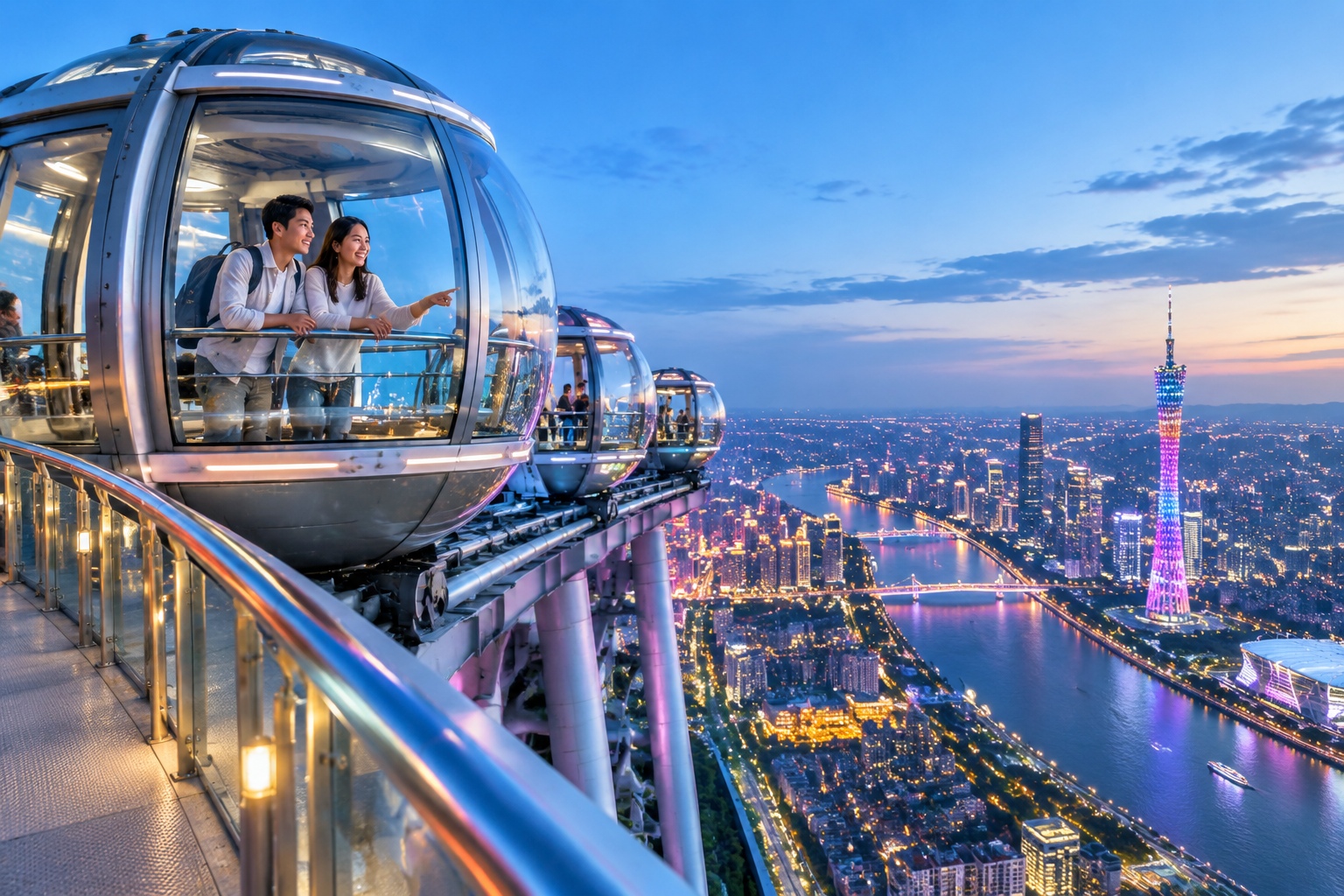
The Bubble Tram is a horizontal Ferris wheel on the rooftop: 16 transparent capsules riding a track around the tower’s rim at about 450 meters, one loop taking roughly 20 minutes. It sells out on weekends and costs extra, usually around 180 yuan.
Then there’s the Sky Drop, which locals call 跳楼机 — ‘the jump-off-a-building machine’, a nickname that needs no translation. You are strapped into a seat on the roof, lifted, and released. The fall lasts a couple of seconds, which is either nothing or everything, depending on your relationship with your own mortality. There’s also a harnessed climb around the outer ring at about 170 meters, the Spider Walk, for people who want their fear of heights to last longer.
Practical reality: the security line on a Saturday evening can run 40 minutes. Buy through the tower’s WeChat mini-program in advance. On a Wednesday at 7pm, you will walk straight in.
Under the Tower: Huacheng Square, Zhujiang New Town, and the CBD That Paid for the View
Look north from the tower base and you are looking at the reason the tower exists. Across the river, Huacheng Square runs roughly a kilometer and a half through Zhujiang New Town, the core of the Tianhe CBD — the district holding the banks, law firms, tech offices and the two glass towers that anchor the skyline, the 530-meter CTF Finance Centre and the 438-meter Guangzhou IFC.
In 2005 this area was demolition sites, fish ponds and construction hoardings. The tower and the CBD grew up together, and the relationship is literal: the tower is the southern full stop on the city’s new central axis, and the APM metro line runs under the river to connect it to those offices, one stop away at Haixinsha, the island that hosted the 2010 Asian Games opening ceremony.
What that means for an evening: at 7pm on a weekday, the square fills with people who have just left work and are not going home yet. They walk. They sit on the low walls. A speaker comes out and a group of women start dancing. There are children on scooters and couples photographing each other with the tower glowing behind them. All of it is free. The expensive part of the night is 450 meters up; the actual life is down here, and it costs nothing but the metro fare.
Across the Water: The Light Corridor on the Pearl River
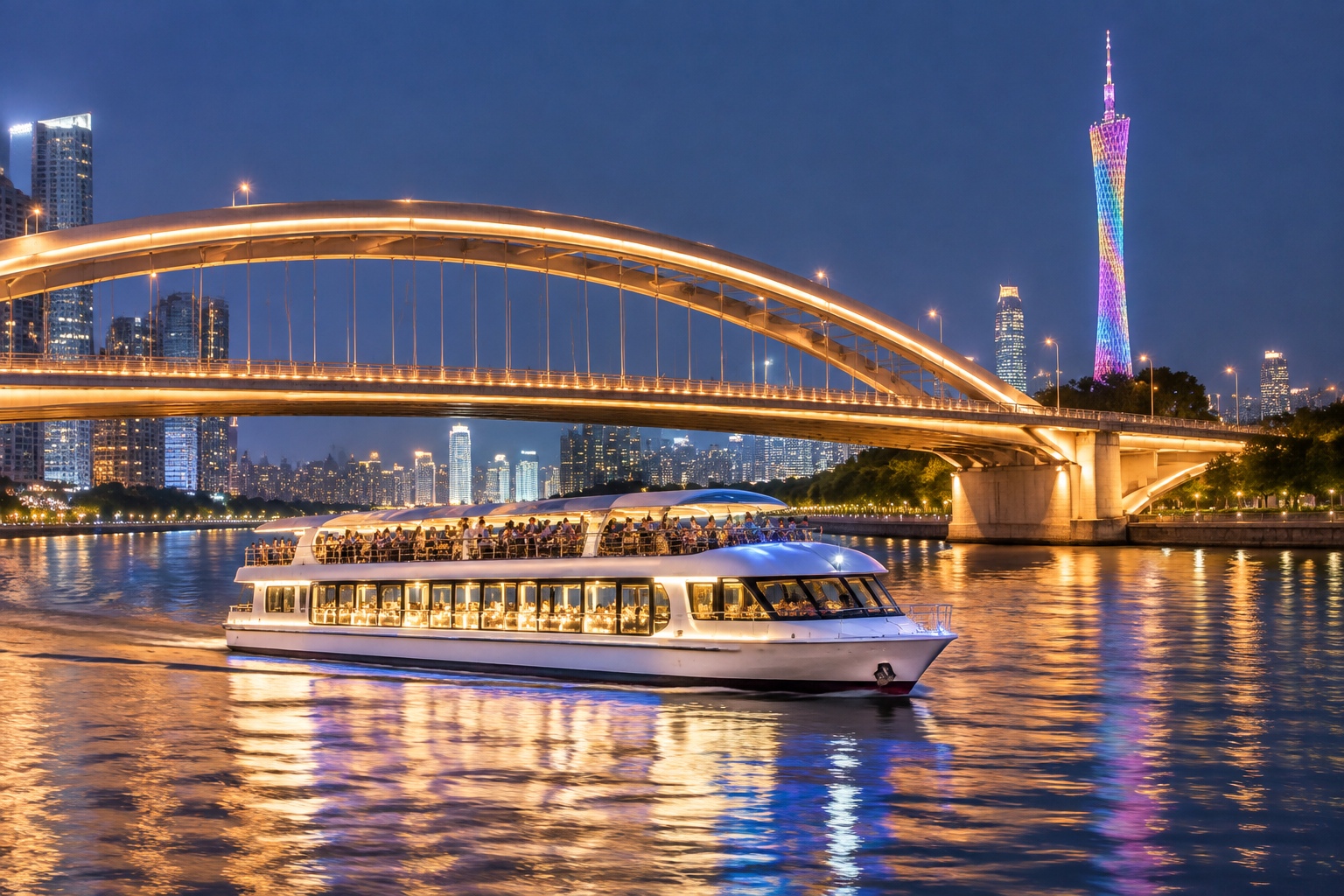
The river is the better show. Night cruise boats leave from piers at Dashatou, Tianzi and Guangzhou Tower itself, running 60 to 90 minutes for roughly 80 to 200 yuan, some with dinner buffets of varying honesty. They pass under a sequence of bridges, each lit differently — Liede, Haizhu, Jiefang — and the tower’s lighting animation runs on a 15-minute loop, so you get several versions of it from the water.
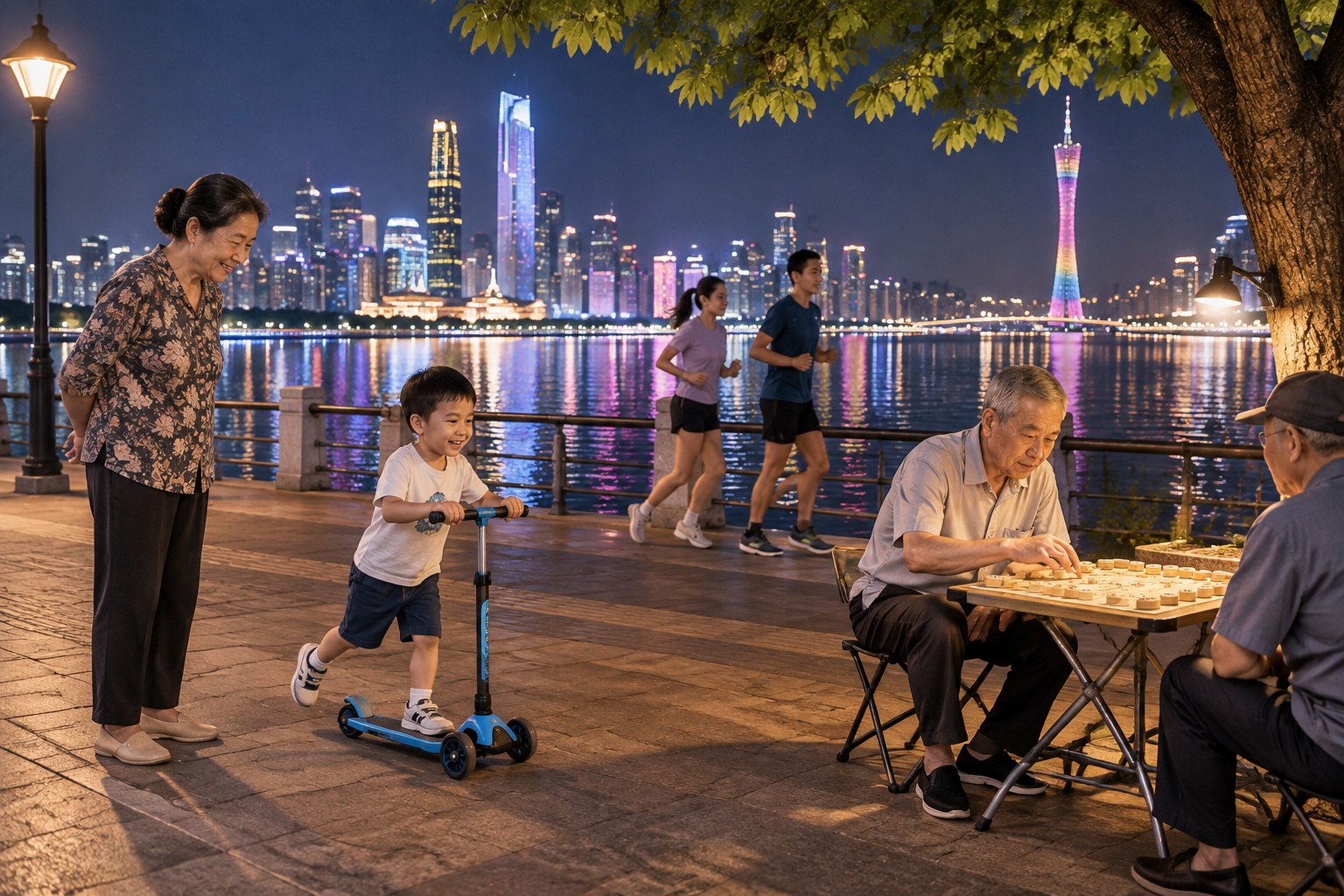
If you would rather not pay, walk. The riverside promenade from the tower west toward the older bridges takes about 40 minutes at a stroll, and it is where the city actually relaxes: joggers, fishermen with hand lines, older men playing Chinese chess on a folding table under the trees with a small clip-on lamp, vendors selling roasted chestnuts in winter. There is also a 17th-century brick pagoda, Chigang Pagoda, standing a few hundred meters inland from the tower — eight sides, nine storeys, Ming dynasty, quiet, and almost always empty. Four hundred years old, four hundred meters from a 600-meter steel tower, and hardly anyone photographing it. That contrast is the most Guangzhou thing on this entire walk.
What Guangzhou People Actually Say About It
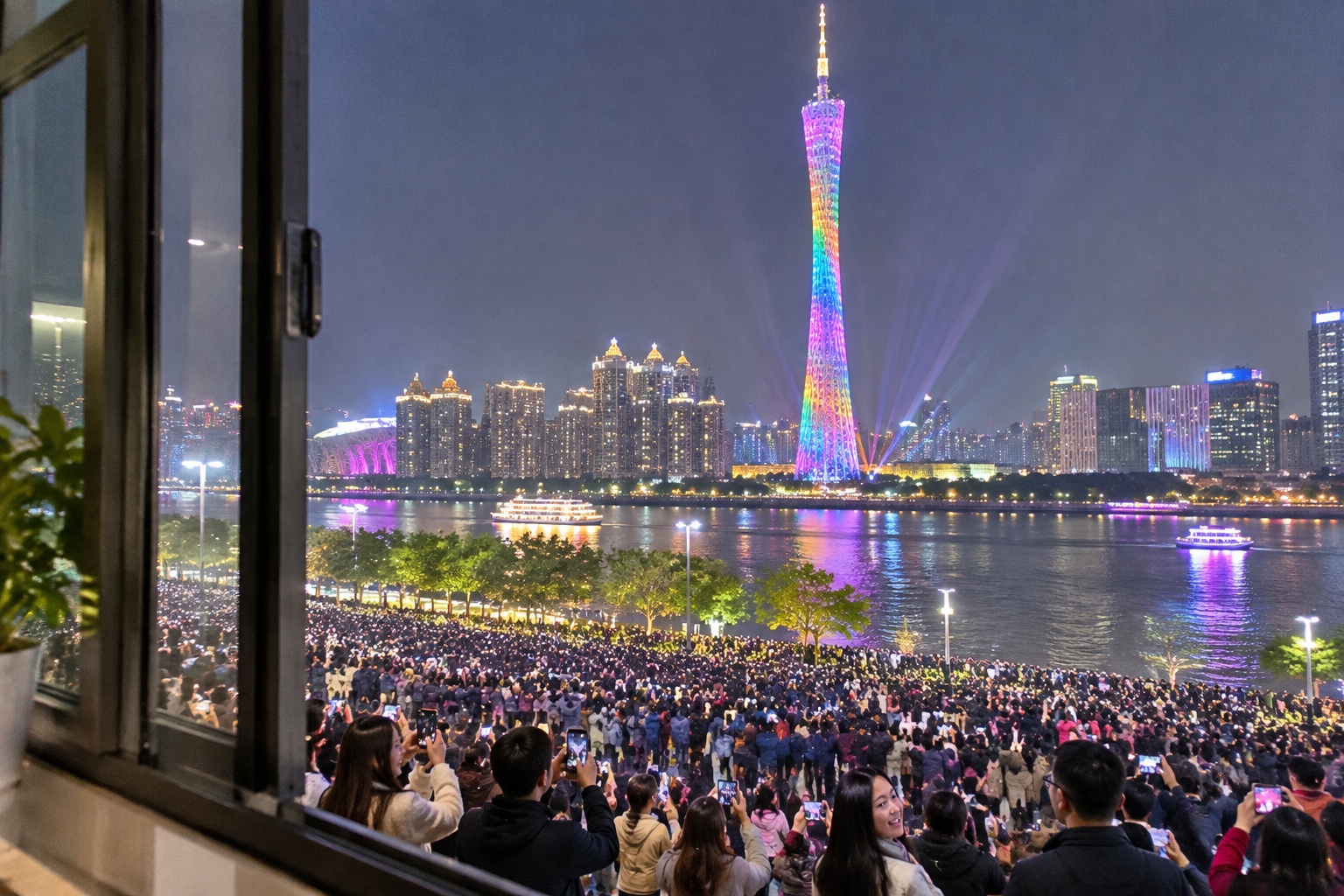
The pride is real and mostly uncomplicated. Ask anyone in the city for the landmark and you get the tower. On New Year’s Eve it runs a countdown light show and tens of thousands of people pack the riverbank; residents in Tianhe watch from their balconies because the metro exits around the tower get closed for crowd control. When the city wants to mark something, it turns the tower a color.
The complaints are just as real. Tickets are expensive by Chinese standards — a family of four going up to the 488-meter deck is over 900 yuan for a view. Queues are long. ‘Locals don’t go up,’ a taxi driver told me. ‘We look at it from the river. It’s free and the food is better.’ And there’s a subtler grumble: the tower stands in Haizhu, technically, but it belongs to the Tianhe skyline across the water. It is a landmark people feel ownership of without ever having paid for.
If You Go: The Practical Version
Getting there. Metro Line 3 or the APM line to Canton Tower Station. Line 3 between 6pm and 7:30pm is genuinely unpleasant; take the APM from Linhexi, or walk over Liede Bridge in about 25 minutes and get the skyline shot on the way.
Timing. Arrive about 45 minutes before sunset. Walk Huacheng Square first while there is still light, cross to the river for the 6:50–7pm lighting moment, then decide whether you are going up. November to February gives the clearest air; summer nights are hazy and humid, and July to September is typhoon season, when the rooftop rides and outdoor deck close for wind and rain.
Cost. Observation decks around 150 yuan, the 488-meter outdoor platform around 228 yuan, Bubble Tram and Sky Drop extra. Night cruise 80–200 yuan. The square and the promenade: free.
Skip. The revolving restaurant, if you care about food. The tower on a cloudy day — you will pay 228 yuan to sit inside a cloud. The weekend 8pm slot, unless you enjoy queues as a social activity.
One rule. Check the tower’s official WeChat account the same day. Wind, rain and maintenance close the roof without much warning, and refunds move slower than the elevator.
Start the discussion at forum.chinacomes.com