
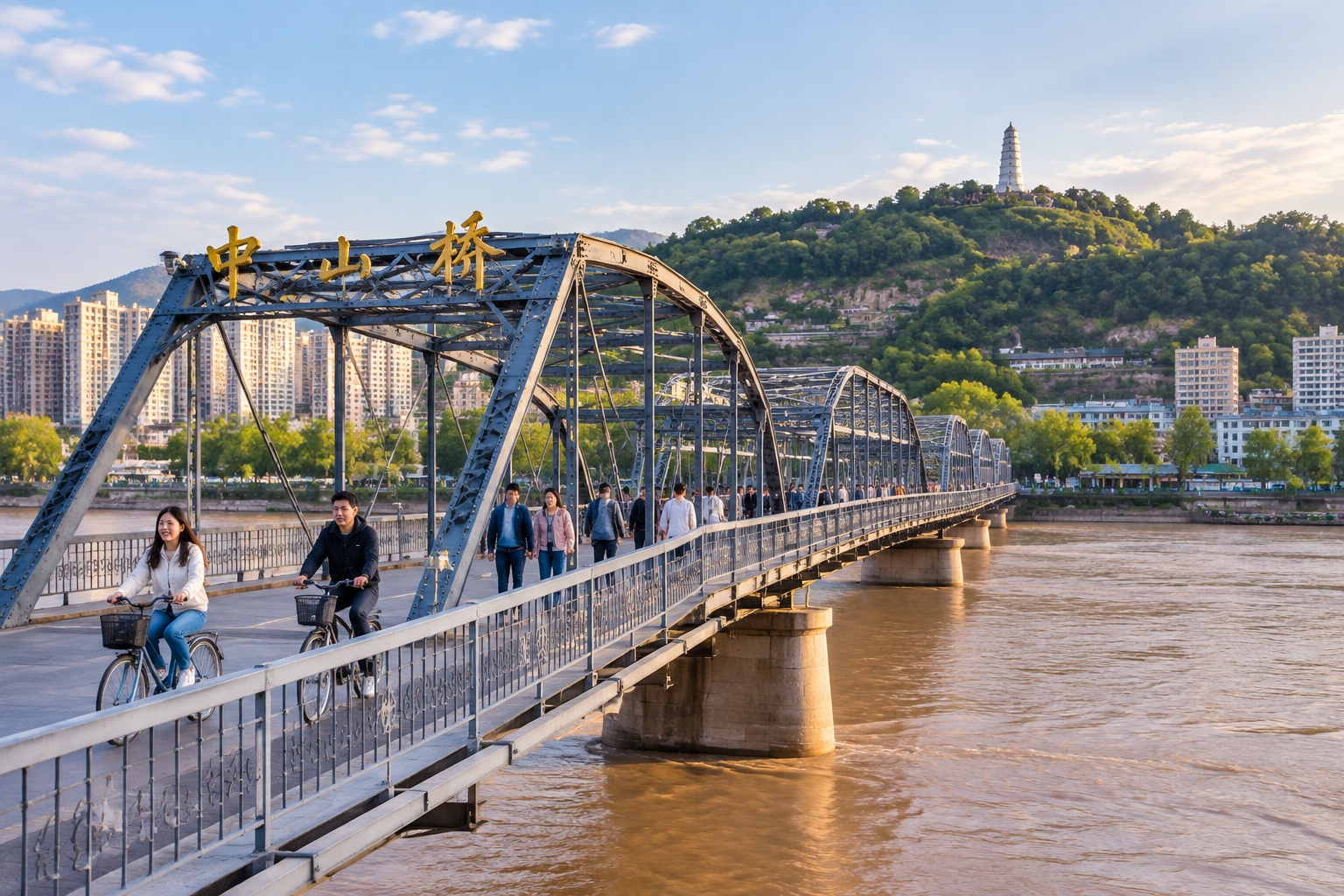

Steel That Arrived by Mule Cart
In the spring of 1907, heavy wooden carts began arriving in Lanzhou from the east, loaded with steel beams, rivets, cement and machine parts. The material had left Hamburg by ship, crossed the ocean to Tianjin, and then covered more than 1,500 kilometers (about 930 miles) overland — by rail where rail existed, then by cart, mule and pack animal along the old road through Xi’an. Lanzhou had no railway of its own. The first train would not reach the city until 1952.
The steel was for a bridge, and the bridge is still standing. Zhongshan Bridge — for most of the twentieth century, everyone simply called it the Yellow River Iron Bridge — carries pedestrians across the river today: roughly 233 meters (765 feet) long, 7.5 meters (25 feet) wide, resting on four piers planted in the current.
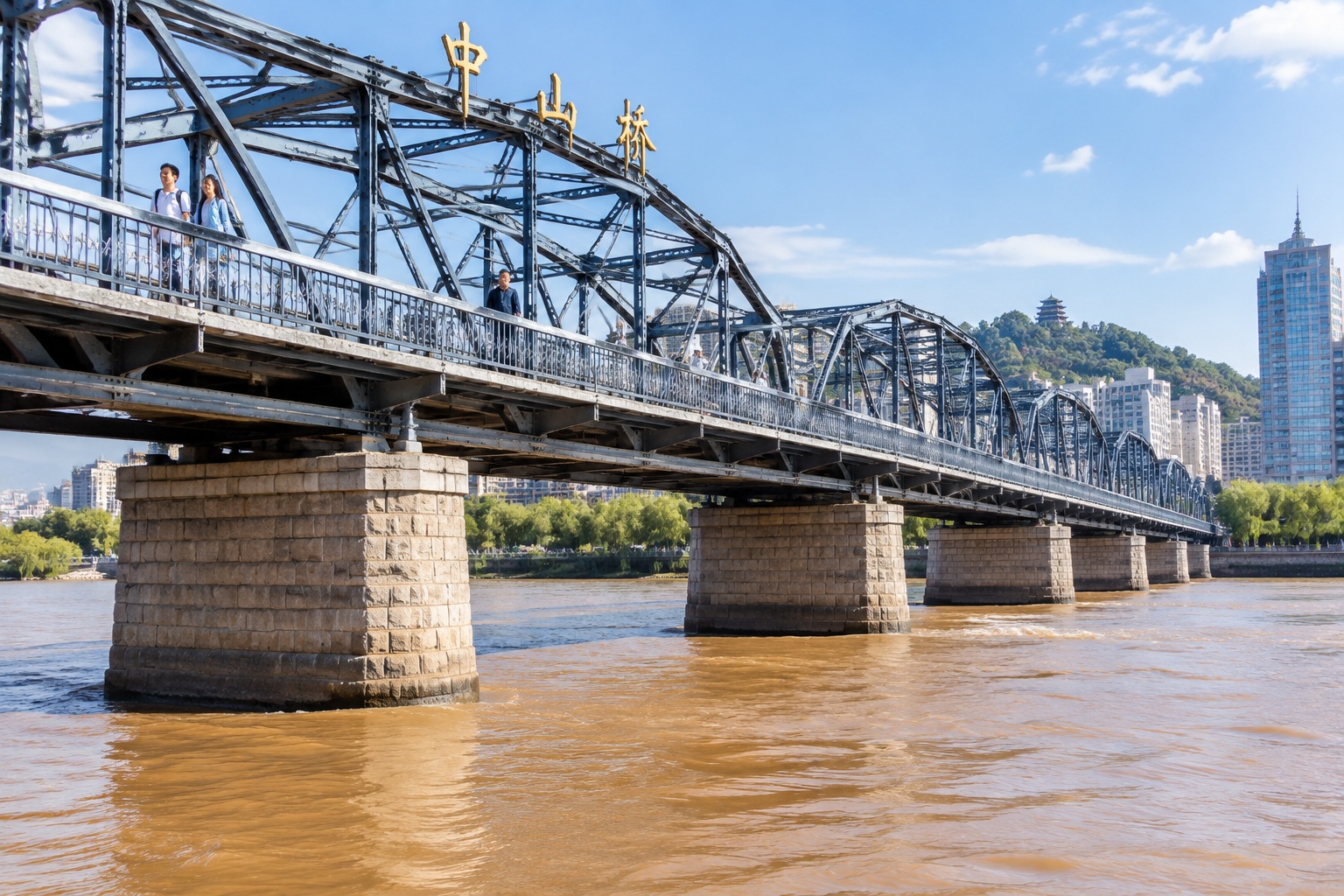
Chinese visitors know it as “the first bridge over the Yellow River.” That phrase needs unpacking, because it is partly engineering history and partly civic pride.
What “First Bridge” Actually Means
The Yellow River runs 5,464 kilometers (3,395 miles) — the second-longest river in China and the sixth-longest in the world — and for most of recorded history it was a barrier rather than a road. At Lanzhou, a garrison town on the eastern approach to the Silk Road, people crossed by ferry. In 1372, Ming dynasty soldiers built a pontoon bridge of boats chained together, the Zhenyuan Floating Bridge, and for the next five centuries that was the only fixed crossing here. Every winter, when ice came down the river, it was taken apart.
Building in iron and steel over this particular river was a different order of ambition. Muddy, fast and heavy with silt, the Yellow River scours piers and shifts its channel; any bridge here has to survive both flood season and ice runs. The first permanent structure to cross the river anywhere was a railway bridge at Zhengzhou, finished in 1906 for the Peking–Hankou line. Lanzhou’s bridge, completed three years later, was the first permanent road bridge across the Yellow River. Both statements are true, and Lanzhou’s claim rests on the second one.
The project was an unusual joint venture for 1906. A German trading firm based in Tianjin, Telge & Schroeter, signed the contract; German engineers supervised the work; the crews who riveted the structure together were Chinese, and local accounts credit a Chinese foreman, Liu Yongqi, with running much of the assembly. The final bill came to more than 300,000 taels of silver, a sum the provincial government of Gansu did not have in a drawer. Raising it took years and a good deal of argument.
A Century of Traffic, Damage and Reinforcement
The bridge’s history is not a smooth line. It was renamed Zhongshan Bridge in 1928, in memory of Sun Yat-sen. In August 1949, during the battle that brought Lanzhou under Communist control, it was damaged in the fighting and repaired within months. In 1954, engineers added curved steel arches along both sides to let it carry heavier loads — which is why the bridge you photograph today does not look quite like the 1909 photographs. For most of the last century it was simply a road: trucks, buses, bicycles and pedestrians sharing one narrow deck.
In the 2000s the city took cars off the deck and made it pedestrian-only, a decision that now looks like the best thing that could have happened to it. In 2006 it was listed as a Major Historical and Cultural Site Protected at the National Level — the Chinese equivalent of a national monument designation — and in 2009 Lanzhou marked its centenary with repairs and a good deal of local ceremony. Work has continued since, but the original piers and much of the original steel are still doing their job.
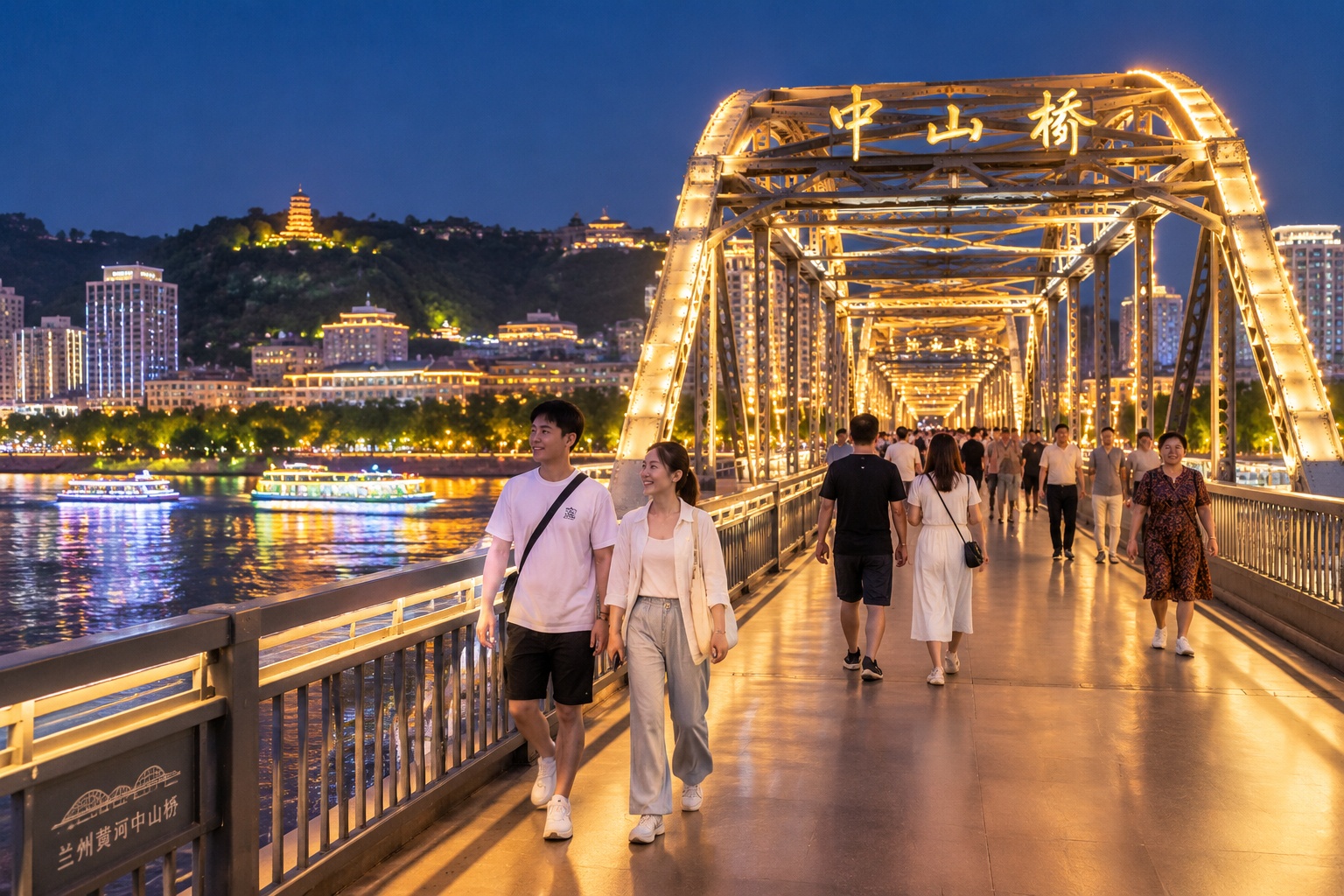
Under the Bridge, on Both Banks
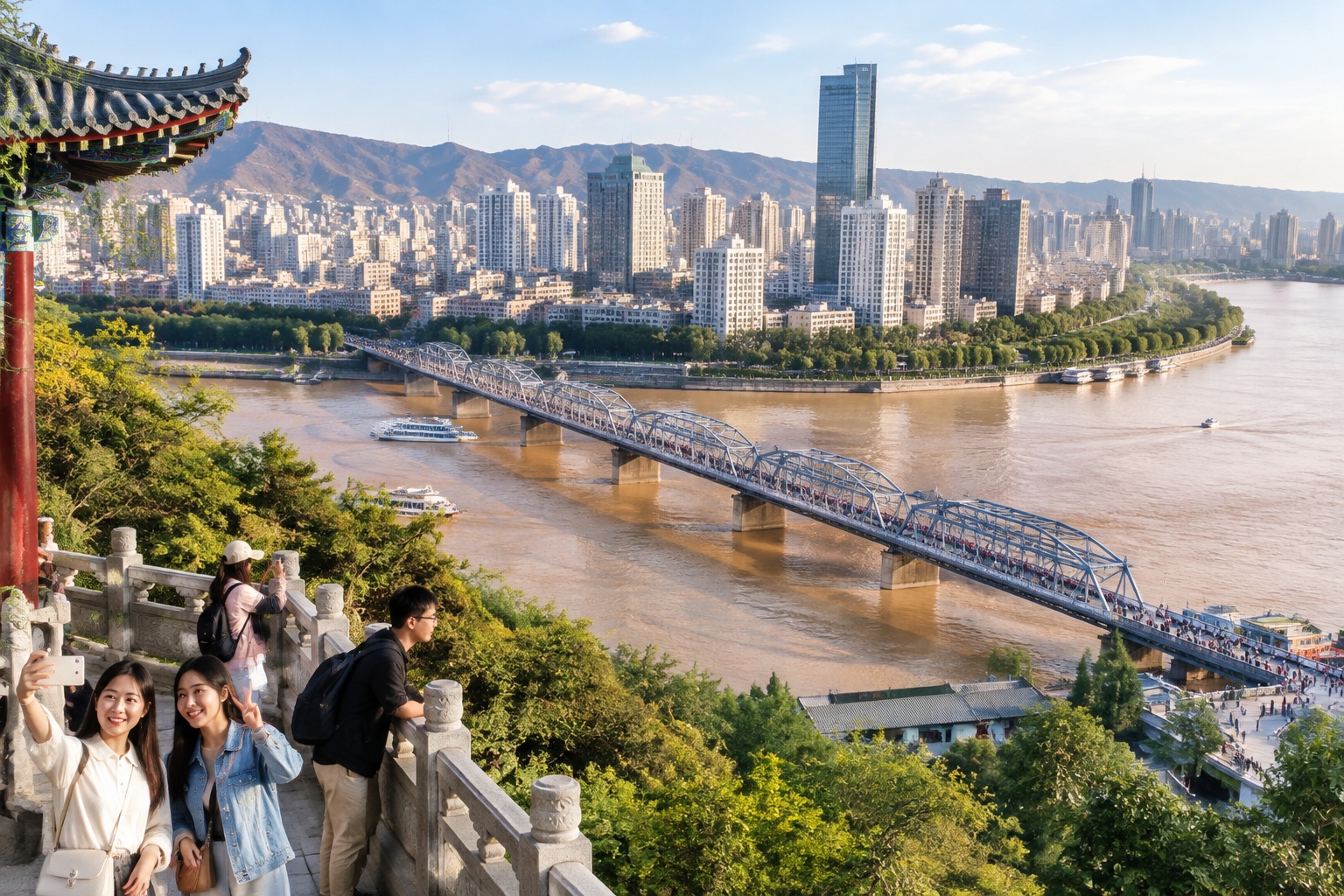
Walk north across the deck and you arrive at the foot of White Pagoda Mountain, whose Yuan-dynasty pagoda sits above the north bank. The climb takes about fifteen minutes and gives you the single best view of the whole arrangement: the iron trusses, the river bending east, and the towers of the south bank stacked up behind them.
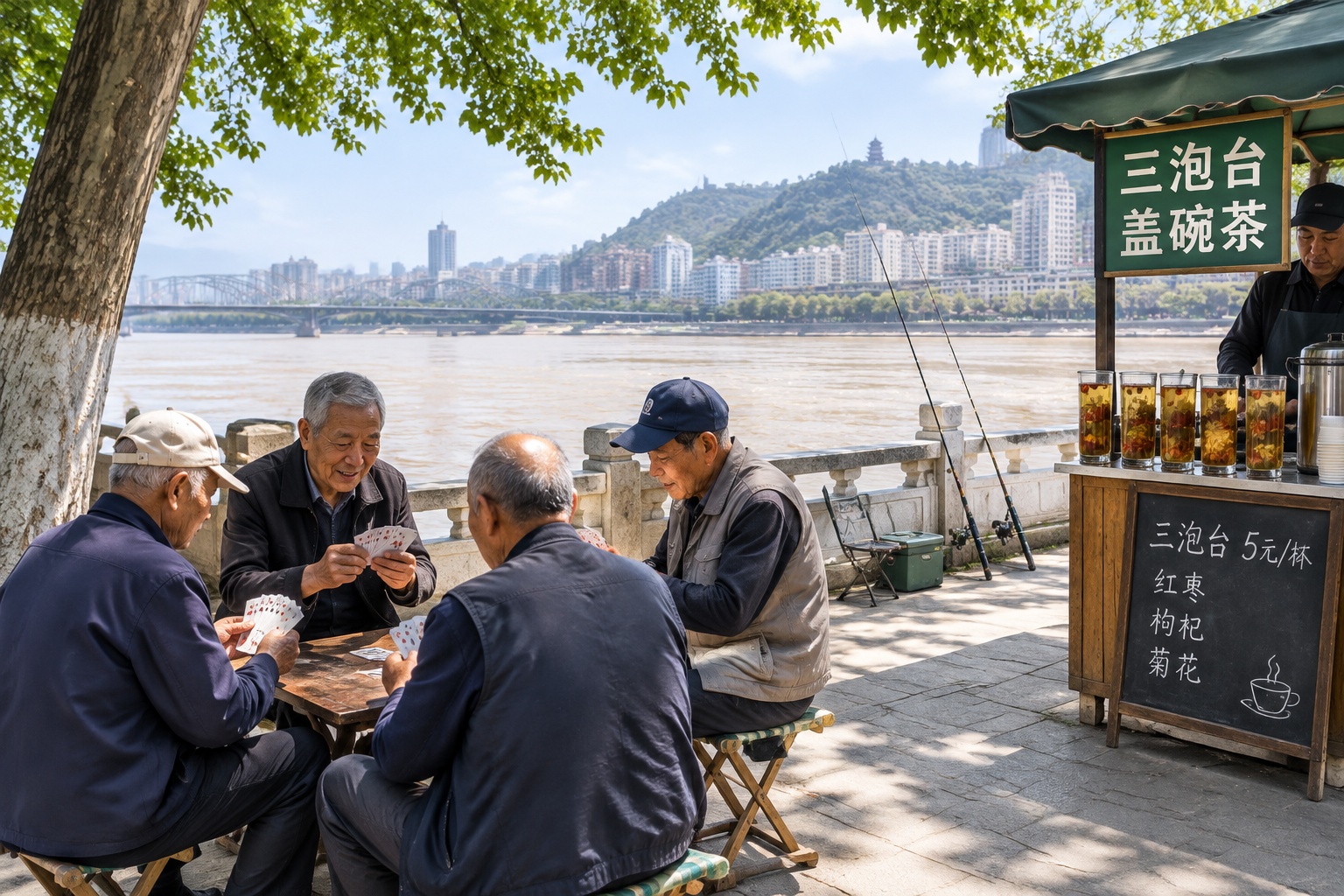
Along the water, Lanzhou has built a riverside promenade running more than 40 kilometers, usually called the Yellow River Scenic Line. It functions less like a tourist attraction than like the city’s living room. Retirees play cards at low tables in the shade. Men fish with long poles. Tea stalls sell sanpaotai, a Lanzhou specialty — green tea in a tall glass with rock sugar, dried dates, longan and goji berries, topped up with hot water until you give up. In summer, children wade at the edges, and sheepskin rafts, the traditional inflated-livestock boats that once carried cargo downstream, still take paying passengers on short hops. The Yellow River Mother sculpture, carved in 1986, stands a few hundred meters upstream.
Some of the most interesting infrastructure along the walk is much older. The giant wooden waterwheels in the Waterwheel Park follow a design introduced to Lanzhou in the 1550s by a local official named Duan Xu; for centuries they lifted river water onto the terraces above the city.
How to See the Bridge
A few practical notes, because timing here matters more than most visitors expect. Lanzhou runs on Beijing time but sits far west of it: solar noon in the city falls around 1 p.m. In winter, the sun can rise after 8 a.m.; in summer it may not set until nearly 8:30 p.m. Local mornings are dark and unhurried, and evenings run long.
If you want the bridge without the crowd, come between 7 and 8:30 a.m., when it belongs to commuters, joggers and people carrying breakfast. If you want photographs, two angles are reliable. The first is from the north bank path below White Pagoda Mountain, looking south through the trusses toward the skyline, which frames steel, river and city in one shot. The second is from partway up the mountain in late afternoon, when the light hits the south bank and the river turns the color of wet clay. After dark the bridge is illuminated, and that is when most locals walk it; the deck stays open all night.
Weekends and public holidays are busy. During the Lanzhou Marathon, held every June along the river, the bridge becomes part of the course and is packed from early morning. And if you want the other local institution: beef noodles cost between 8 and 12 yuan (roughly $1.20 to $1.70), are eaten before 9 a.m., and are almost never called “Lanzhou lamian” by the people eating them.
The Wider Northwest
Lanzhou is not the only city in this region with layered memory. Xining, an hour west by high-speed rail, has the Dongguan Mosque, founded in the fourteenth century and rebuilt in a blend of Chinese and Islamic forms. Yinchuan, roughly two hours northeast by rail, keeps its Drum Tower at the center of the old town, ringed by a Muslim quarter and the food streets that come with it. Both are worth their own trips and their own articles. The reason to mention them here is that China’s northwest is not one story about deserts and oil, but a set of cities where Han, Hui, Tibetan and Mongolian histories overlap in ordinary streets. Lanzhou’s bridge is one way into that region, not the whole map.
Still a Sidewalk
What makes Zhongshan Bridge unusual is not that it survived. It is that it was never retired to a plinth. Schoolchildren cross it on the way home. Office workers use it as a shortcut between the north bank and the downtown core on the south side. Couples take wedding photographs near the southern end. Crowds from the Zhengning Road night market, a short walk inland, drift toward the river afterward.
The steel came from Germany, the labor came from Gansu, and the money came out of a provincial treasury that could barely afford it. More than a century later, the result is a piece of engineering so fully absorbed into daily life that most people crossing it are not thinking about any of that. That may be the strongest thing you can say about a bridge.
Start the discussion at forum.chinacomes.com