
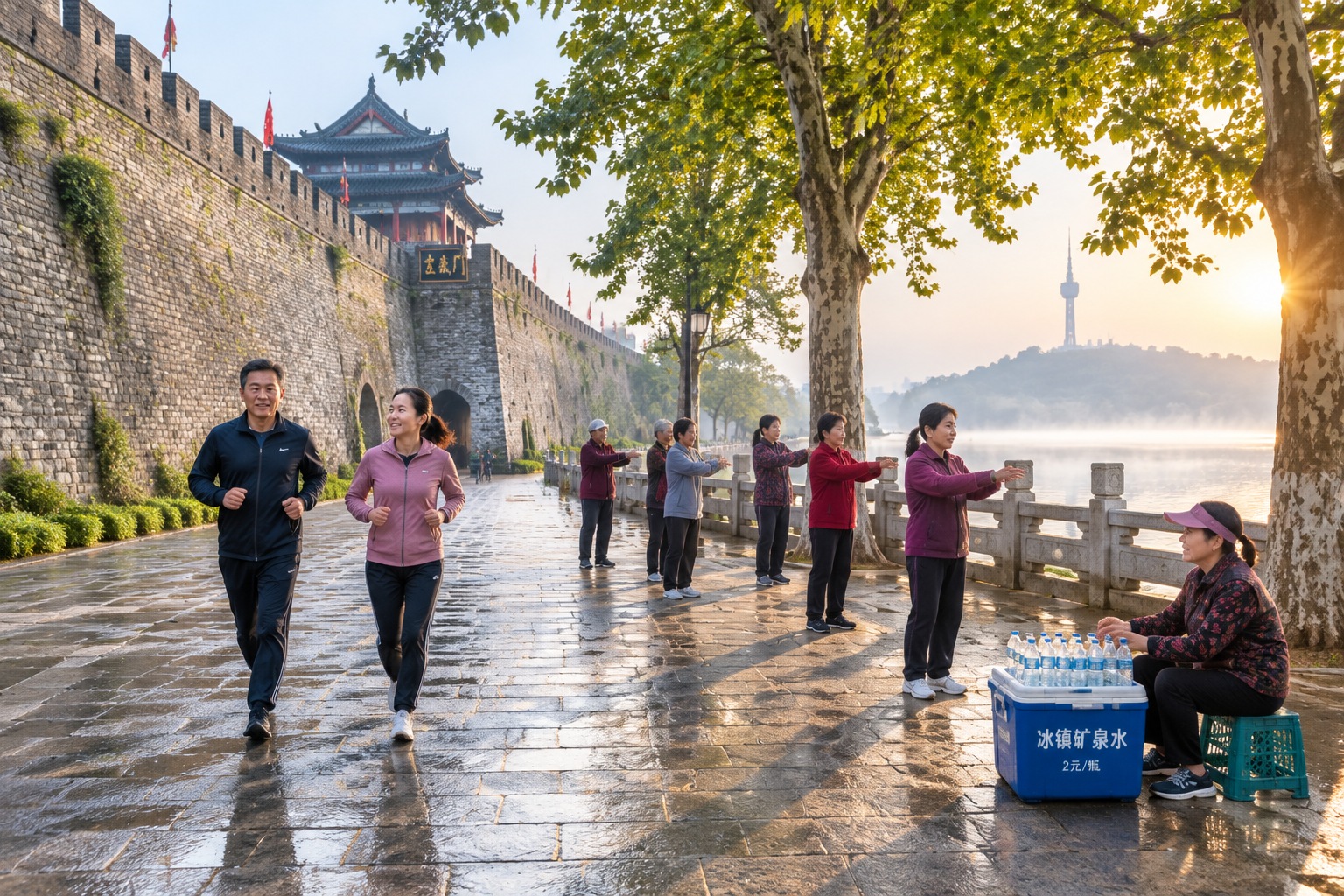

6:40 a.m. at Xuanwu Gate
The first sound at Xuanwu Gate isn’t history. It’s a shuttlecock being smacked back and forth somewhere behind the trees, and a man counting his own laps out loud in a voice that carries across the water.
I arrived expecting a monument and found a park gate. A few dozen retirees were doing slow arm swings under the plane trees. A woman in a pink sun visor sold bottled water out of a cooler, three yuan a bottle. And past all of them ran the wall itself — twelve meters of gray brick, curving left toward Xuanwu Lake and right into the city, a line so long you can’t see either end.
Nanjing’s Ming city wall is not a ruin you look at from behind a rope. It’s infrastructure that people lean on, jog past, and argue next to. That’s the first thing a visitor should understand about this city, and the entire walk from Xuanwu Gate to Jiming Temple is basically a demonstration of it.
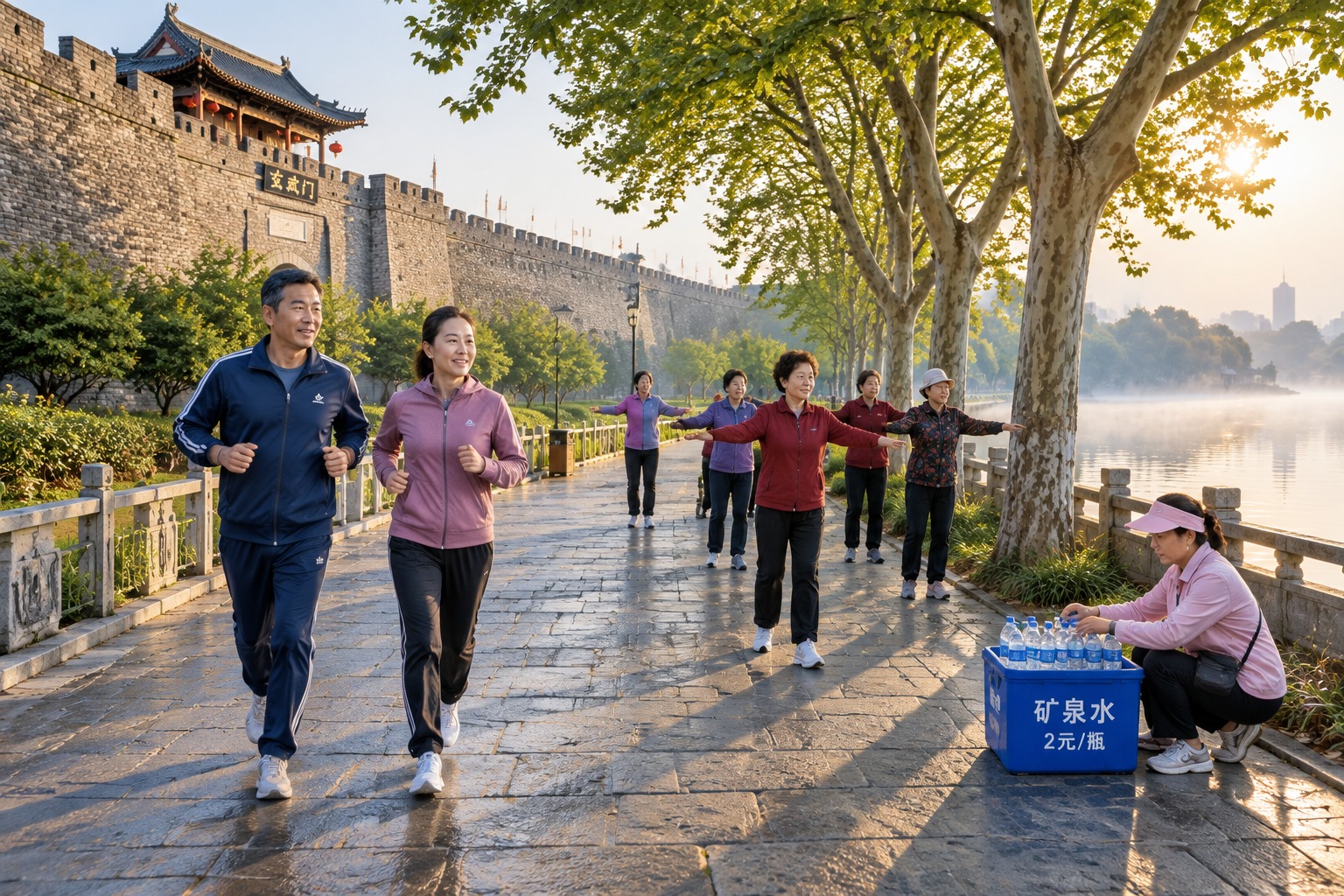
Where the Wall Meets the Lake
Xuanwu Gate sits on the western edge of Xuanwu Lake, which locals treat roughly the way New Yorkers treat Central Park — a giant, free, slightly chaotic backyard. Entry to the lake park has been free since 2010, so on any weekday morning you get the full spectrum: elderly couples doing tai chi by the lotus ponds, twenty-somethings in running gear doing a nine-kilometer loop around the five islands, a man with a portable speaker playing 1980s ballads at a volume that suggests he has already lost the argument.
If you’re the kind of traveler who asks who built what and when: the wall beside you went up between 1366 and 1393, on the orders of Zhu Yuanzhang, the peasant-turned-emperor who made Nanjing the capital of the Ming dynasty. The original circuit ran about 35 kilometers. Roughly 25 kilometers still stand, which makes it the longest surviving city wall in the world — a fact Nanjing mentions often and has honestly earned.
One detail worth knowing: the gate you walk through is not one of the original thirteen. It was cut through the wall by hand in 1908, when the city decided it needed a western entrance to the lake, and was renamed Xuanwu Gate a few years after that. So the wall is 600 years old and the hole in it is about a hundred. Nanjing has been editing this structure, on and off, for its entire life.
Climbing the Wall: Bricks With Names on Them
Walk south along the outside of the wall for about fifteen minutes and you reach Jiefang Gate, where a staircase takes you up onto the ramparts. The ticket is around 30 yuan — check the sign at the gate, prices shift — and it buys you roughly 1.5 kilometers of walking on top of a 600-year-old defensive structure, with a lake on one side and a working city on the other.
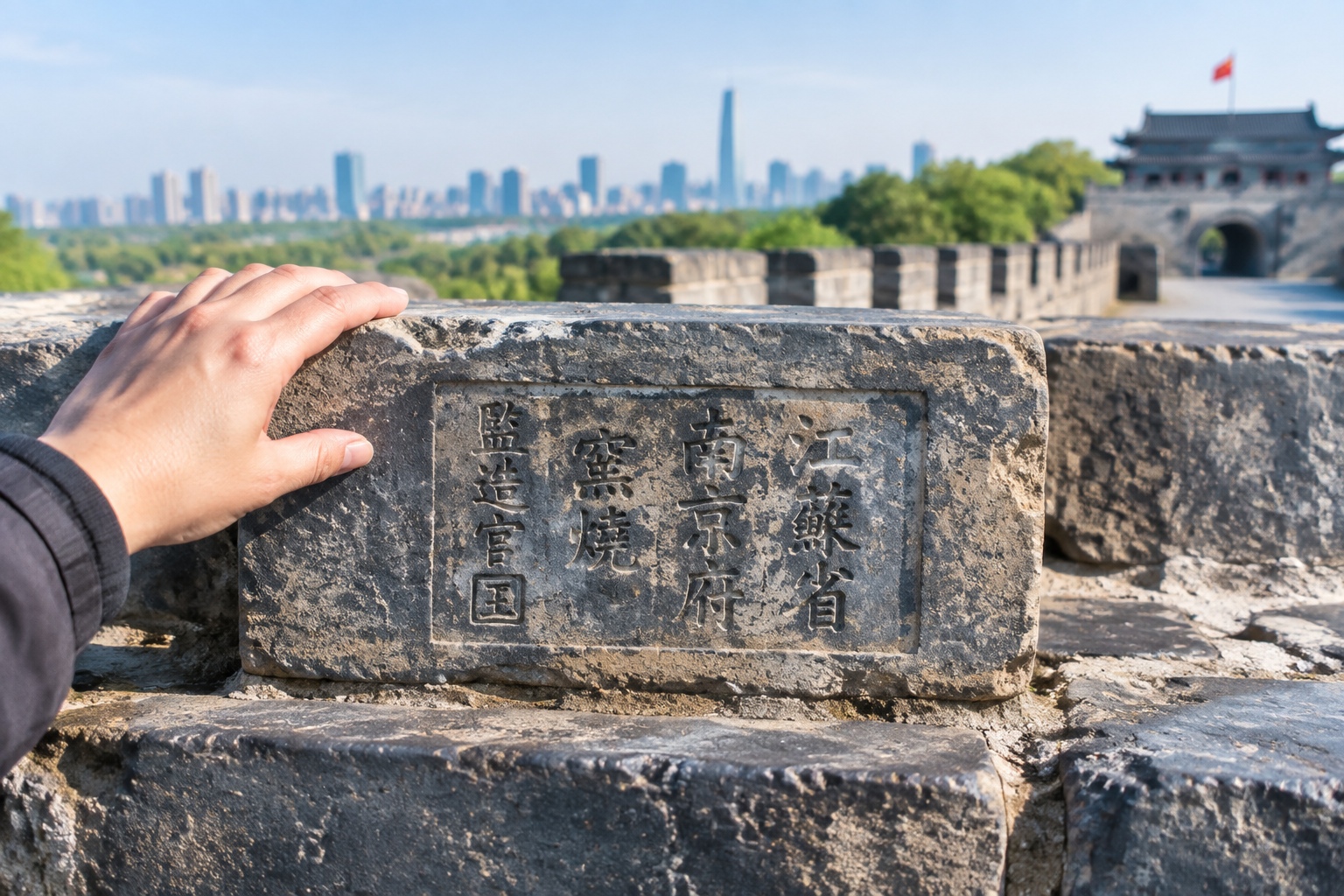
The best thing up there isn’t the view. It’s the bricks.
Look closely and you’ll find characters stamped into them: kiln names, provinces, dates, the names of the officials who inspected each batch. Zhu Yuanzhang ran the largest brick-procurement operation of his era, pulling bricks from provinces across the empire, and he set up a simple quality-control system along with it. If a brick failed, you could trace it back to whoever made it, and that person would answer for it. Six hundred years of monsoon weather later, the stamps are still legible on hundreds of bricks in this stretch. It’s the least romantic and most convincing thing about the wall.
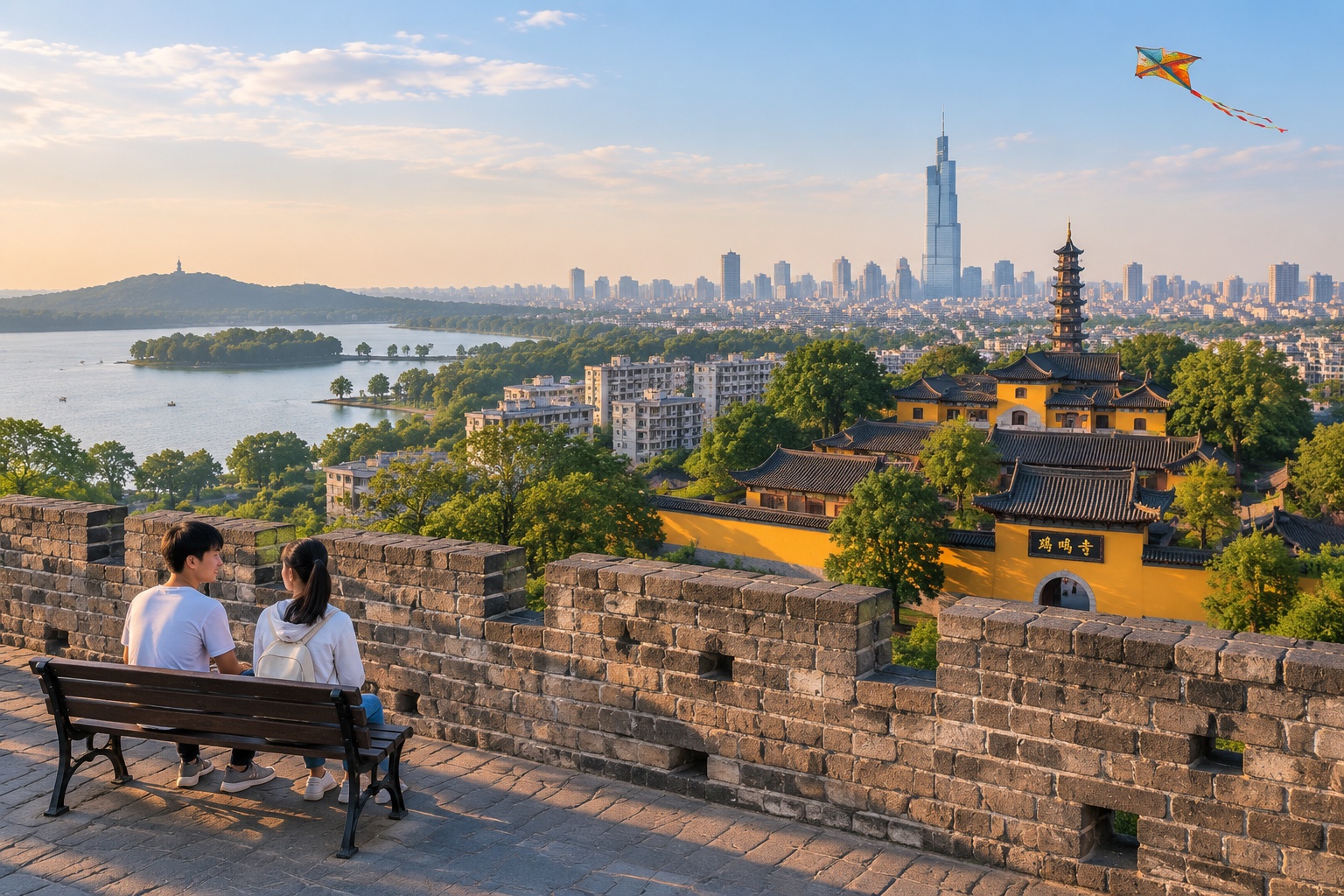
From the Ramparts: A City That Won’t Pick One Century
From the top of the wall near Jiefang Gate, Nanjing does something Chinese cities rarely do: it lets you see three centuries in a single frame. Below you are the yellow walls and tiled roofs of Jiming Temple. To the left is Xuanwu Lake and, beyond it, the boxy residential blocks of the 1980s and 90s. Straight ahead stands Zifeng Tower, 450 meters of glass and steel, and the rest of the modern skyline around Gulou and Xinjiekou.
Nanjing is not a city that cleared everything old to build everything new. It layered. The result is uneven and occasionally ugly, but it’s honest, and from the wall you can read it like a cross-section.
The wall is also public space, not just a viewpoint. On a Tuesday afternoon I counted two teenagers doing homework on a bench, a man flying a kite the size of a small car, and a couple in matching tracksuits walking the full length in silence. There are toilets, a vending machine, and staff who blow a whistle if you sit on the parapet — a rule several people were cheerfully ignoring.
Jiming Temple: Incense, Noodles, and the Oldest Buddhist Ground in the City
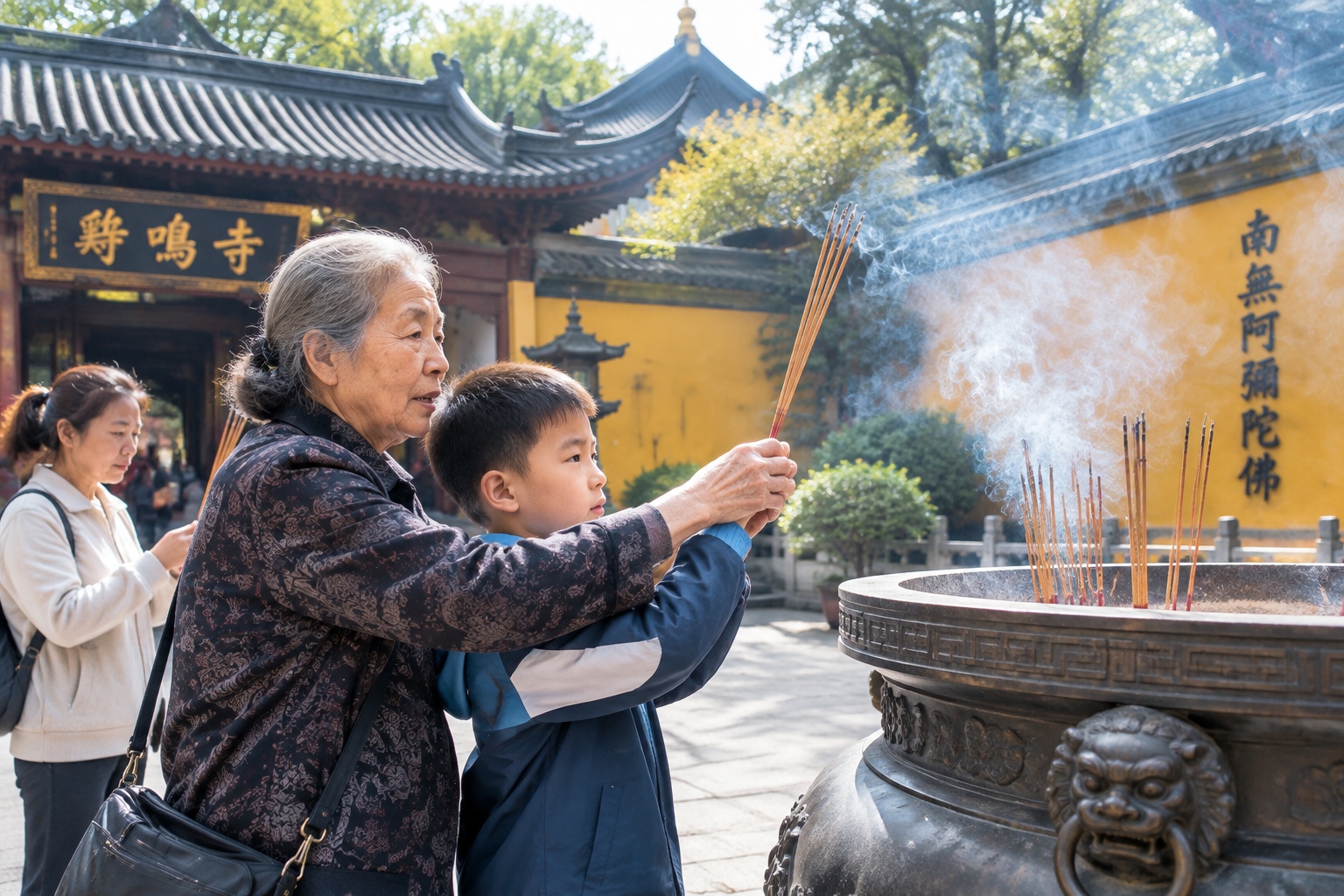
Come down at the northern end and five minutes of walking drops you into a completely different atmosphere: Jiming Temple, the “Rooster Crow Temple.” Its site reaches back to the Western Jin dynasty, around the year 300, making it one of the oldest Buddhist locations in Nanjing. The buildings you see today were rebuilt in 1387 under the first Ming emperor, then rebuilt again in the 1980s after decades of neglect — a cycle you’ll notice all over this city.
What hits you first is smell: sandalwood smoke, thick enough on a busy morning to make your eyes water. Then sound — usually not chanting, but coins clattering into boxes, cushions creaking, and grandmothers giving live instructions on how to hold three sticks of incense correctly.
This is a working temple, not a museum. Admission is around 10 yuan and traditionally includes a small bundle of incense. Most visitors are locals: office workers stopping in before their commute, students, couples. Around lunchtime a queue forms at the temple’s vegetarian restaurant, where the signature dish is a bowl of noodles in mushroom broth for about 20 yuan. It isn’t fancy. It’s very good, and it’s one of the few places in Nanjing where you sit elbow to elbow with monks, tourists, and somebody’s grandfather who has eaten here every week for thirty years.
Cherry Blossom Road: The Two Weeks Nanjing Loses Its Mind
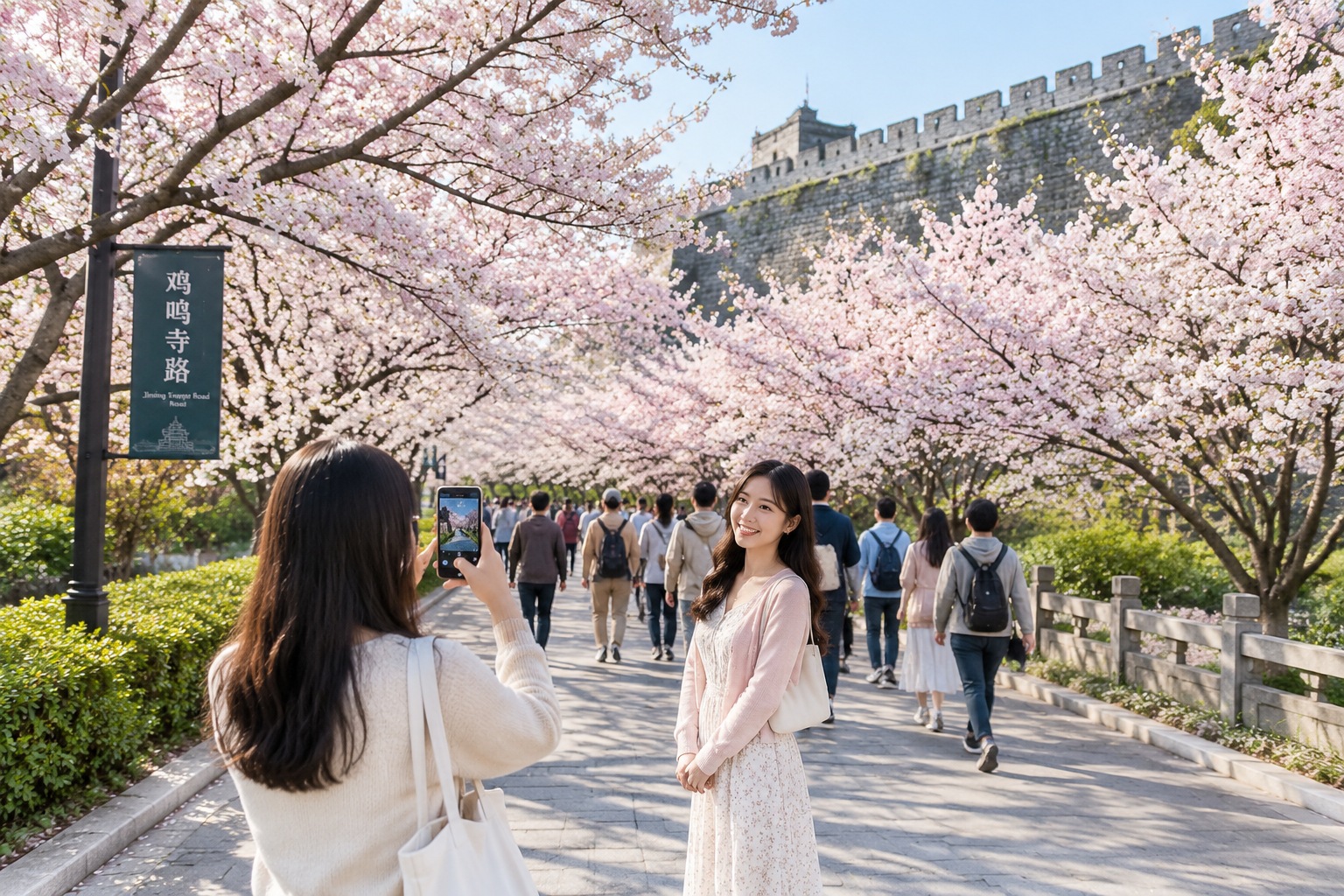
Out of the temple’s main gate, the street in front of you is lined with cherry trees — several hundred of them, along what everyone calls Jiming Temple Road. In late March and early April the whole street becomes a pink tunnel with the gray wall hanging above it, and this is the image printed on every Nanjing tourism poster ever made.
It is genuinely beautiful. It is also genuinely crowded. During peak bloom, weekend foot traffic runs one-way, metro exits at Jimingsi Station get closed or diverted, and the local government posts daily bloom forecasts online. If you want the photo without 400 strangers in it, come at 6:30 a.m. on a weekday, when the only other people there are photographers and elderly couples who have been walking this route every spring for twenty years.
Two weeks later the petals are gone, the street is quiet, and the wall is still there. That’s probably the more honest version of Nanjing, and it’s available about fifty weeks a year.
Practical Notes for Walking It Yourself
Getting there and getting around
Metro Line 1 to Xuanwumen Station puts you at the lake and the wall’s western side. Metro Lines 3 and 4 to Jimingsi Station put you at the temple. The walk between them, including the wall section, takes about two hours at a relaxed pace. Both ends connect to the rest of central Nanjing by metro, and taxis are cheap — a cross-town ride usually costs under 40 yuan.
Best time to go
Early morning, any day. Between 6 and 8 a.m. the wall is nearly empty, the light is soft, and Xuanwu Lake looks its best. Weekdays beat weekends by a wide margin. Late March to early April means cherry blossoms and crowds; October and November mean clear skies, yellowing plane trees, and almost nobody on the ramparts.
What it costs
Xuanwu Lake park: free. Wall section near Jiefang Gate: around 30 yuan. Jiming Temple: around 10 yuan. Vegetarian noodles: around 20 yuan. A full day out comes in under 100 yuan, or about 14 US dollars.
What to eat nearby
Duck blood vermicelli soup is Nanjing’s everyday dish — 15 to 25 yuan a bowl — and there are good versions within a ten-minute walk of Xuanwu Gate. Salted duck, the city’s other signature, is sold vacuum-packed and travels well if you want to take some home.
Things nobody tells you in advance
Bring WeChat Pay or Alipay, or a bank card linked to them. Small vendors here often don’t take cash. The wall has no shade, so in summer walk before 9 a.m. or after 5 p.m. And the temple is an active religious site: keep your voice down inside the halls, and don’t photograph people while they’re praying.
Nanjing is a city that has been destroyed and rebuilt more times than most, and it has learned to live with its own layers rather than flatten them. The walk from Xuanwu Gate to Jiming Temple is short, cheap, and takes you past a lake, a wall ordered by a peasant emperor, a temple where incense has been burning for some 1,700 years, and a road that turns pink for two weeks a year. It isn’t a checklist. It’s just what a Tuesday morning looks like here.
Start the discussion at forum.chinacomes.com