

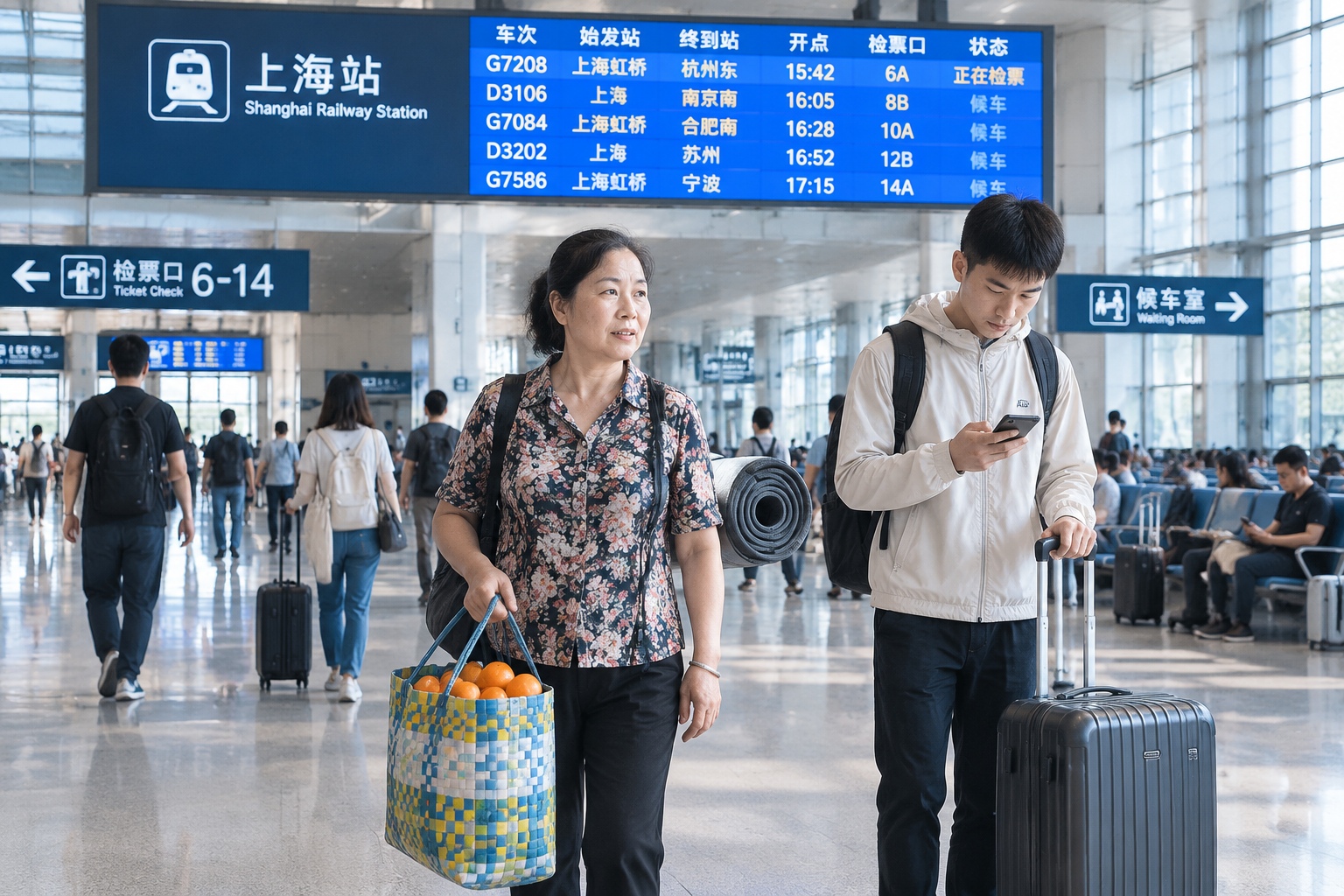
Platform 4, Shanghai Station, 1:05 p.m.
The woman ahead of me in the queue was carrying a woven plastic bag full of oranges, a rolled-up sleeping mat, and a paper ticket she kept checking against the departure board even though the board had not changed in ten minutes. She was going to Hami, 3,600 kilometers west, to visit a daughter who had married there eight years ago and had never once flown home.
I was going further: Urumqi, the capital of Xinjiang. My ticket cost 638 yuan — about $88 — for a lower berth in a hard sleeper. The journey would take roughly forty hours. Until that afternoon, “Xinjiang” was a word I had only read in headlines, a place described by other people, usually in arguments. I wanted to see the ground underneath it.
What 638 yuan buys on one of the world’s longest domestic train rides
Booking took four taps on 12306, China’s national rail app, which now accepts foreign passports after a short verification. At the gate you press your ID against a scanner and a glass door opens. There is no paper ticket anymore — just a QR code on a phone and a carriage number.
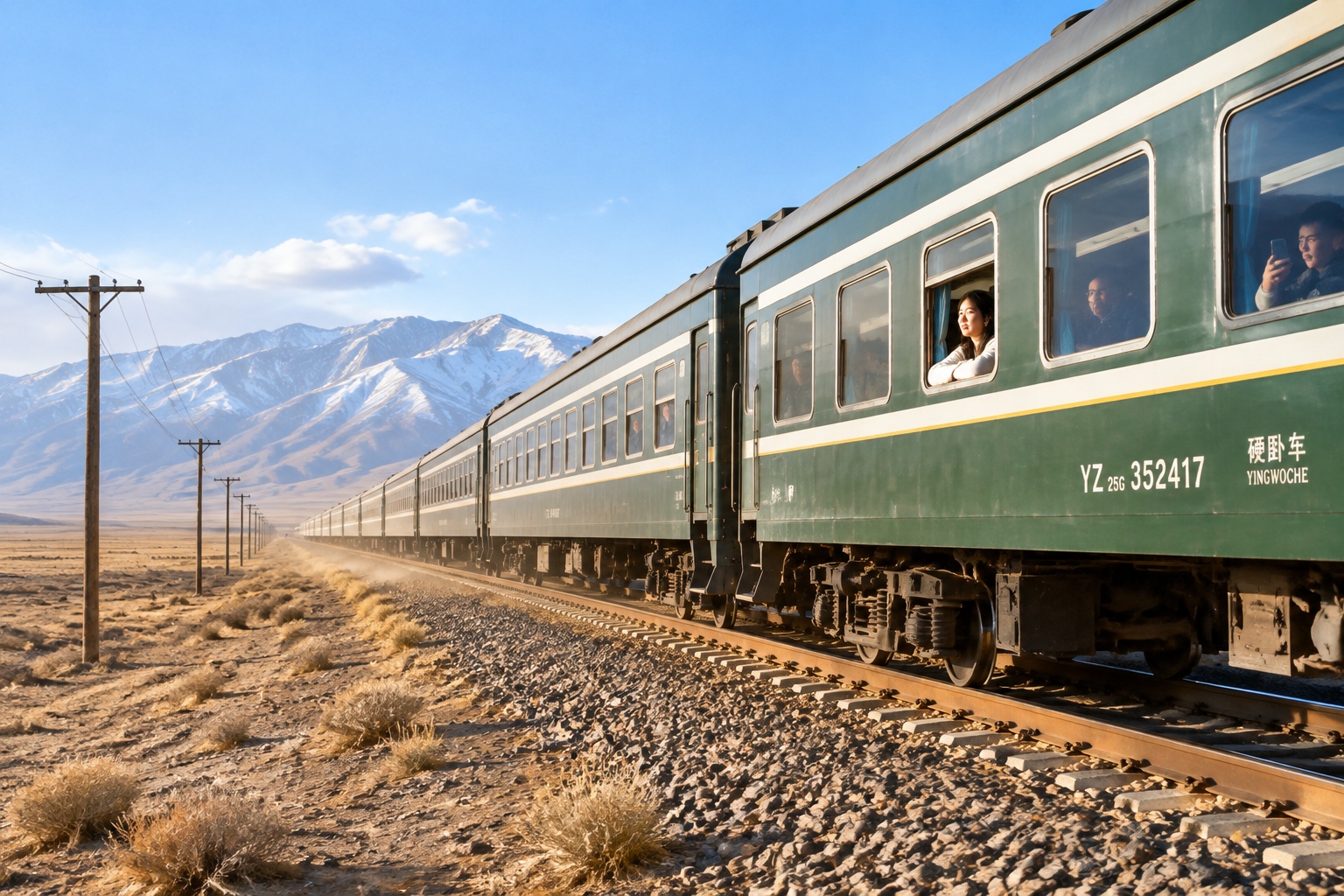
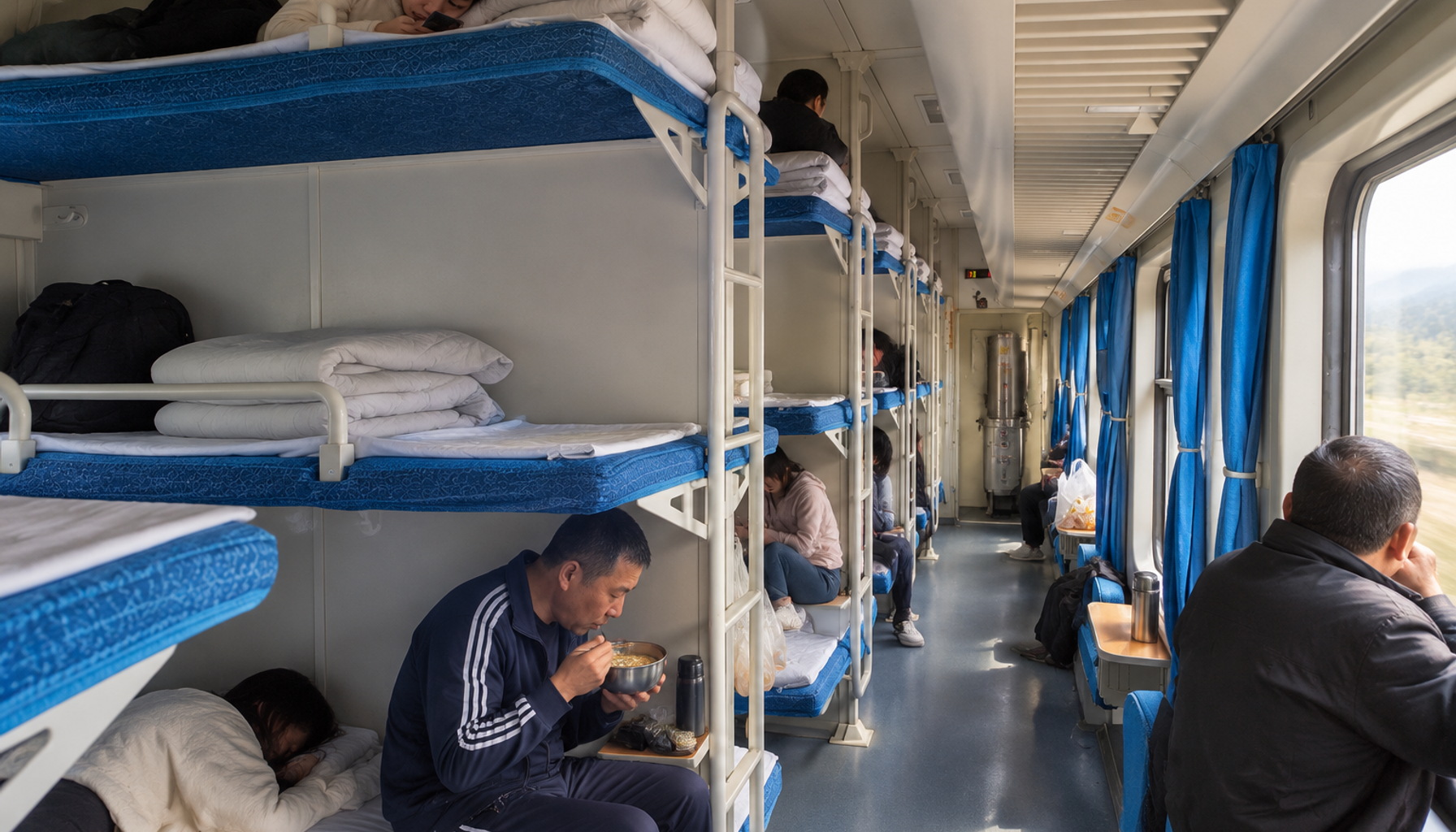
The Z-series train is the workhorse of long-distance Chinese rail. It is slower than the high-speed network, which now stretches past 45,000 kilometers, but it is far cheaper and far more sociable. My carriage held 66 berths in eleven open bays, three bunks on each side, no doors, no privacy. Every bunk came with a folded quilt, a pillow, and a sheet still warm from the laundry.
Some numbers help. Shanghai to Urumqi is about 4,000 kilometers — roughly New York to Los Angeles, or London to Tehran. The train crosses six provinces and one municipality: Jiangsu, Anhui, Henan, Shaanxi, Gansu, Xinjiang. It runs through the Yangtze Delta, the Central Plains, the loess hills, and then a thousand kilometers of desert. Average 100 km/h with stops, and you get forty hours.
The unwritten rules of a hard sleeper
By dinner on the first day, the carriage had organized itself. The man in the bunk below me, a construction worker heading home from a job in Kunshan, unfolded a small table and produced a bag of braised chicken feet. Two students shared a bowl of instant noodles. A woman from Kashgar handed around slices of melon. Food is the currency of the sleeper car; nobody eats alone unless they want to.
The hot water boiler at the end of the corridor runs all night. That single stainless steel tap is why the whole system works: tea, noodles, washing up, a warm towel before bed. Lights go out at ten. Announcements come in Mandarin and English, quietly, and nobody argues about the window blinds.
I spent an hour on a jump seat with a nursing student from Ili who was heading home for the summer. She studies in Nanjing. The train, she said, is cheaper than flying and she likes watching the scenery change; she has done it six times. Then she fell asleep against the glass, and I went back to my bunk and read until the reading light felt too bright.
Forty hours of watching the country change
Hours 1–8: water, cities, and container ports
Leaving Shanghai, you see something visitors rarely picture about eastern China: rice paddies pressed right up against container terminals, narrow canals with barges, and then apartment towers in rows of twenty, every balcony hung with laundry. The train does not leave the built-up area for a full hour.
Hours 12–20: wheat, and the Yellow River
By Henan the water is gone. Flat fields, wheat stubble, grave mounds standing in the middle of cropland, brick villages with blue metal roofs. The Yellow River crossing is a brown smear beneath a long bridge. Industrial parks appear and disappear. It is among the most densely populated farmland on earth, and from a train window it looks like work.
Hours 22–30: loess, tunnels, and half-empty villages
Across Shaanxi and into Gansu, the hills turn to yellow earth cut into ravines, and the train runs through tunnels for minutes at a time. Terraced fields climb the slopes in steps. Some of the villages you pass look half-empty — this is where much of China’s migration to the coast began, and the empty houses are the other half of that boom.
Hours 30–40: the Hexi Corridor
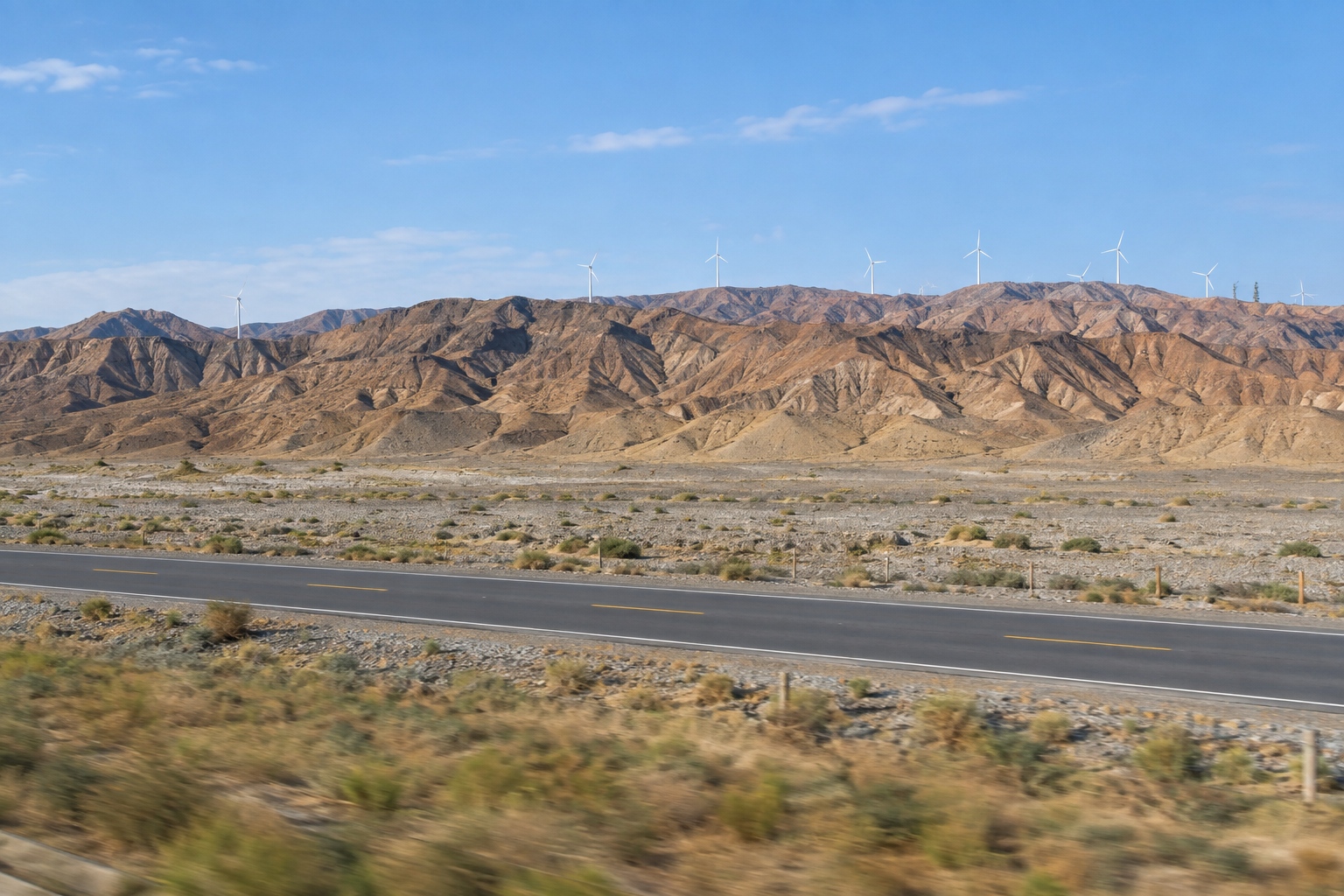
Then the color drains out. Gansu’s Hexi Corridor is a strip of green towns strung along snowmelt rivers with desert pressed against both sides. Wind farms, solar arrays, a four-lane highway with no cars on it. The Great Wall appears — unpainted, crumbling, one brick thick — running dead straight at the horizon. After Jiayuguan, for hours, there is rock, sky, and the occasional white dot of a yurt.
Turpan, and the last stretch
Turpan sits below sea level and is the hottest place in China. Grapes grow on trellises above the streets, watered by karez, an underground irrigation system older than the Silk Road trade it once supplied. At sunset the Flaming Mountains really do look lit from inside. From there it is two more hours to Urumqi.
Arrival: the most ordinary surprise
I had prepared myself for something remote. What I walked into was a city of about four million people with a metro line, glass office towers, delivery riders in blue and yellow jackets weaving through traffic, and a phone signal strong enough to run a livestream.
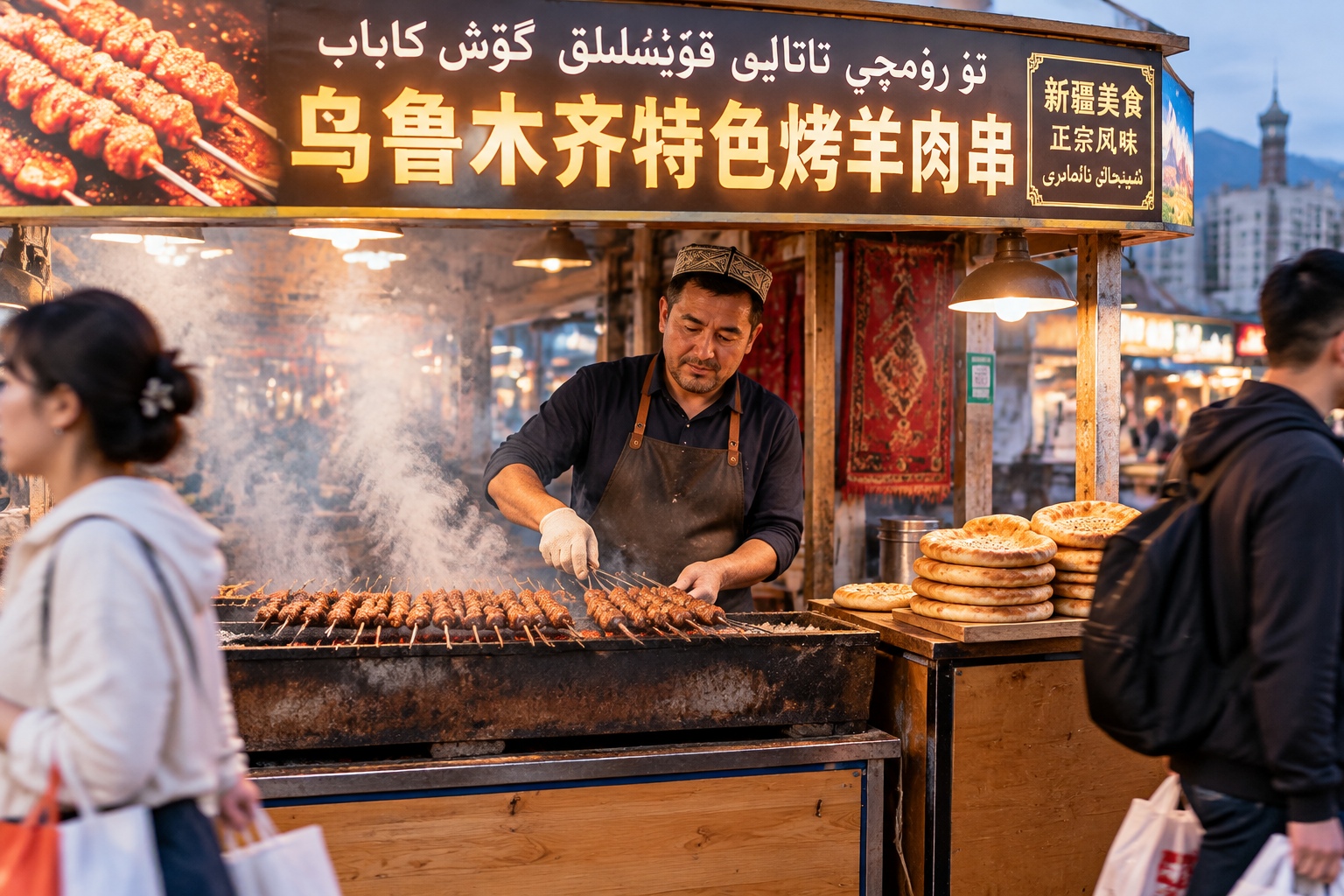
Urumqi’s signs are written in two scripts, Chinese and Uyghur Arabic. In one evening I heard Mandarin, Uyghur, Kazakh, and a Henan accent thick enough that I struggled. At the night market near the International Grand Bazaar, lamb skewers cost five yuan and come buried in cumin; the naan are the size of a steering wheel and keep for a week. A group of teenagers were filming a dance routine on a phone, resetting it four times because someone kept laughing.
The parts that don’t fit either story
Honesty requires this section. Urumqi has visible security: checkpoints at some public spaces, bag scanners at metro entrances, cameras on main roads. I was asked for my passport once, politely, at a museum.
I also sat in a café where a woman in her twenties ran an online shop selling dried fruit and nuts to customers in Guangdong, packing orders before the evening courier pickup. Both things are true on the same street. The versions of Xinjiang that circulate abroad rarely hold both at once, and the versions that circulate inside China rarely discuss the first. What I can report is that the place is not a headline. It is a city where people complain about ring-road traffic, queue for bubble tea, and argue about whether the melons from Hami or Korla are better. (Korla, said the vendor. Obviously Korla.)
Why take the train instead of a five-hour flight
Practical notes, if you want to make this trip yourself:
- Book on 12306. Foreign passports need verification, so start a few days early. Tickets are released 15 days before departure, and lower berths go first.
- Hard sleeper (yingwo) is the sweet spot: roughly 600–700 yuan for the full run. Soft sleeper is quieter and about double.
- Bring cup noodles, a thermos, and slippers. The hot water boiler is free and runs all night.
- There are power sockets at each bay. Download what you want before Gansu — the signal gets patchy.
- Don’t plan anything for your arrival day.
What the ticket actually changed
Before the trip I would have described China as one thing: fast, coastal, urban, digital, and legible in a single sentence. After forty hours of watching it slide past, a better description is a country arranged along a gradient — paddy field to desert, container port to yurt, without a single border crossing in between. The 4,000 kilometers cost me 638 yuan and two nights of sleep. It is probably the cheapest correction to your own imagination that money can buy.
Start the discussion at forum.chinacomes.com