
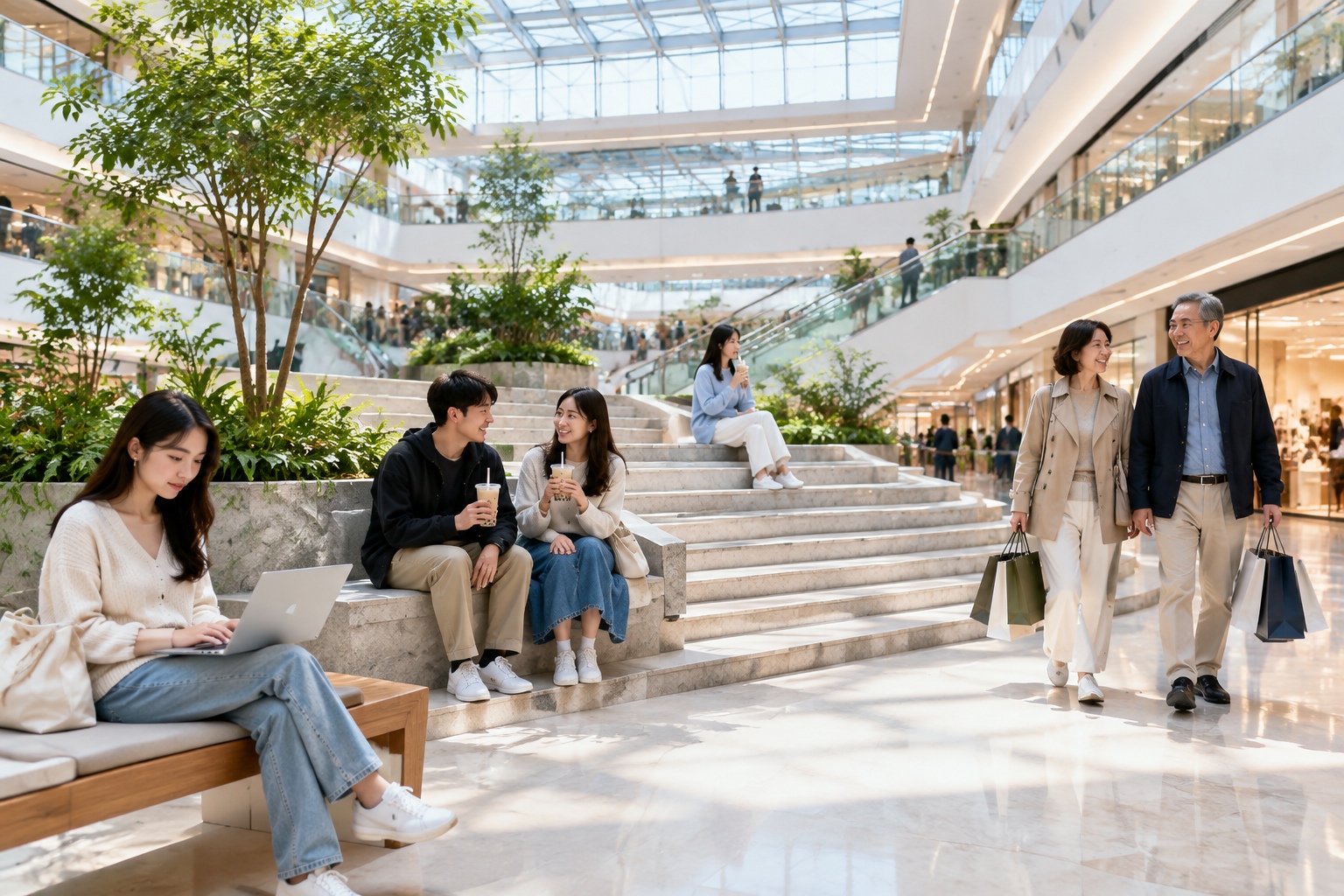

A Saturday afternoon with nothing on the schedule
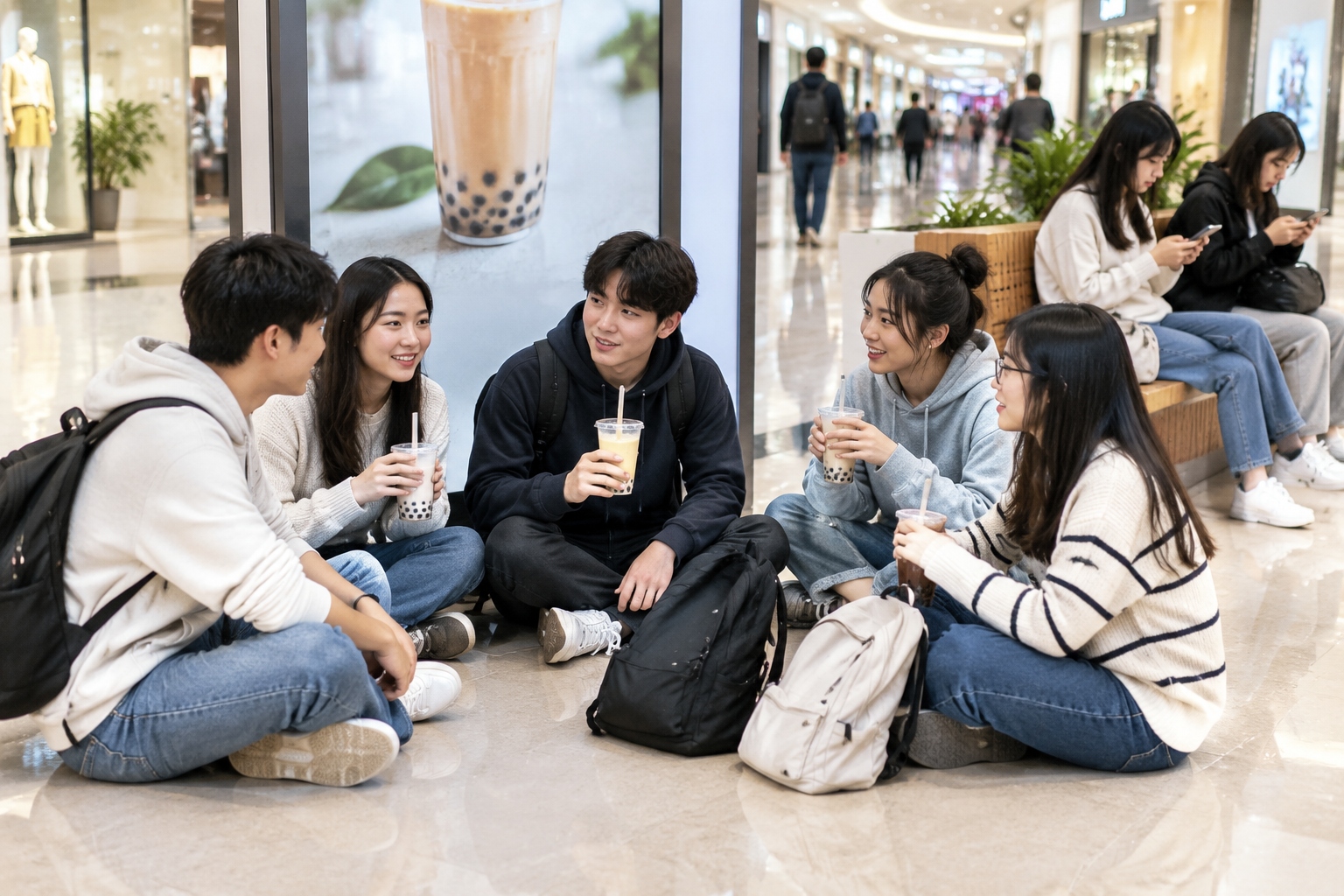
On the fourth floor of a mall in Chengdu, there is a row of benches across from a Uniqlo. On any given Saturday, four kinds of people are sitting on them. A university student with an iced tea and a phone. A man in his late twenties with a laptop open and one earbud in. Two women taking turns photographing each other against a wall of plastic plants. And a handful of teenagers who skipped the benches entirely and are sitting on the floor by the escalator, backpacks piled in the middle.
Nobody asks them to move. Very little money is changing hands. The same scene repeats itself, with local variations, in shopping centers from Shenzhen to Harbin, every weekend of the year.
If you grew up in the United States, this is probably where your eyebrows go up. In plenty of American malls, a group of teenagers sitting on the floor for two hours is a security matter. In a Chinese mall, they are the customers the building was designed for.
First, what a “third place” actually is
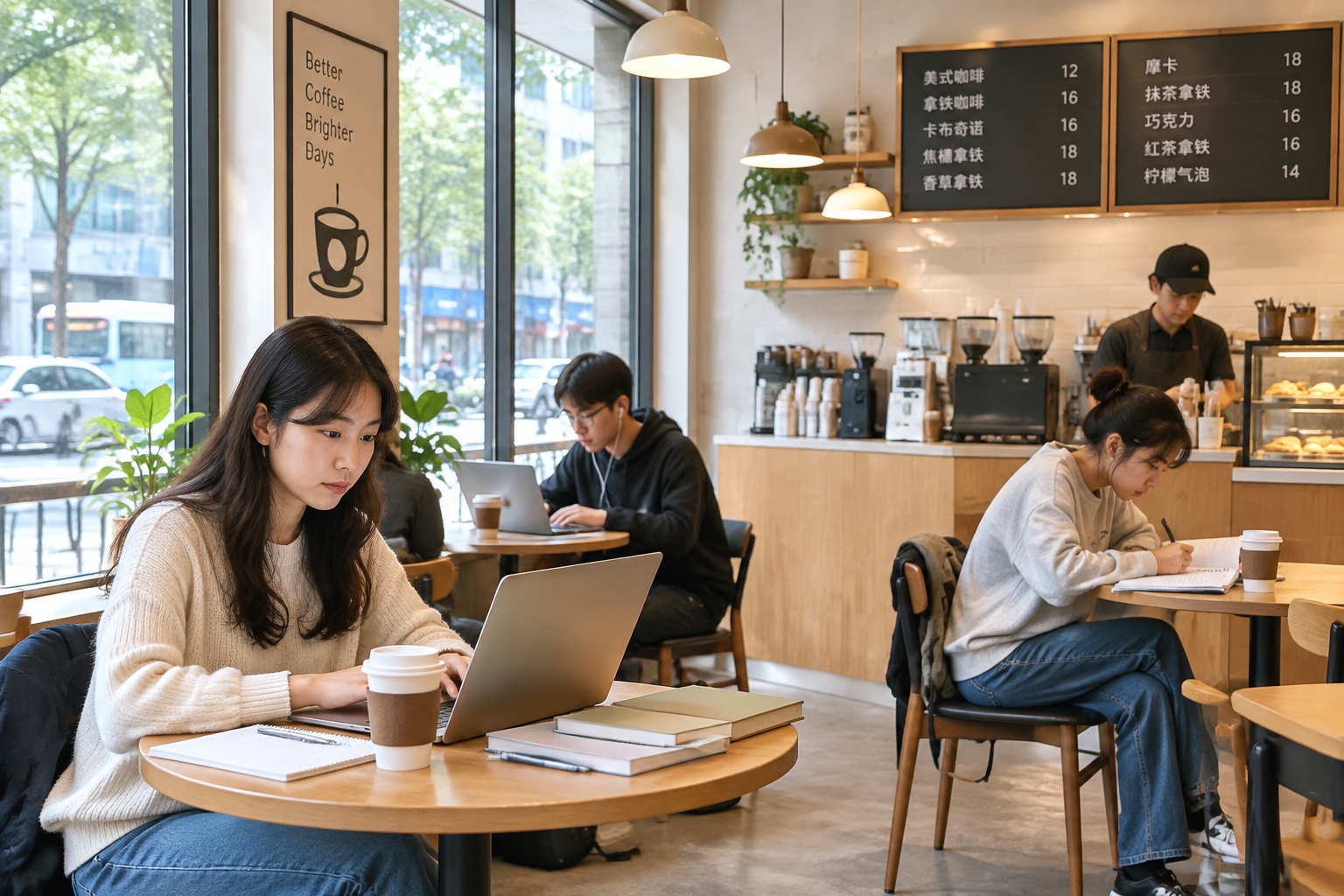
Sociologists use the term “third place” for somewhere that is neither home nor work: the pub, the café, the library, the church hall. Ray Oldenburg put the idea in writing in 1989; Robert Putnam later argued that in the US, these places have been quietly dying off. The classic examples are all Western, and they come with a Western price tag. A British pub expects you to buy rounds. An American café expects repeat orders. A French bistro will not let you hold a table for four hours over one espresso.
China urbanized later and much faster, and it built its third places in a different order. Home is often small or shared. Work is long. The two spaces that fill the gap — the mall and the park — are mostly free to enter, and unusually tolerant of people who are not spending.
Why the mall, of all places?
Four reasons come up again and again.
Weather. In July, Chengdu, Wuhan and Hangzhou routinely hit 35–40°C. In January, apartments in Shanghai and Nanjing can be colder inside than outside — those cities sit south of the Huai River line, where China’s centralized winter heating stops. Air conditioning and warmth are not luxuries here. They are the reason people leave the house.
Space. Many young Chinese rent a room rather than an apartment, or live with parents well into their twenties. Average urban living space is around 40 square meters per person, but that number hides a lot: households are smaller, cities are denser, and hosting people at home is far less common than in Europe or Latin America. If you want to see a friend for three hours without spending 200 yuan on dinner, you go out.
Design. Chinese malls are built to hold people, not just to move them through. Free benches, rest areas, phone-charging stations and public toilets are standard. Malls compete for foot traffic — 客流 — because foot traffic is what makes the restaurants, cinemas and supermarkets inside them work. Removing people who aren’t buying would be commercial self-harm.
Safety. Violent street crime against strangers in Chinese cities is rare, and public space is dense with lighting, people and cameras. This matters most for exactly the group you see sitting on the floor: young women, at night, alone, on their phones.
The twelve-yuan seat
Price is the part that surprises visitors most. A cup of milk tea in a Chinese city runs 10–20 yuan, roughly $1.50–$3. Chain coffee — Luckin, Cotti, Manner — can drop to 9.9 yuan during the price wars that have been running since 2023. There is no tipping, no table charge, and in most places no unspoken rule that one drink equals one hour.
Compare that with a New York café where a latte is $7 before tax and you feel the barista’s eyes on your third hour, or a London pub where the cheapest way to sit down is a £6 pint. In China, the marginal cost of an afternoon out can be close to zero, and everyone involved understands that.
The park is the other living room
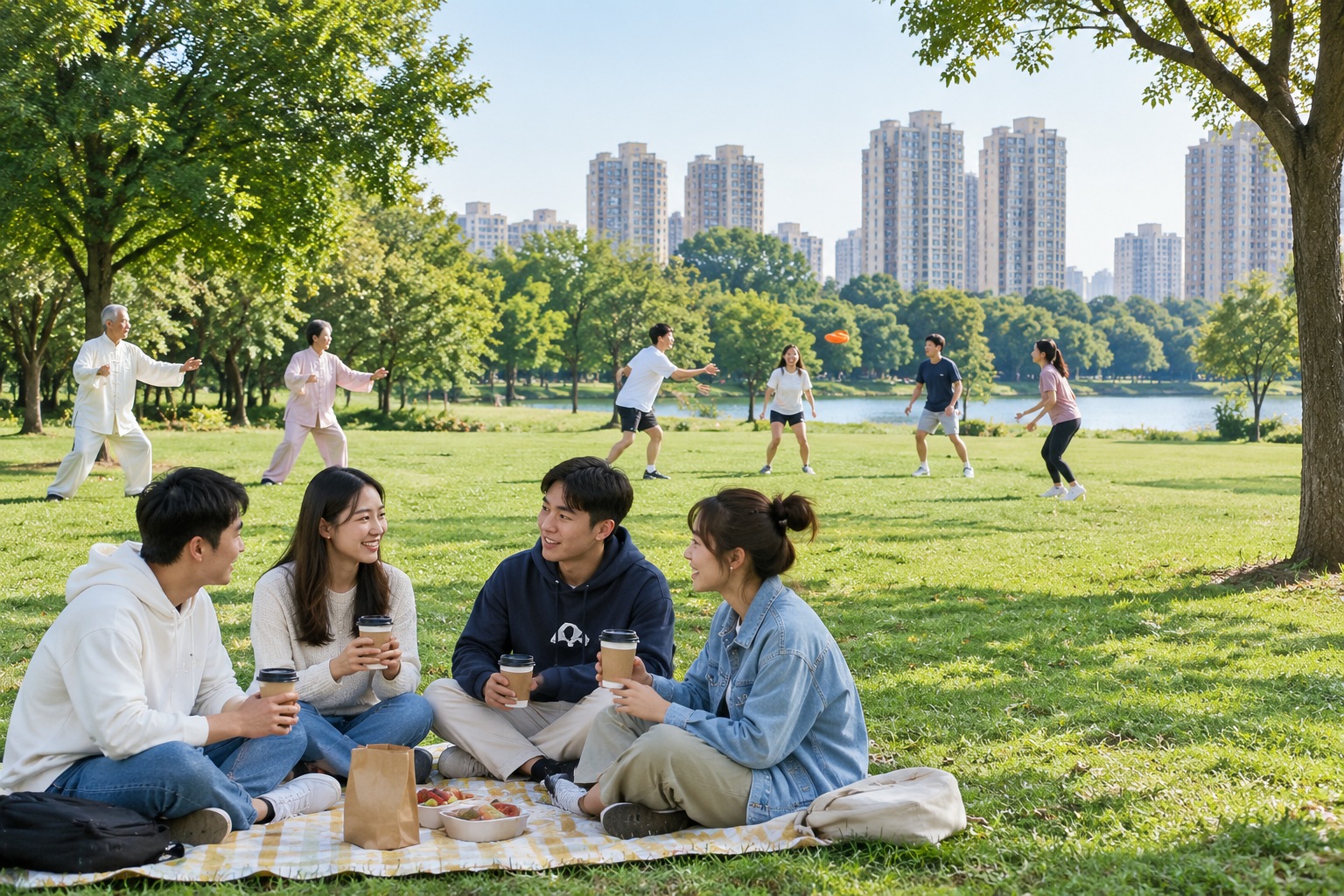
City parks in China are mostly free, and many have become dramatically more accessible in the past few years. Shanghai began opening parks around the clock in 2019 and now has hundreds of 24-hour parks; Beijing, Guangzhou and Chengdu have followed in their own ways. Where entrance fees still exist, they are usually a few yuan.
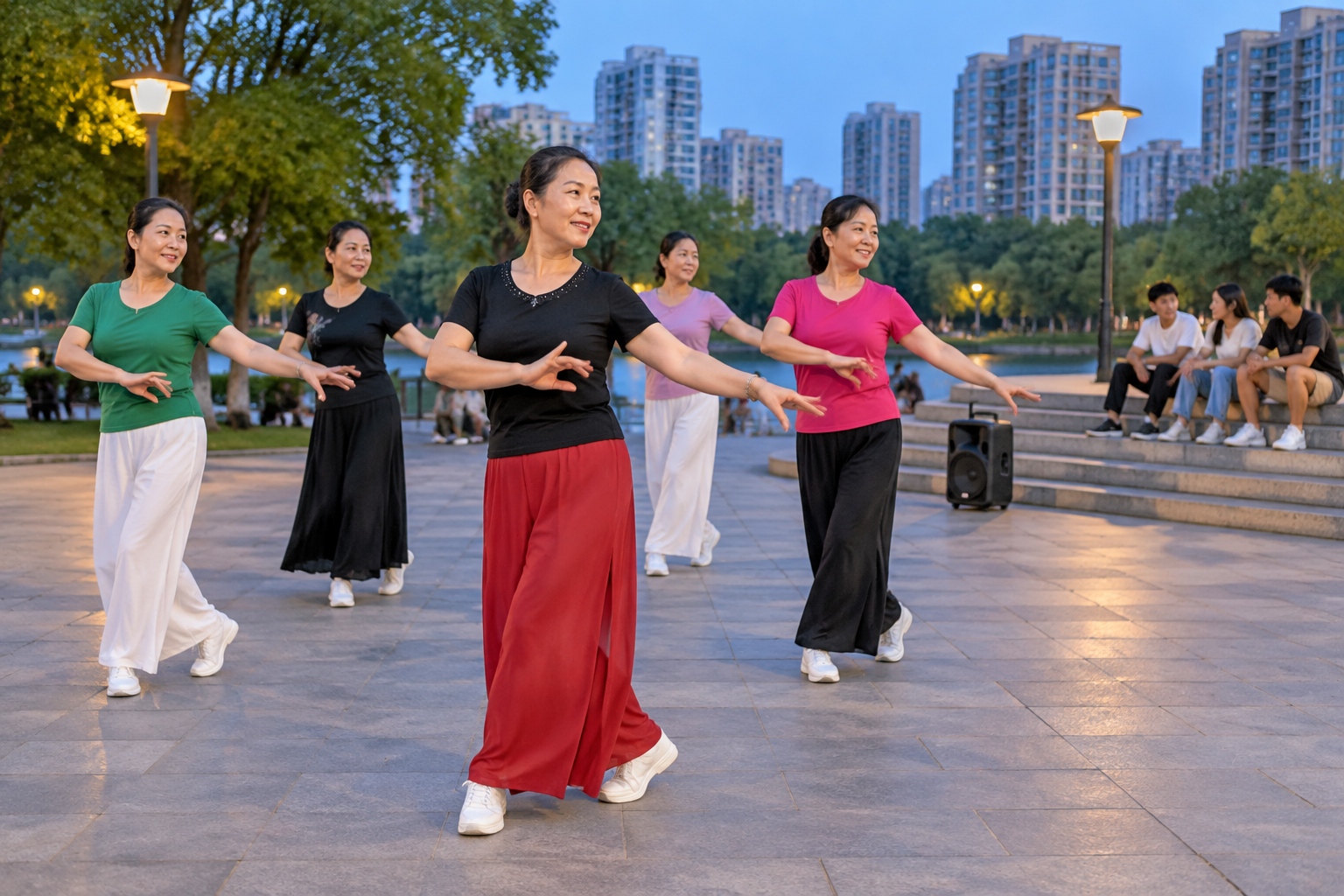
What happens inside is intergenerational in a way that is unusual elsewhere. At 7 a.m., the paths belong to retirees doing taiji, walking backwards, or writing calligraphy on the pavement with water brushes. By 4 p.m., the grass fills with young people on picnic mats, playing frisbee, drinking takeaway coffee and photographing trees for social media. By 7 p.m., the speakers come out for square dancing, and the twenty-somethings move to the steps at the edge and sit there, watching.
The habit even has a name online: the “20-minute park theory” — sit in a park for 20 minutes and your mood improves. It traces back to a 2019 University of Michigan study, went viral on Xiaohongshu in the spring of 2024, and then localized into something simpler: a free, quiet place to be.
Doing nothing is not the same as having nothing to do
It is worth saying what this is not. It is not a story about laziness, and it is not unique to China. Young people in Seoul, Tokyo and Taipei also escape small apartments into cafés, bookstores and shopping complexes. High-density East Asian housing pushes people outward; that part is regional, not Chinese.
What is more specifically Chinese is the combination: free entry, low prices, high safety, and a retail model that welcomes the non-paying visitor. The closest Western equivalent might be a public library with a food court attached, open until 10 p.m., with a dance class happening outside the door.
The economy underneath the benches
There is a harder context. Youth employment has been under real pressure; in 2024, the official jobless rate for 16–24 year olds excluding students hovered around 17%. Young people are marrying later and spending more carefully. “消费降级” — consumption downgrade — became a widely used phrase.
But reading a full park as a shrinking economy gets it wrong. The same generation fills concert venues, hiking trails and campsites. Domestic outdoor brands like Kailas and Naturehike have grown fast. Travel spending is not low, it is distributed differently: cheaper hotels, denser itineraries, more photographs per yuan. Sitting in a mall for free and paying 15 yuan for tea is not an act of poverty. It is a preference for low-commitment, flexible leisure, in a country with excellent infrastructure and limited private space.
What a visitor notices — and what they would miss
If you come from Europe or the US, three things stand out.
First, almost nobody is drinking. The Western third place is often alcohol-based; the Chinese version runs on tea and coffee. That changes the texture entirely: quieter conversations, more phone screens, more families.
Second, the ages mix. On the same stretch of path, a 70-year-old is walking laps while a 20-year-old edits video on a bench. In many Western cities, age segregation in public space is the default.
Third, nothing is expected of you. No minimum spend, no dress code, no social performance. You can sit down, do nothing for two hours, and leave.
What you would miss is the noise of a real pub, the bartender who knows your order, the messiness of a place that belongs to a neighborhood rather than a landlord. Chinese third places are often commercial, managed and a little too clean. The trade-off is that they are open to almost everyone, at almost no cost, almost every day.
What a bench is actually for
Every city has to answer the same question: where do people go when they don’t want to be at home and don’t want to be at work? Britain answered with pubs. France answered with cafés. America answered with malls for a while, and then gradually stopped.
China’s current answer is the shopping center and the park — air-conditioned, well-lit, cheap and free to enter. It is a solution that says less about ambition than about comfort: a place to be alone in public, next to other people doing the same thing. For a generation dealing with small rooms, long hours and cautious budgets, that turns out to be worth quite a lot.
Start the discussion at forum.chinacomes.com