

A Phone Album With No Landmarks
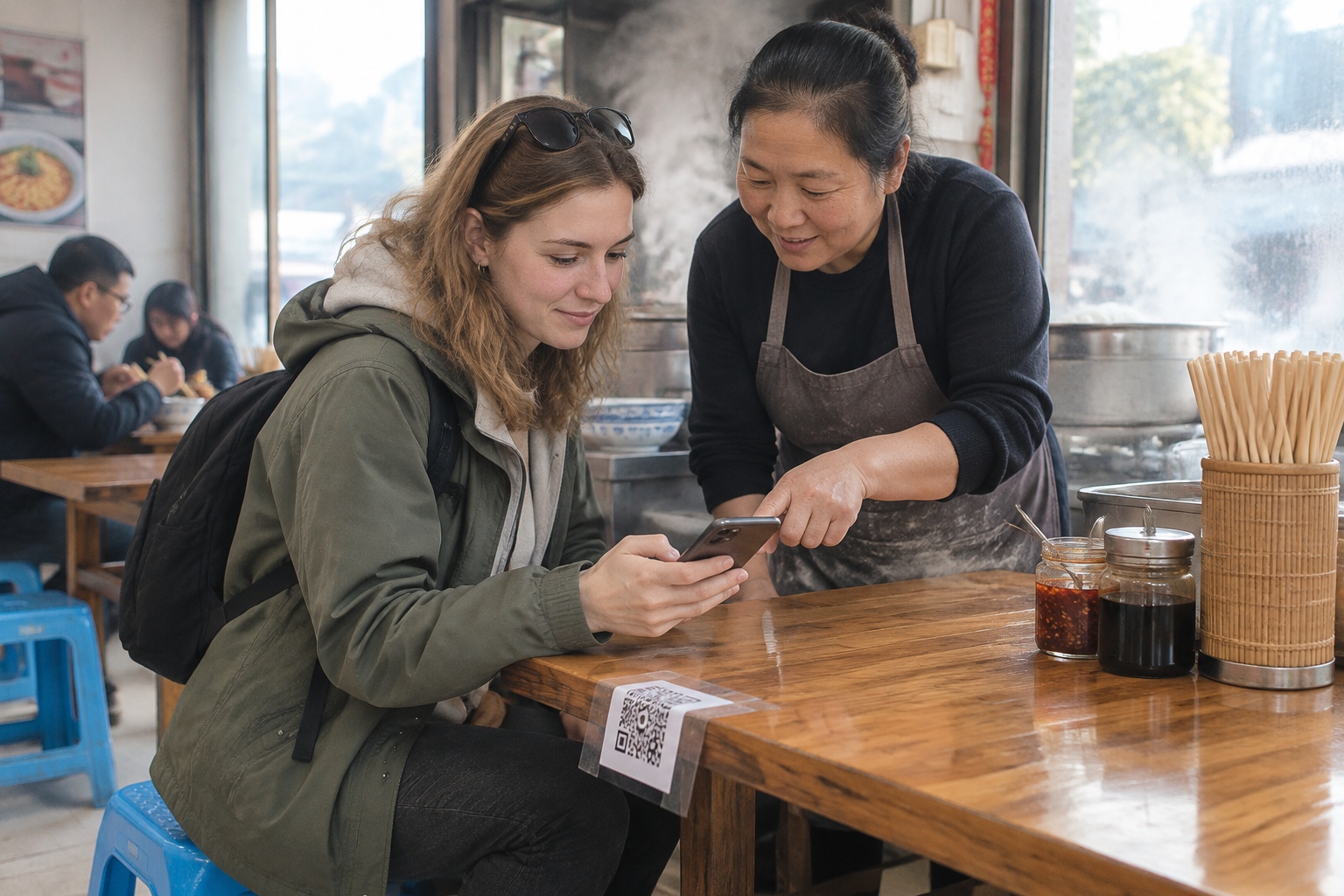
At 7:40 on a Tuesday morning in Chengdu, the noodle shop on the corner has six plastic stools out on the pavement and three people waiting. Steam from the pot fogs the front window. Taped to the edge of every table, just below where your chopsticks rest, is a small square QR code printed on paper that has begun to curl at one corner.
Nadia, 29, from Rotterdam, holds her phone over it for a long moment. Nothing happens. She looks up. The woman behind the counter — everyone calls her Ayi, auntie — wipes her hands on her apron, comes around the table, taps the screen twice with a forefinger, points at the photograph of beef noodles, and holds up one finger.
Sixteen yuan. The bowl arrives in about four minutes.
Later, scrolling through her camera roll on the train, Nadia notices what she actually photographed that week. Not the panda base. Not the skyline at night. A QR code curling at the corner. A convenience store glowing at 11:40 p.m. A train ticket on a phone screen, seat 07F.
Those three images deserve to be taken seriously. They are the places where a first-time visitor’s expectations rub against an ordinary Chinese Tuesday — and where a lot of confusion, in both directions, gets made.
She is not an unusual case. Since China widened its visa-free entry — 30 days for ordinary passport holders from dozens of countries, plus 240-hour visa-free transit through a long list of ports — a particular genre of China Vlog has taken over YouTube and TikTok. Not the Great Wall reveal, but the small frictions of a normal day: the QR code that won’t scan, the shop selling hot food at midnight, the train that departs on the minute.
These clips get watched because they answer the question the traveler was asking herself: what does daily life here actually feel like? Here is what the album shows, and what the edits tend to leave out.
Why a QR Code on the Table Is Ordinary, Not Sci-Fi
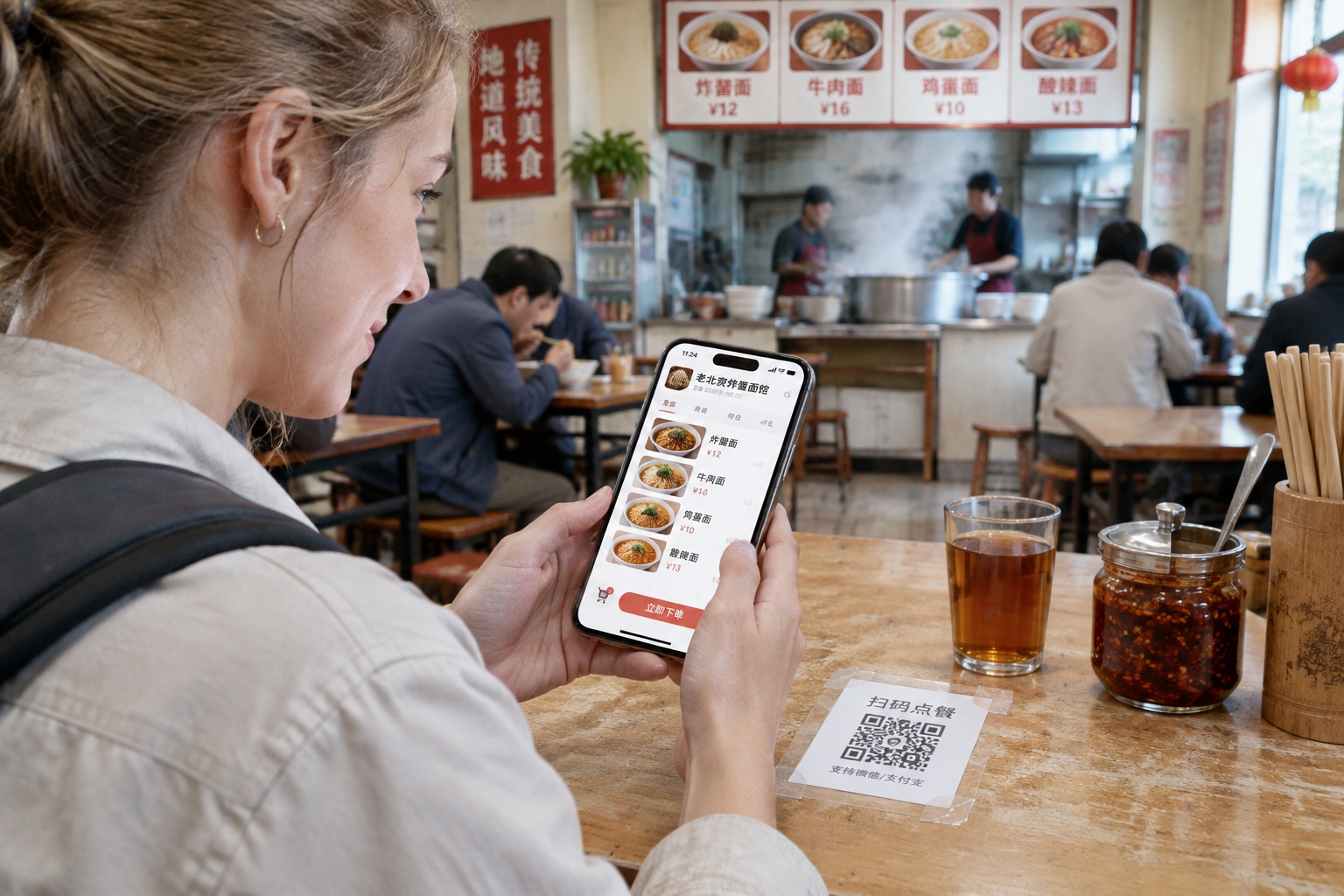
By noon the same shop is full: four staff, forty seats, a queue at the door. Nadia scans the code and it opens a mini-program inside WeChat, with a photograph and a price for every dish. She taps beef noodles, taps 16, and pays through Alipay, which she set up at the airport by linking her Dutch Visa card. Nobody at the counter looks up. The whole thing takes about ninety seconds.
For a visitor, the first scan feels like a demonstration of the future. For the shop, it is bookkeeping. Ayi has eleven years of experience and four people on shift. If she takes every order at the counter herself, the queue moves at half speed and she stops cooking. The table code shifts where the ordering happens; it does not remove the labour. Someone still carries the bowl.
What the vlogs rarely show is the failure rate. Plenty of mini-programs ask for a Chinese phone number or an identity check. Some links break on foreign app stores. Nadia’s first attempt, in Shanghai, did not work at all; the second needed Ayi to switch the menu into English mode. That is the real learning curve, and it takes about a day.
Two things worth saying plainly. Cash is still legal tender in China, and refusing it is against the rules — the central bank has repeatedly told merchants, especially in markets and small shops, to keep taking notes, largely for the sake of older customers who never switched. Paper menus still sit under the glass on the table. Mobile payment is dominant, not compulsory. Alipay and WeChat Pay both accept foreign cards now, which is how a Dutch debit card clears a 16-yuan bowl of noodles in Chengdu.
What a Late-Night Convenience Store Says About City Life
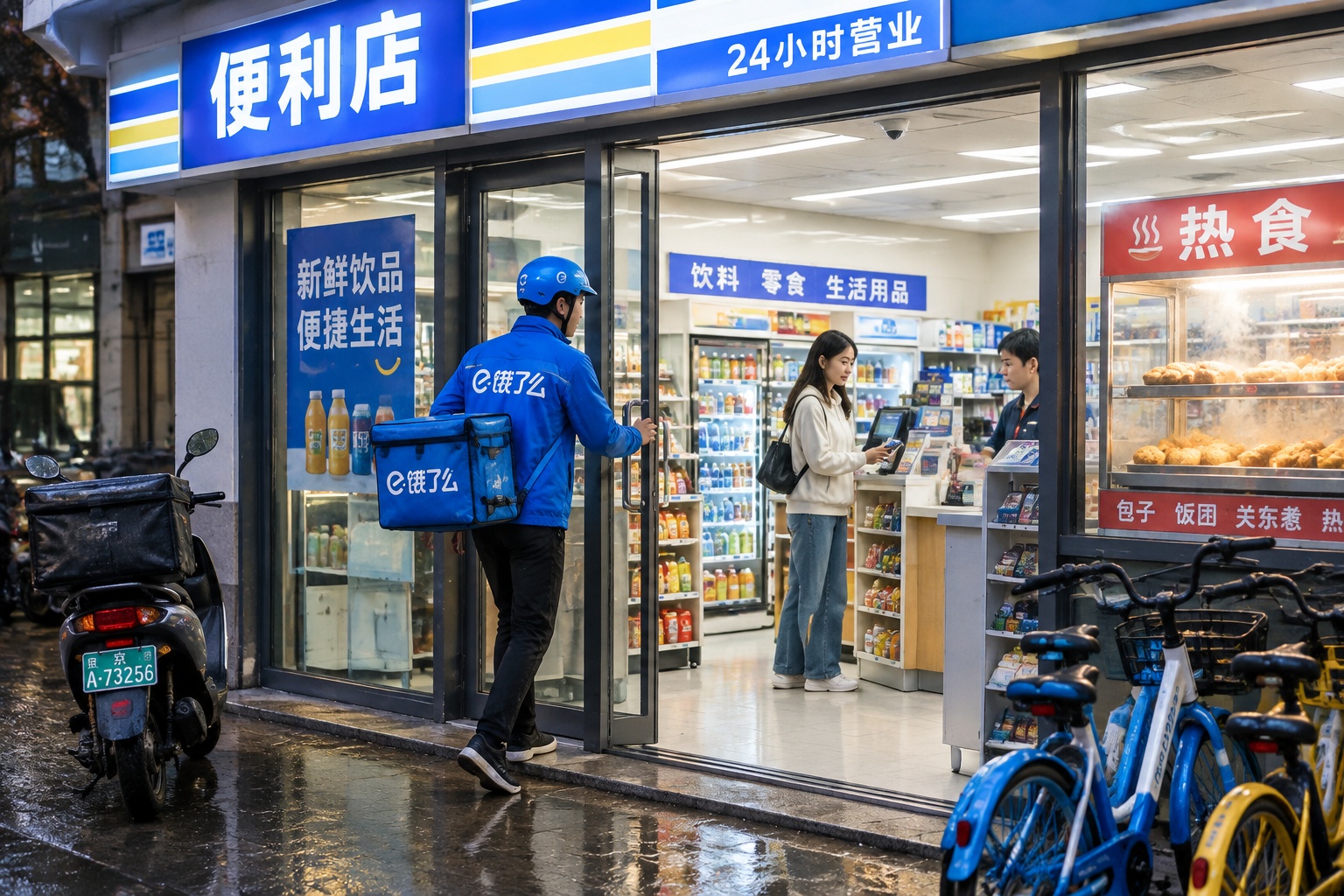
At 11:40 p.m., the store near the subway exit is the brightest thing on the street. Inside: a tray of oden — radish, tofu, fish balls, three to five yuan each — a steamer of baozi, a fridge wall of drinks, a cabinet of rental power banks with four slots empty, an umbrella stand, a hot-water tap, and a shelf of phone cables and adapters near the register.
The customers arrive in a slow trickle. A delivery rider in a blue jacket, helmet tucked under one arm, waits for an order number and buys a three-yuan bottle of water. A young woman still wearing her office lanyard picks up yogurt and a rice ball. An older man buys cigarettes and a lighter and says nothing at all.
The clerk is 24, from a county two hours away, and earns around 4,500 yuan a month plus a meal allowance. She restocks milk tea between customers and keeps one eye on the door.
Night-time safety here is not an abstraction. It is the fluorescent light spilling onto the pavement, the cameras above the door, the fact that the subway ran until 11:30, the noodle place next door that is still serving, the low steady hum of other people. Infrastructure, not slogans.
One caveat the vlogs skip: this is a city phenomenon. In smaller county towns, the shutters come down at ten, and a 24-hour store may simply not exist.
A High-Speed Train Ride Through Ordinary Chinese Routines
Hangzhou East to Shanghai Hongqiao: 73 yuan, 46 minutes. On the Beijing–Shanghai line, the fastest trains cover 1,318 kilometres in about four hours and twenty minutes.
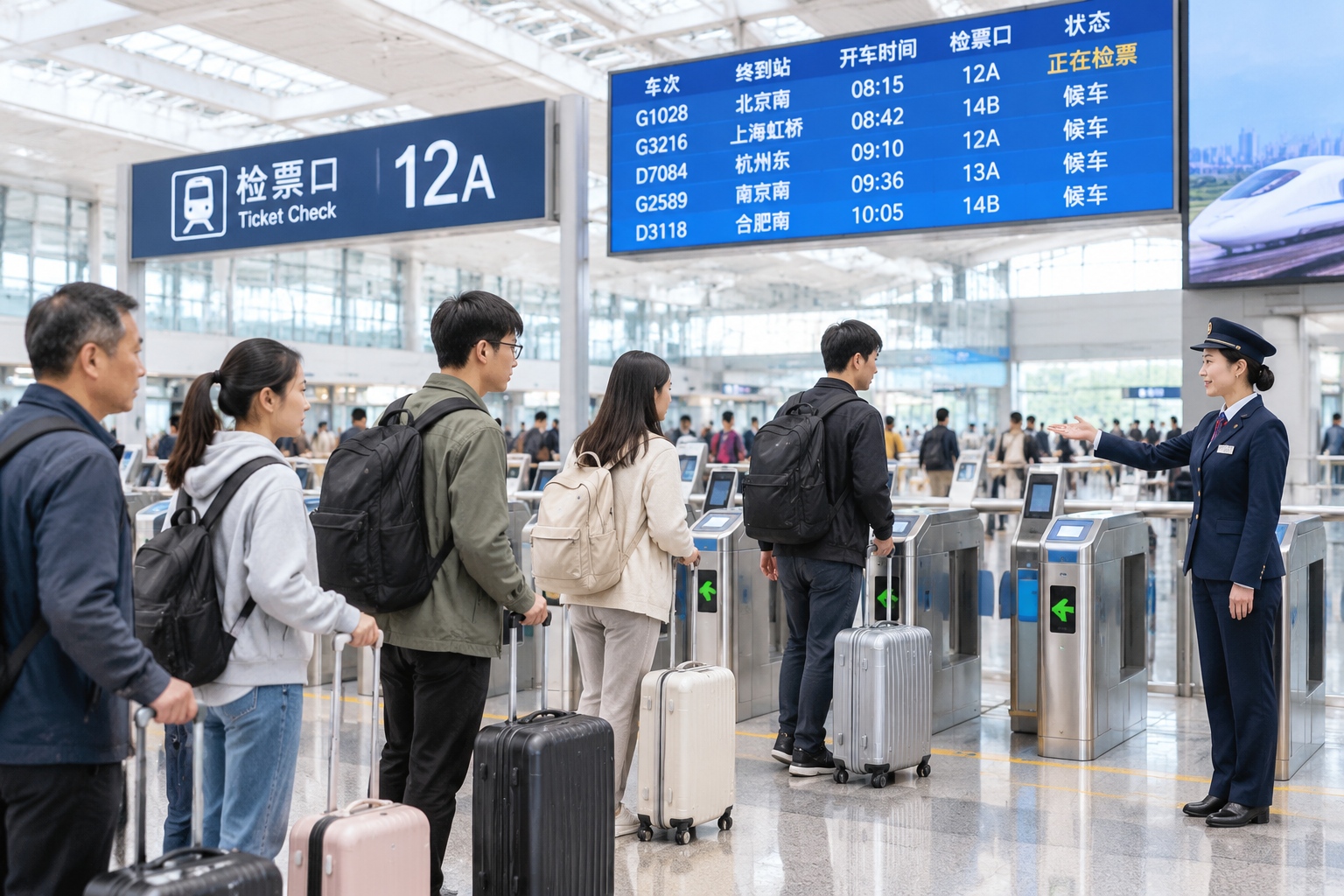
The process is unglamorous and worth describing honestly. The ticket sits in the 12306 app, which now verifies foreign passports online, though many visitors still buy at a counter their first time. At the station, a passport scan at the manual lane, bags through an X-ray, an escalator up into a hall the size of an airport terminal, a gate number on a screen, a queue that forms fifteen minutes before departure, a gate that closes five minutes before. Then seat 07F, by the window.

Inside the carriage, the scene is work, not tourism. A man in a shirt stands in the vestibule on a call so his voice won’t carry. A woman has her tray table down, a spreadsheet open, coffee in the cup holder. A family passes around a plastic bag of oranges. Someone eats a boxed meal bought at the station for 35 yuan. Announcements come in Chinese, then English.
The network behind this is roughly 48,000 kilometres of high-speed line, more than two-thirds of the world’s total. But what the train is for matters more than its speed. Mostly it moves people between jobs, homes and parents: the 46-minute Hangzhou–Shanghai run functions like a commuter belt, and the 19:04 to Suzhou is full of people going home for the weekend.
The People Behind the Convenience
Ayi is 52 and has worked in that noodle shop for eleven years, six days a week, six in the morning until three in the afternoon. She has learned roughly eight words of English and a set of hand gestures that handle the rest: a finger raised for one bowl, a flat palm for no chilli, a point at the code for people who don’t know how.

The night clerk chose the shift because the pay is slightly higher and the store is a ten-minute walk from her rented room. The 27-year-old on the 19:04 train works in marketing in Shanghai, grew up in Suzhou, and goes back twice a month. None of them appear in the vlogs as people; they appear as background, doing the thing that makes the convenience look effortless.
That is the part worth slowing down for. Every one of these small conveniences is priced in someone’s hours, and the system works because those hours are worked consistently, not because the technology is magic.
What These Vlog Details Do Not Tell You
Visa-free entry does not mean English everywhere. Airport and railway signage is bilingual; a neighbourhood noodle shop may have no English at all. Translation apps handle menus, and hand gestures handle the rest — but the assumption of universal English will trip you up within an hour of leaving the terminal.
Mobile payment dominance is not a cashless society. Notes still work, and legally must. What has changed is the default, not the rule.
The high-speed train is fast, and it is also a queue. Security screening, passport checks, long walks inside enormous stations, crowds on the first day of a public holiday. The smooth 46-minute ride sits inside an hour of logistics on either end.
Geography matters more than most travel content admits. The QR code on every table, the 24-hour store, the metro every four minutes — that is the city. Two hundred kilometres west, the rhythms are different, and closing times are earlier.
And the edit itself selects. Nobody posts the 25 minutes spent hunting a taxi in the rain, or the restaurant where the code simply did not work and they gave up and pointed at the next table’s bowl.
Back to the Album
Nadia’s camera roll ends the trip with 412 photos. Roughly 300 are of food, signage and shopfronts. The ones she keeps looking at are the boring ones.
A QR code that failed the first time. A lit window at midnight with her own reflection in the glass. A ticket for seat 07F.
None of them are arguments. They are simply small enough to check, and familiar enough that a reader in Rotterdam or Ohio can put themselves at the table, phone in hand, waiting to see whether the thing works. That is what a China Vlog does at its best — not settling the question of what China is, but handing you three details you can hold in your hand and compare with your own street.
Start the discussion at forum.chinacomes.com