

A 15-Yuan Pancake, and a Fair Question
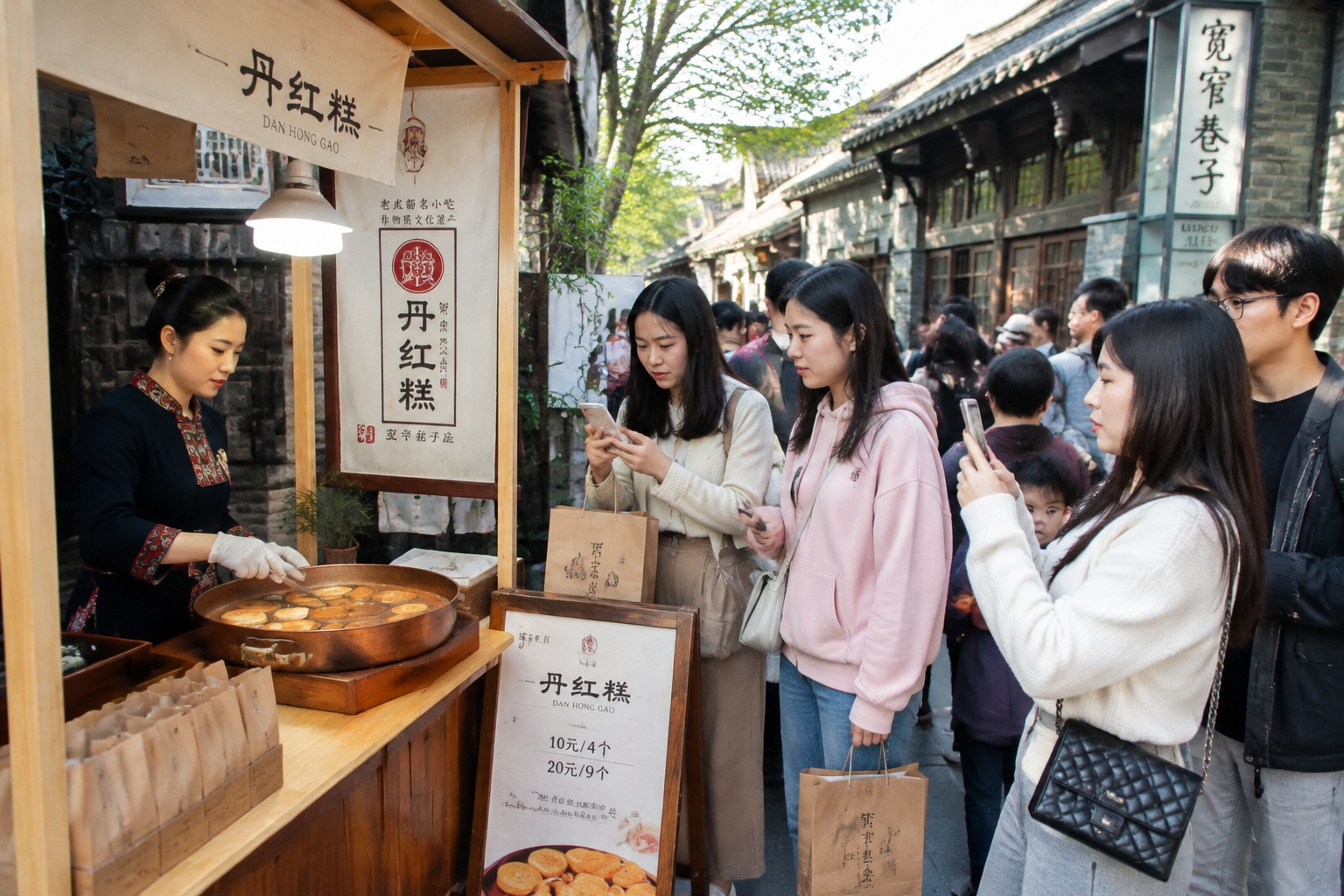
It is a Tuesday morning in Kuanzhai Alley, the restored Qing-dynasty lane complex that nearly every first-time visitor to Chengdu puts on the itinerary. A woman in her fifties works a small copper pan over a burner, pours in a ladle of batter, flips it with a thin steel spatula, folds in pork floss and pickled mustard tuber, and passes it over. Fifteen yuan. Almost everyone in the queue holds a phone in one hand and the paper bag in the other, photographing the cake before eating it.
It tastes fine. But on this street it is a performance of a snack rather than the snack itself.
Which leads to the question any curious visitor eventually asks: do the people who actually live here eat this? Not on a public holiday, not with relatives in from out of town, but on an ordinary Wednesday, on the way to work or on the way back from the vegetable market.
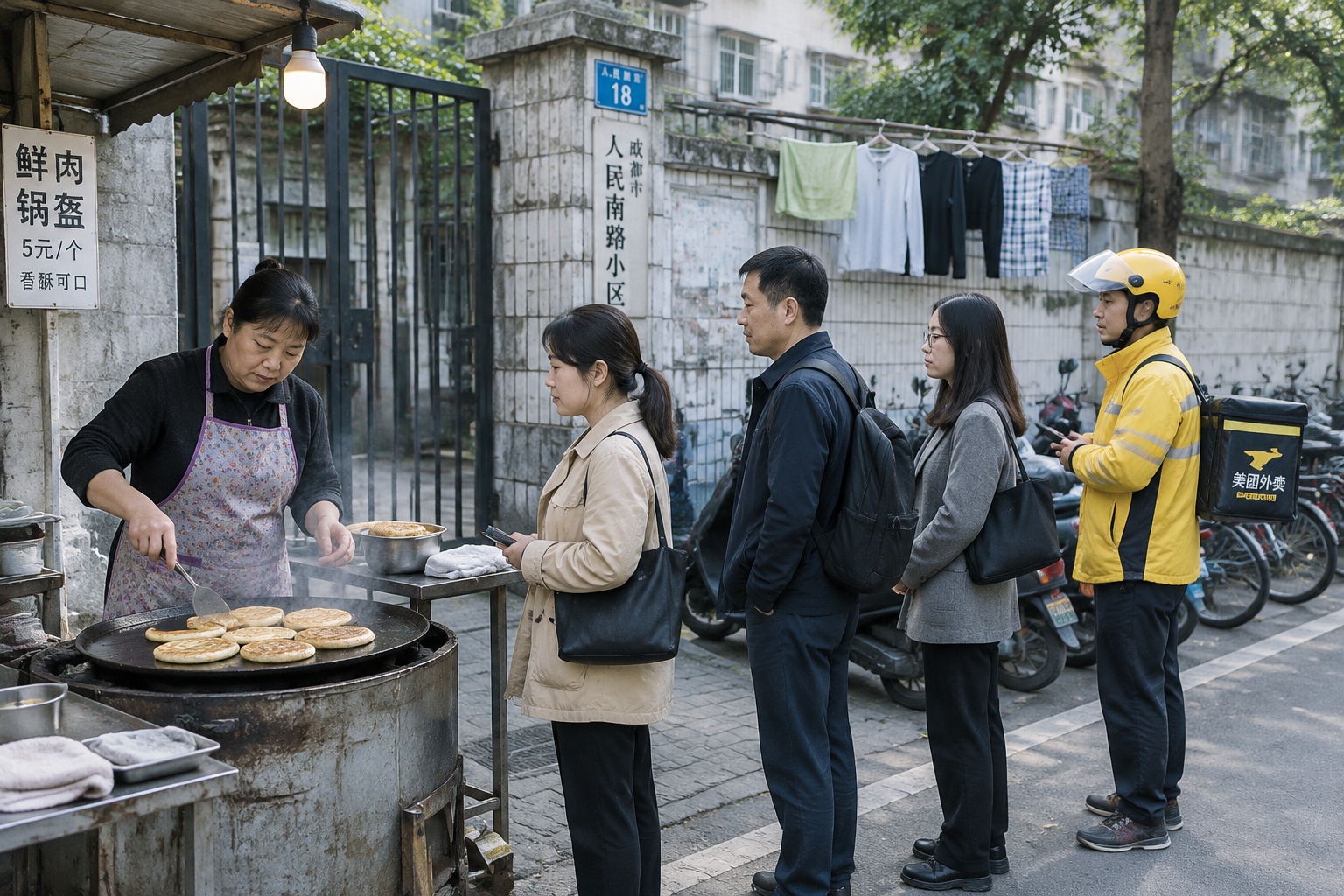
The answer is yes. Chengdu residents eat dan hong gao — the small egg-batter cake with sweet or savoury fillings — constantly. They just don’t eat it here, and they don’t pay 15 yuan for it. A ten-minute bike ride away, at the gate of a 1980s housing compound, the same cake costs four.
Leave the Scenic Area, Then Keep Walking
Chengdu’s snack map has two layers. On paper they look similar. In practice they behave like different cities.
The first layer is the tourist circuit: Kuanzhai Alley, Jinli, the lanes around Wenshu Monastery, the edge of Taikoo Li. Rents are high, foot traffic is enormous, and the menu is built for people who will eat once and never come back. Prices typically run two to three times what the same dish costs fifteen minutes away.
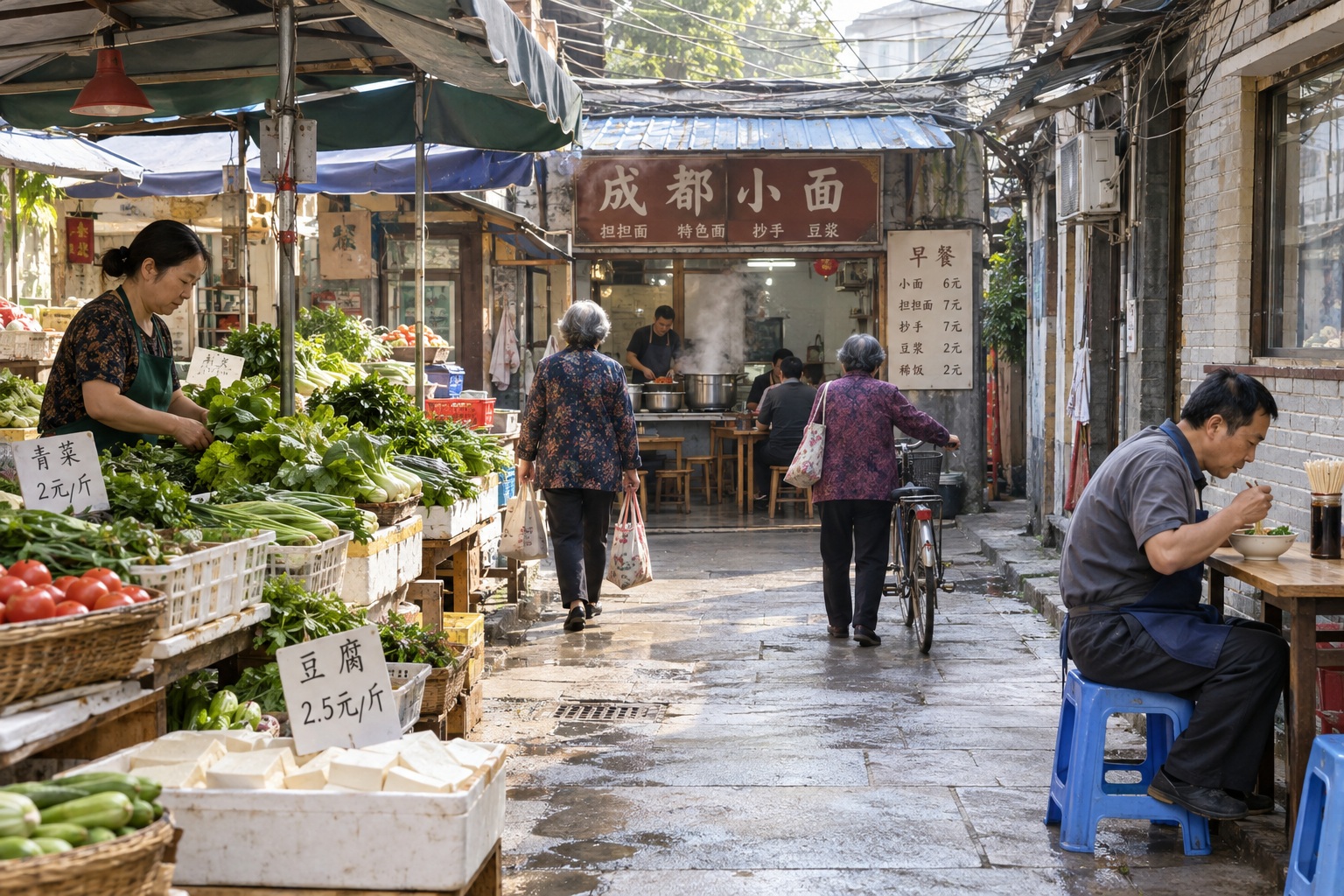
The second layer is not a list of restaurants. It is a set of places where food appears because people are already standing there. In Chengdu that means, roughly:
- Wet markets and their edges. A market entrance at 7 a.m. is a food street nobody promotes. Vendors eat before their stalls open, which is why the noodle shop beside the vegetable gate opens earlier than anything else in the neighbourhood.
- The gates of old residential compounds. Look for the 1980s and 1990s work-unit housing blocks — tiled facades, bicycles, laundry on the balconies. Whatever is sold at that gate is sold to people who live forty metres away and will complain if it is bad.
- School gates. Primary and middle schools empty out between 4:30 and 5:30 p.m. The carts parked outside are calibrated to a child’s pocket money: three to eight yuan.
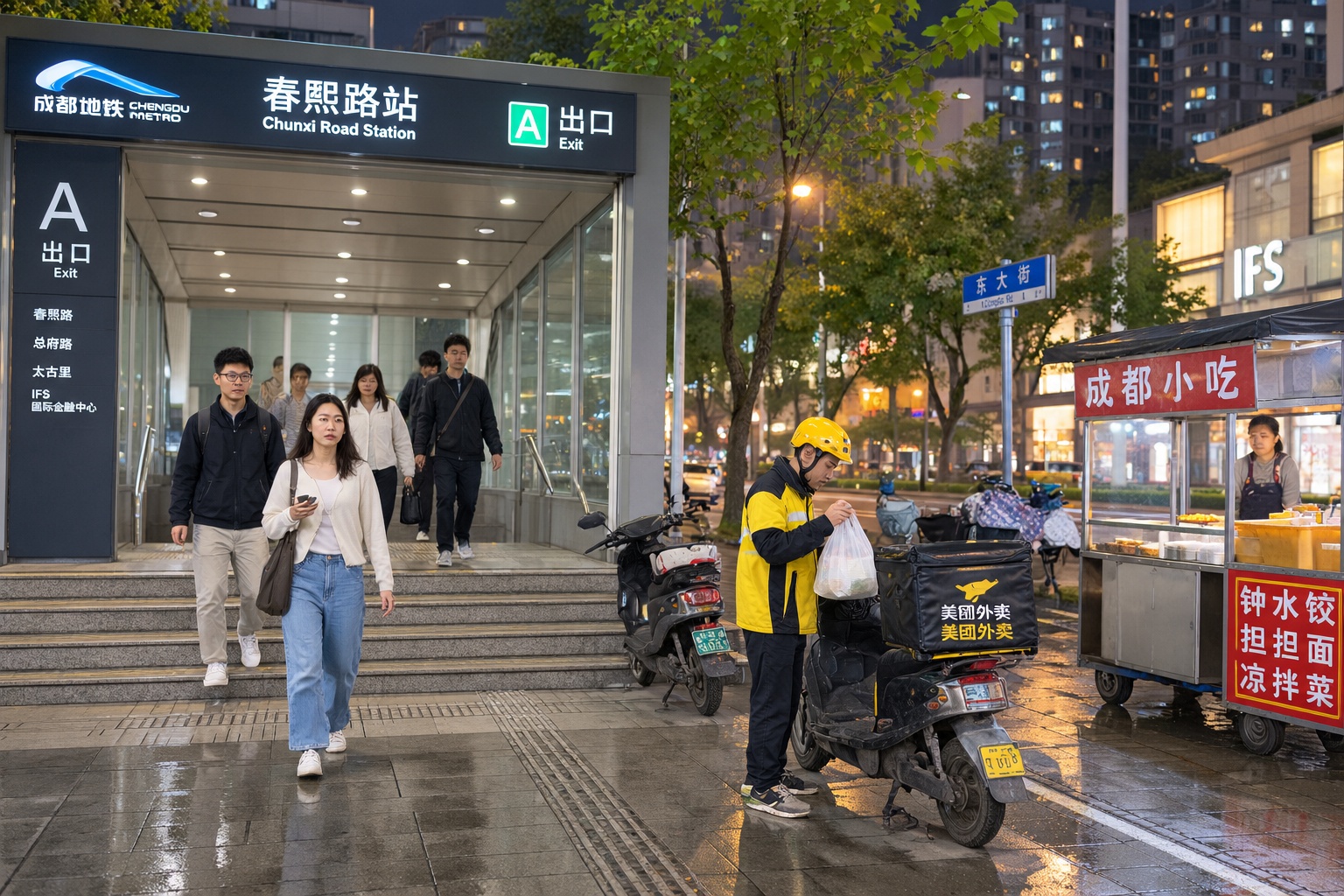
- Subway exits, at the right hours. Not the exits themselves, but the fifty metres around them between 7:30 and 9 a.m., and again after 6 p.m.
- Late-night stalls. After 10 p.m. the customers change — delivery riders finishing a shift, hospital staff, taxi drivers. The food gets simpler, saltier and cheaper.
What These Shops Actually Look Like
None of this is exotic. It is just specific. Four examples, all ordinary, all repeatable.
Guokui at 7 a.m.
Guokui is a layered, flaky wheat cake, pan-fried or baked, often with minced pork and Sichuan pepper between the layers. In a neighbourhood shop — one griddle facing the pavement, a plastic tub of dough, a handwritten sign — a pork guokui costs around six to eight yuan. In Kuanzhai Alley or Jinli the same item runs 15 to 20. The good shops open before 7 a.m. and are often sold out by nine. The tell is not the queue length but who is in it: people in work clothes, delivery riders, an older man who has clearly been coming for years and doesn’t need to say what he wants.
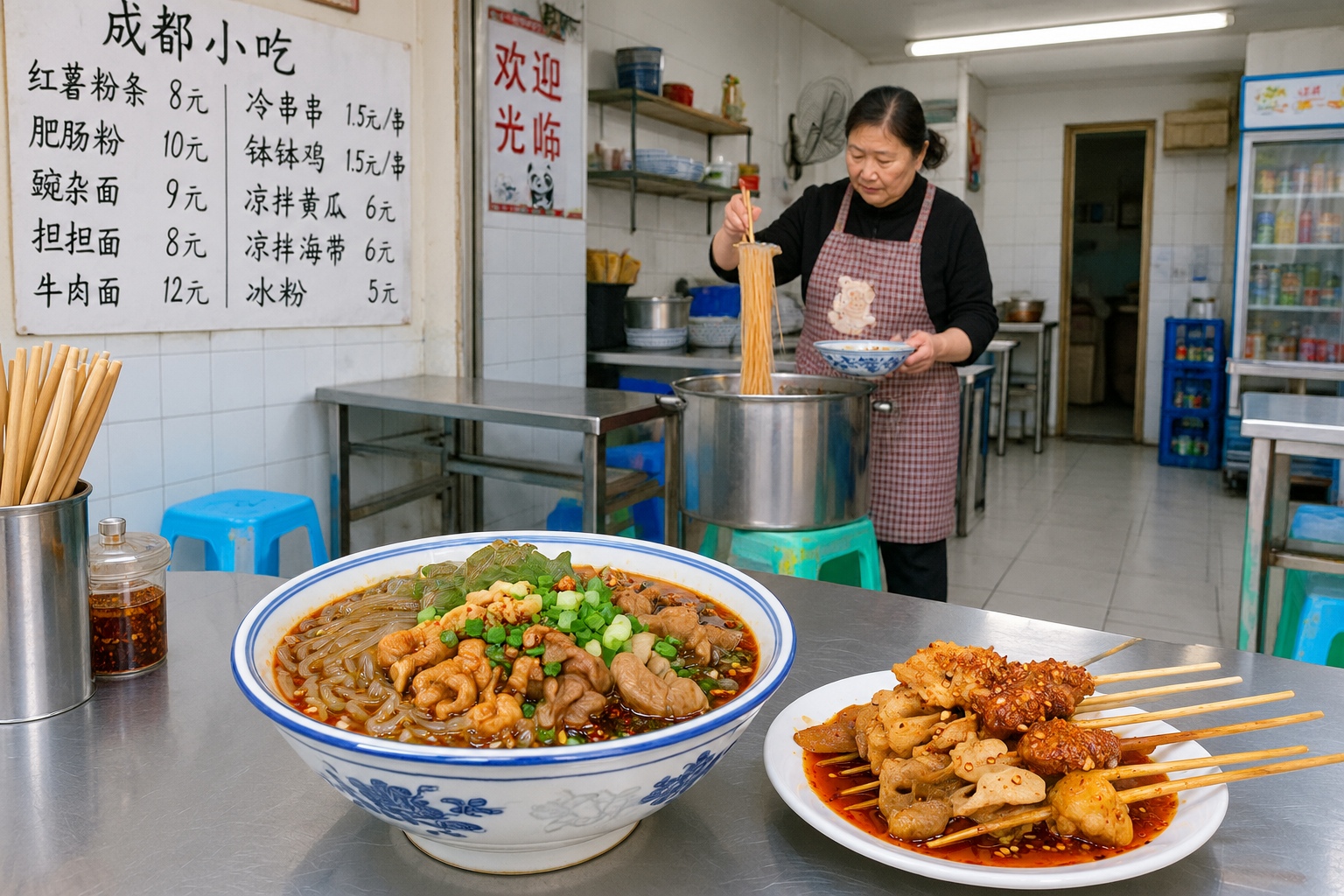
A 14-yuan bowl of feichang fen
Feichang fen is sweet potato starch noodles in a pork-bone broth with braised pig intestine, usually served with a crisp guokui on the side. In a residential neighbourhood a small bowl is around 12 yuan, a large around 16. In the tourist lanes, expect 25 or more. The dish is eaten fast, often in under fifteen minutes, and the shops run two shifts — breakfast and from about 5 p.m. — because that is when people are passing through. Watch the owner: intestine lifted from the pot with chopsticks in one motion, noodles dropped into a bamboo basket and pulled out after about ninety seconds. Speed is the business model.
Bobo ji, where the price tells you who the customer is
Bobo ji is cold skewers — chicken, tripe, lotus root, potato slices, tofu skin — steeped in chilli oil and sesame, priced per stick. This is the clearest price signal in the whole city. In a shop serving a residential block, skewers run roughly 0.5 to 1.5 yuan each and a filling plate costs 20 to 30 yuan. In a tourist-facing shop one street over from a hotel, skewers can be 3 to 5 yuan and the same meal goes past 100. The format is identical. The customer is not.
Dan hong gao and the 4 p.m. shift
Dan hong gao is cooked to order, one at a time, about two minutes each. Tian shui mian — thick hand-pulled noodles with sweet soy, chilli oil and garlic — costs 8 to 12 yuan in a neighbourhood shop. Both peak in the late afternoon, when school lets out and offices begin to empty. The vendors know the rhythm precisely: a cart that appears at 3:45 p.m. beside a primary school gate is gone by 5:30, and the same vendor may reappear near a subway exit at 6:30.
How Locals Decide Where to Eat
Mostly, they don’t decide. They follow a route they already have.
The logic is closer to commuting than to dining out. Breakfast sits on the way to the subway. Lunch is within a five-minute walk of the office, which is why the same twelve shops in a business district trade places in popularity every few years while keeping the same customers. Dinner is often bought on the way home from the vegetable market. Late-night food is chosen by whoever is still awake and working.
This is why rankings and review apps are only partly useful here. They are excellent for finding a restaurant and poor for finding a snack, because the places that matter most are the ones nobody bothers to review. A shop serving the same 300 households every week does not need a five-star listing. It needs to open at 6:30.
Renovation, Rent, and Delivery Apps: How the Map Is Moving
The snack map is not stable. Three forces are actively redrawing it.
Renovation. Chengdu has spent the past decade upgrading older neighbourhoods — Caojiaxiang in the north, parts of Yulin in the south, Fuqin in the west. Better drainage, new paving, cleaner streets. Renovation also raises rents, and a shop selling six-yuan guokui cannot absorb a tripled rent. Some vendors move a block or two further out. Some switch to a format that can charge more.
Rent and the tourist premium. The gap between a scenic-area shop and a community shop has widened. That has produced two genuinely different products: one optimised for photographs and one-off customers, one optimised for speed, volume and repeat visits. They share a name and little else.
Delivery platforms. Meituan and Ele.me now carry a large share of evening meals in Chengdu, and late-night orders have grown steadily. For a small shop this stretches the customer radius from a few hundred metres to two or three kilometres. It also changes the menu: dishes that travel badly quietly disappear, and portion sizes and packaging get built around a scooter ride.
The old food has not vanished. The same dish now exists in two economies, and they are increasingly easy to tell apart once you know what to look at.
Practical Notes for Visitors
Pay the way everyone else does. Almost every small shop uses WeChat Pay or Alipay QR codes. Foreign cards can be linked to both, but set this up before you are standing in a queue at 7 a.m. with no cash.
Learn three phrases. 一两 and 二两 are the standard noodle portion sizes, small and regular. 微辣 means mildly spicy, which in Chengdu is still spicy. 不要香菜 means no coriander, and it is worth saying.
Use price as a filter. A 30-yuan bowl of noodles is not automatically bad, but it is a signal about who the shop expects to serve. In most residential neighbourhoods a good bowl is 10 to 16 yuan.
Look for the wrong things. Slippers, plastic stools, a wall menu in Chinese only, no photographs of the food, an older customer served without ordering. These are better indicators than a queue of people filming.
Respect the hours. Many of the best shops close by 2 p.m. and reopen at 5. Some shut one day a week with no notice. That is not disorganisation; it is a business with exactly as many customers as it needs.
The Coordinate Is a Route, Not a Shop
Visitors often ask for the name of one restaurant, the single place they should eat. That question does not have a useful answer in Chengdu, because the food that matters is not concentrated at a landmark. It is spread along ordinary lines: the walk from the compound gate to the subway, the detour past the wet market, the 4 p.m. reappearance of a cart outside a school.
Kuanzhai Alley is worth seeing. It is genuinely handsome, and the architecture is real. But it is a museum of a street, and the snacks there are exhibits. The living version is fifteen minutes in almost any direction, where prices drop, menus lose their English translations, and the person behind the counter knows most of the people they are serving.
That is the real coordinate. Not a point on a map, but a route a few million people take every day without thinking about it.
Start the discussion at forum.chinacomes.com