

4:40 A.M., and the Line Is Already Long
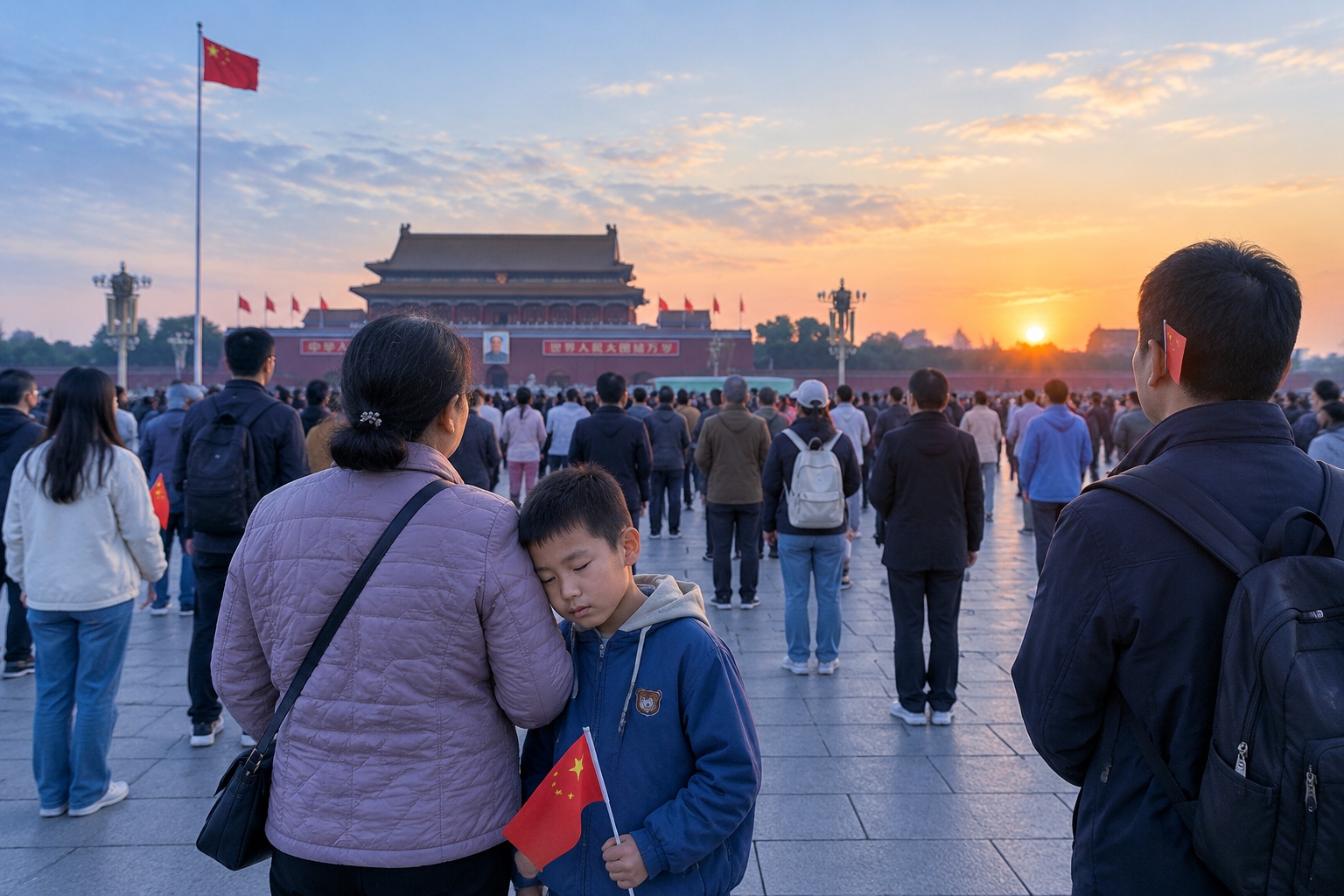
The subway isn’t running yet. The first buses up Chang’an Avenue are still mostly empty. But on the east side of Tiananmen Square, a few hundred people are already standing in a queue that curls back toward the underpass, and hardly anyone is talking.
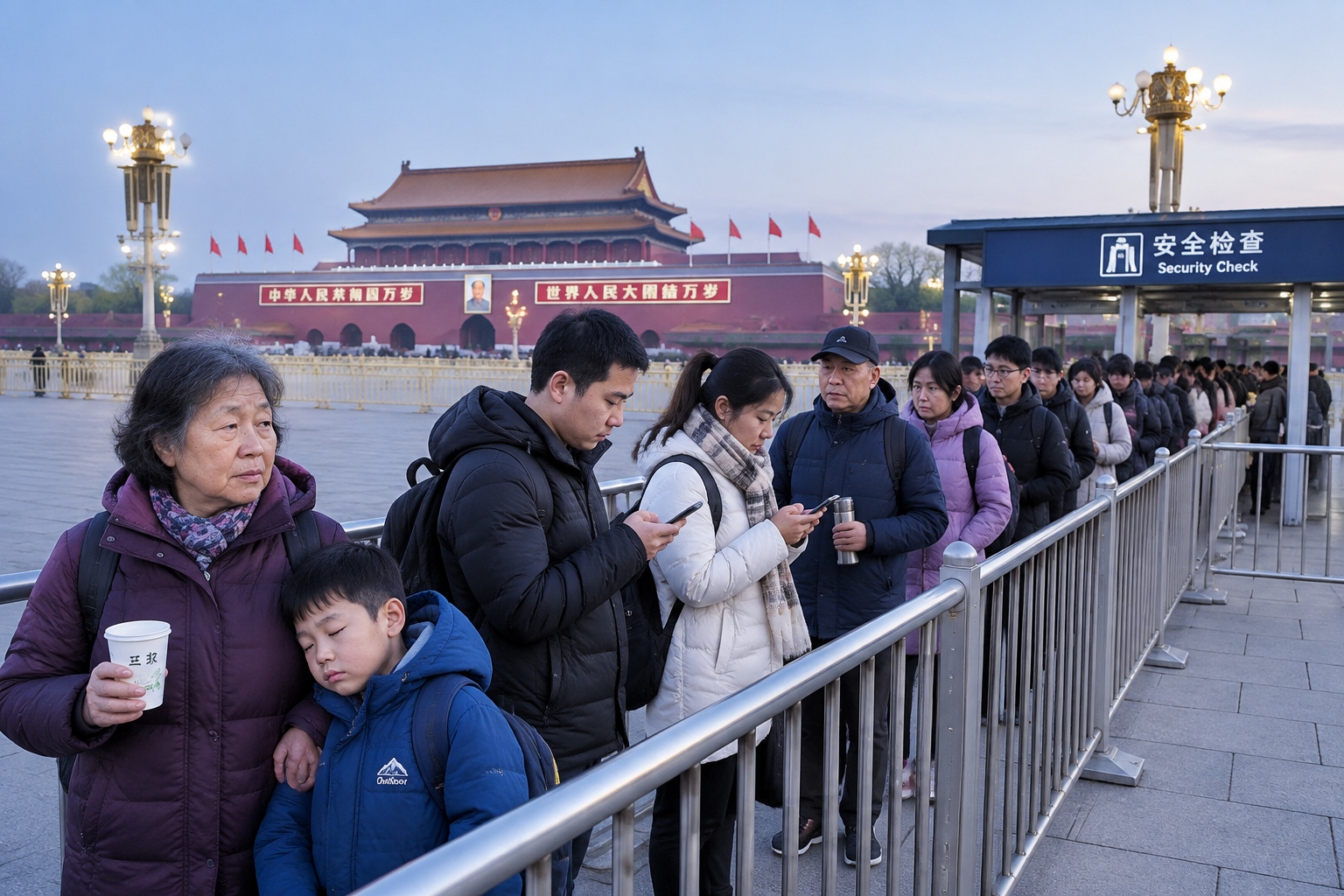
A woman in front of me — she’s from Henan, traveling with her seven-year-old grandson — tells me they got off an overnight train two hours ago and came straight here. She’s holding a paper cup of soy milk that has gone cold. “He wanted to see the soldiers walk,” she says, nodding at the boy, who is half asleep against her arm.
They are here for the flag-raising. It happens every morning at the moment the sun clears the horizon, which in Beijing means anywhere between about 4:45 in June and 7:30 in January. The ceremony itself lasts a little under two minutes. Most people in this queue traveled further than the ceremony lasts.
What This Gate Actually Is
Tiananmen was built in 1417, during the Ming dynasty, as the southern gate of the imperial city. Its first name was Chengtianmen — the Gate That Receives the Mandate of Heaven. It burned down, was rebuilt, burned again, and in 1651 was reconstructed and renamed: Tiananmen, the Gate of Heavenly Peace.
For most of its life, it was not a place for crowds. It was a boundary. Imperial edicts were read out from it. The space in front of it belonged to officials and ceremony, not to the ordinary residents of Beijing, who mostly lived outside the city walls. The gate told you where you could and could not go.
That is the part that gets lost when you only see it on a screen. In 1417 it was architecture designed to keep people at a distance. Today it is a building you walk through — through the side archways, on your way to the Forbidden City, with a ticket on your phone.
The central arch, the one directly beneath the portrait, is not for you. That is where the line between public passage and national stage becomes visible.
How a Gate Became a National Symbol
On October 1, 1949, Mao Zedong stood on the rostrum above the central archway and announced the founding of the People’s Republic of China. Within a decade, Tiananmen had been absorbed into the country’s visual vocabulary in a way that is hard to overstate: it appears on the national emblem, on banknotes, on textbook covers, on the signs of government offices.
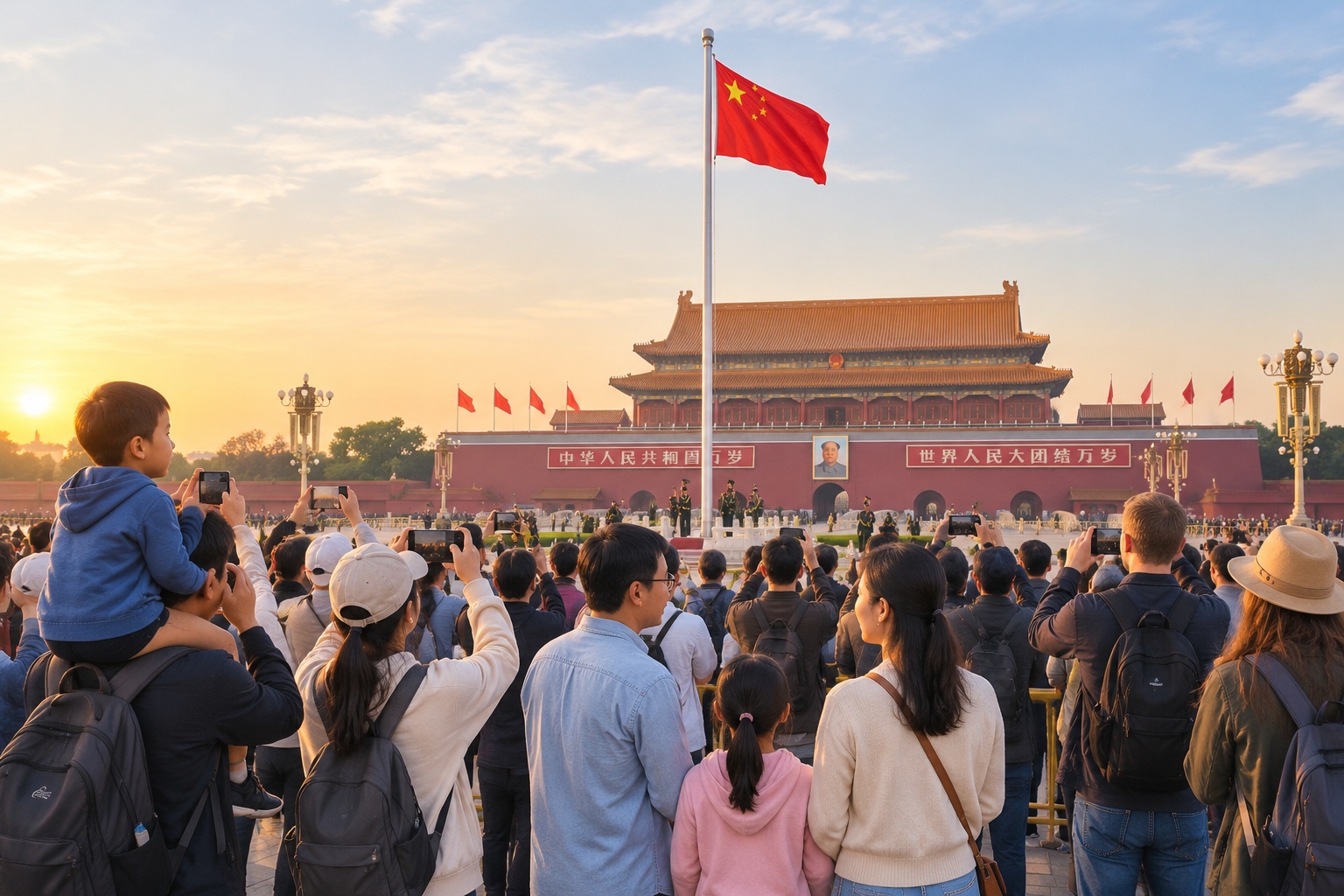
Two details on the wall stop a lot of first-time visitors. One is the portrait of Mao, roughly six meters tall and four and a half wide, repainted every year by artists from a state studio and quietly replaced before National Day on October 1. The other is the pair of slogans on either side: “Long Live the People’s Republic of China” on the west, “Long Live the Great Unity of the World’s Peoples” on the east.
The flag rises in exactly 46 seconds. That is the length of the national anthem, and the timing is not approximate — the flag reaches the top as the last note ends.
The Two Minutes, From Inside the Crowd
By 4:55, the queue has been pushed through two checkpoints. Bags go through a scanner; IDs get checked. Chinese visitors show a national ID card, foreigners show a passport. Phones go up. A man next to me has a small paper flag pressed against his cheek. He tells me he drove six hours from Shandong overnight and will drive back after breakfast.
The honor guard comes out of the gate in a single line, boots hitting the pavement in a rhythm you hear before you see it. Then the anthem starts over the loudspeakers, and the square goes quiet in a way that four thousand people normally cannot manage.
What surprises me every time is not the precision. It is the mix of people watching it. A young couple taking a selfie. A retiree in a windbreaker standing at attention, eyes forward, the way he probably learned fifty years ago. Two foreign tourists filming vertically. A kid on his father’s shoulders asking, loudly, why the soldiers walk so slowly.
Then it’s over. The speakers click off, the crowd turns, and everyone heads back toward the subway like they’re leaving a stadium. Someone near me says, “Okay — breakfast?”
Where Ordinary Life Reasserts Itself
That is the tension I keep coming back to when friends abroad ask me about this place. It is genuinely a national symbol, and it is also a very ordinary public square that people cross on their way to somewhere else.
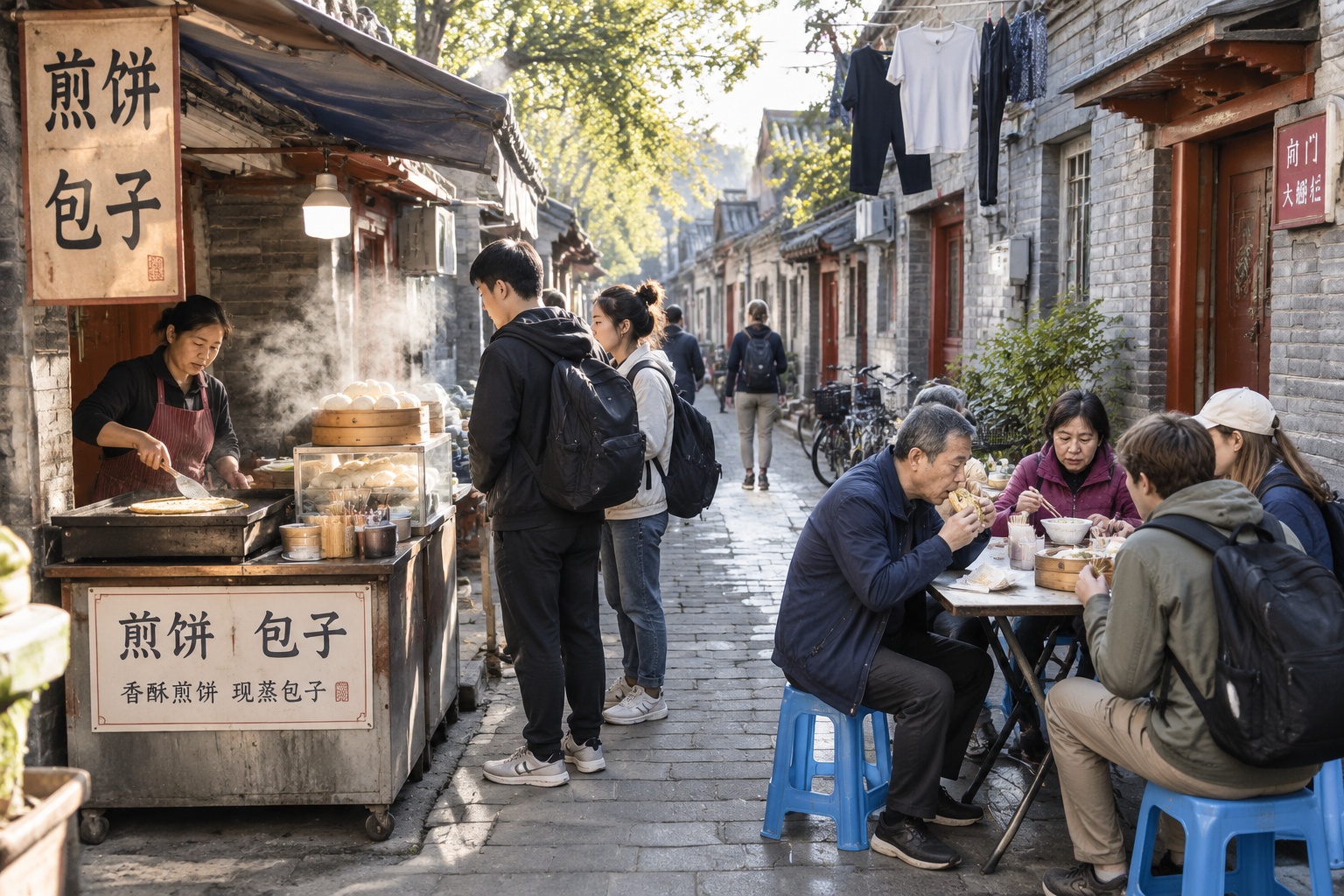
Look at what surrounds those 44 hectares of paving. To the east is the National Museum of China, free to enter with an online reservation, home to the Houmuwu ding — an 832-kilogram bronze vessel from the Shang dynasty that school groups are taken to see. To the west is the Great Hall of the People, where the legislature meets and where tour groups pose for photos on the steps. To the south, past the Monument to the People’s Heroes and the mausoleum, is Qianmen, and behind it Dashilan, a grid of narrow alleys where you can eat a bowl of zhajiangmian for 20 yuan and buy socks from a shop that has been there for decades.
North, through the gate, is the Forbidden City. Tickets are released seven days ahead, tied to your passport or ID, and sell out within minutes in summer. If you get one, walk through it, then climb Jingshan just to the north for the view back across the roofs. From up there the whole logic of the old city is laid out: the gate, the axis, the halls, the symmetry.
What Has Changed, and What You Should Know
Some things about the square have tightened over the years, and it is worth being straight about them. Since 2019, entering the square itself requires a free advance reservation (foreign visitors register with a passport). Security is visible and thorough, and there are areas where you cannot stand or linger. Drones are banned. The Line 1 stations at Tiananmen East and Tiananmen West sometimes skip stops during events and holidays with little warning.
How the space gets used has changed too. In the 1980s and ’90s, the square was known for kite flyers and families sitting on blankets. Today it is far more managed, and more of its daily life happens around the edges — the museum queue, the Forbidden City entrance, the photo spot on the underpass steps. That is not a small shift, and it belongs in an honest picture.
None of this makes the flag-raising fake. The people in that 4 a.m. queue are not performing patriotism for a camera. Some are tourists ticking off a list. Some are parents who wanted their kid to see it once. Some are older people who came because it means something to them that they would not put into words for a foreigner with a notebook.
If You Go
Practical notes, in the order you’ll need them. Reserve the square in advance — it’s free, but you need the QR code and your passport at the checkpoint. Check the flag-raising time online the night before; it tracks sunrise to the minute. Arrive 30–40 minutes early on a normal weekday, 60–90 during National Day or school holidays. Bring your passport, and expect bag screening at the square and again when you re-enter the subway.
The Forbidden City is closed most Mondays, and the National Museum is closed Mondays as well. Both need reservations made days ahead. The underpass beneath Chang’an Avenue is the only way to walk between the square and the gate, and it is also the best place to photograph the wall from below, with traffic moving behind you.
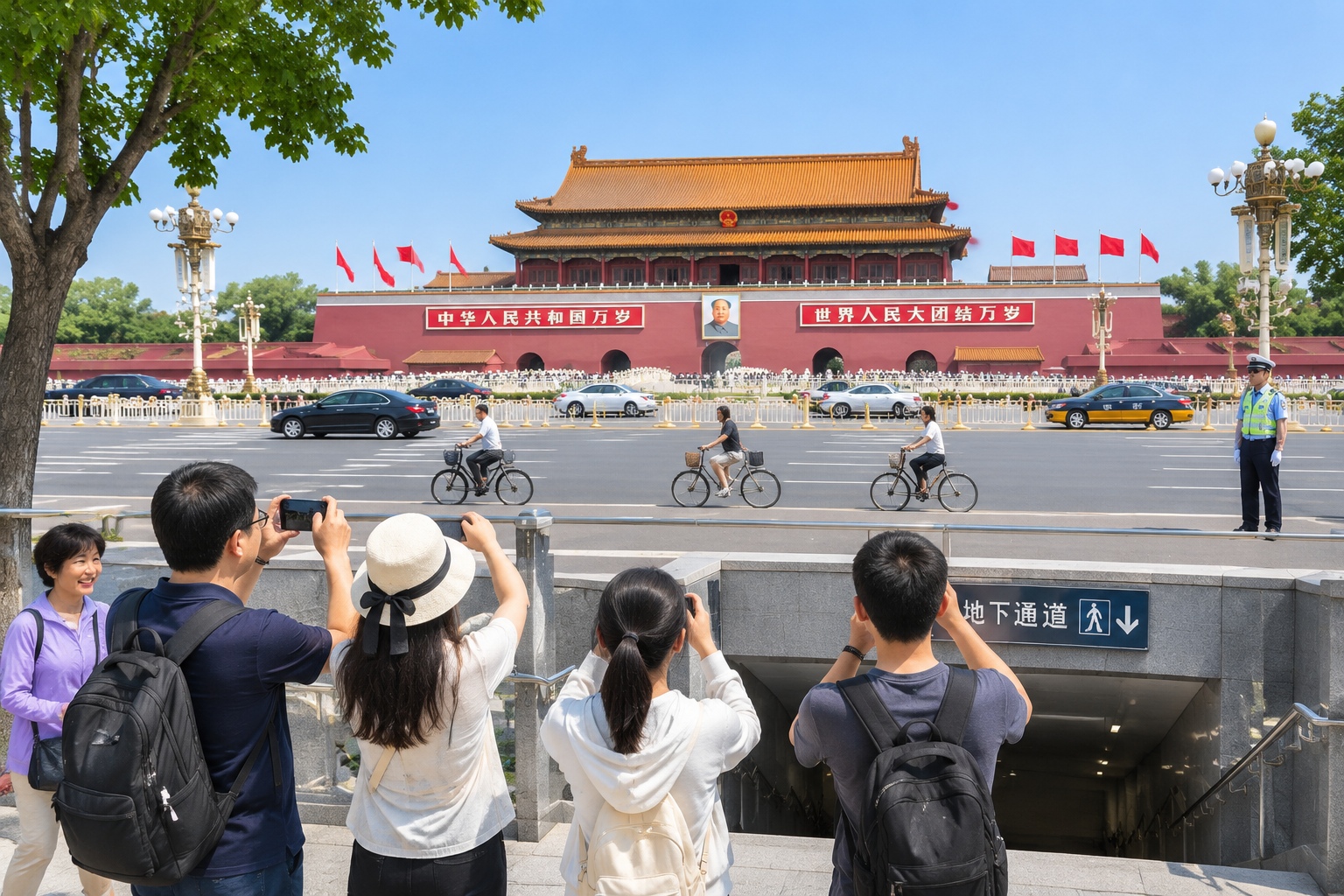
The Gate at Seven in the Morning
By the time I walked south toward Qianmen, the square was almost empty again. A crew was hosing down the pavement. A man in an orange vest was folding up barriers. The gate itself, in flat morning light, is just a very large red wall with a picture on it, and a steady stream of people walking through the side archways because that is the way to the palace.
Both things are true at once, and I think that is the most useful way to hold it. Tiananmen is a national symbol — it carries the weight of 1949, of the anthem, of the portrait that gets repainted every year. It is also a gate on a walking route, with a metro station behind it and breakfast waiting a few hundred meters south. A 600-year-old building has been a boundary, a stage, and a passage. On most mornings, it manages all three before 7 a.m.
Start the discussion at forum.chinacomes.com