
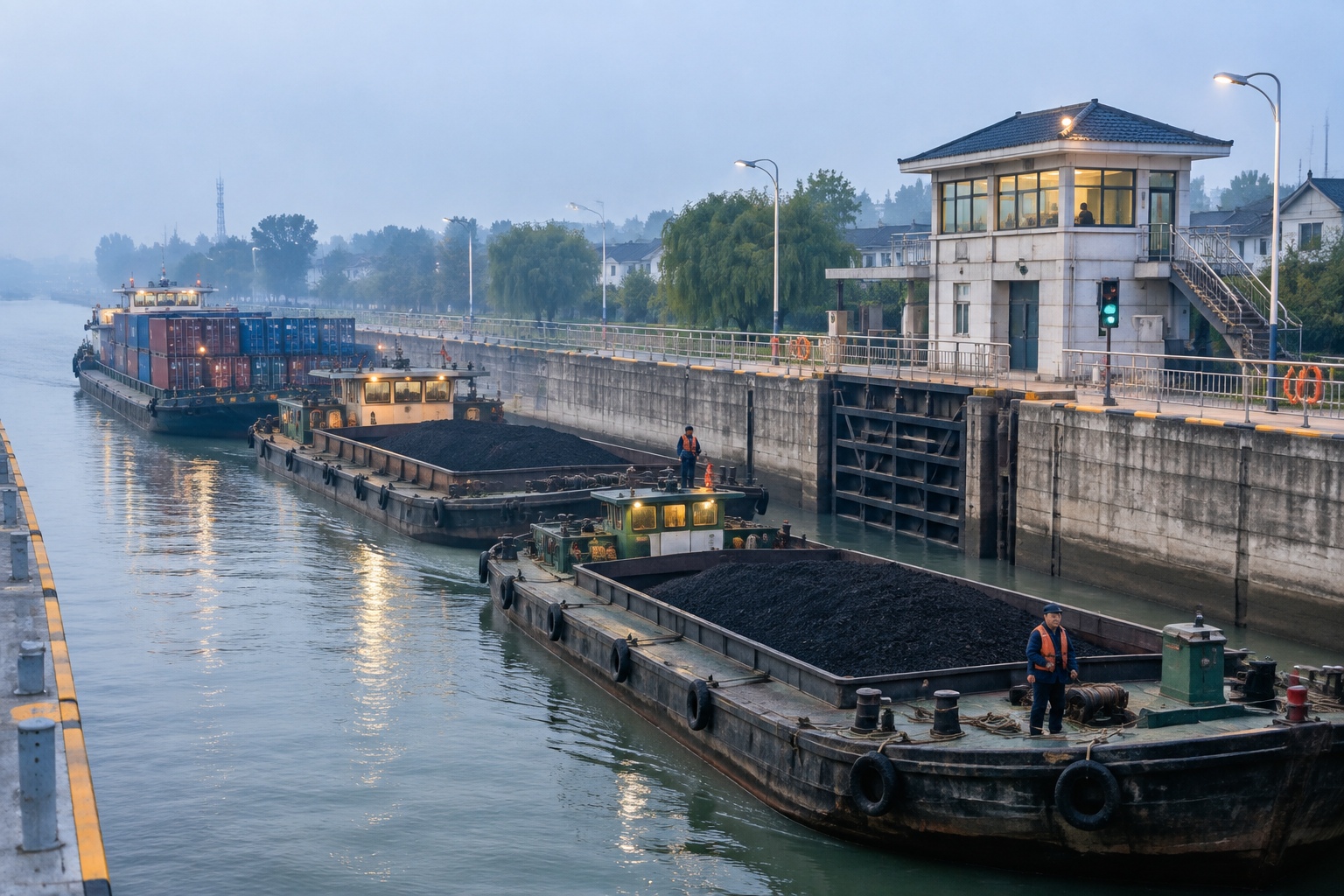

5:40 a.m., Third in Line at the Lock
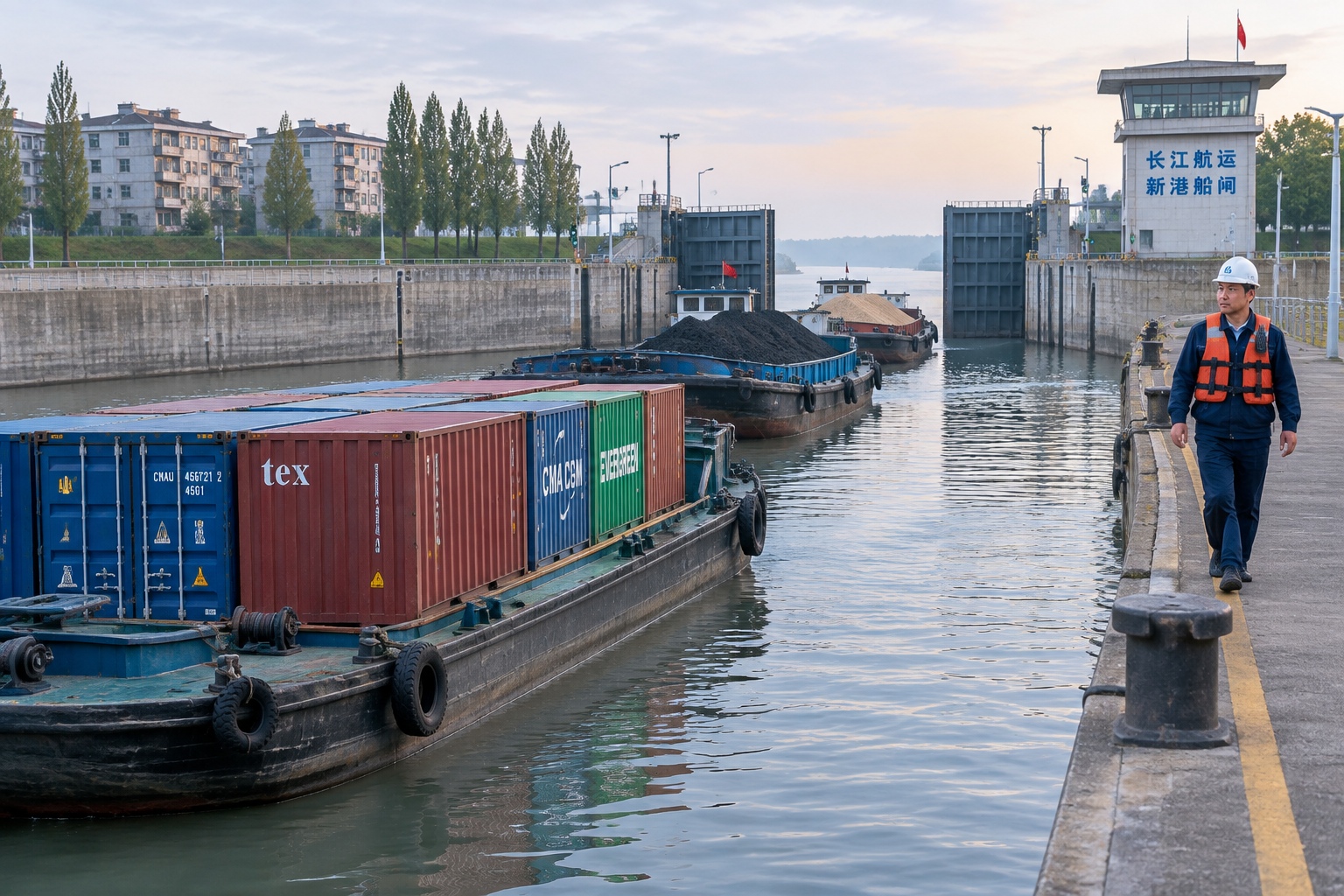
North of Yangzhou, on the Jiangsu stretch of the Grand Canal, a barge loaded with containers is waiting its turn at the Shaobo lock. Ahead of it sit two flat barges full of coal, riding low, engines idling. The gate opens at six. By noon there will be forty vessels behind it.
Nobody here is taking pictures. This is a working river, and it has been working for a very long time.
“Golden waterway” — huangjin shuidao — is not a tourism slogan. It is a planning term. It describes an inland river with enough depth, width and lock capacity to move heavy cargo in large volumes at low cost, with enough factories and ports along its banks to keep the barges full. The phrase was popularised for the Yangtze in the 1990s. Today it applies to a lot more than the Yangtze.
If the Yangtze Is the Motorway, These Are the Truck Routes
The Yangtze earns its reputation. Its main line has handled more than 3 billion tonnes of cargo a year for years running — more than any other inland river on earth, several times the Rhine, which many Europeans assume is the world’s busiest. Suzhou, Nanjing, Wuhan and Chongqing sit along it.
But China’s inland waterways as a whole move something close to 5 billion tonnes a year. Strip out the Yangtze and a surprising amount is left: the Grand Canal, the Pearl River–West River system in the south, the Huaihe, and tributaries like the Han, Xiang and Gan rivers. Each of them is the main street of a region you have probably bought something from.
The Grand Canal: A Heritage Site That Still Moves Coal
The Grand Canal is 2,500 years old in its earliest sections and roughly 1,800 kilometres long in its classic Beijing-to-Hangzhou form. The northern half, from Jining up to Beijing, mostly stopped being navigable in the 19th century. The southern half never stopped working.
The Jiangsu section alone carries on the order of 500 million tonnes of cargo a year — comparable to a very busy freight railway, and more than many countries move by water in total. The cargo is unromantic: coal, sand, gravel, steel, cement, chemicals, and increasingly containers moving between inland ports in Shandong and the container terminals at Taicang and Shanghai.
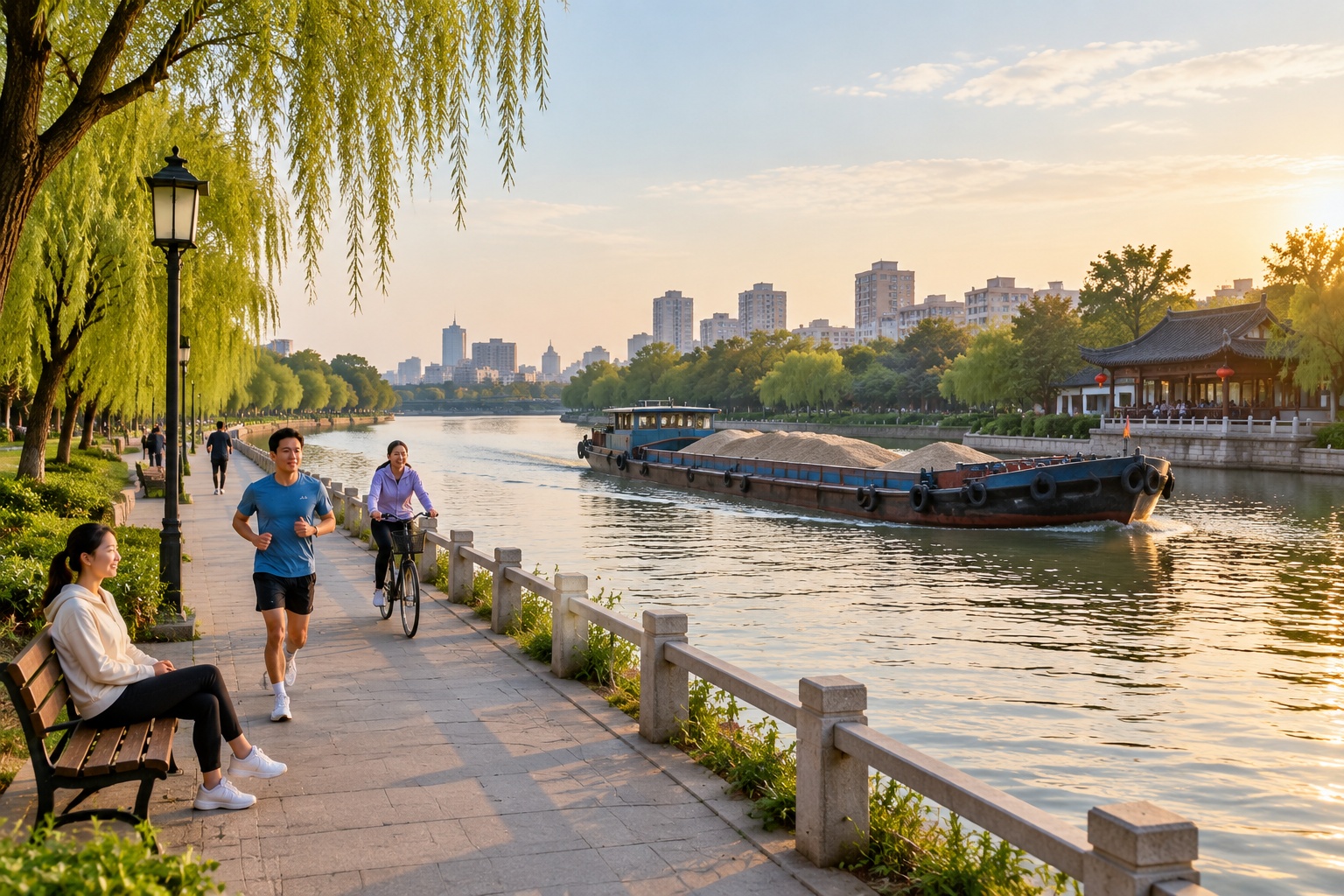
Along the banks, the canal has been replanted and repaved. In Yangzhou, Huai’an, Suzhou and Jining, the old towpaths are riverside parks where people jog after dinner. That is a genuine change of the past decade — the same water body acting as freight corridor and neighbourhood front yard, with the barges sitting in the middle distance.
The West River: The Warehouse Behind the Greater Bay Area
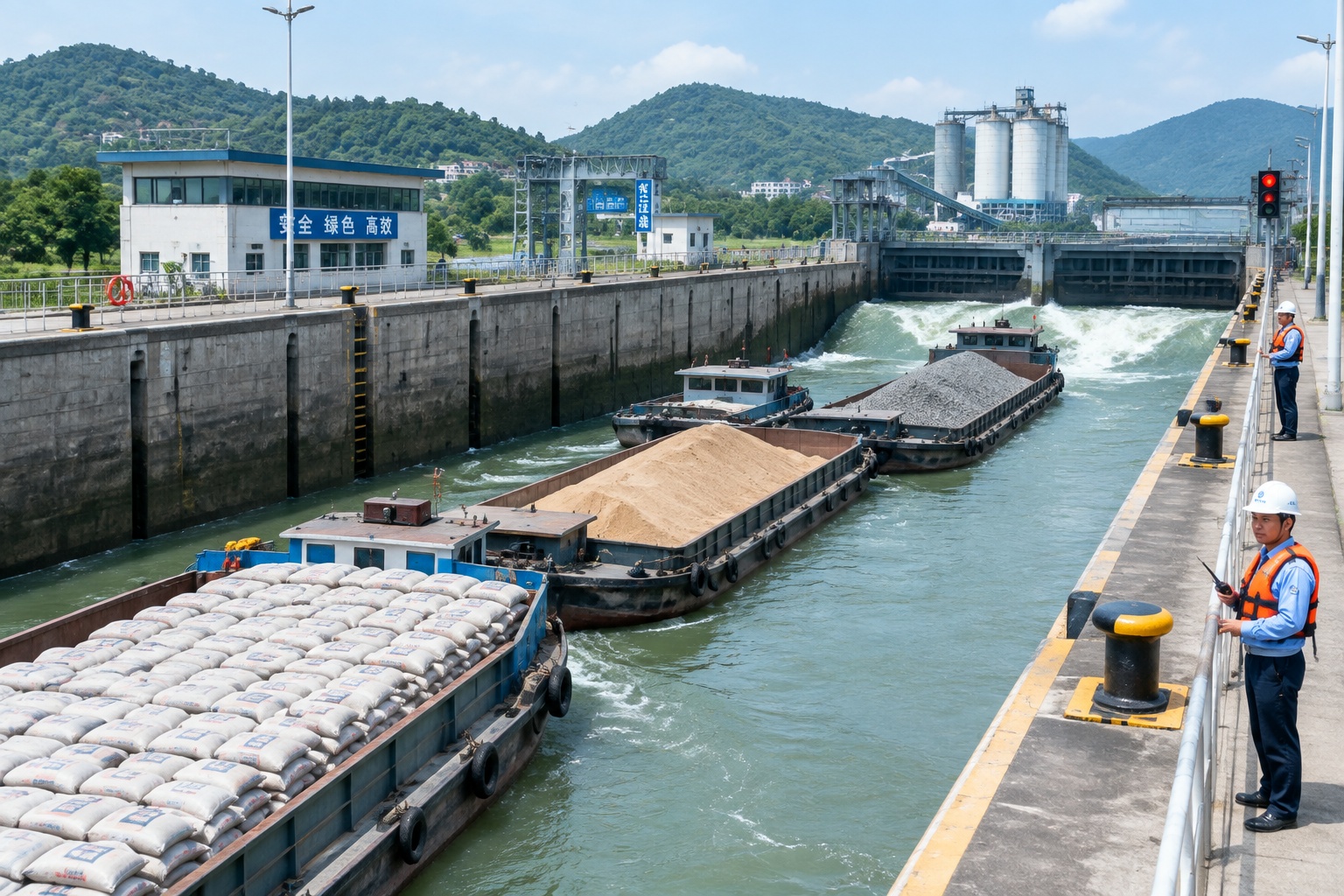
In southern China the working river is the Xijiang, or West River, which drains Guangxi and western Guangdong and empties into the Pearl River delta. The Changzhou lock at Wuzhou is one of the busiest inland locks in the country, passing well over 100 million tonnes a year, and queueing there is a permanent condition rather than an incident.
The cargo explains how the Greater Bay Area gets built. Guangxi sends cement, sand, ceramics, timber and coal downriver; Foshan, Zhaoqing and Jiangmen take them in for construction and manufacturing. A 3,000-tonne channel now runs from Wuzhou to Guangzhou, so one barge carries what would otherwise need dozens of trucks — through some of the densest factory country on earth.
The Huaihe Finally Gets a Shortcut
For most of history, if you put a barge on the Huaihe in Anhui and wanted to reach Shanghai, you had to wind your way around. The river had no direct connection to the Yangtze big enough for serious shipping, so cargo detoured hundreds of kilometres.
That changed with the Jianghuai Canal, the navigation arm of the Yangtze-to-Huaihe water diversion project, which began carrying ships in 2023. Several hundred kilometres of new and upgraded channel now link the Yangtze near Wuhu and Tongling with the Huaihe near Huainan and Bengbu.
The consequences reach inland. Zhoukou, in Henan — a city with no coastline and no major airport — has become the province’s largest inland port, sending grain, coal and building materials down the Shaying River toward the Huaihe, the Yangtze and eventually the sea. For factories in Henan and northern Anhui, the difference between shipping by barge and shipping by truck is the difference between competing for export orders and not.
Han, Xiang, Gan: The Tributaries Doing the Heavy Lifting
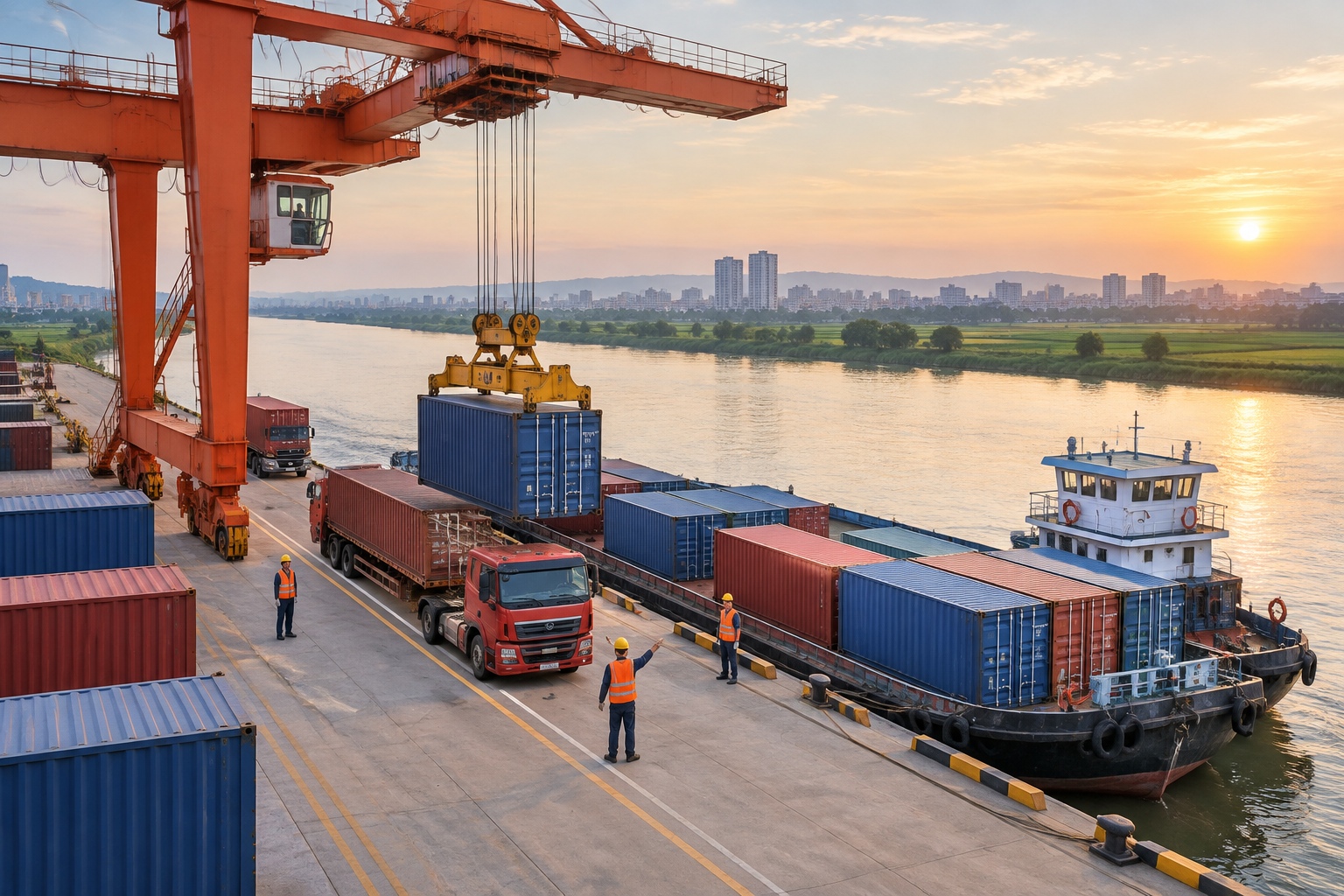
Three rivers do quiet, enormous work. The Han ties Wuhan to Xiangyang and up into Shaanxi. The Xiang connects the Changsha–Zhuzhou–Xiangtan industrial belt to the Yangtze at Chenglingji. The Gan links Nanchang and Ganzhou to Poyang Lake and the Yangtze at Jiujiang. All three have been dredged and locked to take larger vessels, and all three function as conveyor belts carrying inland factories’ output to Shanghai and out to sea.
Ganzhou is a good example: a city in the hills of southern Jiangxi, known for rare earths and furniture, now shipping containers by river to Jiujiang and onward to the coast. The trip takes days. It is cheap enough that it changes what those factories can compete on.
The Odd Ones Out
Not every waterway fits the pattern. In the northeast, the Songhua and Heilongjiang rivers freeze for four to five months a year, so shipping is seasonal — grain, coal, timber, and on the border river some trade with Russia. In Fujian, the Min River was reconnected for larger vessels after decades of interruption by hydroelectric dams, and now carries bulk cargo for Nanping and Fuzhou. In Zhejiang, the Qiantang and Fuchun rivers carry less freight than they once did and rather more tourists.
Then there is the Pinglu Canal, under construction in Guangxi and due to open around the end of 2026. It will run roughly 135 kilometres from the Yong River at Nanning to the Gulf of Beibu, giving southwest China a sea route that skips a long detour east. When it opens, some of Guangxi’s and Guizhou’s cargo will simply go a different way.
What It Looks Like From the Wheelhouse
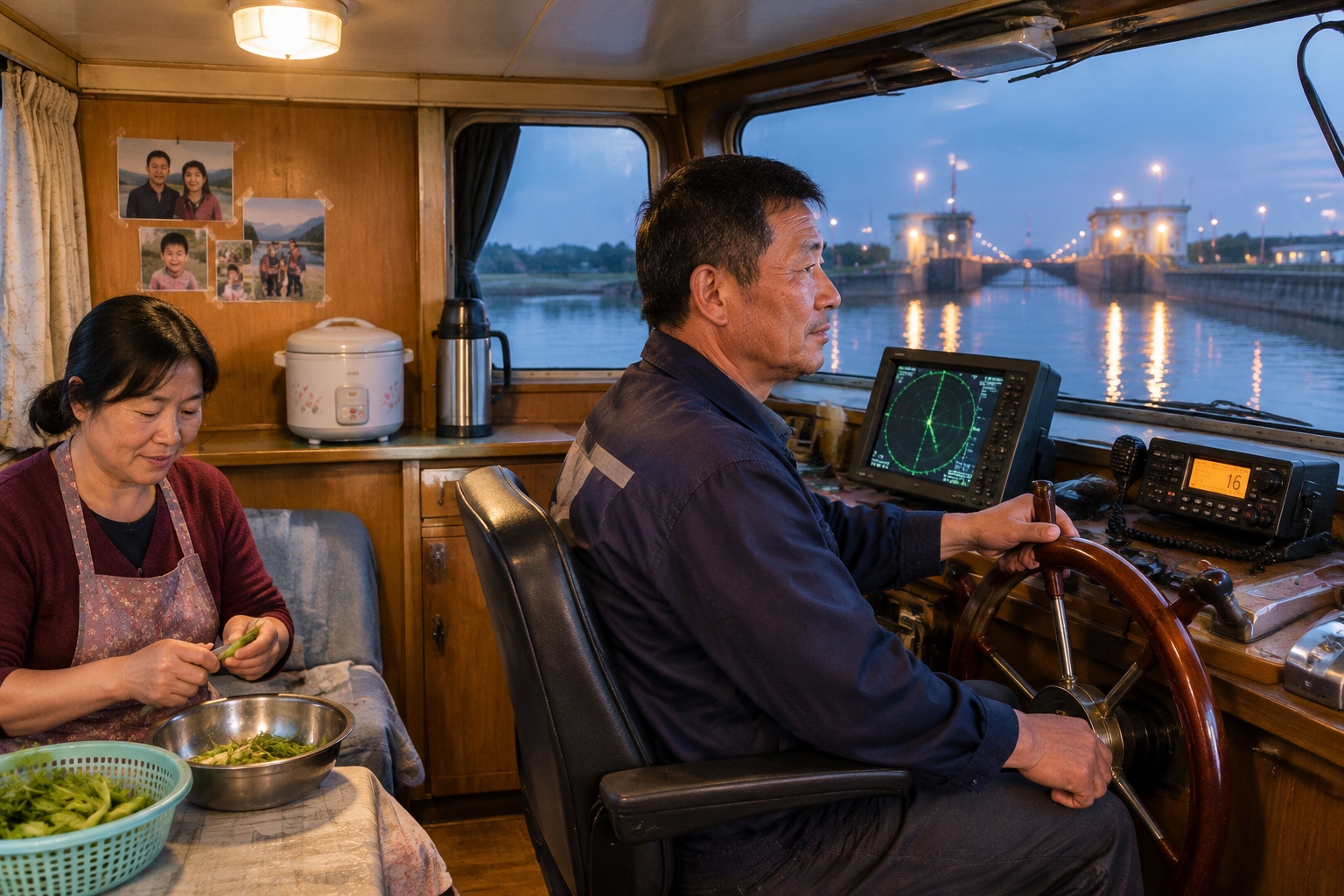
Ask a barge captain about golden waterways and you get an accountant’s answer. A 2,000-tonne vessel burns a few hundred yuan of diesel an hour pushing upstream. Passing a lock is cheap; waiting is not. The owner of a boat out of Wuzhou will tell you the difference between a good month and a bad one is usually how many days he spent in the queue at Changzhou.
The people around him matter just as much. Lock operators, crane crews, and the small shops near the locks that stay open all night selling instant noodles, cigarettes, phone chargers and thermos refills of hot water. Many boat families live aboard year-round, and their children change schools depending on which town the barge is moored near that term.
Low Water, Silt, and the Porpoise Question
Rivers that carry cargo also run low. In dry seasons, authorities cap how heavily barges may be loaded, and on the Yangtze and its tributaries that can cut effective capacity sharply. Silt has to be dredged, which costs money and disturbs riverbeds. Traffic brings engine noise, oil, and the risk of spills.
Against all that, inland shipping is one of the lower-carbon ways to move freight. Per tonne-kilometre a barge burns far less fuel than a truck — commonly cited comparisons put water freight at roughly a third of road transport’s energy use, at a fraction of the cost. For a country that has pledged to peak its emissions before 2030, that arithmetic matters.
The trade-offs show up in specific places. The Yangtze’s finless porpoise — locally the “river pig” — fell to dangerously low numbers; a decade of fishing bans, patrols and habitat work has stabilised the population, and sightings near Nanjing and Tongling now turn up in local news. On the Huaihe and the Grand Canal, the challenge is more mundane: keeping water clean enough for towns that have turned their canal banks into parks.
Why a River You Have Never Heard of Is in Your Shopping Cart
The economics are not abstract. Cheap barge capacity is one reason bulk building materials in Chinese cities cost what they do; it is part of why a factory in a landlocked province can export at all. And the Grand Canal towpaths are jogging routes today partly because freight moved back onto the water and the banks stopped being loading docks.
So the next time something says “Made in China”, it is worth remembering where the journey may have started: not in Shanghai or Shenzhen, but in Zhoukou, Wuzhou, Jining or Ganzhou, on a barge that spent two days waiting at a lock, on water most of the world has never heard of.
Start the discussion at forum.chinacomes.com