


Before You Can See It, You Hand Over Your Phone
The lockers at the visitor center in Pingtang County, Guizhou, fill up with the same items every morning: phones, cameras, smartwatches, car key fobs. Anything that transmits stays behind. The rules are posted in plain language — no Wi-Fi, no Bluetooth, no drones.
From there a shuttle bus climbs for about twenty minutes through green karst hills, past cornfields and the occasional farmhouse, and stops at the foot of a wooden staircase. You climb a few hundred steps. Then the valley opens.
A silver bowl about 500 meters across sits inside a natural hollow in the limestone, and a small cabin hangs above its center on steel cables. It looks less like a machine than a lake that someone poured into a mountain.
Chinese media call it 中国天眼 — “China’s Sky Eye.” Its formal name is FAST, the Five-hundred-meter Aperture Spherical radio Telescope. It is the largest single-dish radio telescope on Earth, and it is the reason a quiet corner of one of China’s poorest provinces now shows up in astronomy papers from Europe, Australia and the United States.

Why the World’s Biggest Radio Telescope Sits in a Sinkhole
Guizhou is karst country: soft limestone, heavy rain, thousands of collapsed hollows. One of them, a bowl-shaped depression called Dawodang near Kedu Township, turned out to be almost exactly the shape engineers needed.
Three things made it work. The shape saved money and material, because a natural basin already approximates the curve of a dish. The limestone drains rainwater away, so the telescope is not sitting in a pond. Most importantly, the ring of hills around it blocks some of the radio noise that now fills the modern world.
Radio astronomy is a hunt for extremely weak signals, and the twenty-first century is loud — mobile towers, microwave links, garage door openers, satellites. That is why the area around FAST is a designated radio quiet zone. Inside a 5-kilometer core, transmitting equipment is heavily restricted; in a wider ring beyond it, rules still apply to residents, farmers and drivers. Enforcement is not theoretical. Staff monitor interference around the clock, and local authorities have shut down or moved transmitters before.
What “13.7 Billion Light-Years Away” Actually Means
A light-year is a distance, not a duration — how far light travels in a year, roughly 9.46 trillion kilometers. When a telescope collects light from a galaxy 13 billion light-years away, it sees that galaxy as it was 13 billion years ago, because the light has been traveling ever since. Astronomers call this look-back time. It is the closest thing anyone has to a time machine.
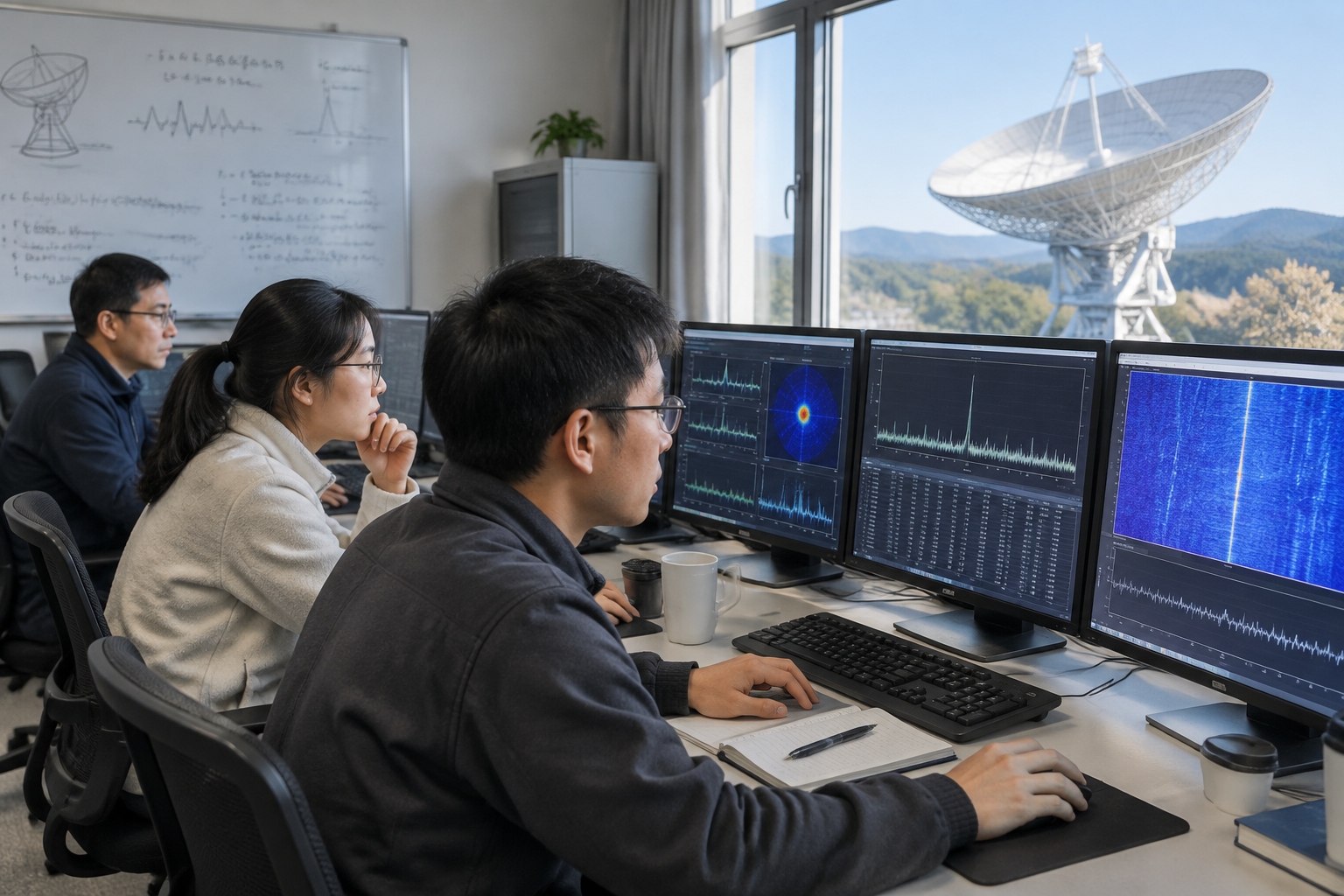
Radio telescopes do not hear anything. Radio waves are light with long wavelengths, and FAST’s dish works like a giant mirror, focusing those waves onto a receiver suspended above the surface. The signal arrives as numbers — voltage, frequency, arrival time — and the science happens in software.
FAST observes roughly between 70 megahertz and 3 gigahertz. That window includes the 21-centimeter line, the natural radio glow of cold hydrogen, the most common stuff in the universe. It also covers the clock-like pulses of neutron stars and the millisecond flashes known as fast radio bursts.
So is the telescope really watching 13.7 billion years into the past? Honestly, no — not directly, and researchers at the site will tell you so. The number is shorthand for the age of the universe, not a distance FAST routinely reaches. The oldest light in the cosmos, the cosmic microwave background, sits at millimeter wavelengths and fills the entire sky, which makes a huge dish the wrong tool for it. Where FAST does reach into deep time is indirect: through pulsars that let astronomers detect ripples in spacetime, and through surveys of hydrogen gas in distant galaxies.
What FAST Has Actually Found
Pulsars: The Steadiest Clocks We Know Of
Pulsars are neutron stars — a sun’s worth of matter crushed into a sphere the size of a small city, spinning up to hundreds of times a second, sweeping beams of radio light past Earth like a lighthouse. By 2024, FAST had discovered more than 900 new pulsars, a substantial share of all the pulsars humanity has ever catalogued. More keep arriving.
They matter because they tick more regularly than atomic clocks. Small changes in the arrival time of their pulses betray gravitational waves passing between the pulsar and us, let physicists test general relativity in extreme conditions, and in a few famous cases revealed planets orbiting dead stars.
Fast Radio Bursts: Milliseconds, Enormous Energy
FRBs are flashes lasting a few milliseconds, arriving from galaxies billions of light-years away, releasing in that instant more energy than the Sun puts out in years. Nobody knows exactly what produces them. FAST’s sensitivity turned the subject from a trickle of events into a flood: in 2021 it recorded 1,863 bursts from a single repeating source in 82 hours, and 1,652 bursts from another over 47 days. That volume of data let astronomers watch a source switch on and off, and map the magnetized plasma in front of it.
A Low Hum of Gravitational Waves
In June 2023, several teams around the world — including the Chinese pulsar timing array, which leans heavily on FAST data — reported evidence of a background of nanohertz gravitational waves, most likely from pairs of supermassive black holes slowly spiraling toward each other. It is a whisper stretched across decades, extracted from the timing of dead stars.
Keeping a 500-Meter Dish Alive
The dish is not solid. Its surface is 4,450 triangular aluminum panels, each one adjustable. To observe, engineers bend a 300-meter patch of that surface into a proper parabola aimed at the target, up to 40 degrees off vertical; 2,225 winches pull the panels into position. The receiver cabin weighs about 30 tonnes and hangs roughly 140 meters above the surface, held by six cables and steered by a motorized platform. Shape and position are corrected constantly.
Maintenance is physical work: inspecting cables and actuators, cleaning, replacing panels that get damaged. Much of the observing runs automatically through the night while the control room watches the numbers come in.

A Scientific Instrument With Tourists Next Door
FAST is both a working observatory and an attraction. Kedu Township, a sleepy farming area a decade ago, now has an “Astronomy Town” with hotels, a planetarium and restaurants serving sour fish soup to visitors who arrive daily. Families that once grew corn run guesthouses. Local middle-school students take field trips to see the dish.
The relationship takes management. Around 9,000 people living inside the core quiet zone were relocated before the telescope came online — a subject discussed inside China with pride in the project and, sometimes, an acknowledgement of the disruption. Some of those families ended up working at the observatory or in the tourism economy it created.
Tourists and radio silence also have to coexist. Buses stop at a viewing platform, phones stay in lockers, and staff watch for interference. One detail visitors remember: photographs taken up at the platform have traditionally been shot on film rather than digital, because even small electronics are unwelcome that close to a dish built to catch a cosmic whisper.
So What Is It Really Listening For?
Not aliens, mostly — at least not on purpose. FAST’s daily work is surveying, timing and cataloguing: building the most detailed census of pulsars ever assembled, catching radio bursts that last less time than a blink, and slowly turning a limestone hollow in Guizhou into one of the most sensitive ears humans have ever pointed at the sky.
The “13.7 billion years” headline is better read as ambition than as a measurement. What the telescope actually delivers is stranger and more concrete: the ability to notice a change in the rhythm of a dead star halfway across the galaxy, and from that, to say something about the shape of the universe.
Standing on the platform, with no phone in your pocket and no signal in the air, that is what the silence is for.

Start the discussion at forum.chinacomes.com