
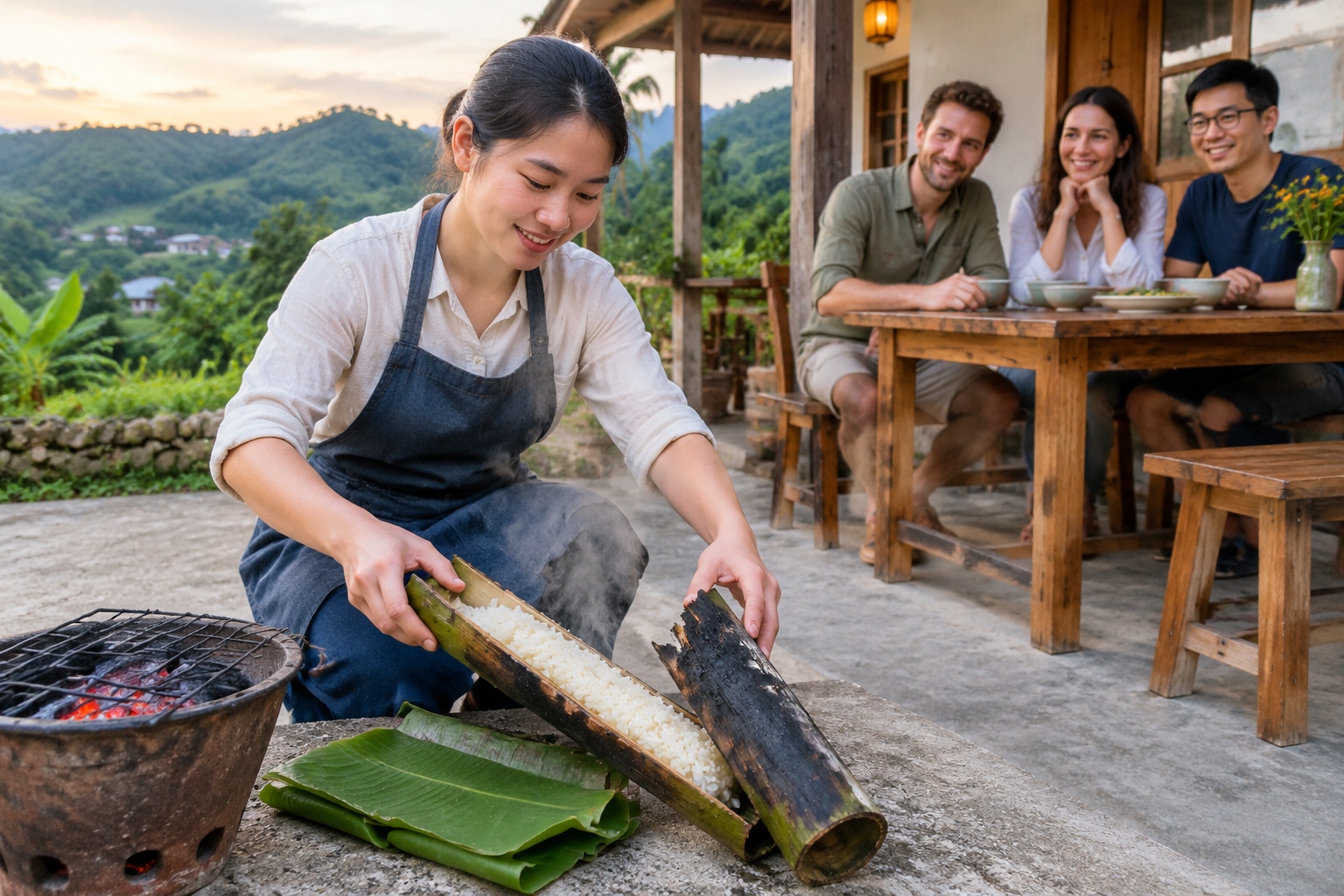

A bamboo tube split open on a concrete step
It is just after six on a Saturday evening in a village outside Wuzhishan, in the green middle of Hainan, and a woman in her late twenties lifts a length of bamboo off a charcoal brazier with a pair of pliers. She sets it on the concrete, taps it once, and opens it with a single blow of a cleaver. Steam comes out first, then the smell: toasted rice, warm banana leaf, something faintly sweet that has nothing to do with sugar. Six guests from Shanghai and Guangzhou lean in with their phones. Her grandmother, on a plastic stool a metre away, does not look up.
The guests paid for dinner, but they did not pay for a performance. That cleaver is the same cleaver used on a wet Tuesday in June when the homestay has no bookings at all. Which is the first thing worth knowing about Li bamboo rice: it is a household food that tourism has learned to sell, not a dish invented in order to be sold.
What bamboo rice actually is
Hainan is usually sold to foreigners as beaches: Sanya, surfing, resorts with swim-up bars. But the centre of the island is mountain and rainforest, and it is home to the Li, Hainan’s indigenous people, who number roughly 1.5 million and live mostly in Wuzhishan, Baisha, Qiongzhong, Baoting, Ledong and Changjiang. Bamboo rice is one of their everyday foods, also a festival food, and also the thing you make when a guest arrives and there is not much in the kitchen.
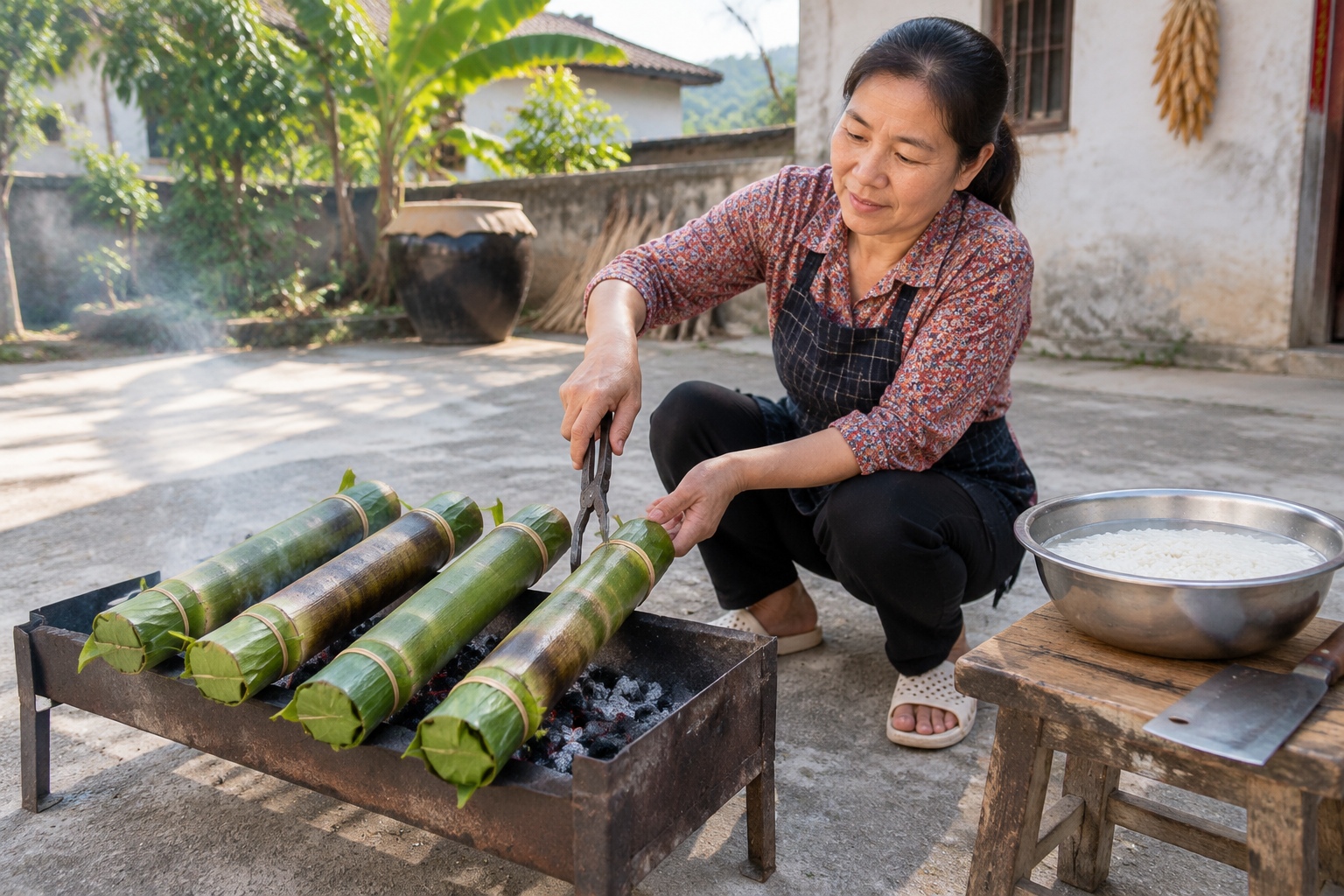
The technique is simple to describe. Green bamboo is cut into single-node sections, each one a portion. Rice goes in, water goes in, a folded banana leaf plugs the top, and the tube lies over a fire until the rice is cooked. The bamboo is the pot, steam is the method, and the thin membrane on the inside of the tube keeps the rice from scorching. When it is done you split the tube lengthwise and eat the rice with your fingers, scraping it off the bamboo with a sliver of the tube itself.
If you have eaten lemang in Malaysia or khao lam in Thailand, you have met a cousin of this dish. The family resemblance is real: related foodways run across Southeast Asia and into Hainan’s interior. But the local version has its own anchor, shanlan rice, a dry upland variety grown on slopes instead of flooded paddies. It yields less than ordinary rice, costs several times more, and tastes nuttier. Villagers also ferment shanlan wine from it, which is what you should be drinking with the rice.
On the third day of the third lunar month, the Sanyuesan festival, usually in April, bamboo rice shows up alongside the wine, the antiphonal singing and the bamboo pole dancing. On other days it shows up because someone was hungry.
Forty-five minutes, and four ways to ruin it
The version served to guests at the homestay is not complicated, which is why the margins are so thin.
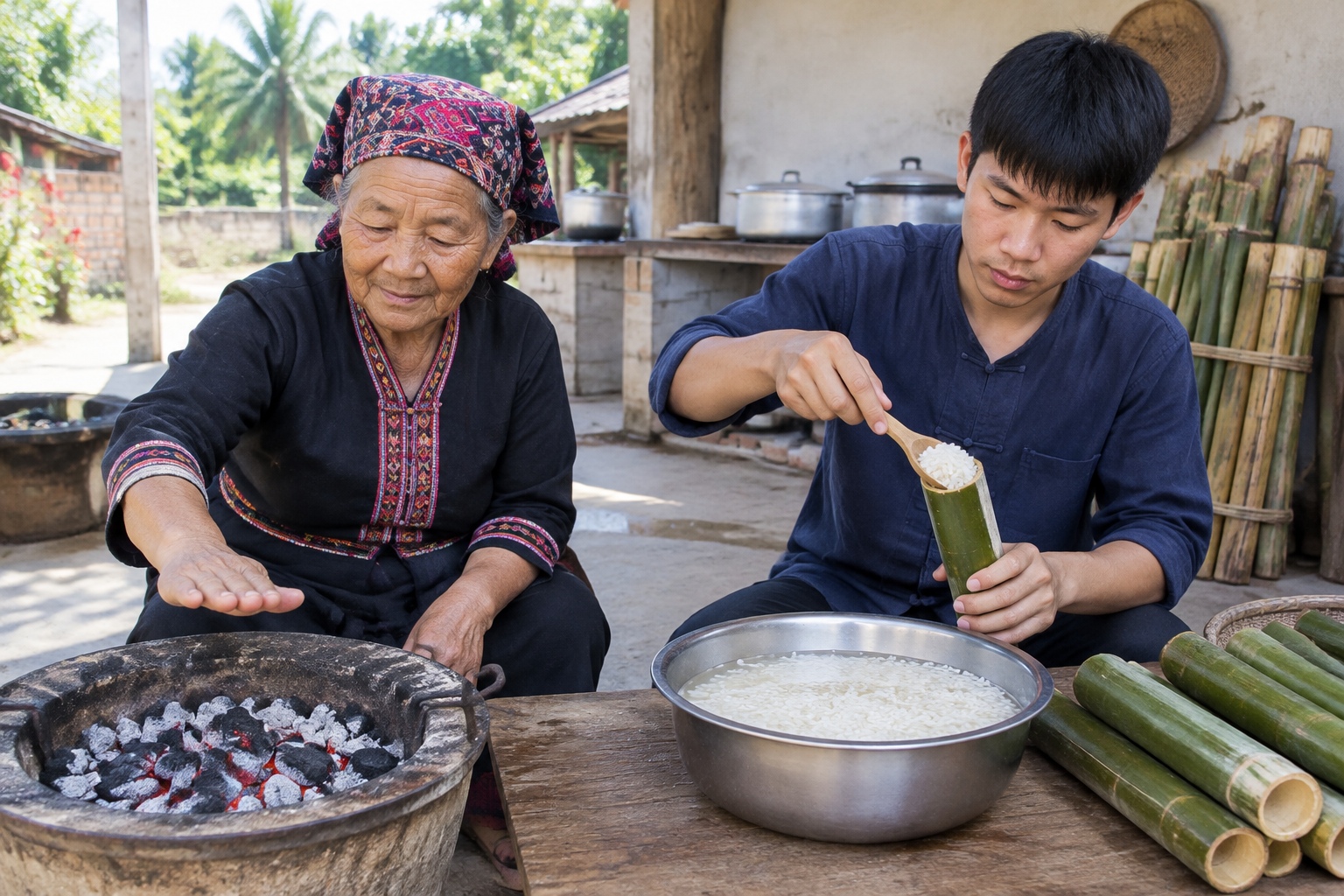
Bamboo is cut in the morning, ideally young green bamboo with moisture still in the wood. Rice is soaked for two to four hours, then drained and packed into the tube to about three-quarters full. Rice expands, and a greedy fill means the leaf plug pops off into the fire. Water goes in just above the rice line. The plug is banana leaf, folded twice and tied down with a strip of bamboo skin.
Then comes the part nobody photographs. The tubes lie at an angle over charcoal, not over direct flame, and are turned every five to eight minutes. Too hot and the bamboo burns through before the rice is done; too cool and you get smoky raw rice. Depending on the diameter, cooking takes forty to sixty minutes. The last step is the one most home cooks skip: let the tube stand for five minutes before opening, so the steam settles.
At the homestay the division of labour is clear. The grandmother judges the fire by holding her palm near the brazier, a measurement nobody has ever written down. The owner handles orders, packaging, the WeChat group for guests and the timing. A nineteen-year-old cousin fills tubes and learns, mostly, by being told he filled them wrong.
What tourism changed, and what it paid for
For a long time, Hainan’s tourist map stopped at the coast. The shift inland is recent and visible. The island’s tropical rainforest was formalised as a national park in 2021, a 988-kilometre ring road around the island opened at the end of 2023, and provincial campaigns for rural tourism pushed visitors up mountain roads that previously carried farm trucks. Hainan reported more than 90 million visitor trips in 2023, against a resident population of about 10 million.
Bamboo rice rode that wave and changed shape on the way. Three versions now exist side by side.
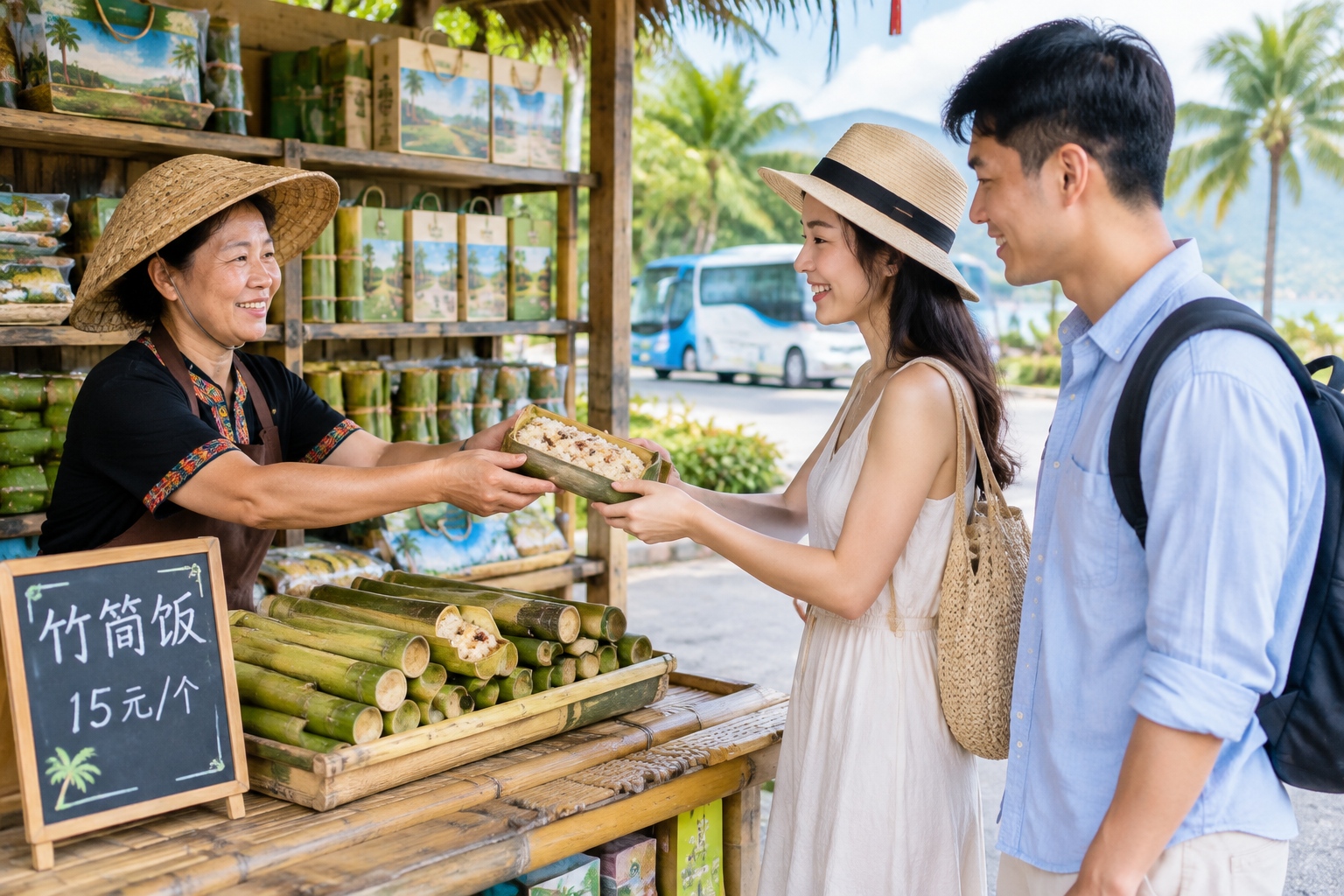
The roadside stall version, near a scenic area or a rainforest trailhead, sells one tube for roughly 15 to 30 yuan, about $2 to $4. It is cooked to order if you are lucky and held warm in a steamer if you are not. The restaurant version, in an air-conditioned room, costs more and tastes milder, because tour groups reliably ask for less salt. The souvenir version is vacuum-packed, shelf-stable for months and sold in the island’s speciality shops and on Chinese e-commerce platforms. The rice in it is genuinely bamboo rice, but it was steamed in a factory and reheated in your kitchen, which makes it a different food.
In towns, you can now order bamboo rice through a delivery app. For a homestay, that shows up as a change in the rhythm of income. Bookings cluster around Spring Festival, the May Day holiday, the summer school break and Sanyuesan; for many small operators, those few weeks carry half the year. On a good Saturday in April, the courtyard above will split two hundred tubes. On a rainy Tuesday in September, it will split five.
The parts you can’t cut
Not every compromise is a loss, and not every tradition is worth defending for its own sake. Here is where the line seems to fall.
Charcoal is being replaced indoors and in some scenic areas by electric ovens, for fire safety and air quality. Electric heat is more even and easier to standardise, and it does not produce the smoke that seasons the rice. Most cooks will tell you the difference is small but real; almost none of them want to go back to a fire that fails an inspection.
Bamboo is a bigger question. Each tube is used once, because you cannot cook again in a tube that has been split. Some larger kitchens now buy bamboo by the bundle from wholesalers instead of thinning village groves, and a few use stainless-steel sleeves lined with bamboo leaf for group meals. Freshness matters more than provenance: bamboo cut that morning still holds water in its walls, and that moisture is part of how the rice steams.
Shanlan rice is where the cheap version and the honest version diverge. It is low-yield and expensive, so some kitchens blend it with ordinary rice, or quietly switch entirely. Nobody is committing fraud; menus just rarely specify. If it matters to you, ask. 山兰米, shanlan rice, is a phrase worth knowing.
What almost nobody cuts: the three-quarter fill, the resting time, and the split in front of the person who is going to eat it. Those are cheap to keep and expensive to lose.
How to order it without turning a meal into theatre
Pick a place where the fire is visible and locals are also eating. A Chinese-only menu, a stack of cut bamboo by the door and a brazier that is actually lit are better signals than a sign in four languages.
Order one tube per two people to start, plus a plate of mountain vegetables and, if it is offered, the fermented fish Li kitchens call yu cha: sour, pungent and a genuine divider of opinion. Eat with your fingers. Use the split bamboo as a scraper.
Some homestays run hands-on sessions of sixty to ninety minutes, usually 70 to 100 yuan per person, where you fill and seal your own tube and it goes on the fire with your name on it. It is worth doing once, because fire control is the part that is hard to learn by watching.
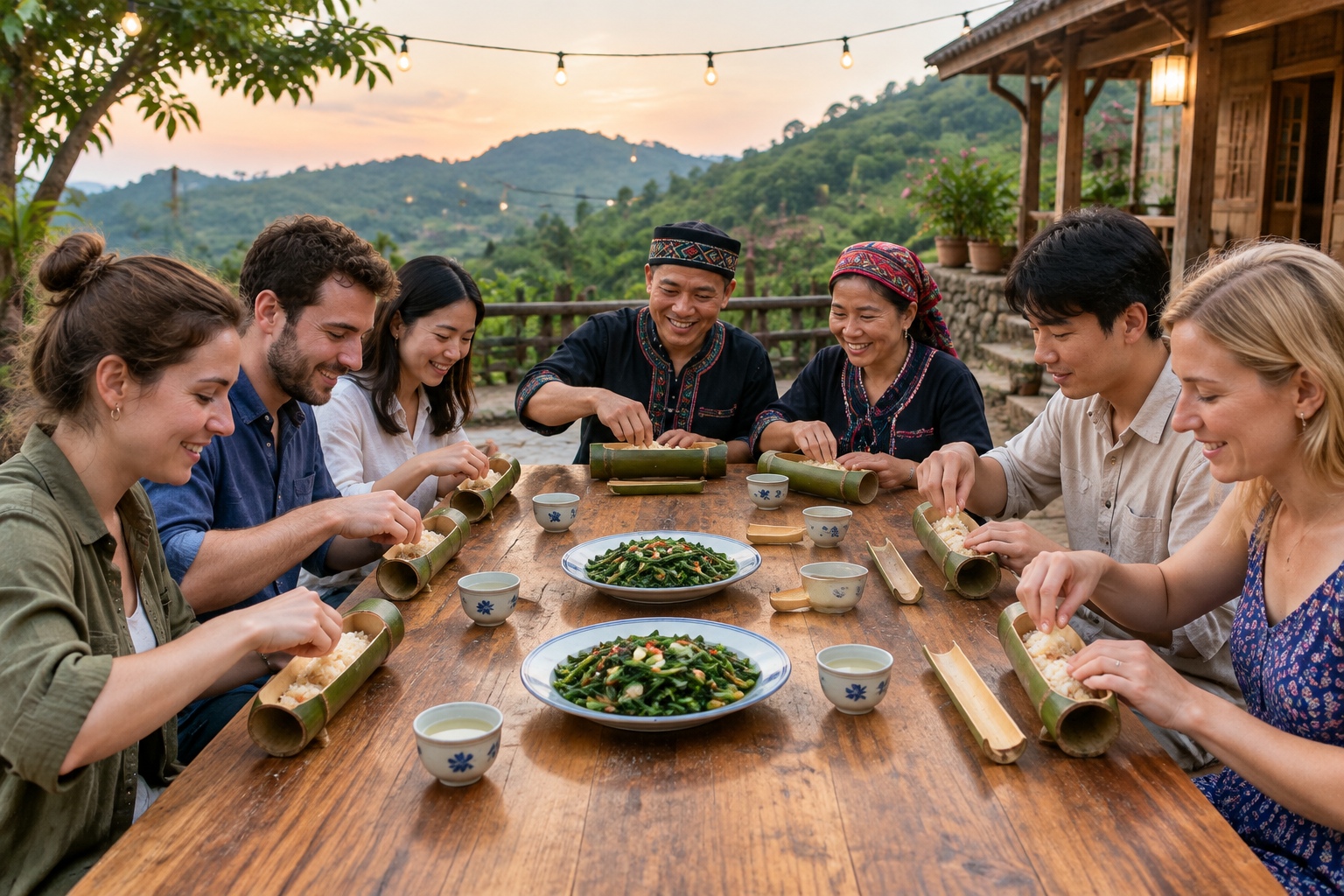
Two small courtesies. Ask before filming inside a kitchen or a family courtyard; the split itself is fair game, because that is the moment your host is offering you. And do not treat a family meal as an exhibit. If the grandmother is eating her own lunch, let her eat it.
Still cooked on a Tuesday
The interesting thing about bamboo rice in Hainan is not that it has survived. It is that it is still being renegotiated. The grandmother will not switch to an electric oven at home. Her granddaughter will, for the tour groups, and the two of them will argue about it in the kitchen. The nineteen-year-old cousin will eventually judge charcoal by hand too, and will also film it for short video, because that is how the homestay gets booked in winter.
A tradition that is only displayed is already finished. One that is argued over, priced, sold, complained about and eaten on an ordinary evening is not. Either way the bamboo gets split. The question is whether anyone is still hungry.
Start the discussion at forum.chinacomes.com