
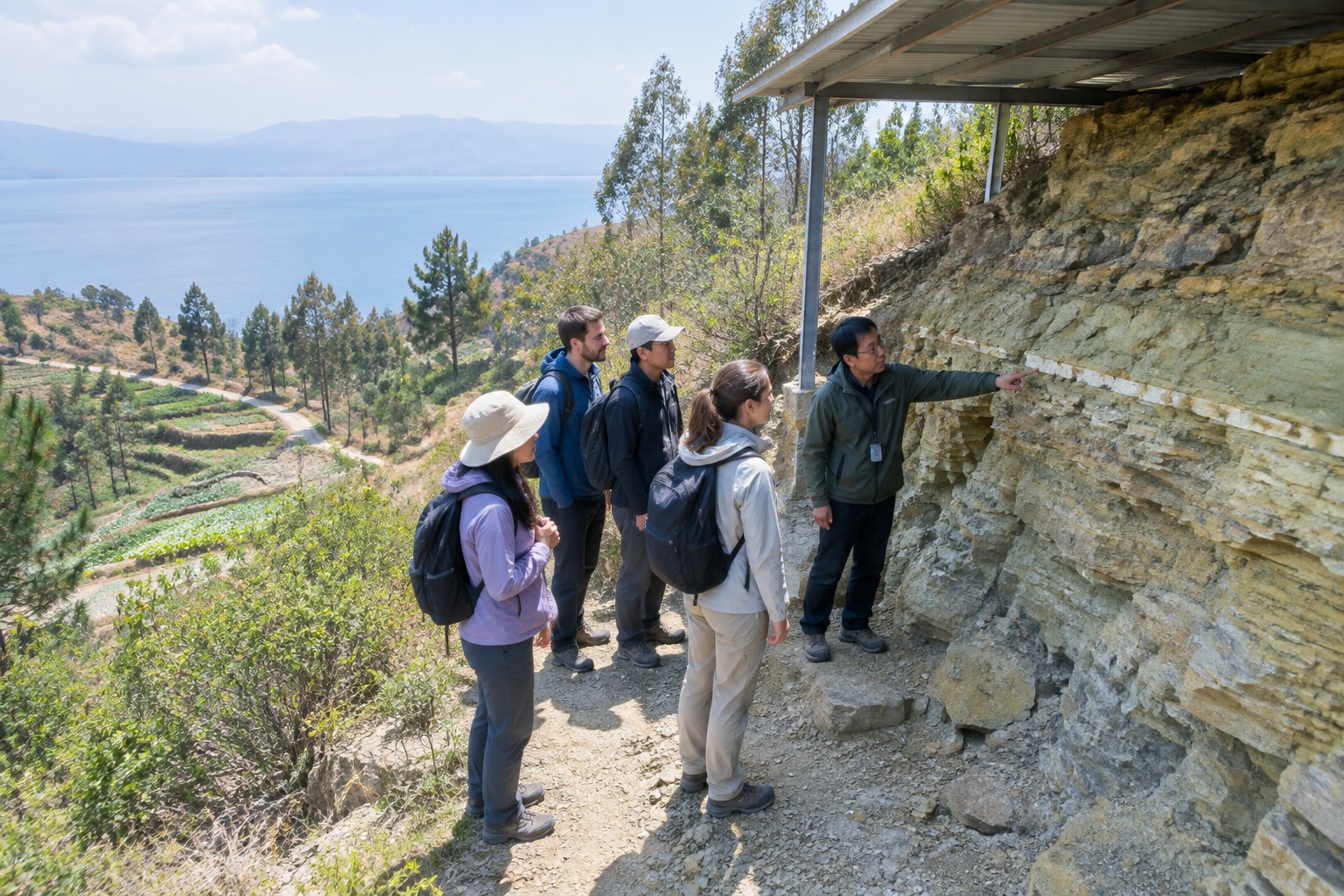

From the road, Maotianshan does not look like a place that rewrote the history of life. It is a low, scrubby hill about 60 kilometres south of Kunming, in Yunnan Province: a stone marker at the foot, a paved path, and a quarry face of yellowish-green rock under a shed roof. Farmers grow vegetables on the flats below. On a clear day you can see the blue edge of Fuxian Lake to the west.
The rock in that quarry is roughly 518 million years old. Chinese museum labels usually round it to 5.3亿年 — 530 million — and popular articles say “about 520 million”. The rounding matters less than what the number means: these layers record the Cambrian explosion, the geologically abrupt appearance of complex, mobile, predatory animal life.
Before 1984, almost everything scientists knew about that moment came from a single place: the Burgess Shale in the Canadian Rockies. Chengjiang, found that year, gave them a second window — about ten million years older, and in some respects sharper.
What the Chengjiang biota actually is
The site has produced something like 300 species, spread across more than 20 animal phyla — that is, most of the major branches of the animal tree that still exist today. The number is not fixed; new species are still described every year.
What makes Chengjiang famous is not the count but the preservation. Most fossil beds keep only hard parts: shells, teeth, bones. The mudstone here kept soft tissue. Researchers have found guts, gills and eyes, and in 2012 and 2014 they described the brain and nerve cord of an early arthropod called Fuxianhuia protensa — structures that almost never survive fossilisation.
Sedimentologists call this kind of deposit a Konservat-Lagerstätte, a fossil bed that preserves soft bodies. There are only a few dozen in the world. Chengjiang is one of the two most important, and it is roughly ten million years older than the Burgess Shale.
In 2012, UNESCO added the 512-hectare site to its World Heritage list, noting that it records, in the committee’s words, the anatomy of early animals with exceptional fidelity. That phrase — exceptional fidelity — is why palaeontologists from Cambridge, Berlin and Beijing keep coming back to a hillside in Yunnan.
The 1984 find that rebalanced the field
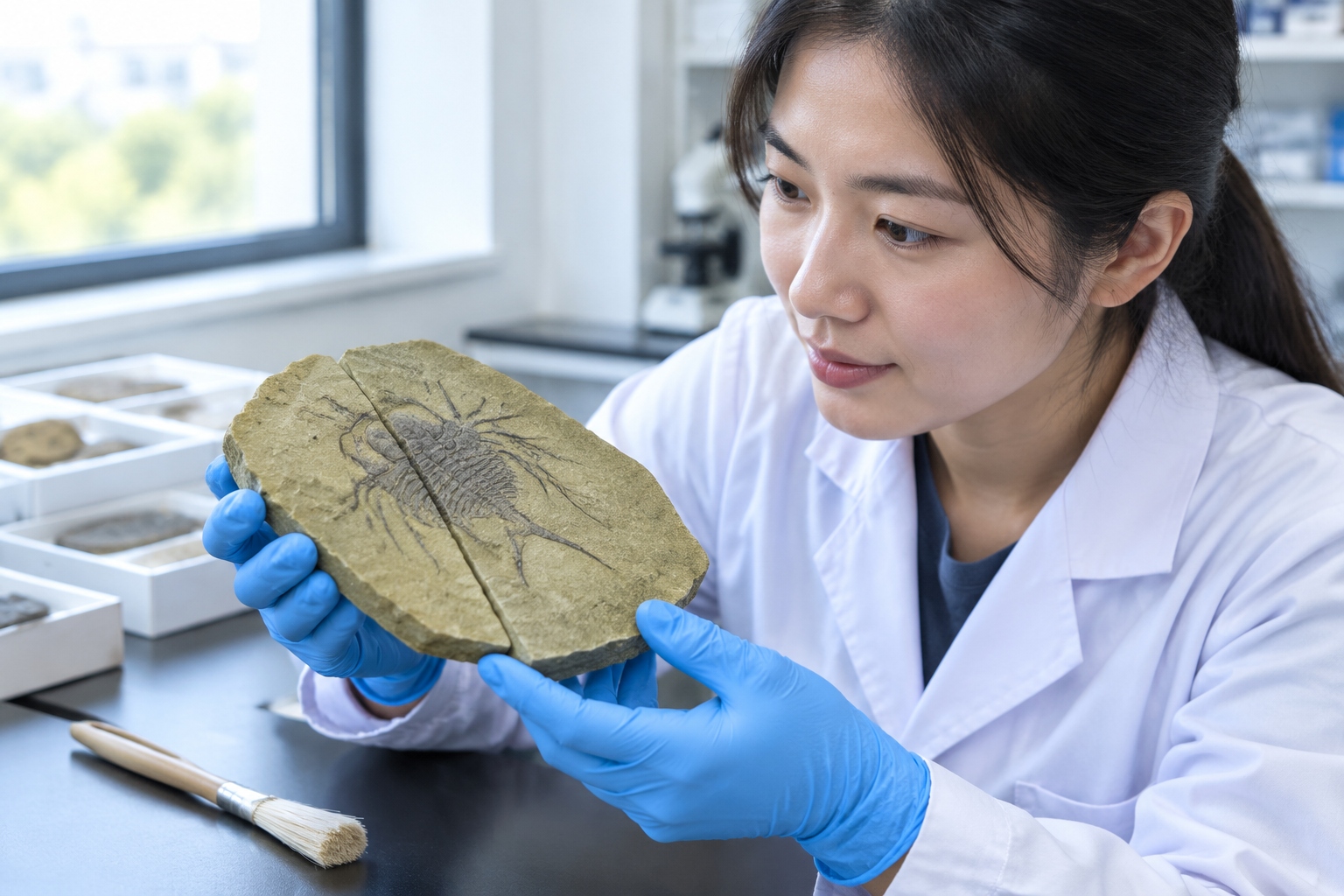
On 1 July 1984, a young palaeontologist named Hou Xianguang was working on the hill and split open a slab of shale. Inside was a small arthropod with its limbs and soft parts still visible. He had been looking for trilobites. He found something more useful.
The weight of that discovery only makes sense against the background of the time. For more than seventy years after the Burgess Shale was found in 1909, it was effectively the only window onto the Cambrian explosion. Chengjiang supplied a second one, and an older one.
In 1999, a team led by Shu Degan described two animals from these layers: Myllokunmingia and Haikouichthys. They were fish-like creatures two to three centimetres long, with a head, a notochord and gill pouches. They are widely treated as the oldest known vertebrates, or their closest relatives — which means the origin of the lineage that includes every fish, bird, frog and human alive today is recorded in mudstone beside a country road in Yunnan.
What you actually see inside the museum
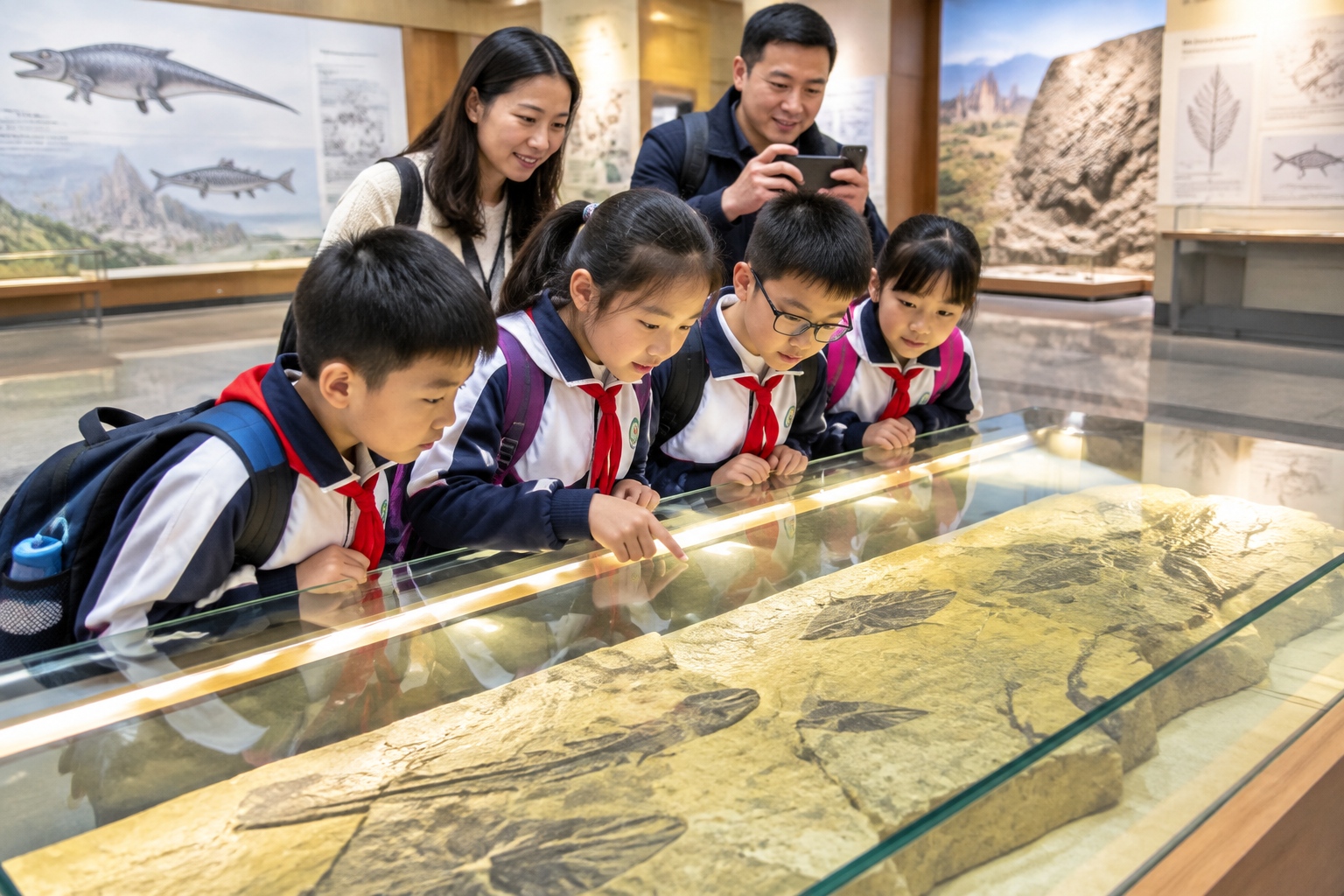
The Chengjiang Fossil Site Natural Museum opened in Chengjiang in August 2020. It is a large building shaped like a set of fractured rock layers, and it sits between the county town and the lake. Entry is free, but you normally need to book ahead through the museum’s official WeChat account or mini-programme, and like most public museums in China it usually closes on Mondays. Holiday hours change, so confirm before travelling.
Inside, the fossils do not look like the tidy skeletons in a dinosaur hall. Most appear as dark or rusty films pressed into yellowish-green stone. Knowing what you are looking at makes the difference:
- The first fish. Look for a dark, eel-like smudge about the length of your thumbnail. Myllokunmingia and Haikouichthys are not skeletons; they are thin films in which the eye, gill pouches and notochord can sometimes still be made out.
- A preserved brain. Specimens of Fuxianhuia protensa show a brain and a nerve cord running the length of the body — the most frequently cited example of the “impossible” preservation at Chengjiang.
- The Cambrian’s top predator. Anomalocaris had spiny grasping appendages and a pair of large compound eyes. Its mouth was a ring of plates, which is why it usually turns up in pieces: the parts fall apart after death.
- Trilobites. The one fossil most visitors can identify on their own. Chengjiang’s trilobites are not the most numerous, but they are well preserved.
- The unglamorous majority. Sponges, algae, priapulid worms and hyoliths. They are less exciting than a predator with a metre-wide reach, but the ecosystem only makes sense with them included.
Then walk up the hill
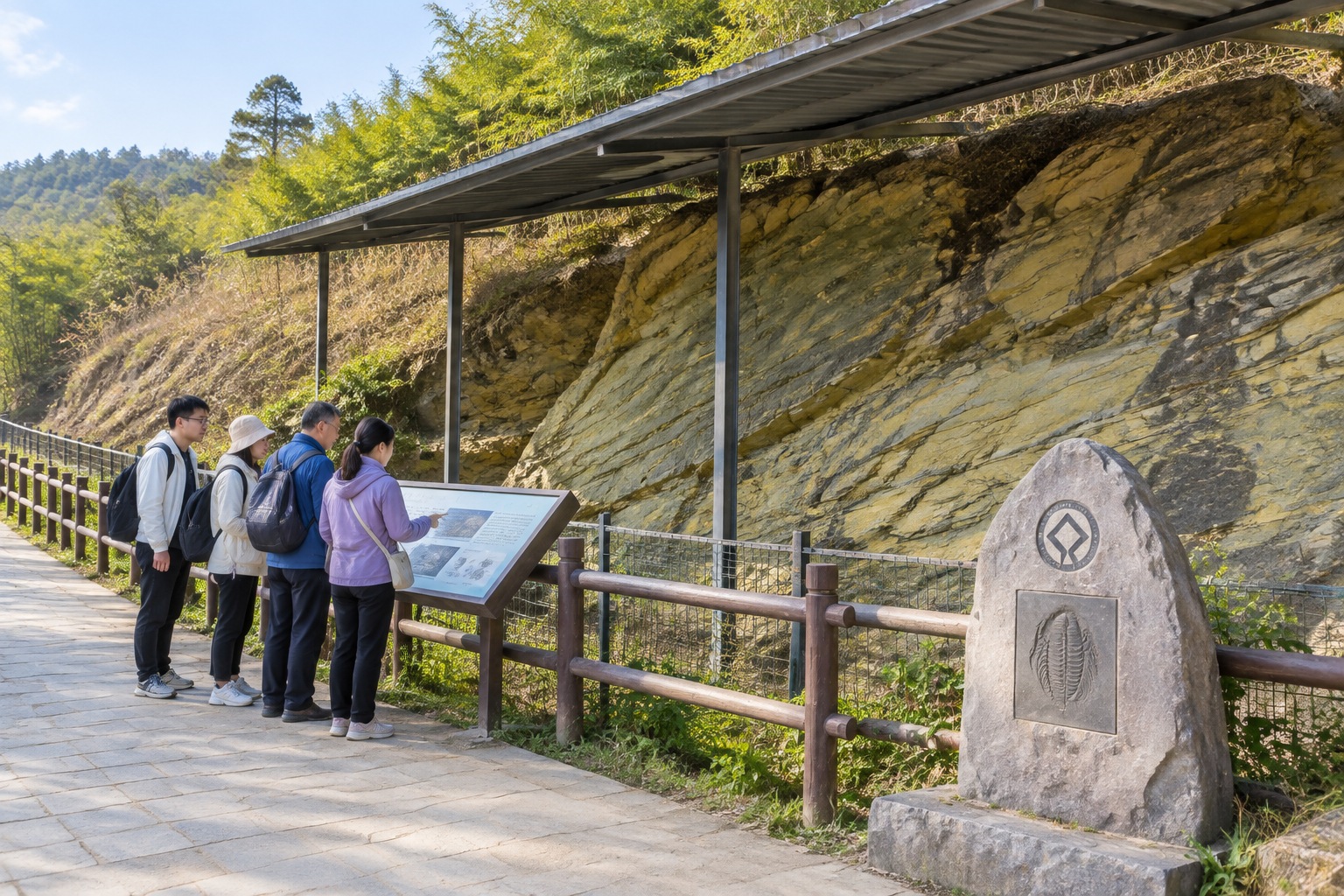
Maotianshan itself is about a 20-minute drive from the museum. The original quarry is small, roofed and fenced. The fossil-bearing layer is thin — often only a few tens of centimetres, sandwiched between much thicker beds of barren rock. A World Heritage plaque stands nearby.
Two things are worth keeping in mind. First, this is a protected site: collecting fossils, or buying them from villagers, is illegal in China, and at a World Heritage site it is a particularly bad idea. Second, manage your expectations. There is nothing dramatic here — no cliff of bones, no excavation in progress. The value is in the layer, not in the view.
“Explosion” is a slightly misleading word
The Cambrian explosion did not happen in an afternoon. It unfolded over roughly 20 million years, between about 540 and 520 million years ago. In geological terms, though, that is fast: a short interval in which most of the animal body plans we know today appear in the fossil record.
Part of the pattern is biological. Animals got larger and more mobile and began eating one another; hard shells and skeletons appeared, possibly as armour. Part of it is geological: animals started burrowing into sediment, and ocean chemistry shifted. And part of it is a quirk of preservation — hard parts fossilise far more readily than soft ones. Chengjiang matters because it cuts through that last problem, showing that soft-bodied animals were already diverse before hard parts became common.
Beyond the fossils: Fuxian Lake and a working Yunnan county
Chengjiang is not a museum town with nothing else to it. The county sits beside Fuxian Lake, a plateau lake of about 212 square kilometres that is one of the deepest in China — over 150 metres at its lowest point, with an average depth near 90 metres. Its water is unusually clear for a lake of that size, and it supplies drinking water to the region.
The local food justifies the detour. Copper-pot fish — tongguo yu — is cooked at the table in a copper pot with spring water and ginger. Lotus root starch is sold as a powder to stir into hot water, and blueberries grow on the surrounding hills. Family restaurants along the lake shore serve all of it, at prices that still feel low by big-city standards.
The fossils have also changed how the county sees itself. Schools run fossil-themed classes, road signs borrow the shapes of trilobites and Anomalocaris, and the museum has become the default destination for Kunming families on a wet weekend.

If you go
Getting there. Chengjiang is about 60 kilometres from central Kunming, roughly one to one and a half hours by car or taxi. Intercity buses leave from Kunming’s southern bus station. Many visitors pair the fossil site with a night or two at Fuxian Lake.
What to do first. Museum first, then the hill. The hill only makes sense once someone has explained what you are looking at.
When to go. Yunnan’s plateau climate is mild year-round; the lake sits at about 1,700 metres. Spring and autumn are the most comfortable. The sun is strong even in winter.
How long. Two to three hours for the museum, an hour for Maotianshan, plus driving time.
One caution. Opening hours, booking rules and ticket policies change. Confirm through the museum’s official WeChat account before you set out.
Why it is worth the trip even if you do not care about rocks
There is a version of the Cambrian explosion that reads like a business story: a long quiet stretch, then a short burst in which almost every major design still in use was tried out at once. It is a reminder that complexity is not always gradual and inevitable. Given the right conditions, it arrives quickly.
Chengjiang is also part of a larger shift. Over the past two decades China has become a significant producer of palaeontological research and of the museums that explain it: the Jehol beds in Liaoning with their feathered dinosaurs, the Qingjiang biota in Hubei announced in 2019, and Chengjiang itself. For an overseas visitor, Chengjiang is among the easiest to reach — an hour from a provincial capital, free to enter, and small enough to cover in an afternoon.
On the hillside at Maotianshan, the layer that matters is only a few tens of centimetres thick. Standing there, it is hard to feel its weight. Then you remember that the small dark smear of a fish in the display case above the lake is the earliest known member of a family that eventually produced the person looking at it.
Start the discussion at forum.chinacomes.com