

One Dish, One Small Town
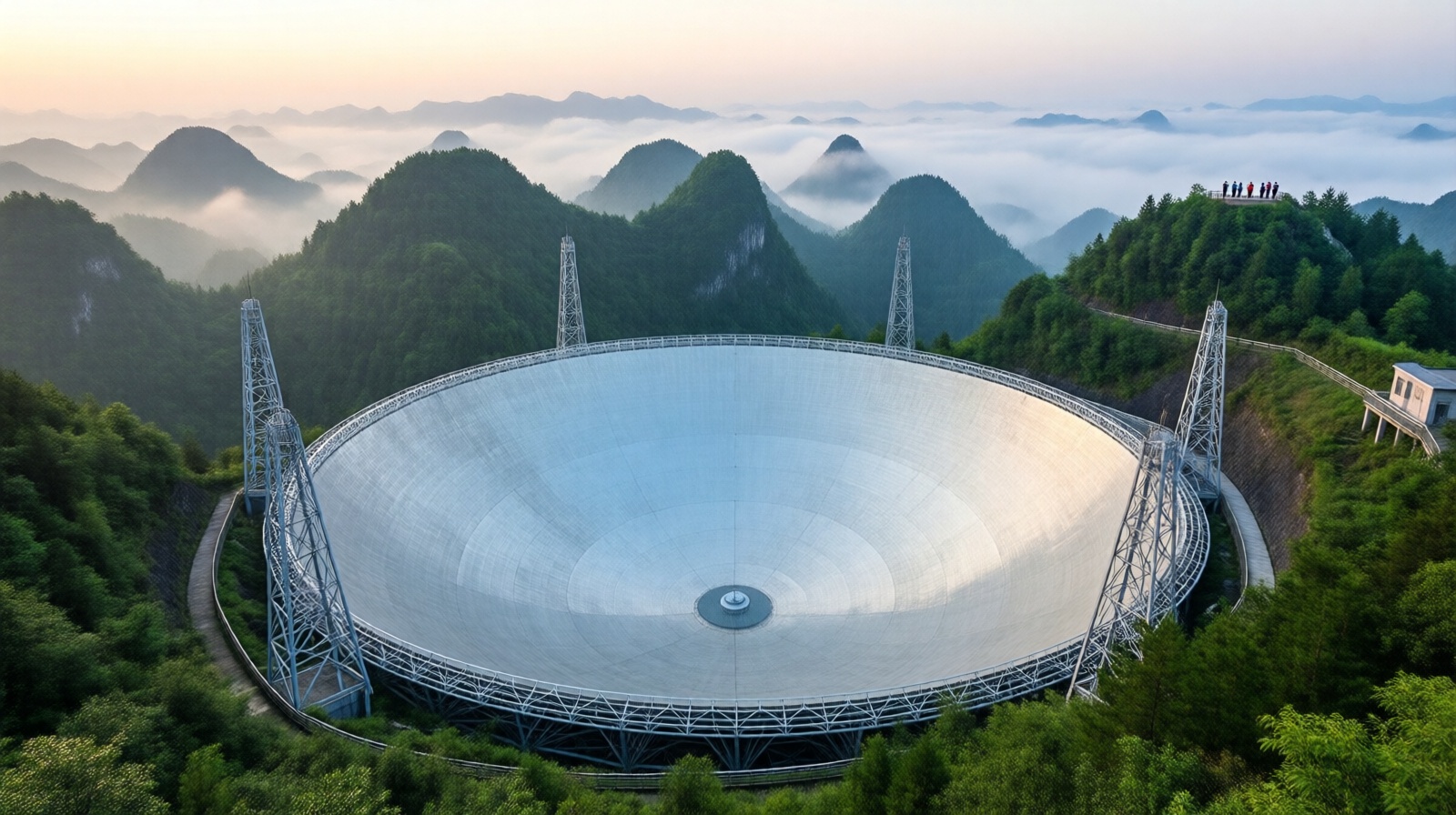
It looks like a scene from a sci-fi movie. In the middle of a remote karst landscape in Guizhou Province, a silver disc wider than 30 football fields sits tucked into a natural bowl of mountains. This is FAST — the Five-hundred-meter Aperture Spherical Telescope — the largest single-dish radio telescope on Earth. Chinese scientists call it “Tianyan,” which literally means “Sky Eye.” Since it began observing the universe, it has discovered hundreds of new pulsars and helped astronomers search for signs of alien life. But for the people living in the nearby small towns, the telescope has also become something else: an engine of survival and reinvention.
For decades, Pingtang County was a poor agricultural area. Farmers grew rambutan and rice, but there was little industry. Many young people left for coastal cities. Now, thanks to the “Sky Eye,” this little corner of southwest China has become a place where tourists from Beijing and Shanghai pose for photos, schoolchildren learn about pulsars, and local families earn a living under a starry sky.
The Valley That Whispered to the Universe
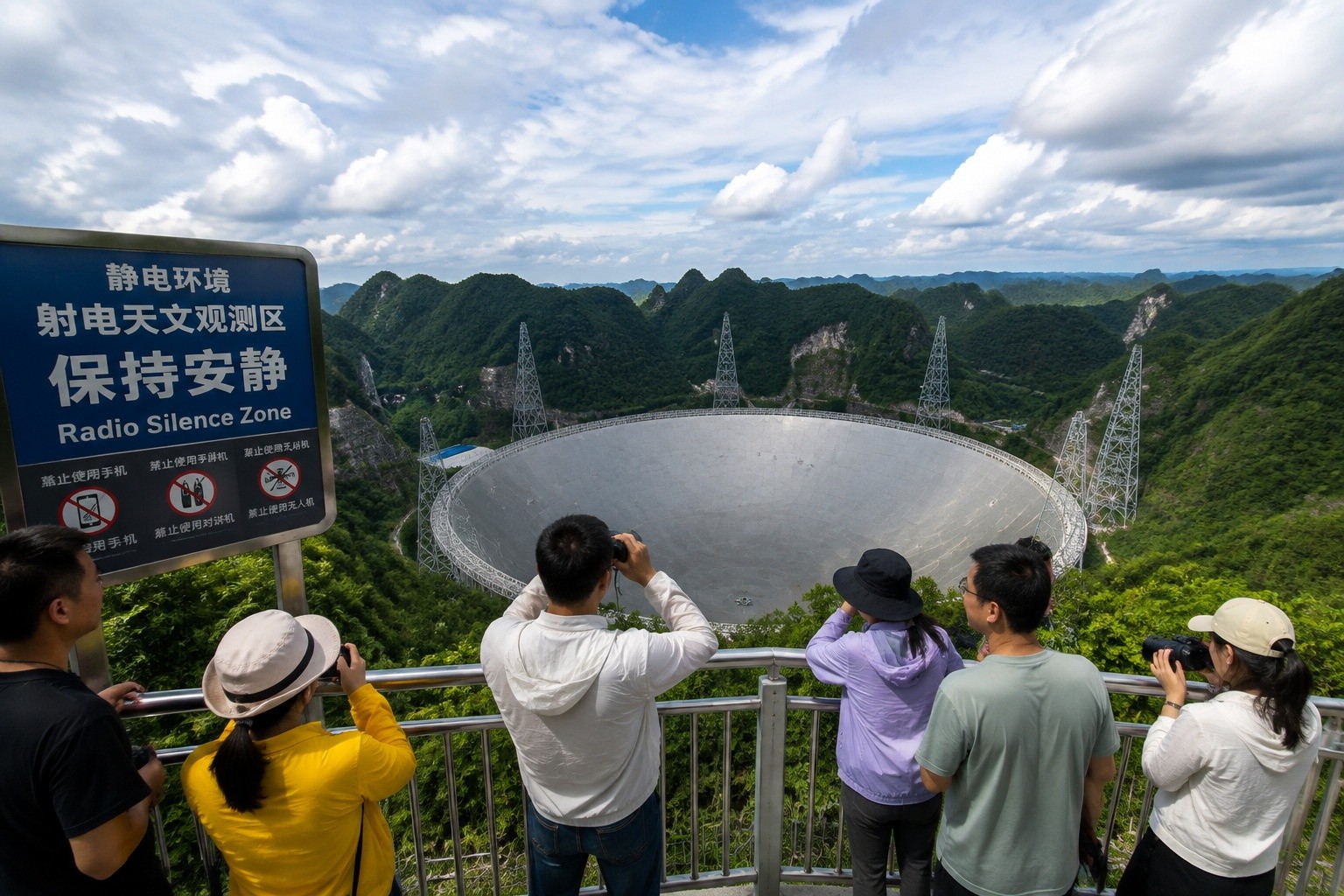
The story of this transformation starts in the early 1990s, when Chinese astronomers began searching for a perfect site to build the next generation of radio telescopes. They eventually chose the Dawodang depression in the mountains of Guizhou. The location was naturally shielded by limestone peaks, which blocked man-made radio signals. But building there came at a price. The project required a quiet zone of about 5 kilometers, where radio emissions had to be strictly controlled. That meant more than 9,000 local residents had to be relocated from their ancestral villages to new homes in other areas.
For a time, it looked like the telescope would be both a symbol of high-tech progress and a painful disruption for the local community. The relocated villages were subsidized, and new infrastructure such as roads and sewage systems were built. Still, the initial years were difficult. But as the telescope went up, so did opportunities. Construction workers from the area learned new skills. After the telescope opened to the public, the towns started to see an unexpected flow of visitors.
A Tourism Boom in the Mountains
The official “Sky Eye” scenic area was opened in 2017, and the numbers have been climbing ever since. By the end of 2023, local records show that over 2.7 million visitors had toured the site. The tourism boom has had a direct impact on the local economy. In the small towns of Ke Du and Pingtang, new guesthouses and inns have appeared, many with astronomy-themed names like “Starry Sky Homestay” or “Orbit Hotel.” Restaurants serve creative dishes like “pulsar soup” (a local sour soup with star-shaped tofu). Farmers who once grew rice now sell telescopes, postcards, and constellation maps to tourists.
One of those farmers is 32-year-old Luo Min. She returned to her hometown after working in a toy factory in Guangdong. Now she runs a “Galaxy B&B” with her husband. “We have ten rooms,” she told me. “On weekends during the summer, they are always full. Our guests are mostly families from cities like Chengdu, Chongqing, and Guangzhou. They are very curious about the sky. In the evening, I show them how to use a small telescope I bought for the roof terrace.”

The Silent Rule: No Phones Near the Dish
Tourists often talk about a surprising experience when they visit FAST: they must give up their smartphones before taking the shuttle bus. The scientific protection policies demand that no electronic device enter the core area. At the visitor center, everyone locks away their phones, cameras, smartwatches, and even car keys. Then they ride a bus to the base of the mountain, walk up the stairs to a viewing platform, and stand in front of the gigantic dish — with nothing but their eyes. The only way to capture the moment is by purchasing a disposable film camera from a gift shop or relying on the official photo service.
It sounds inconvenient, but many visitors say it’s actually refreshing. “I couldn’t take a selfie with the telescope, but it was the most memorable view I’ve ever had,” said one traveler from the United States. For locals, this rule is also a way of life. The radio quiet zone is monitored by staff who ensure that no one picks up a signal. The village of Keluo still keeps its distance from Wi-Fi routers, but locals are used to it.
More Than Just a Dish: Science Education and Pulsar Pride
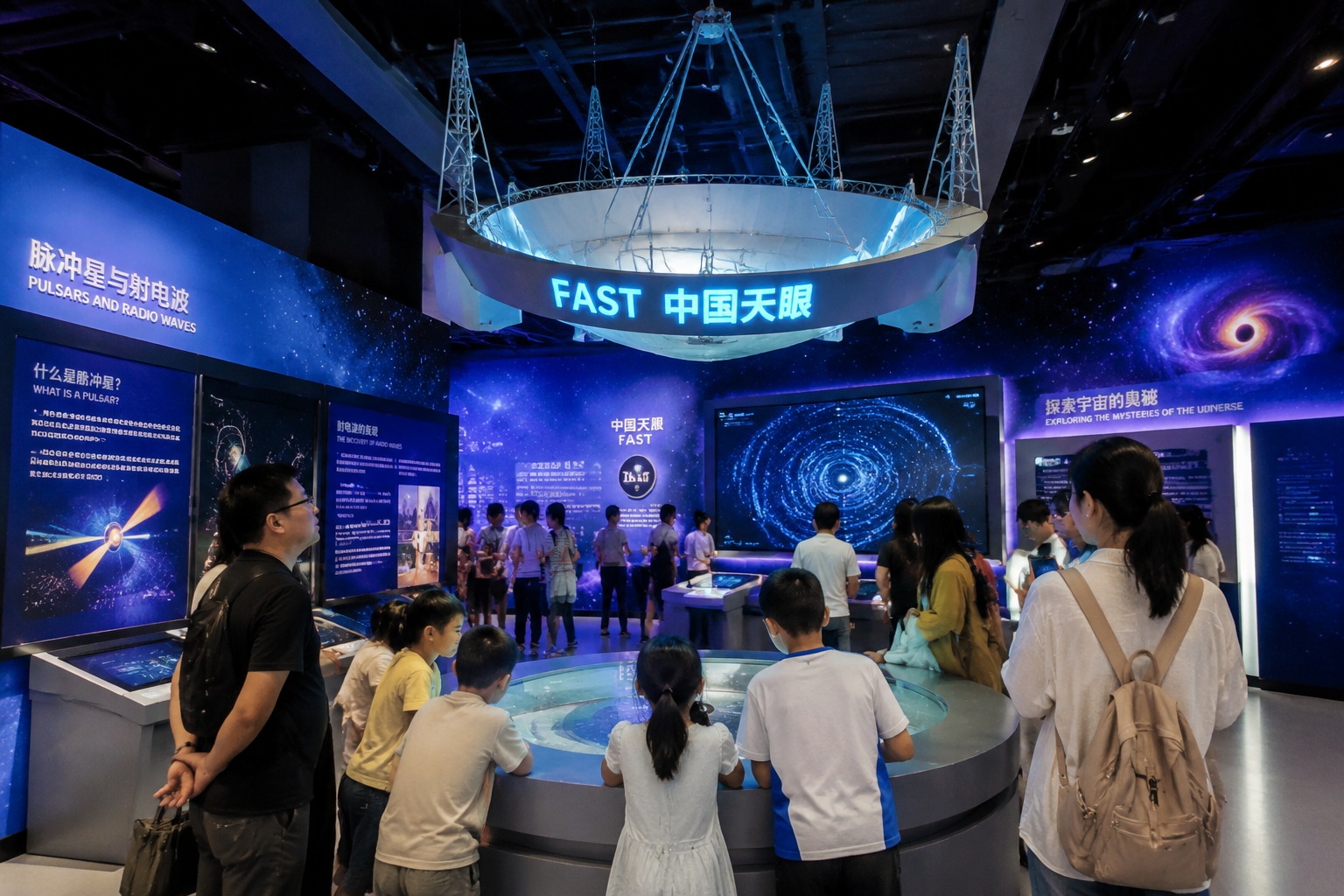
About a 20-minute drive from the telescope, a modern science museum stands like a silver spaceship on a hill. It’s called the “China Sky Eye Science and Culture Center” — one of the largest astronomy museums in China. There are interactive exhibitions where kids can control a mock radio telescope and listen to the “heartbeat” of a pulsar. There are also immersive theaters that take visitors on a flight through the galaxy. The museum has become a key part of the tourism package, drawing tens of thousands of schoolchildren each year.
And the pride is palpable. In Pingtang, the image of the telescope appears on almost everything: billboards, streetlights, even manhole covers. The county has renamed some roads with astronomy terms. The local government often hosts “night-sky festivals,” combining poetry, music, and stargazing. In this way, the distant universe has become part of everyday suburban life.
Balancing Science and Tourism
As successful as the telescope has been, there are challenges. FAST is not just a tourist attraction; it is also a highly sensitive scientific instrument. Astronomers worry that increased tourism could affect the quiet electromagnetic environment. To ease these concerns, officials have capped the maximum number of daily visitors at around 2,000. During holidays, the crowds still line up for hours. Some visitors complain that tickets sell out quickly. Others note that the surrounding area is still underdeveloped — there’s not much to do beyond the telescope and the museum.
Local leaders are well aware of these issues. They plan to build a “radio science town” with a university campus and high-tech companies. But they also need to keep the town’s character. As one official put it, “We don’t want to become a noisy amusement park. We want to be a place where science and nature coexist.”
How to Plan Your Own Visit
If you’re planning to see FAST, here are some practical tips. The telescope is located in Pingtang County, Qiannan Prefecture, roughly a two-hour drive from Guiyang, the capital of Guizhou. High-speed rail plus local bus is also possible. Tickets are around 70 yuan (about $10) for the scenic area, plus a shuttle bus fee. You must book in advance, especially on weekends. Bring your passport. Remember to leave your phone and all electronic devices in the storage lockers. Plan to spend at least half a day to hike the area and explore the museum.
The modest town of Pingtang itself is worth seeing, too. Stroll along the waterfront, taste the sour soup, and listen to local people talking about “Tianyan” as if it were a beloved neighbor. The telescope has given this corner of China a new reason to exist, and its echoes stretch far beyond the valley.
Start the discussion at forum.chinacomes.com