

The sound and the silence
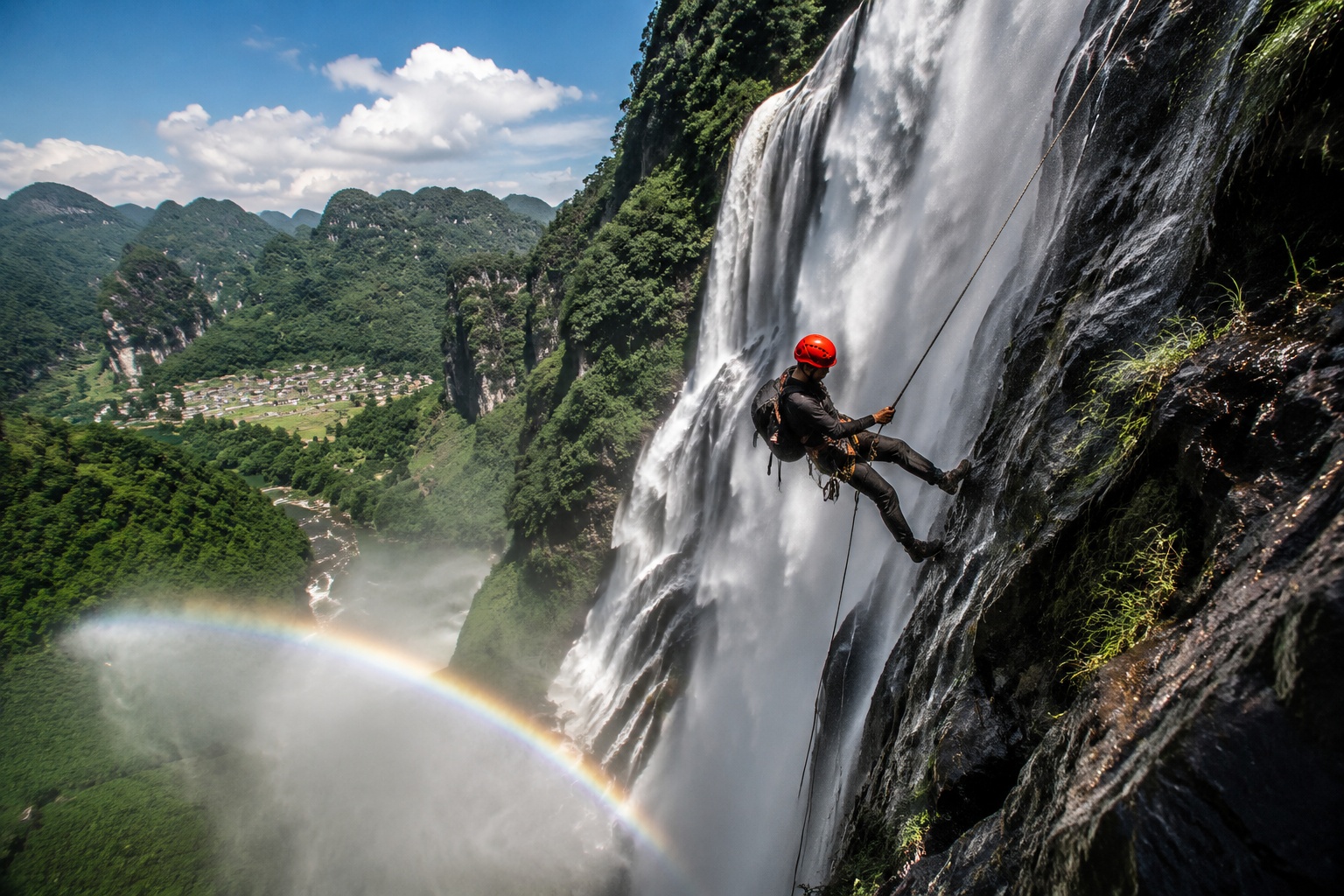
The first thing you notice is the sound. It pins you to the cliff like a hand on your chest. Three hundred metres below, the Dishuitan Waterfall thunders into a jade-green pool, and spray turns the whole valley into a cold, subwoofer-heavy room. For a moment I forgot the rope attached to my harness, forgot the wet rock under my boots, and just stood there, shivering.
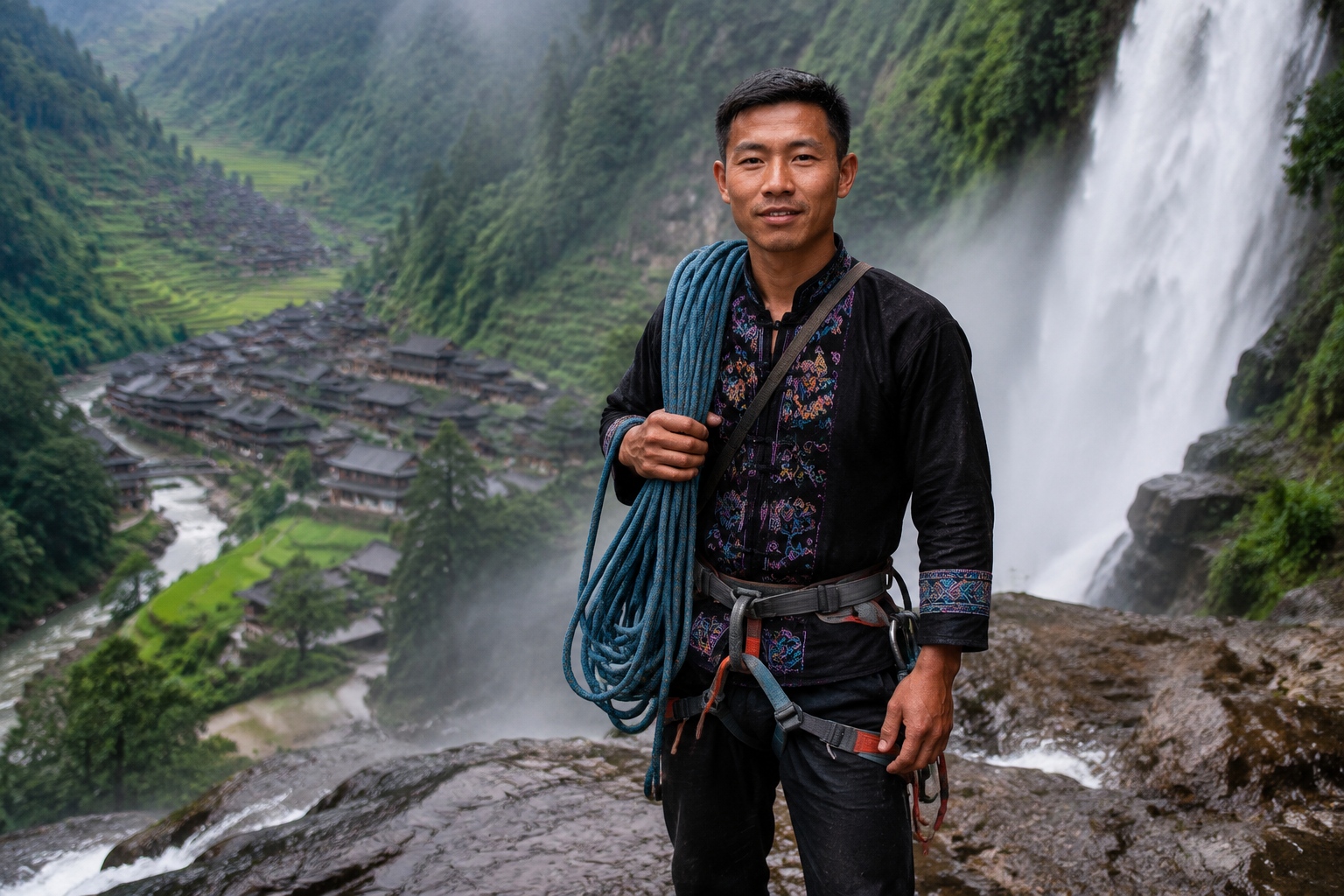
My guide Xiao Wu did not seem bothered. He is a Miao man in his early 30s, born in a village a kilometre from the river. He was wearing a dark embroidered jacket under a modern Via Ferrata harness, and he was putting a phone call on speaker so he could tie a knot at the same time. “The mutton noodles are ready,” his wife said. “I’ll be back tonight,” he answered, then looked at me. “Time to work.”
A waterfall that wants to be climbed
In China, waterfalls are usually seen from behind a railing. You buy a ticket, you walk a path, you take a photo and you leave. But in the last five years, a different kind of tourist has been coming to Guizhou. They don’t come to stare at the waterfalls. They come to be inside them.
The sport is called “puxia” — literally “waterfall down” — and it is a cousin of canyoning. You start at the top of a waterfall, lock yourself into a rope system, and walk backwards into a vertical river. Guizhou is the natural home for this: the province is a limestone maze carved by more than 900 named waterfalls and tens of thousands of seasonal ones. The karst cliffs are so perforated that local people sometimes drive roads through caves.
Dishuitan, where I was standing, is a multi-tier cascade that drops roughly 400 metres in several steps, which makes it one of the highest in southwest China. It still looks unvisited: no ticket office, no guardrail, just a red-painted sign that says “Danger”. There is a faint path up, maintained by local outdoor clubs, and at the top you are greeted by a pile of faded prayer flags and a few empty bottles of local craft beer.
The rite of the rope
Equipment was spread over a wet tarpaulin: German carabiners, a Chinese rope that felt as thick as a sailing line, and a helmet with a sticker reading “Born to be wild” in English. Xiao Wu changed into a thin wetsuit, and I did the same, secretly pulling mine on under my clothes while pretending I felt cold.
Before anchoring the rope, Xiao Wu placed a handful of rice on a flat rock and said two sentences in Miao. I asked him what he was saying. “Asking the mountain’s permission,” he said. “My grandmother used to pray before washing clothes in the river. Now I pray before taking people down it. Same habit, different request.” He did not smile when he said that, and I didn’t laugh.
He hooked my harness to the rope and showed me the brake. The instruction was simple: keep your legs wide, feet planted against the rock, and walk backwards until the ground disappears. When you can’t see your feet anymore, let go a little and trust the water to hold you against the cliff. The water, he said, is actually an advantage. It pins you to the wall, so you don’t swing.
Behind the water curtain
At first it felt like standing under a fire hose. I stepped off a lip of rock and immediately lost hearing. The waterfall was not a curtain but a collapsing ceiling. It pummelled my helmet, flooded my nose, and pushed my legs away from the cliff. My feet searched for a hold. I found a small ledge, breathed, and looked down: the pool was far below, and a rainbow was bending through the spray at half height.
Then came the strange part. The rope eased me sideways, and suddenly I was behind the cascade. There was an air pocket, like a cave behind the water. The noise dropped to a dull roar. I could breathe. I could see the green valley upside down through the falling water. It felt like being inside a flipbook. For twenty seconds I forgot to be afraid.
That moment — the fear, the cold, the crystal-clear glimpse through the water — is what people come for. It is completely different from seeing Huangguoshu, the province’s most famous waterfall, from a wooden platform. There, water is something you watch. From inside Dishuitan, water is something you negotiate with.
The village below
At the bottom, wading backwards out of a pool full of pebbles and dazed fish, we were greeted by Lili, Xiao Wu’s younger sister. She was holding dry towels and a bag of roasted chestnuts. She had not climbed, but she grew up sliding down smaller waterfalls with a flour sack as a sled.
Xiao Wu took me to his mother’s house, a wooden stilt building in a village where the first floor is for livestock and the second floor for people. The fire pit was already lit. His mother, a woman in her 60s wearing a blue indigo headwrap, ladled out tāng, a sour-soup fish dish made with vegetables from the hillside and small fish from the river. It tasted like nothing I’d eaten: sharp, savoury, smoky, with a small electrical shock on the tongue.
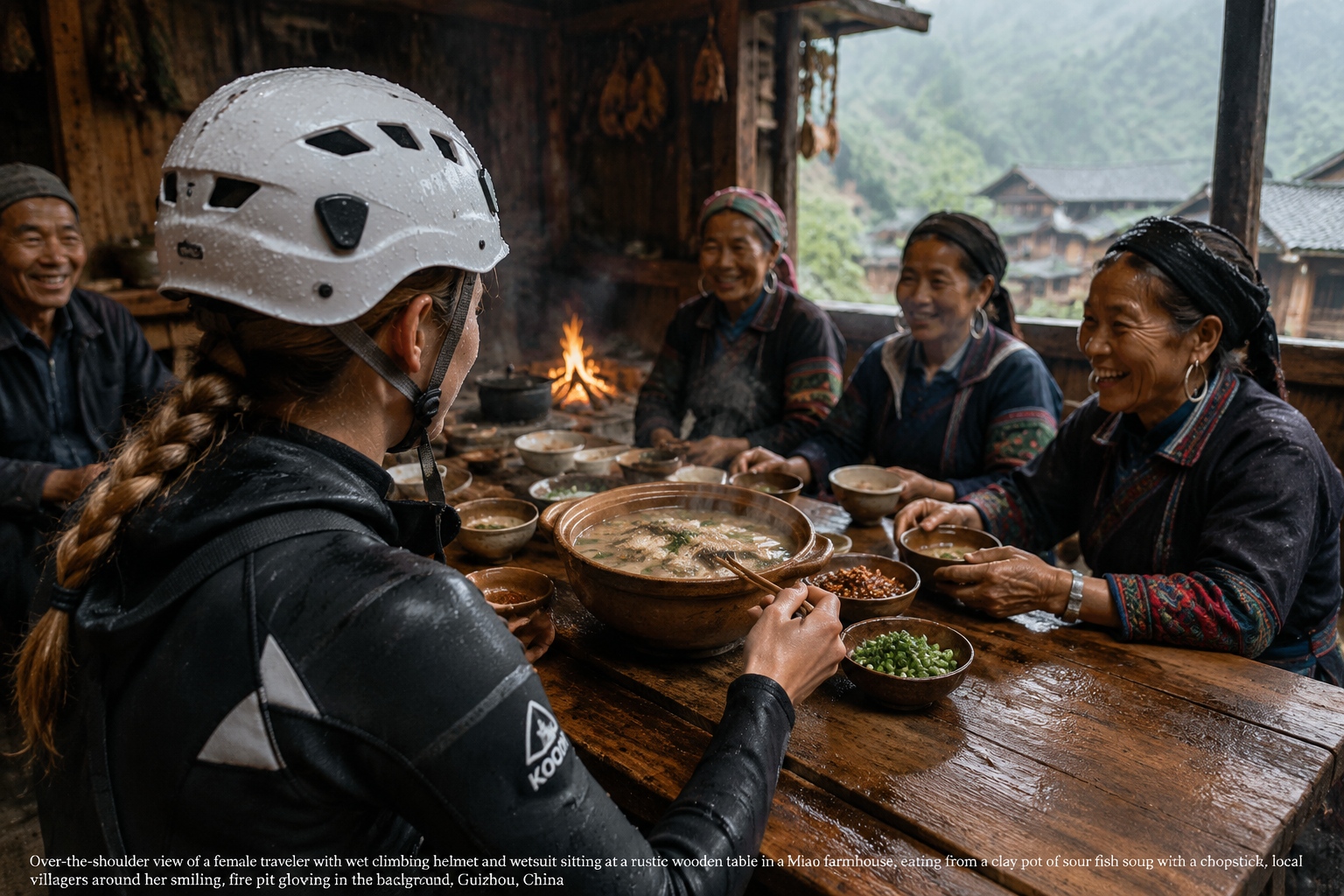
I asked what local people thought of climbing on the waterfall. Xiao Wu translated. His mother laughed, then said a long sentence. “She says, you pay money to suffer; we grew up suffering for free,” Xiao Wu said with a grin. “She also says your rice bowl is your altar. Mine is modern, hers is the mountain.”
The conversation turned serious. In the past, the waterfall was a place of rituals. Villagers would cast rice and incense into the pool to ensure rain. Today, some still do. But now the valley also has a geotourism economy. Xiao Wu earns between 500 and 800 yuan (roughly $70–$110) per trip in the high season — enough to raise two children and renovate his mother’s kitchen. He still plants rice in the summer, because the land is free and the harvest makes his family happy.
A collision, not a contradiction
Adventure tourism has brought money to a poor rural province. It has also brought questions. The fixed bolts and ropes sometimes worry elders, who see them as nails in the mountain’s skin. There are safety accidents in China’s outdoor scene every year, often because clubs skip training or use worn equipment. And the internet has turned some sites into viral video spots, which means more trash, more noise, and more people lining up on Sundays.
Xiao Wu is aware of all this. He now refuses to take groups unless every client has at least one day of dry-land training. He also collects plastic litter left by climbers and burns it in his mother’s stove. “The mountain gives, the mountain takes,” he said, pulling a cigarette from his harness. “I just try to give back the plastic parts.”
How to try it without becoming a cautionary tale
If this sounds like something you want to try, the first rule is to ignore the videos that make it look easy. Proper operators in Guizhou now offer course-based packages: one dry-land session to learn knots and braking, a half-day practice wall, and only then a real waterfall. Reputable groups will ask about your health, your swimming ability, and your fear of heights — and they will let you quit without judgment.
The best season is late spring to early autumn, when the temperature is around 20°C and the water is not too high. Bring quick-dry clothing, a pair of old trainers with good grip, and a phone enclosed in a waterproof case. If you use a local guide, ask to see the rope records; they usually show you the last inspection date, often carved in Chinese characters on a tag. A rope that has been wet for years looks surprisingly new. You have to look closely.
The bigger tip is cultural. Before you put your boot on the rock, spend an hour in the village. Eat a bowl of rice, drink tea, and let someone tell you what the waterfall meant before it had an adventure tourism website. That hour will change how you breathe on the way down.
Feet on the rock, eyes in the water
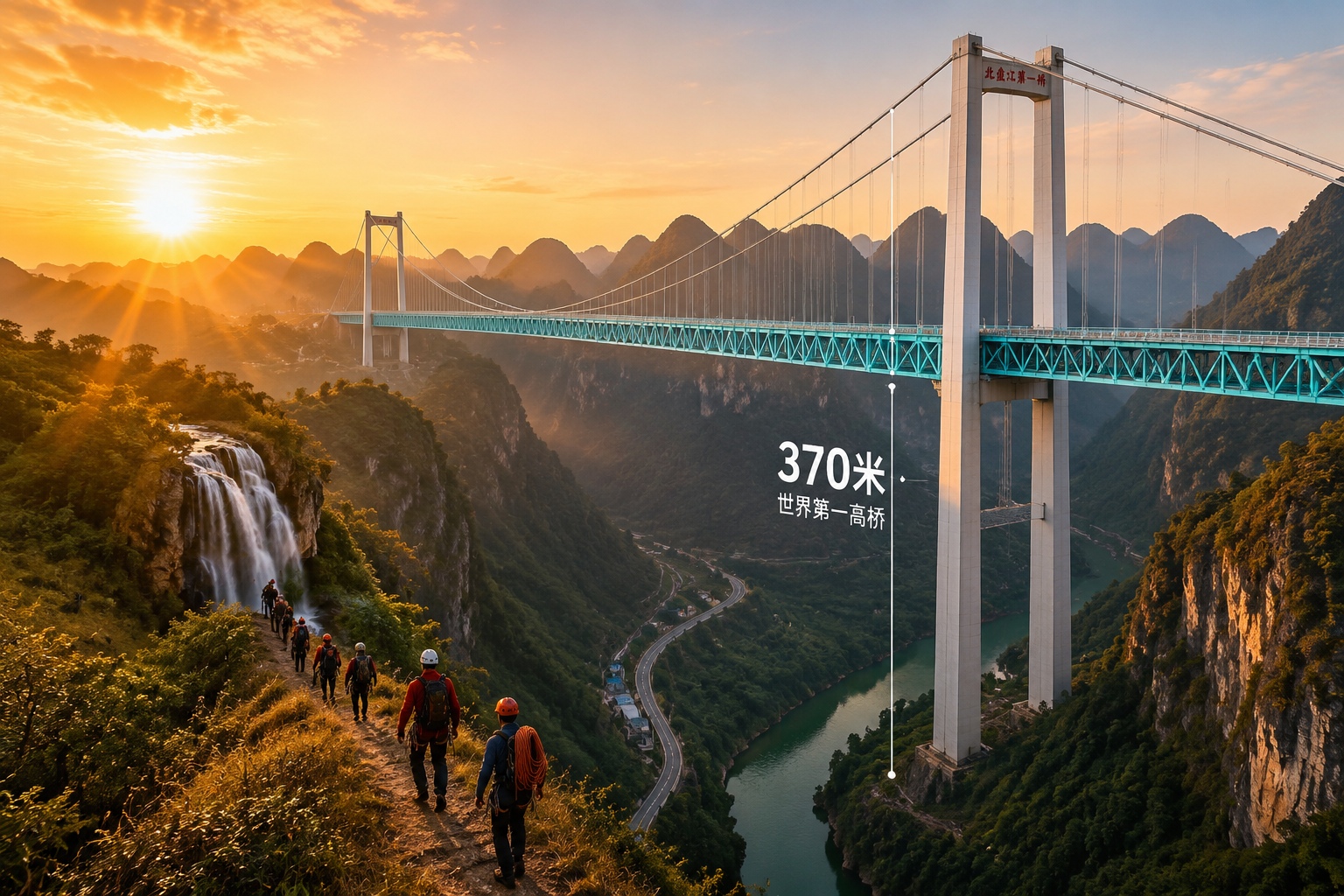
On the long drive back to Guiyang, the capital, I watched the limestone peaks roll by. The bridge we drove over was one of the highest in the world — 370 metres above the Baling River. Below it, tiny figures were walking toward a waterfall with rope bags on their backs. I thought about how quickly a place can change meaning. A generation ago, that waterfall was a boundary. Now it is a starting point.
The real cultural collision in Guizhou is not between tourists and locals. It is between the speed of a viral video and the slowness of a river. We come to conquer a waterfall, spend an hour on the rope, then leave with a photo. But the people who grew up under that falling water don’t see it as a challenge. They see it as a conversation. And after one afternoon, I stopped asking which view is correct.
From the top, the waterfall looks like a problem. From the bottom, it looks like a god. I stood in both places in the same day, and I think the god and the problem need each other.
Start the discussion at forum.chinacomes.com