

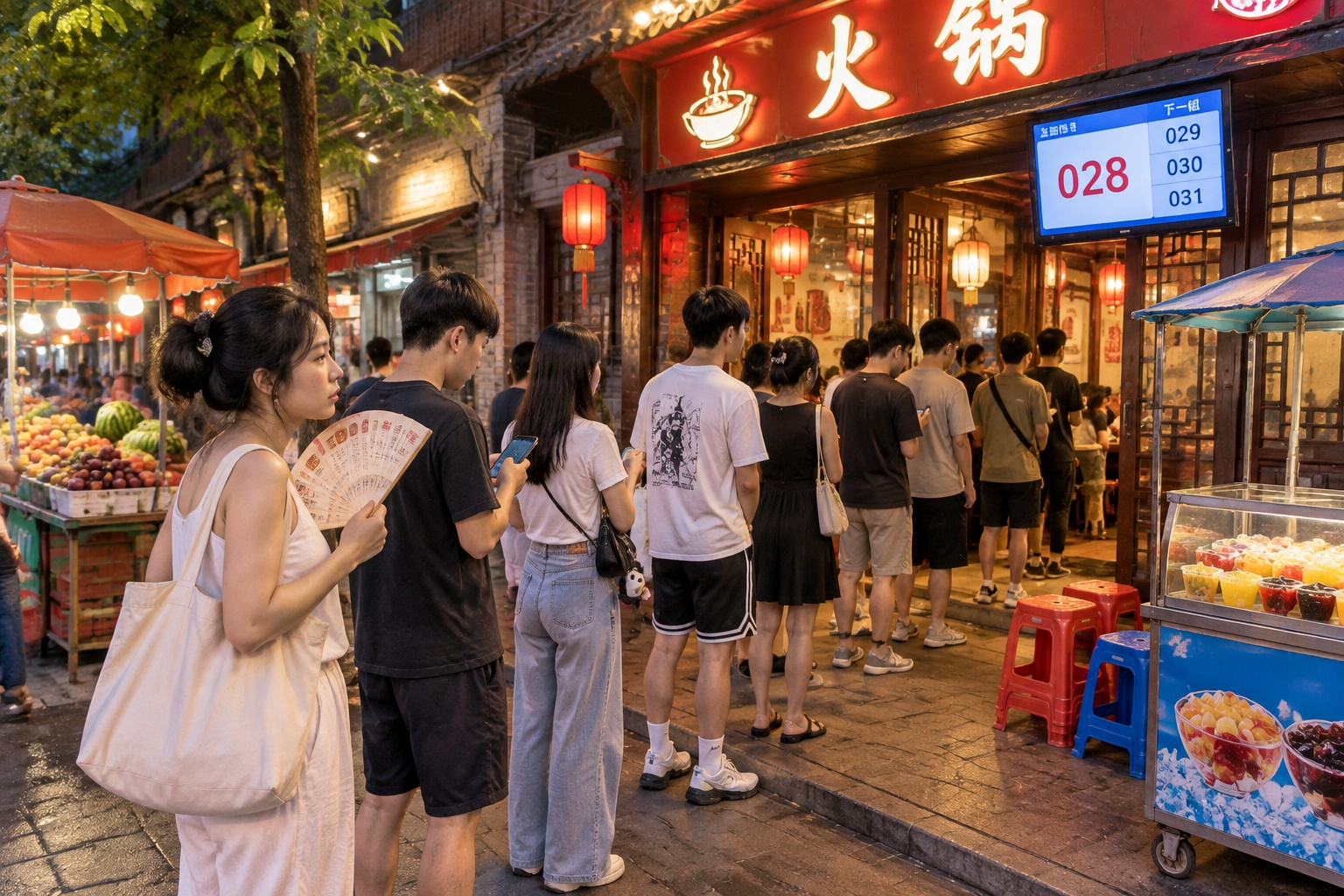
A queue that starts at six and ends after midnight
At 8:40 on a July evening in Chengdu, it is still 33°C. The line outside a hot pot restaurant on Yulin Road curves past a fruit stand and a woman selling bingfen, cold jelly in paper bowls, and stops near a parked scooter. A young woman fans herself with the menu. The screen above the door shows A23. Her ticket says A47. She does not look annoyed. She looks like someone who has done this before.
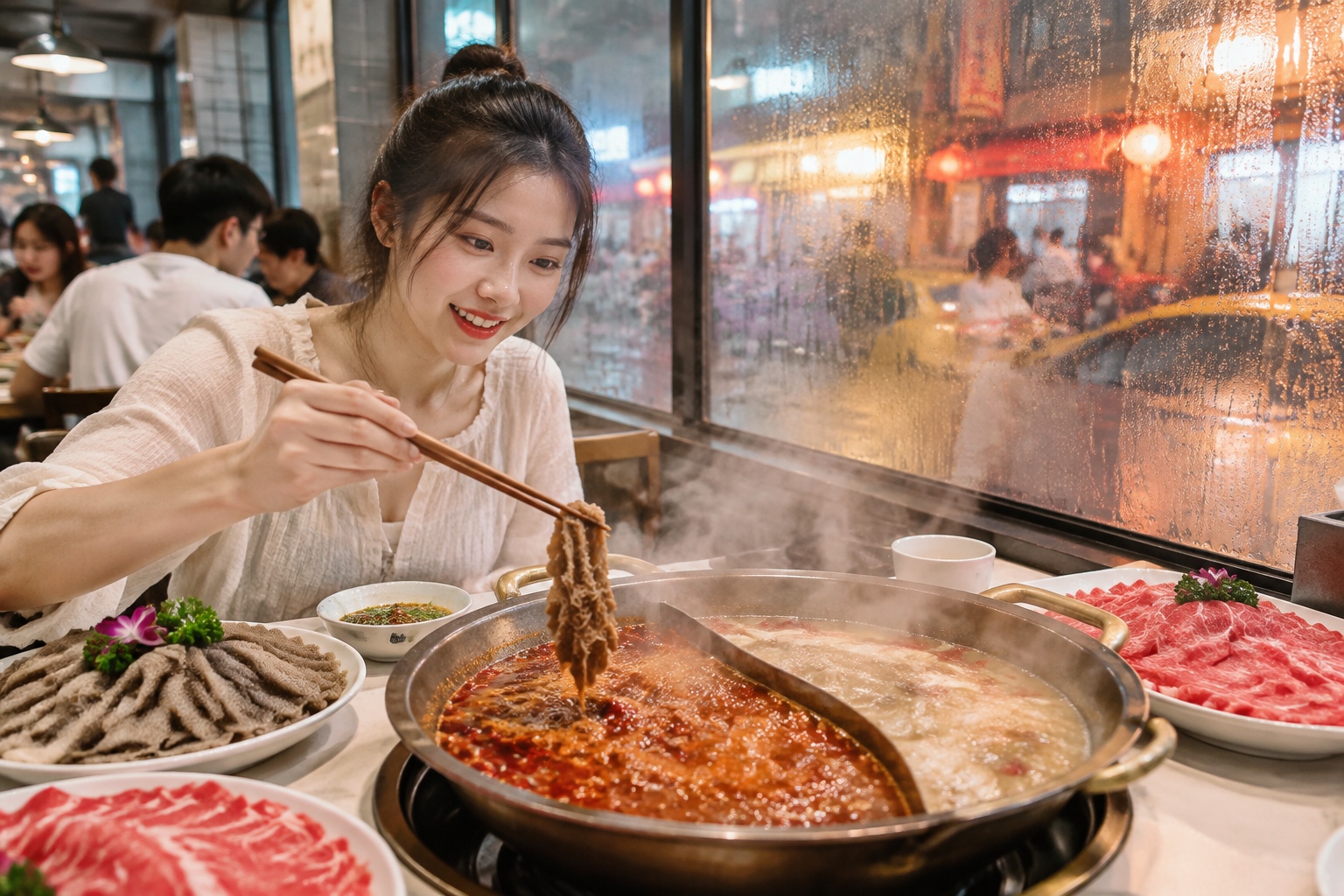
Inside, behind fogged glass, two hundred people are eating. Beef tallow and chili oil are boiling on every table. Waiters carry trays of tripe, duck intestine and thinly sliced beef. The smell of fermented chili and garlic follows you down the block.
Nobody in that queue thinks this is strange. For a foreign visitor, though, a hot pot restaurant in July can look like a small act of self-harm. In most of Europe or North America, soup season ends in March. In China, the big hot pot cities — Chongqing, Chengdu, Guiyang, Changsha — treat summer as the busy season, not the off-season.
That gap between what outsiders expect and what actually happens on the street is worth unpacking, because the answer is not only about food. It is about medicine, air conditioning and the way Chinese people use a table.
The traditional medicine answer: heat against damp
Ask a Chinese friend why they eat hot pot in August and you will often get the same four words: yi re zhi shi — use heat to drive out dampness.
The idea comes from traditional Chinese medicine, where the body is understood as a system that climate can throw out of balance. The Sichuan Basin, where this style of hot pot was born, is humid year-round, and summer rain makes it worse. In this way of thinking, cold and damp accumulate inside the body, and sweating is how you push them out. So you eat something hot, you sweat, and the sweat carries the problem away. A fiery broth is not a punishment. It is a treatment.
The same logic drives the most counter-intuitive tradition of the Chinese summer: sanfu, the roughly forty hottest days between mid-July and late August. During sanfu, hospitals run special clinics where patients receive sanfutie, small herbal plasters pressed onto the back, on the theory that the hottest days are the best time to treat illnesses that only appear in winter. Summer is not a season for retreat. It is a season for pushing the body a little harder.
There is a physical explanation too, and it is not nonsense. Capsaicin, the compound that makes chilies hot, triggers sweating and sends blood to the skin. Sweat evaporating cools you down. People in Thailand, India, Mexico and Nigeria have eaten chilies in hot weather for centuries for exactly this reason. The difference in China is that the biology has been wrapped in a whole philosophy of the body — and that philosophy is what fills restaurants in July.
A pot is a social machine, and it needs three hours
Here is the practical part. A hot pot meal is not a quick meal.
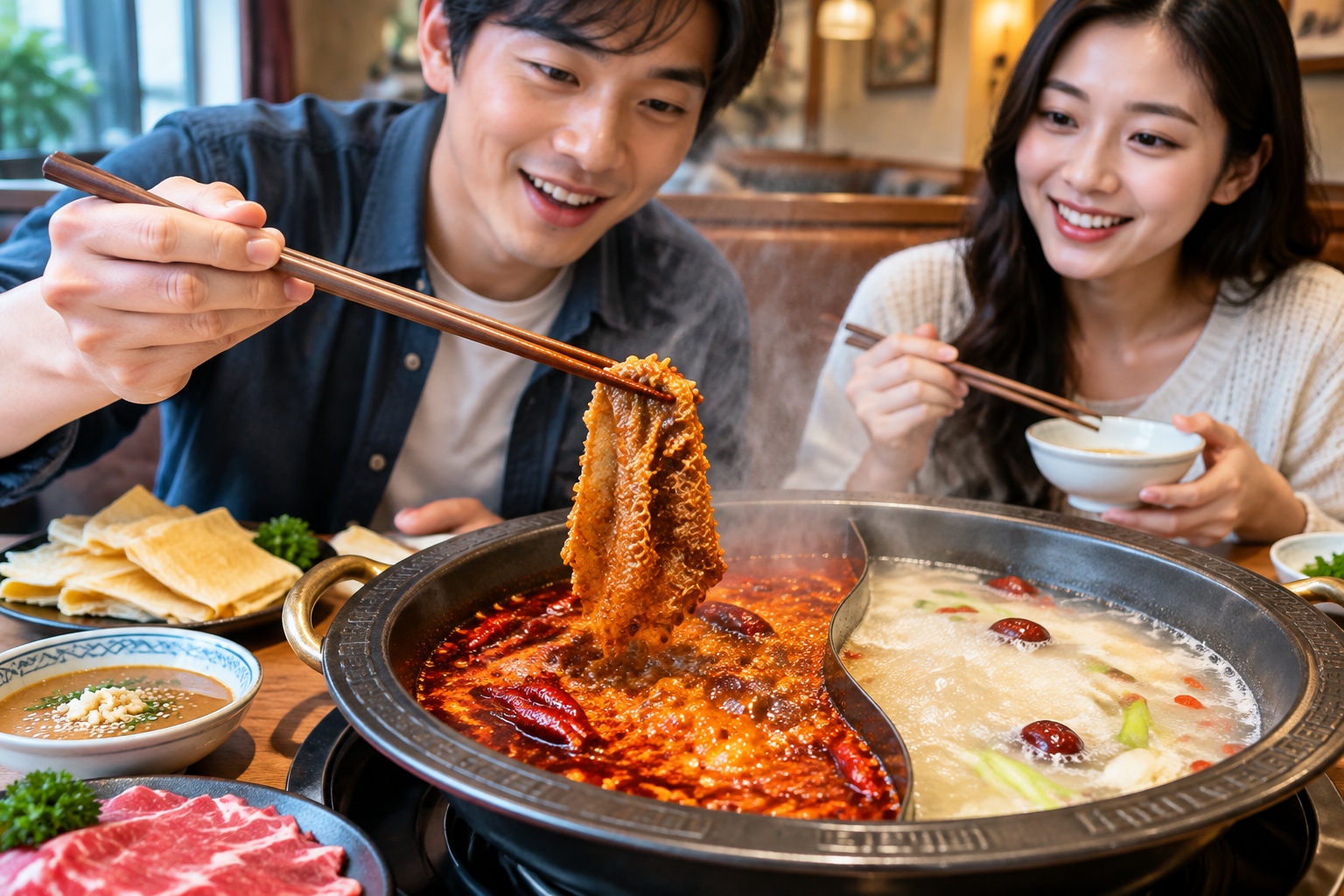
Nobody orders a main course. You order raw ingredients — tripe, beef, tofu skin, potato slices, shrimp paste, greens — and you cook them yourself at the table, in a pot of boiling broth, one piece at a time. Tripe takes about eight seconds; duck intestine, seven. Leave it too long and it turns to rubber. This means everyone at the table is occupied. The meal cannot be finished in forty minutes. A normal hot pot dinner runs two to three hours, and the people around the table are doing something together the entire time.
In a country where dinner is often the only free hours of the day, that matters. Hot pot is unusually good at absorbing people: a table of eight with two pots can hold colleagues, cousins, a new girlfriend and a friend of a friend without anyone having to talk to the whole group at once. You talk to the person across the pot. Then you cook something else.
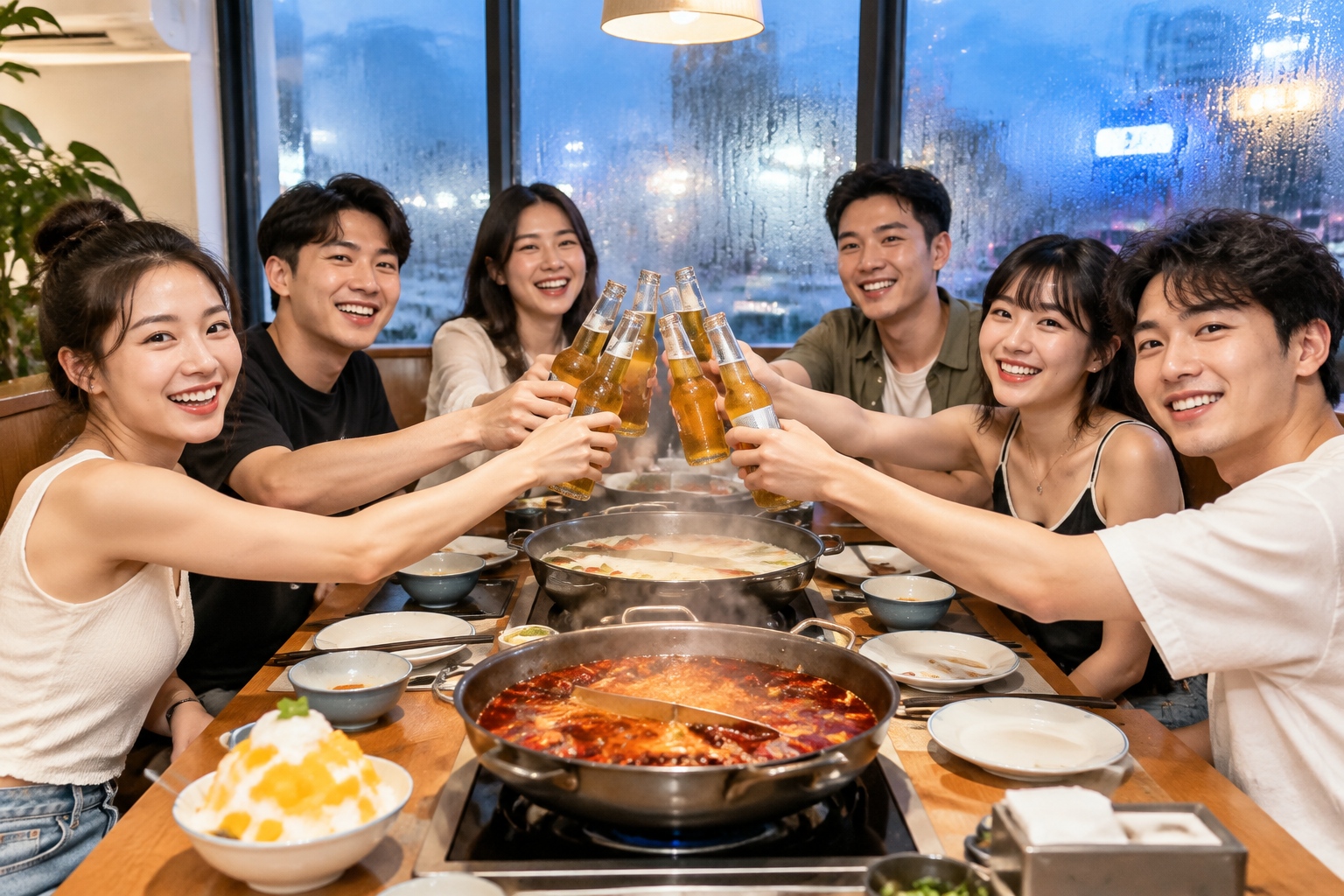
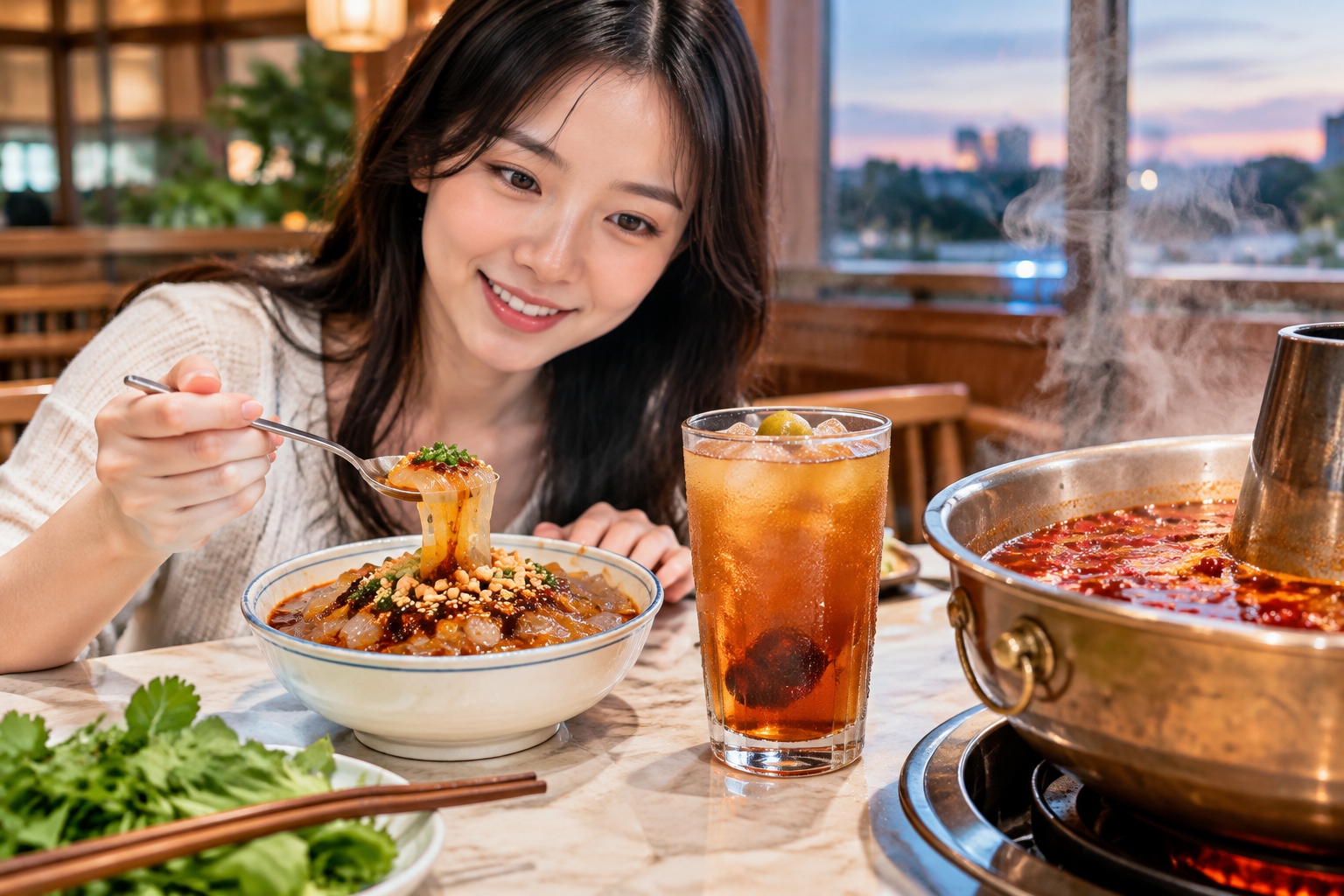
The heat becomes part of the atmosphere rather than an obstacle. Everyone is sweating. Everyone has flushed cheeks. Jackets come off, and so does some of the day’s careful composure. Cold beer, sour plum juice, soy milk, a bowl of bingfen between bites. The discomfort is shared, and shared discomfort is a very fast way to become friends.
Air conditioning rewrote the rules
It is worth remembering that this is a recent habit.
In the early 1990s, most urban Chinese households had no air conditioner at all. By recent national statistics, cities now average well over one unit per household — roughly 130 air conditioners per 100 urban households — and hot pot chains keep their dining rooms at a stubborn 18 to 22°C.
That single piece of machinery changed summer eating. Thirty years ago, a hot pot restaurant in Chongqing was often an open-air or street-side operation, and summer was a genuine test of endurance. Now it is the reverse: bigger chains advertise their cold. You walk in from 36°C, the sweat on your back dries in a minute, and the pot in front of you is at a rolling boil. The temperature contrast becomes part of the pleasure — the same instinct that makes people eat ice cream in a heated room in January, only in the opposite direction.
The chains understood this early. Haidilao, the biggest hot pot company in the country, built its reputation on waiting areas with snacks, drinks, free manicures and board games, because a two-hour queue in summer needs a reason to be tolerated. Hot pot is the single largest category in Chinese restaurant dining by revenue, a market worth several hundred billion yuan a year, and summer is when it peaks.
A new generation, a new pot
Hot pot has also learned to bend.
Not everyone wants to sweat. The divided yuanyang pot — half fiery, half mild — used to be treated as a compromise for children and foreigners. Now it is standard. Tomato, mushroom and pork-bone broths have become categories of their own, and Chaoshan beef hot pot with its nearly clear broth, or coconut chicken hot pot from Hainan, have spread far beyond their home provinces.
Young diners pair the pot with cold desserts that barely existed in restaurants a decade ago: bingfen, cold rice balls in osmanthus syrup, shaved ice, iced tea, craft beer. Convenience-store freezer aisles sell self-heating hot pot, a plastic box where a chemical reaction brings the broth to a boil in fifteen minutes, and hot pot delivery — a courier arrives with a full pot, a burner and pre-cut ingredients — has become one of the fastest-growing corners of the takeout market. In a heatwave, some people simply move the whole ritual indoors and skip the queue.
But the core has not moved: boiling broth in the middle, raw food around it, people cooking for one another for three hours.
Other countries eat hot food in summer, but not like this
China is not unique in defying the thermometer. Koreans eat samgyetang, a whole chicken stuffed with ginseng and rice, on the three hottest days of the year. Japanese shops promote grilled eel on the Day of the Ox in midsummer. Thais, Indians and Mexicans put chilies in almost everything, including in hot weather.
What is different is the format. Samgyetang and grilled eel are single dishes, eaten by one person, often quickly. A hot pot is a shared, self-cooked, three-hour event that has no real equivalent elsewhere. It turns a hot night into a social occasion instead of a night to be survived with cold noodles — and once a food culture has a format that good, the weather stops being the deciding factor.
What the July queue actually tells you
At 10:50 pm, the woman with ticket A47 finally sits down. She orders tripe first, then beef, then a plate of winter melon. The air conditioning hums. The pot boils. She lifts a piece of tripe out of the oil after eight seconds, dips it in sesame paste and garlic, and eats it. Outside, on the other side of the glass, the street is still 31°C and the queue is still forty people long.
That scene is not exotic, and it is not a stunt. It is what happens when a food culture decides that the point of eating is not to manage the temperature but to stay at the table together for as long as possible — and then builds the rooms, menus and habits that make it comfortable. Summer hot pot looks backwards to a foreigner. To the people in the queue, it is simply Tuesday.
Start the discussion at forum.chinacomes.com