
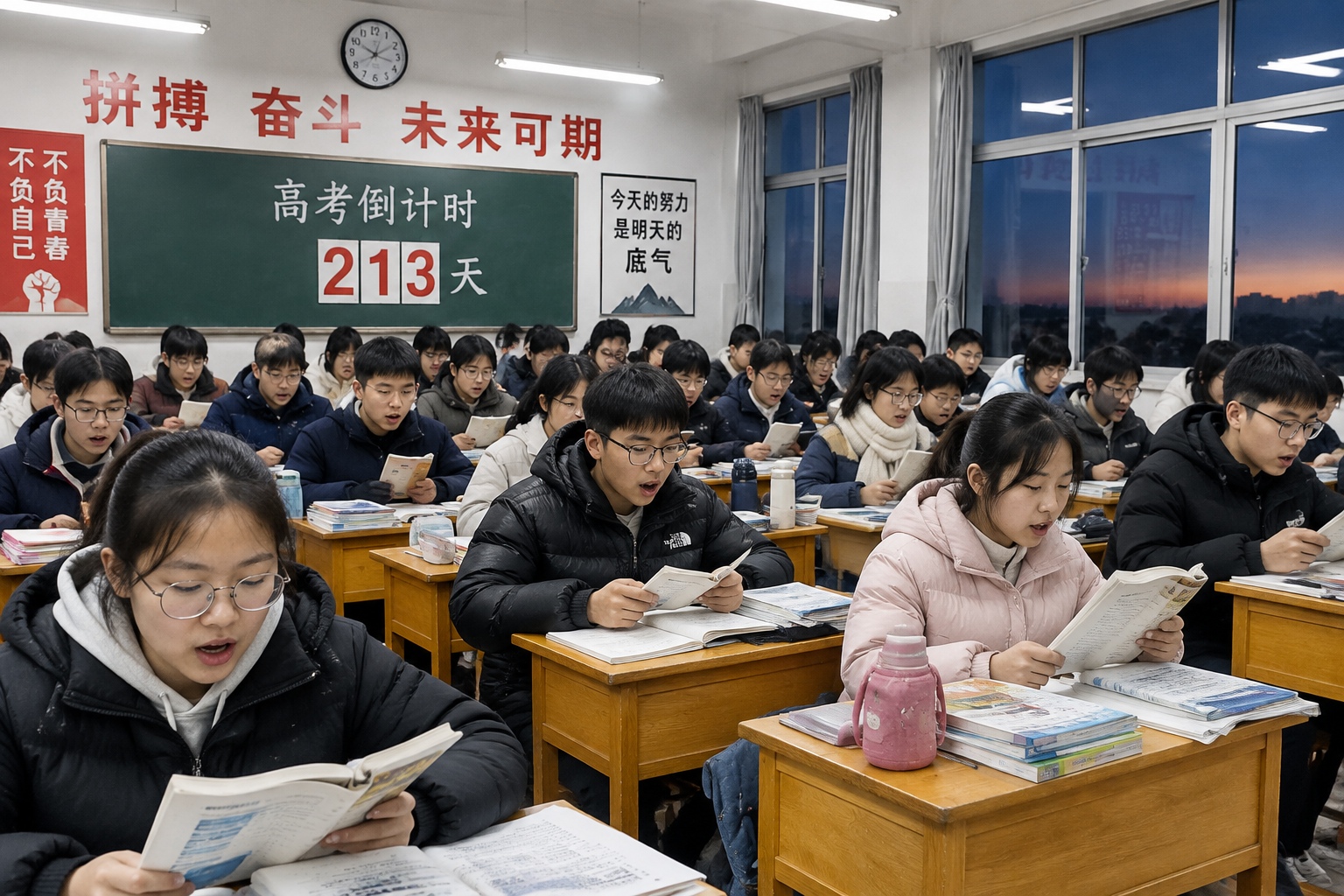

The alarm on Yao Tong’s phone goes off at 5:30. The 17-year-old doesn’t snooze. He swings his legs out of the bunk and splashes water on his face. By 5:40, he’s at his desk on the fourth floor, where the air smells of stale air-conditioning and cheap ballpoint ink. Outside the window, the sky is the color of a bruise—dark blue, just beginning to lighten at the edge of the rooftops.
Yao is a senior at Yuxian No.1 High School in central Henan province. The school has about 4,000 students, and almost all of them board. A few dozen families rent cramped apartments just outside the campus gates to be closer to their kids; the rest live in noisy dormitories. Yao shares a room with seven other boys and a toilet that sometimes works.
But it’s early, and he’s not alone. In every classroom across the six-year campus, lights are already on. The sound that greets him as he walks through the corridor is the sound of a hundred voices reading in unison—English vocabulary, classical Chinese essays, political theory. It’s the prescribed way to wake up an entire school: the morning reading.
Morning Reading: The Loudest Hour
“You memorize best when you read out loud,” says Chen Li, a 28-year-old English teacher who has been at the school for three years. She walks slowly between the rows of desks, stopping to correct a pronunciation or to touch a sleeping student on the shoulder. “It’s not just about learning,” she adds. “It’s a way to switch on the body. If you don’t shout, the day doesn’t start.”
The noise is physical. At 6:10, the girls in Class 17 recite a passage from a narrative essay; the boys in Class 18 shout English verb tenses. A few students are clearly half-asleep—their heads bob, their syllables slur—but the volume doesn’t drop. The monotony is broken only by the sharp ring of the bell for breakfast.
Breakfast lasts exactly twenty minutes. Yao eats two steamed buns and a boiled egg at the canteen, then walks back to the classroom to pack his bag for the day. He has done this every day since he was sixteen. “It feels normal after a while,” he says. “It’s just what you do.”
In Class: The Weight of a Single Point
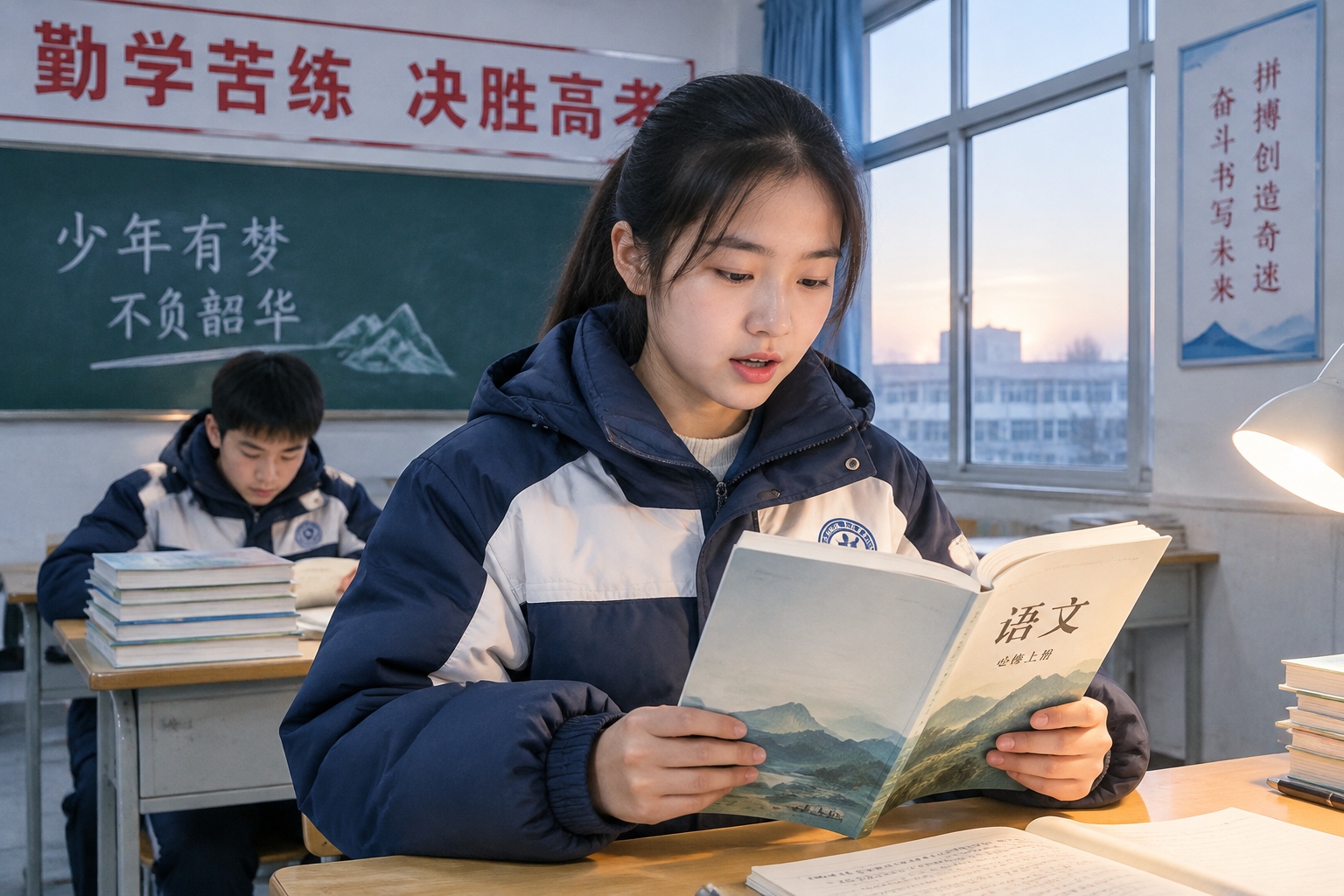
By 7:30, the first class is underway. Taped to the wall outside the door, a poster reads: “Distinguish yourself by your diligence; surpass yourself through the gaokao.” The gaokao is China’s national college entrance exam, taken every June by more than ten million students. While the overall university acceptance rate has climbed in recent decades, the contest for the most prestigious universities remains brutally fierce. As the math teacher, Mr. Zhao, puts it: “One point can push a thousand people off the cliff.” He doesn’t smile when he says it.
He walks through the steps of a calculus problem while the students scribble into their exercise books. Someone at the back yawns, but no one looks away. Phones are switched off and stored in a metal box near the door; school policy bans them during class. A few students wear glasses so thick they seem welded to their faces.
In the afternoon, the pace barely relaxes. Two more classes, then a short break, then two more. For most students, the highlight of the day is the 4:30 group run around the track—fifteen minutes of coordinated movement that mirrors the discipline of the classroom. It’s also the only time they see the sky.
Lunch: A Quick Nap With a Textbook as a Pillow
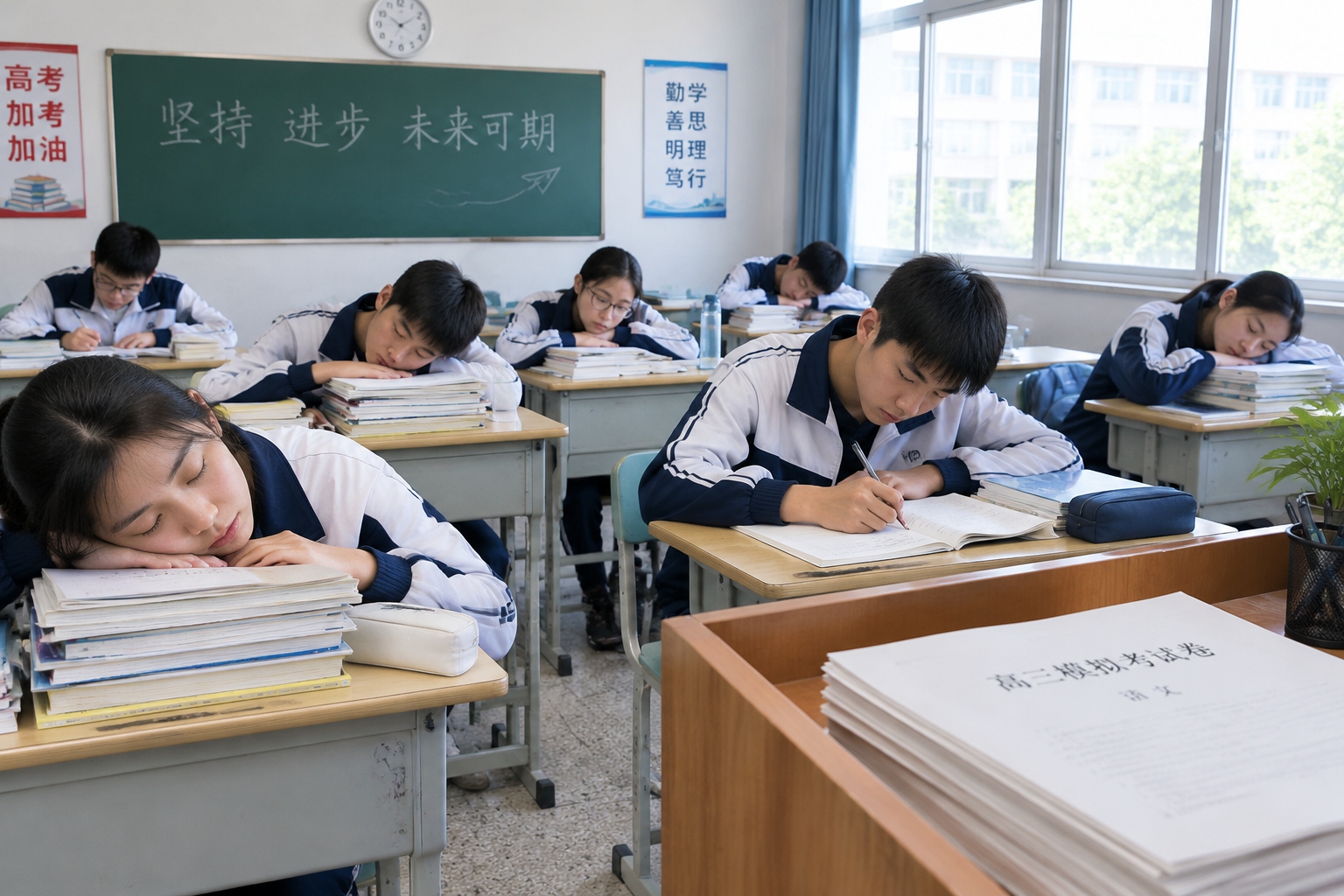
Lunch is served at 11:45. The canteen roars with the clatter of trays and hurried chatter. Students eat in about ten minutes, then rush back. The corridor quiets down as a 45-minute nap break starts. Many students simply lie on the desk, using a stack of papers as a pillow. A few keep working, their heads bent over a practice sheet, chewing on the end of a pen.
“I’m used to it,” says Li Meiyuan, a girl from Class 12, rubbing her eyes. “If I close my eyes for more than ten minutes, my brain starts to feel wrong.” She pulls out a thermos of coffee—a luxury she saves for the afternoon. “I used to dream about being a painter,” she says quietly. “Now I just dream about a full night’s sleep.”
She laughs, but the joke lands with a hollow sound.
The Night Oath and the Mother’s Wait
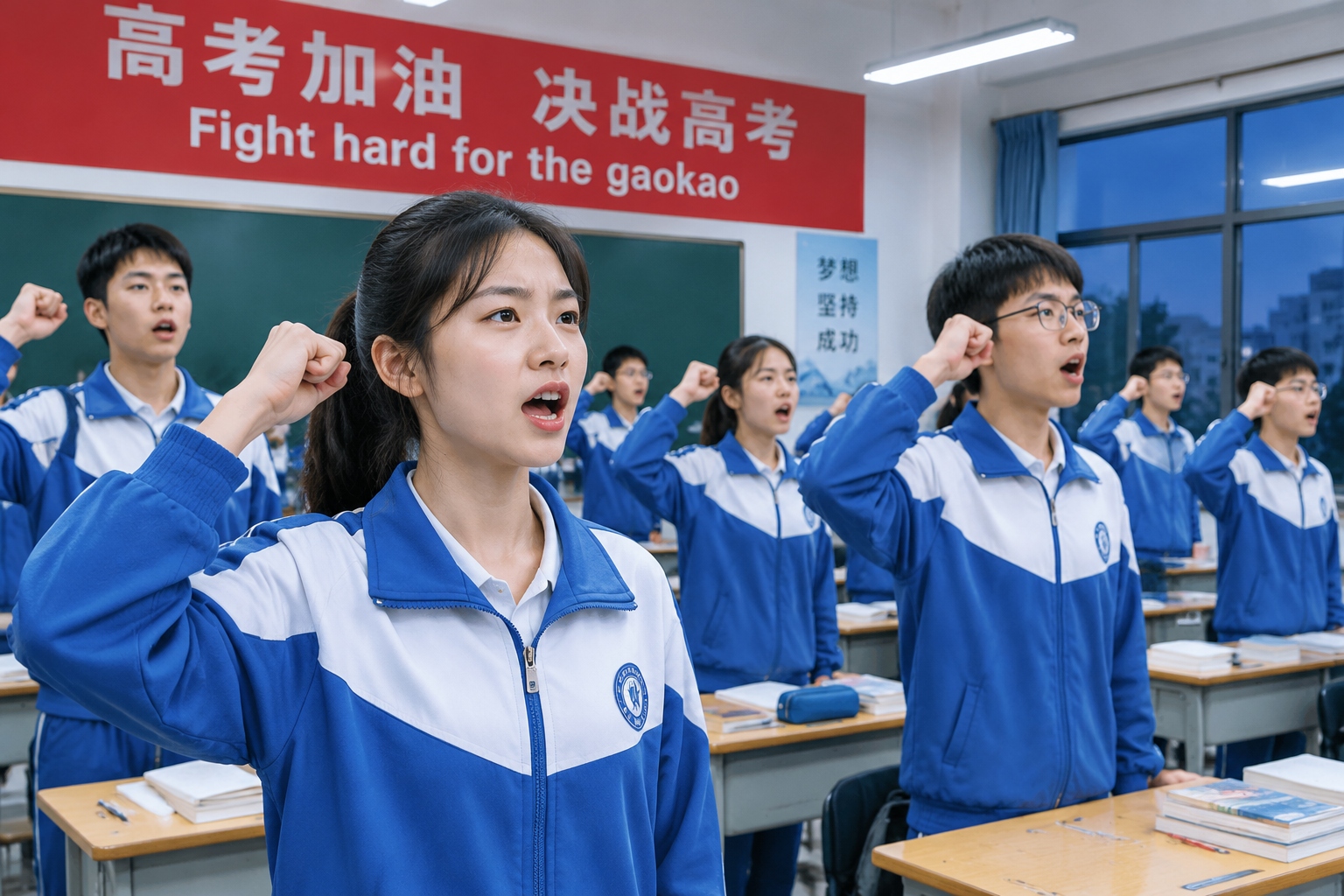
At 8:50 PM, after hours of evening self-study, an announcement comes over the broadcast: time for the “evening oath.” Students stand up, raise their hands, and shout in unison: “I will not waste another minute. I will face the gaokao as a soldier faces a battle.” The words echo across the campus, past the school gates, into the narrow lanes where a different kind of battle is being fought.
Outside the east gate, in a row of aging apartment buildings, a small army of “study-company mothers” has settled. Each rents a one-room flat with a stove and a narrow bed. They cook meals, wash uniforms, and wait. Chang Xiuqin, 47, arrived from a village three years ago to live with her son. Her husband works at a factory in Jiangsu and sends money home. She has not had a job since, and she does not complain about it.
“If he succeeds, the whole family succeeds,” she says, sitting on a stool outside the building, a thermos of hot water in her hand. “I can’t help him with the homework. All I can do is make sure he eats well and sleeps well. That is also the battle.” But she adds a quieter sentence: “Sometimes I miss the village. The sky is so narrow here.”
Not Just a Machine
Not every student is full of grit. He Han, a quiet boy with a buzz cut, says he sometimes feels like a “robot.” “We are a machine for remembering,” he says. “But it’s my choice. I want to study computer science in Shanghai, so I have to get a high score.”
Yet even in this pressure cooker, small rebellions find their way. During the ten-minute breaks, students crowd around the school vending machines, compare doodles in the margins of their notebooks, and whisper about the latest episode of a TV drama. Some have secret phone numbers hidden in their socks. Others save their spare change for bubble tea on the once-a-month Sunday off.
“It won’t always be like this,” He Han adds, looking at the yellowing posters on the wall. “But I don’t know what else would be better.”
The final bell rings at 10:40. The lights go out one by one. The school falls into silence, wrapped around the dark, exhausted bodies of tomorrow’s workers.
In the morning, at 5:40, the alarm will ring again.
Start the discussion at forum.chinacomes.com