

A Night in the Gobi Desert
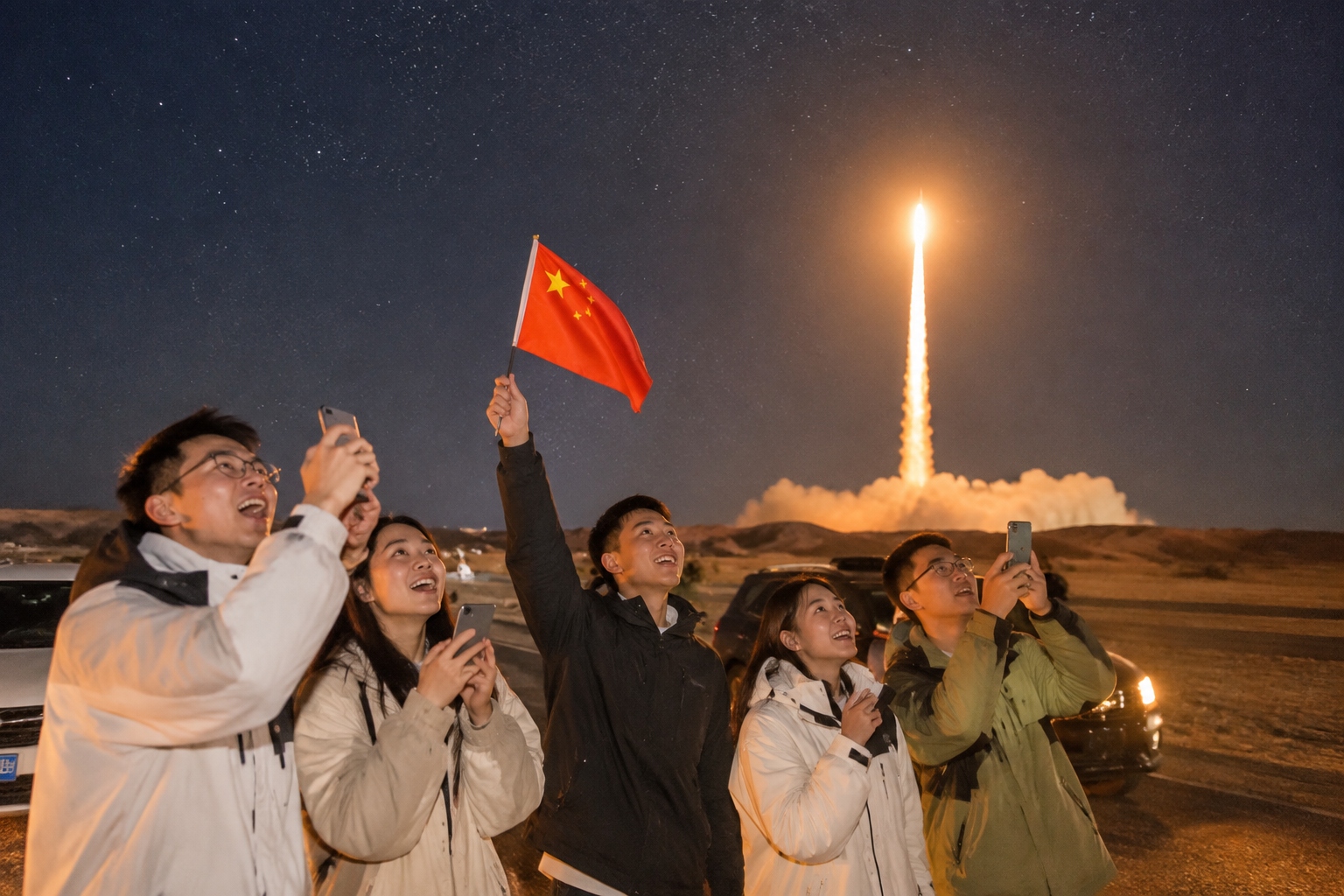
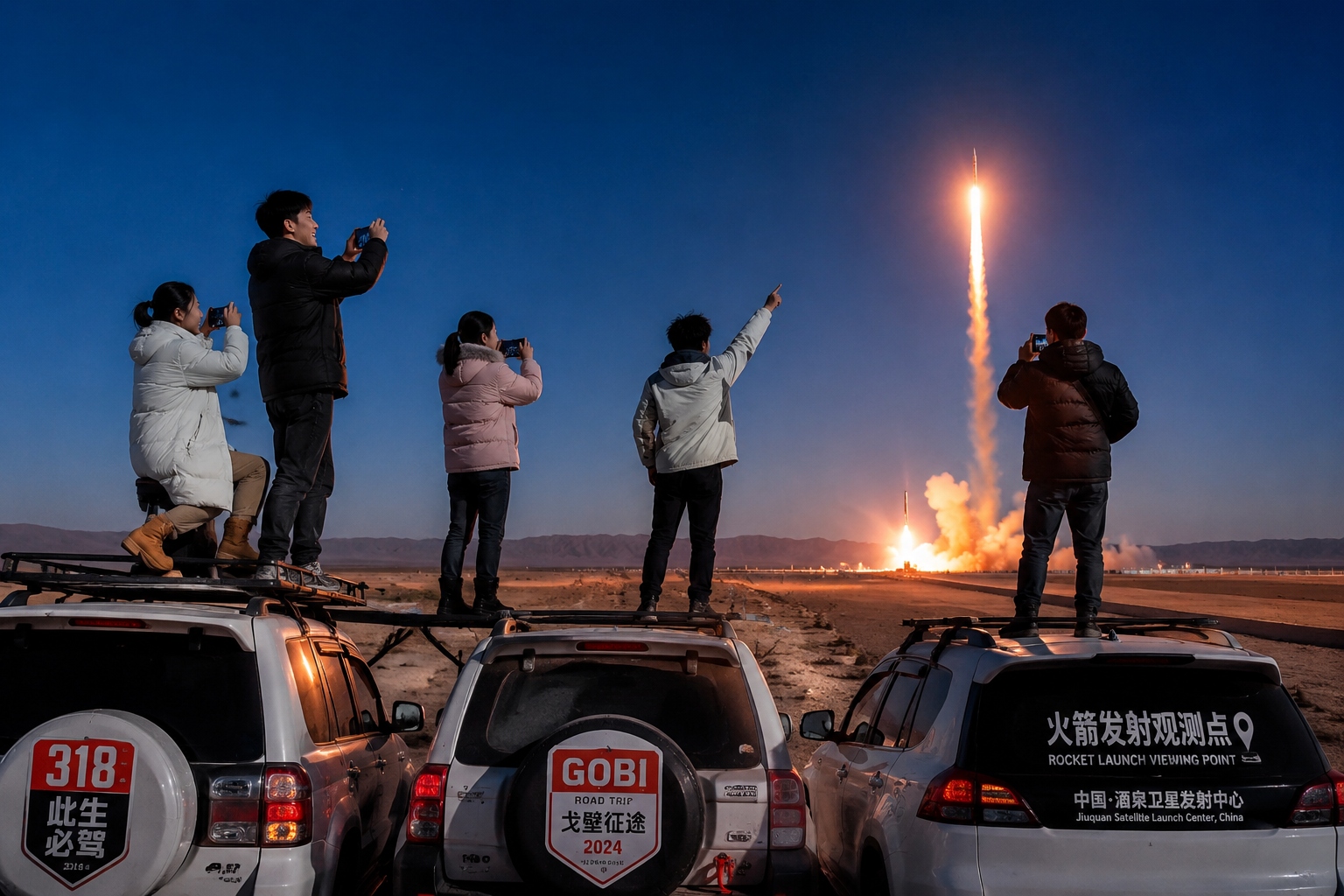
The wind is cold, the ground is gravel, and the only highway for miles is now a makeshift parking lot. It is launch night in Jiuquan, in northwest China’s Gobi Desert. Hundreds of cars are lined up along the road, most with young people standing on the hoods, bundled in down jackets, phones pointed to the sky. Some have brought folding chairs and thermoses; others have set up small telescopes. A girl in an oversized hoodie is handing out stickers that say “I watched a rocket go to space.”
When the countdown ends, the sky ignites. The rocket rises on a pillar of flame, and for a few seconds it is louder than any concert, brighter than the rising sun. Strangers hug. Some people cry. It feels less like a state event and more like a rock festival, except the headliner is a machine made for leaving Earth.
Chen Meng, a 22-year-old art student from Shanghai, traveled 2,000 kilometers with two friends to see this. She doesn’t study anything related to space. She paints watercolors of old neighborhoods. But for three years she has followed every Chinese launch, watched livestreams of space station modules docking, and even crocheted a small model of the Tiangong station. “I don’t know why,” she shouts over the fading roar, “but every time a rocket goes up, I feel like I’m going with it.”
Satellites Built in Dorm Rooms
That passion has a tangible side. On university campuses across China, students are building actual spacecraft. At Tsinghua University in Beijing, a team of undergraduates has designed a pico-satellite the size of a shoebox. It will test a new communication module and is scheduled for launch later this year on a commercial rocket. The project is no publicity stunt—it’s part of a growing wave of student-built satellites that have caught the attention of the Chinese space community.
Li Xinyu, a 21-year-old electrical engineering major, spends his weekends in a cramped lab full of wire cutters, soldering irons, and thick manuals. He joined the satellite project as a freshman because, he says, he wanted to “touch something that would actually go to space.” Now he spends his nights writing code for the satellite’s power system. “It’s like a crazy group thesis, but with higher stakes,” he laughs. “My roommate is saving up to buy an electric scooter. I’m saving up to watch my name streak across the sky.”
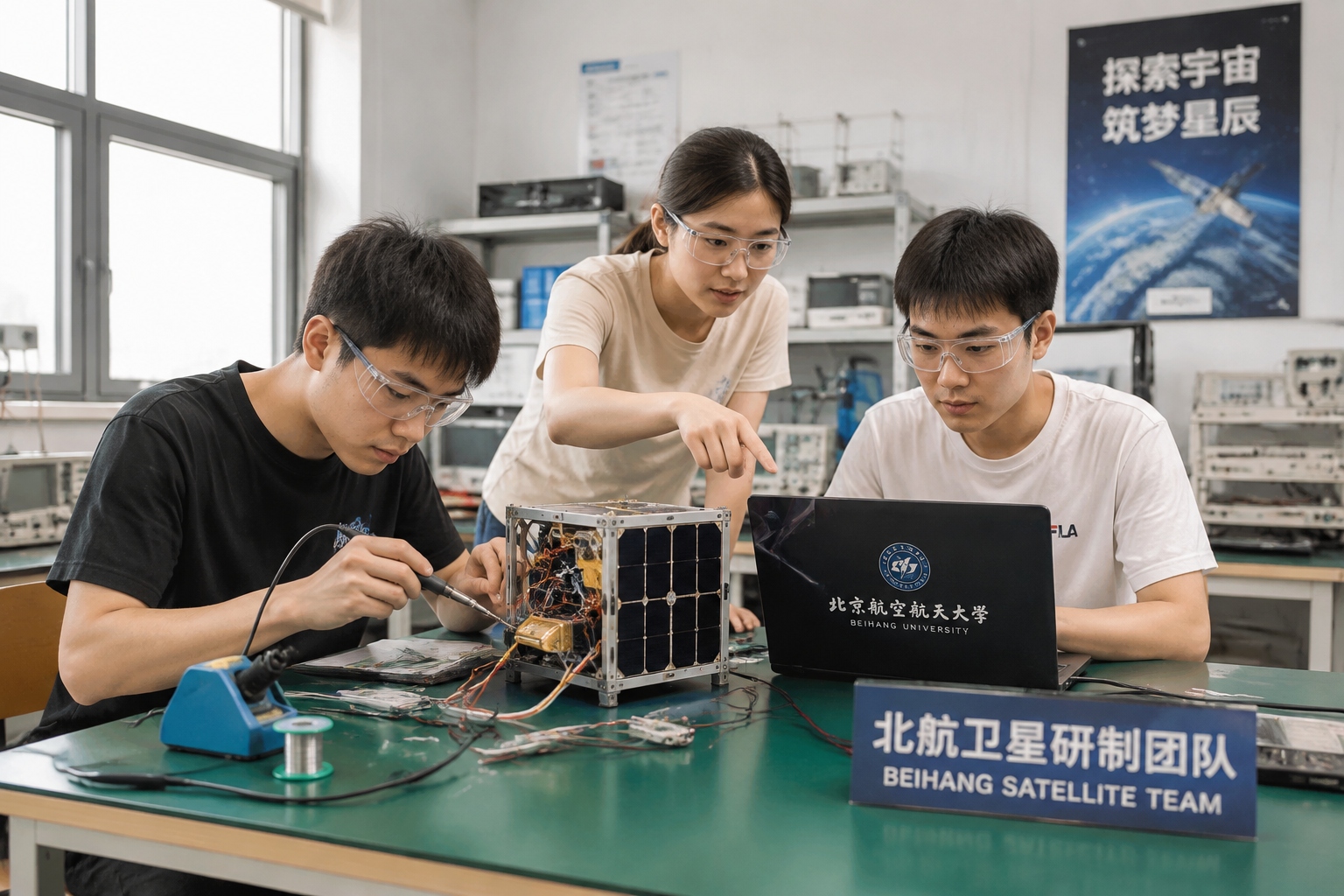
His teammate Wang Jing, a physics student, explains that the project has forced her to learn skills beyond engineering. “We have to negotiate with our partner university in Sweden, write reports in English, and even make a graphic novel to explain our mission to elementary school kids,” she says. “Space used to be a mystery. Now I feel like I’m inside it.”
The Commercial Space Boom
Li and Wang are headed for a fast-growing field. Although China’s state-owned space agencies still dominate launches, the government opened the industry to private capital in 2014. Since then, more than a hundred commercial aerospace startups have registered. Some focus on small rockets; others on communication or remote-sensing satellites; a few on much riskier ideas like space tourism and space solar power.
Zhao Lei, 26, is a mechanical engineer at one such startup in Beijing. He wears a plain black hoodie and carries a laptop covered in stickers of rockets and equations. His team of about 300 people has an average age of under 30, and they are betting they can put a reusable small rocket into orbit next year. “When I was in high school, my parents wanted me to study finance,” he says. “They thought space was a dead end. Now they call their friends and talk about my ‘space company’ with pride.”
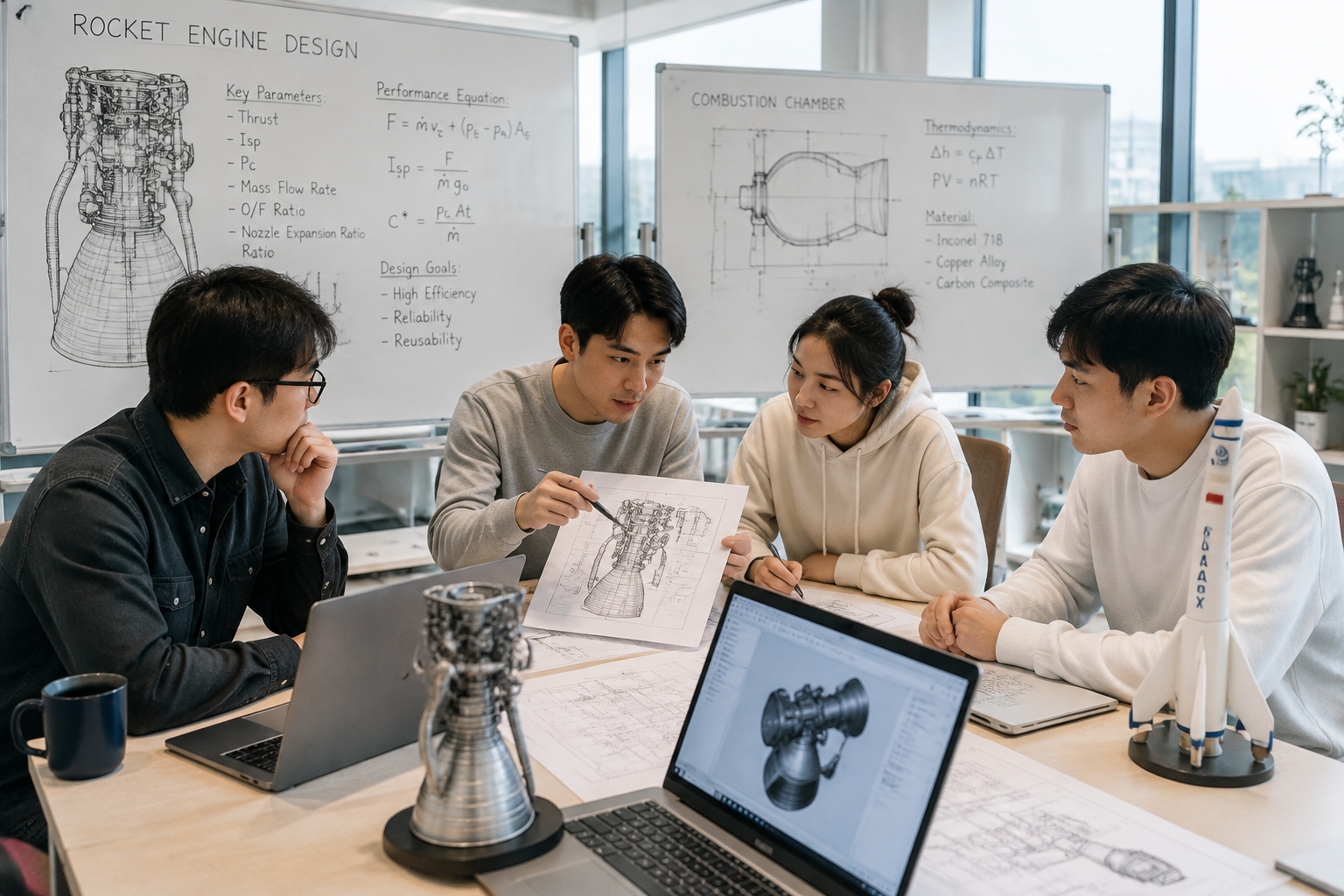
Even as a student, Zhao never doubted his path. He watched Yang Liwei’s Shenzhou V mission in 2003 when he was 14, and that single TV broadcast changed his life. He started a model rocket club in his dorm, spent his scholarship money on physics textbooks, and traveled to two other universities to audit aerospace courses. “It wasn’t the easiest choice, but it was the only one that made sense,” he says.
Space in Everyday Life
This enthusiasm is no longer limited to engineering campuses. It has begun to seep into everyday culture. On Bilibili, China’s answer to YouTube, videos about rocket launches routinely get hundreds of thousands of views. Amateur creators make surprisingly funny animations explaining orbital mechanics, or travel to remote Gobi sites to film launches with their own cameras. They are not professional journalists; they are just fans.
In schools, space programs have become a way to make science cool. Science museums in cities like Chengdu and Shenzhen feature simulators where kids can practice docking the space station or driving a Mars rover. Some primary schools have partnered with aerospace institutes to build mini satellite mock-ups in science classes. Then there are the astronauts themselves—the crew of the Tiangong space station have become internet celebrities. Their lectures from orbit, streamed live to millions of children, have turned basic physics into a kind of family event.
One café near Nanjing University hosts a monthly “space night” organized by a student club not officially connected to the school. Members share papers, discuss lunar missions, and watch launches together on a projector. Some are aerospace majors; others are studying literature or economics. “It’s a way of feeling close to something huge,” one member tells me. “You don’t need a degree to be part of the journey.”
The View from Inside
It would be misleading to pretend the enthusiasm comes without friction. Aerospace engineering is still one of the most demanding fields in China. Students face brutal exams, long lab hours, and the constant pressure to publish or produce. Some worry that the industry is too dependent on government policy, and that commercial companies are vulnerable to sudden changes in funding or regulation. A few people I spoke with admitted that friends had left the field for more stable, higher-paying jobs in technology companies.
Mao Feng, a third-year graduate student in rocket propulsion, puts it plainly: “The difficulty is real. I have classmates who wake up at 7 a.m. and don’t leave the lab until midnight. Some switch to software or banking. But the ones who stay are here because they can’t imagine touching anything more amazing than a rocket engine.”
That sentiment, more than money or fame, seems to drive the continued interest. It is visible in the cars parked along the Gobi highway, in the university labs where students solder circuits into the night, and in the young founder who sketches a reusable rocket on a café napkin.
Conclusion
By the time I got to the airport in Jiuquan, Chen Meng was at a café table, sketching the launch tower from memory. She had added planets and little stars around it. “People ask me why an art student cares about space,” she said, not looking up. “But art is about imagining things that don’t exist yet. Space is the biggest blank canvas we have.” Her friend, a biology student, nodded and added: “Also, we just really like a good show.”
Perhaps that’s the most honest answer. China’s young generation is drawn to space for many reasons—scientific curiosity, career ambition, national pride, or simply a love of spectacle. What they share is a belief that they can be part of it. And that belief is something you don’t need to calculate to feel.
Start the discussion at forum.chinacomes.com