

A Village Official’s Unusual Morning
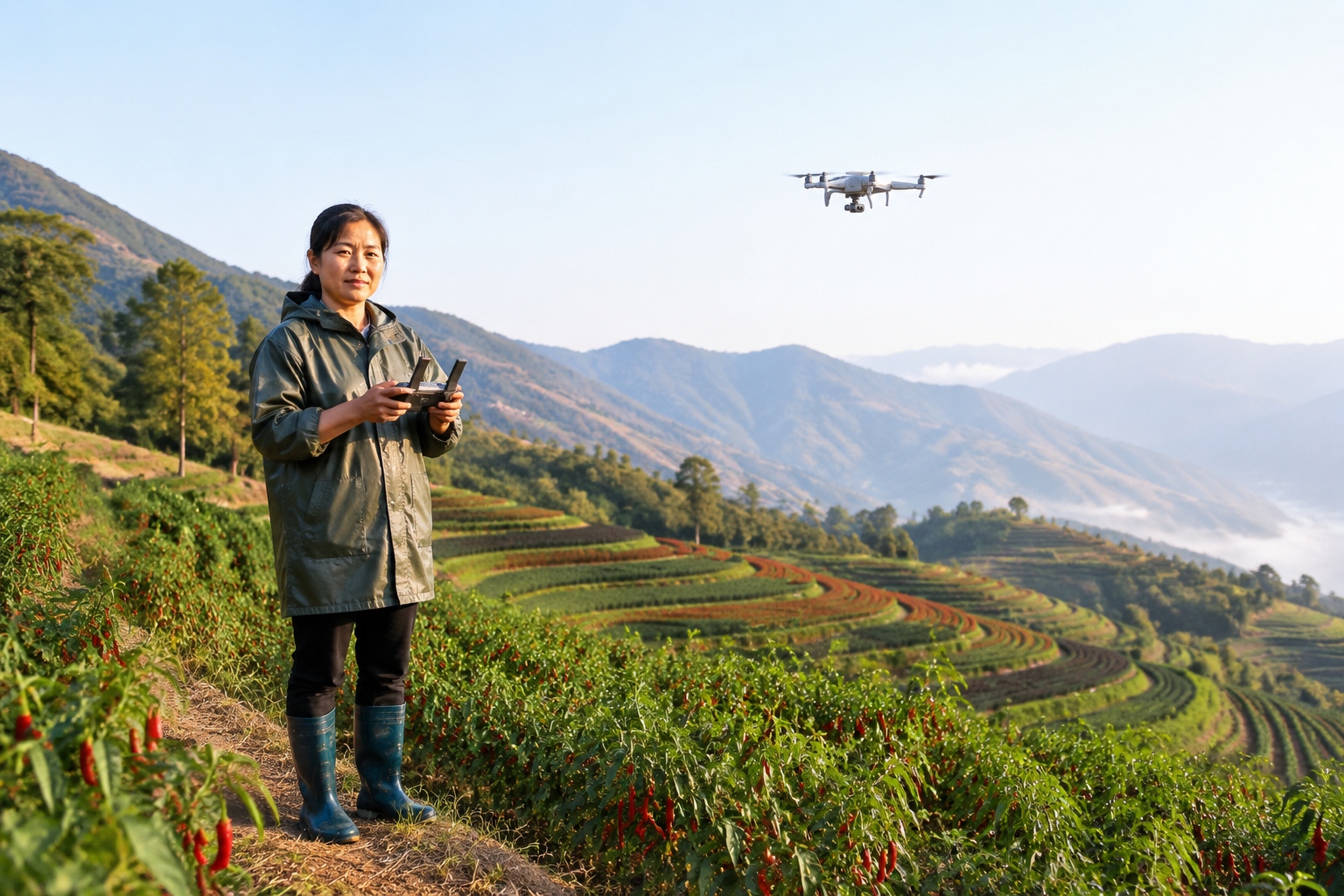
You might expect a female village official in rural China to start the day with a notebook and a loudspeaker. Instead, 48-year-old Zhang Cui begins with a drone. Shuanghe Village, where she serves as Party secretary, sits on steep slopes in Yunnan Province. Below her, hundreds of chili pepper plants are turning from green to bright red. Zhang Cui launches the drone, watches it rise over the valley, and within minutes receives detailed images of the crops’ health on her phone screen. Two plots need extra watering; one shows early signs of a fungal infection.
This isn’t a publicity stunt. For villages scattered across mountainous terrain, manual inspection is time-consuming and inefficient. In the past, Zhang Cui would ride a motorcycle along narrow paths to check the fields, a journey that could take half a day. Now she can cover the entire village’s farmland in ten minutes. The drone saves fuel, time, and most importantly, it allows her to spot problems before they become disasters. “We have 20 acres of chili fields,” she says. “One early pest outbreak could ruin a family’s annual income.” Villagers have noticed the difference. They used to call her “the motorcycle secretary.” Now they call her “the flying secretary.”
Who Runs China’s Villages Today?
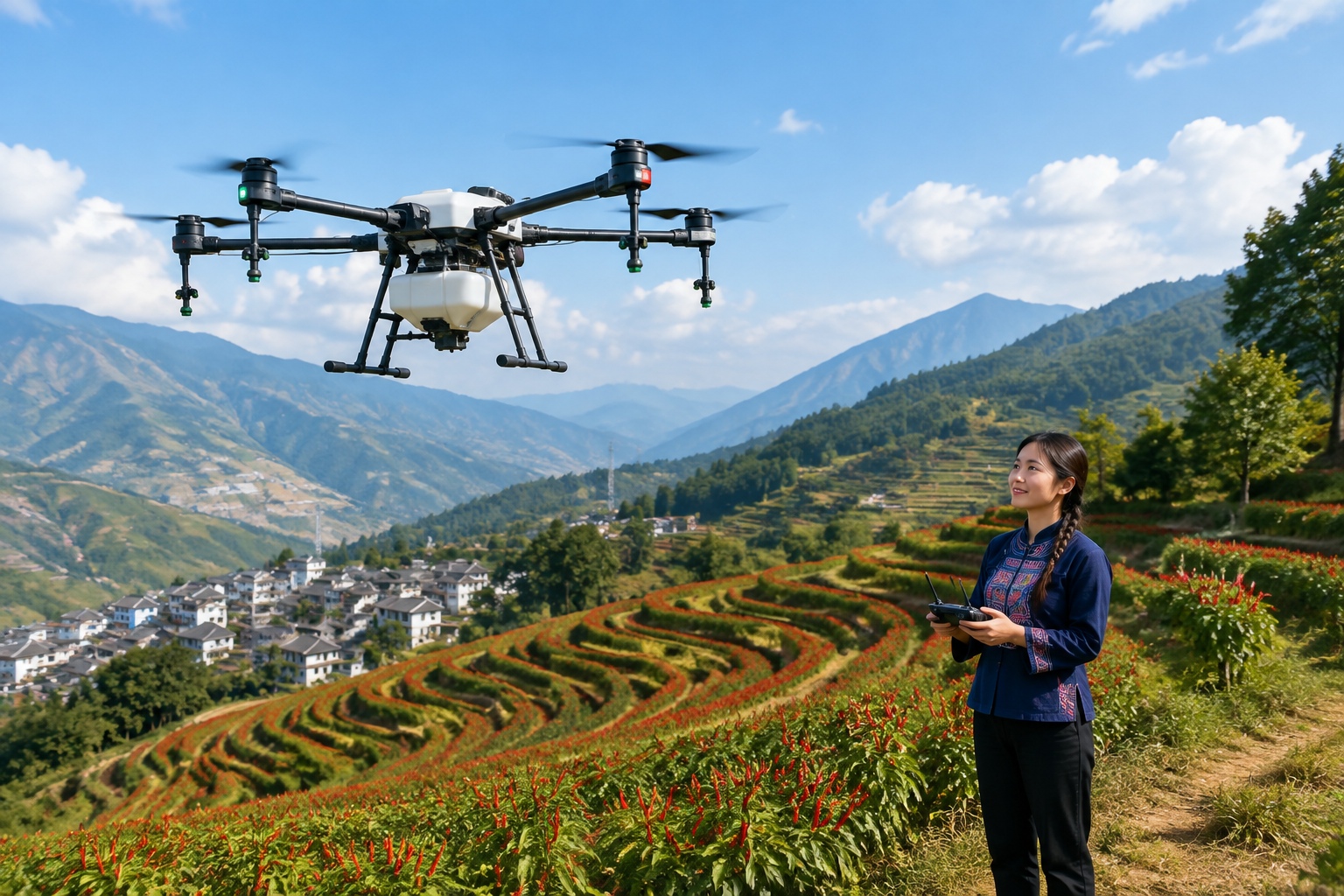
Zhang Cui is part of a quiet transformation in rural governance. China has roughly 500,000 villages, each with an elected committee and a Party branch. The Party secretary is often the top decision-maker, and for decades this position was almost always held by a man. The work largely involved paperwork, tax collection, and managing conflicts. But since the national rural revitalization strategy was launched in 2017, the job description has widened. Officials are now expected to understand markets, operate digital tools, and attract talent.
Women are increasingly filling these roles. According to the All-China Women’s Federation, women make up about one-third of village committee members, and the number of female village secretaries is rising steadily. Many, like Zhang Cui, lived and worked in cities before returning to their hometowns. They bring a broader perspective, yet they are also deeply embedded in local networks. This combination is changing the way decisions are made in the countryside.
The Chili Pepper Negotiation
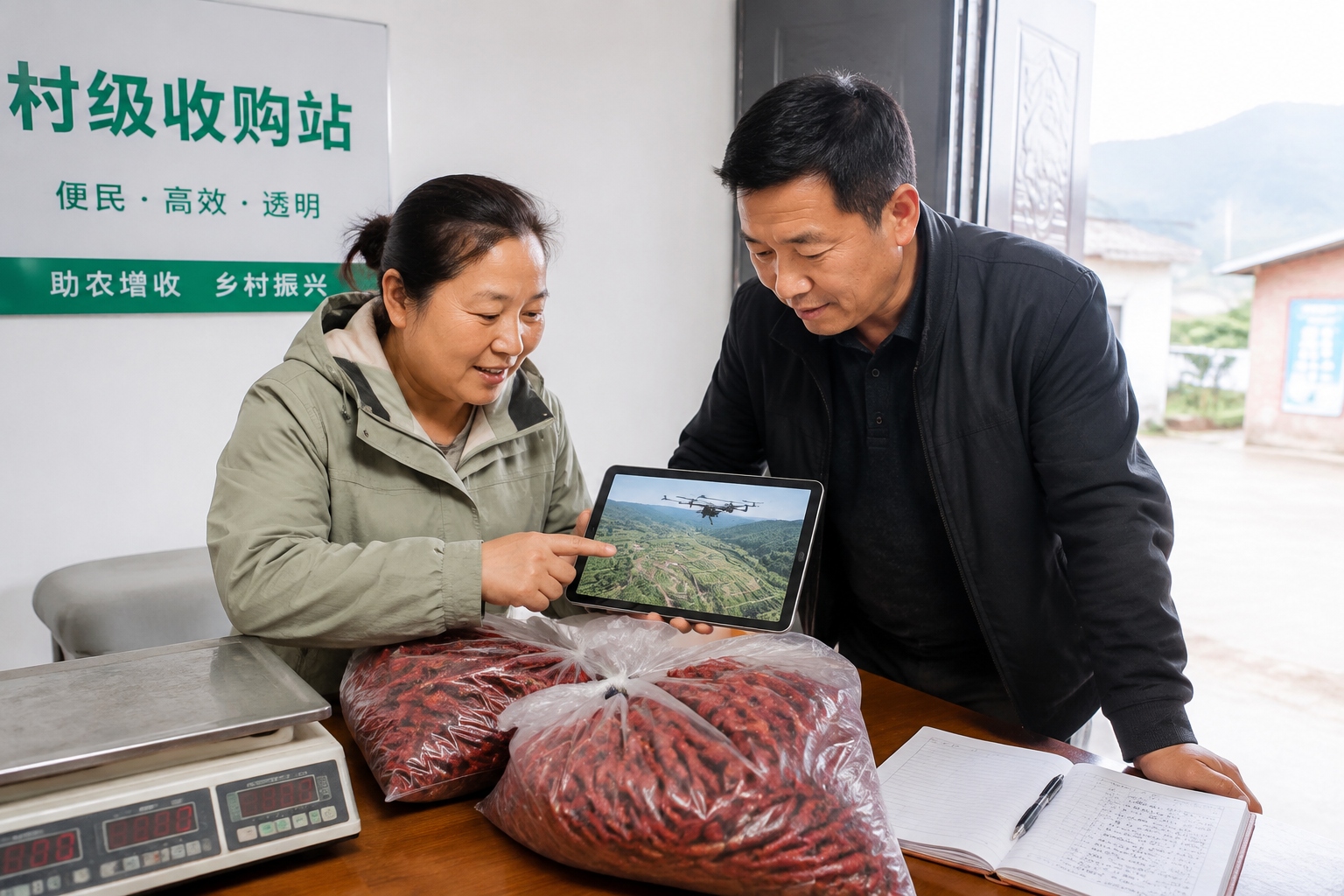
By mid-morning, Zhang Cui drives down the mountain to the township purchasing station to meet Wang Laoban, a wholesale agent who has bought chilies from the village for the past six years. The harvest looks abundant, but regional prices have been unstable. Zhang Cui arrives with a canvas bag of dried chilies, a tablet showing drone images, and a list of average prices from three nearby counties.
Wang tastes a chili. “Good quality, but the market is weak,” he says. Zhang Cui doesn’t push back emotionally. She shows him a drone image of a uniformly red field and explains how the village adjusted irrigation and pest control earlier in the season. She also points out that the village can supply a consistent volume over the next three months, which makes logistics cheaper for him. After forty minutes of careful back-and-forth, Wang agrees to pay 5% more than last year and signs a letter of intent for long-term supply.
For a village of 400 households, where more than half rely on chili income, that 5% increase adds up to roughly 100,000 yuan (about $14,000) for the village cooperative. In the past, individual farmers sold their harvest alone and had almost no bargaining power. Traders would simply quote a price and farmers had to accept it. Now the cooperative acts as a single seller, pooling the crops and negotiating as a unit. Zhang Cui’s negotiation is not just about one price; it is a step toward a more organized and market-oriented rural economy.
Settling Disputes with Digital Evidence
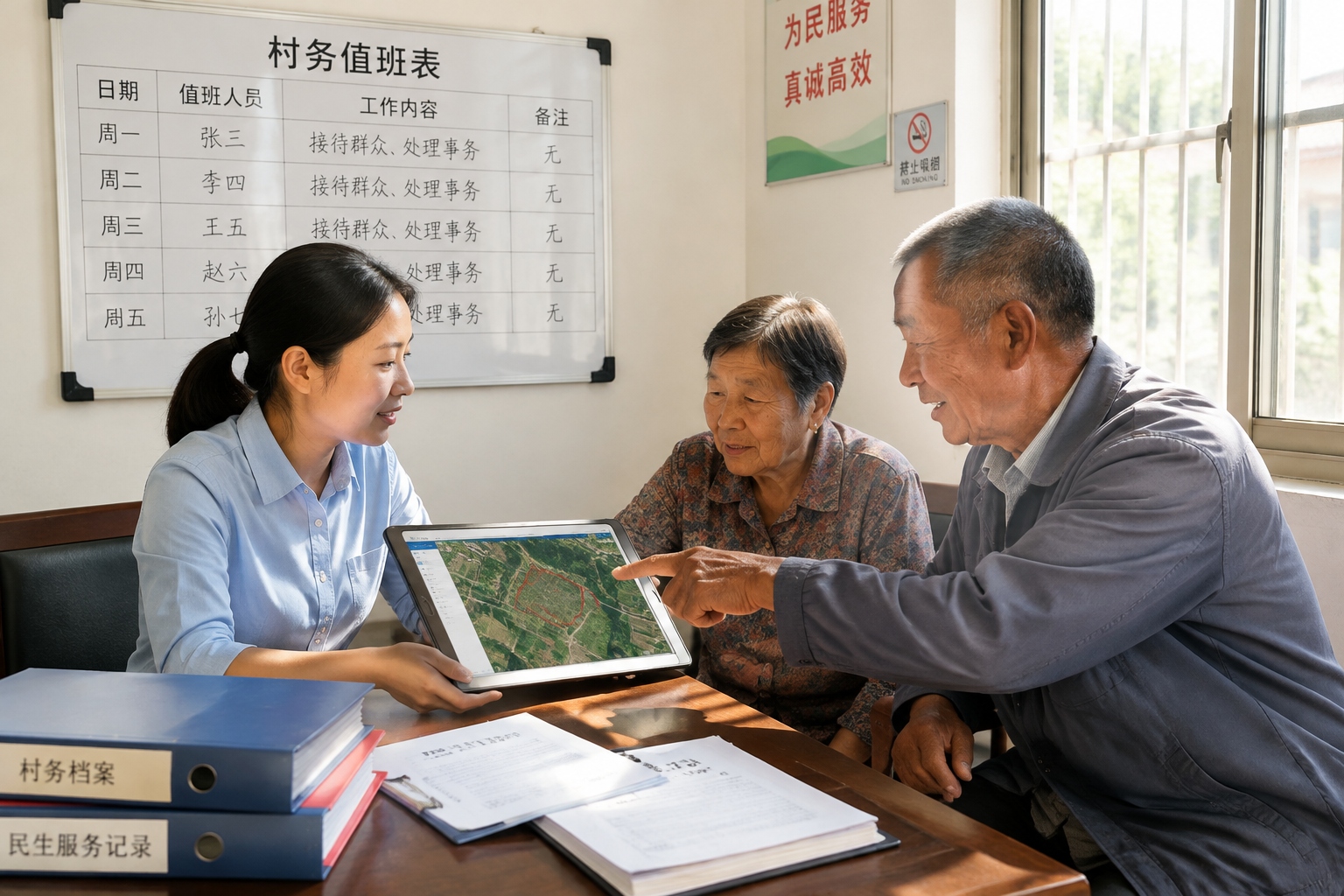
After lunch, Zhang Cui returns to the village office and finds two families arguing in the courtyard. One family says the other’s bamboo fence has cut into their plot. Zhang Cui doesn’t raise her voice. She opens a satellite imagery application on her tablet and zooms into the parcel boundary. The government’s land survey data, updated with high-resolution aerial photos, shows a clear historical line. Both families peer at the screen. After a few minutes, the argument turns into a nod of agreement. The fence is moved, and the dispute is closed in 20 minutes.
Such disputes were once settled by shouting or by summoning an elder. Now, digital evidence provides a transparent reference that people trust. “They know I’m not hiding anything when they can see the same map I see,” Zhang Cui says. She records the resolution in an electronic ledger, which can later be used if the conflict recurs. This might sound like a small thing, but it creates a sense of fairness in a community built on personal relationships.
Livestreaming from the Fields
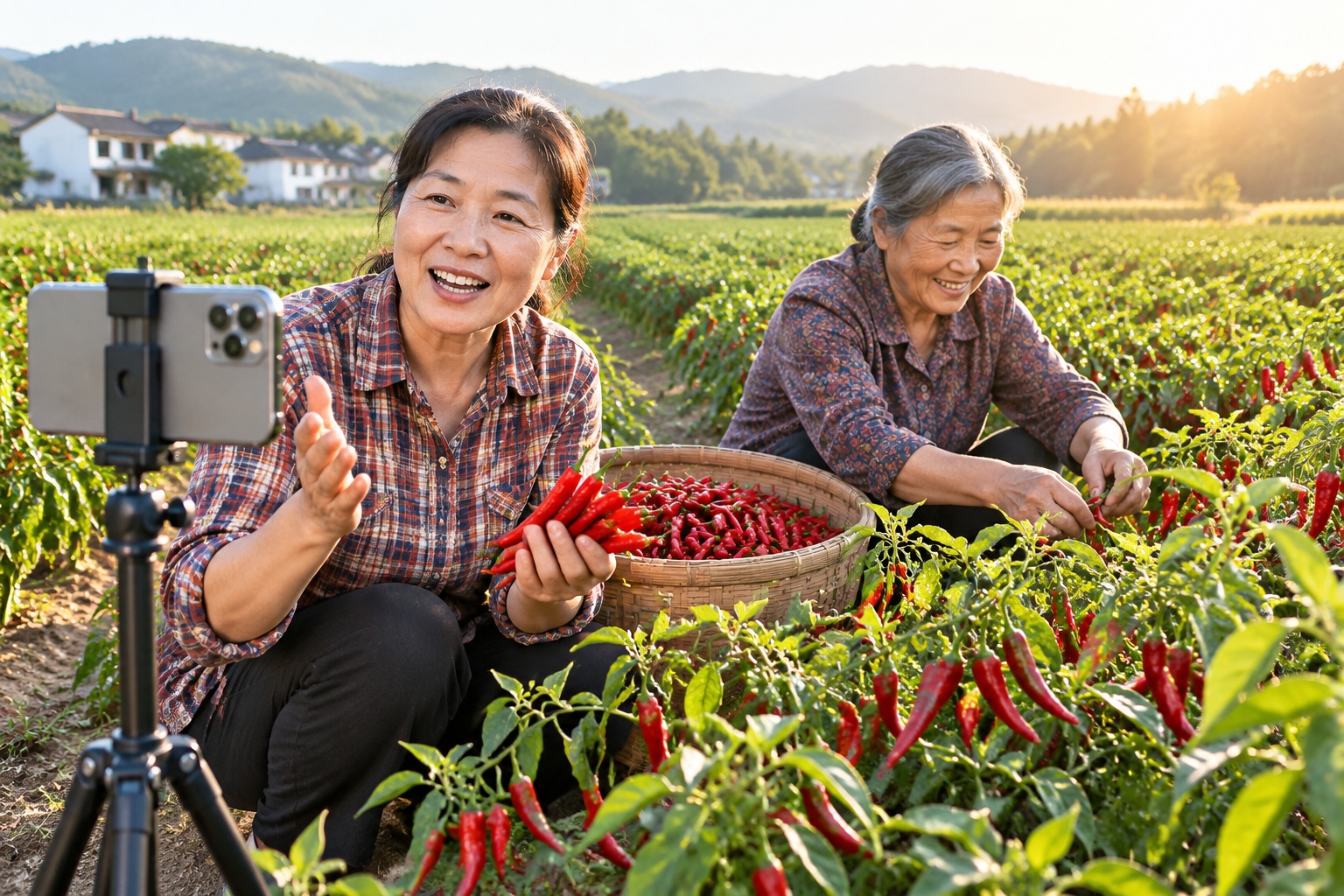
At 4 p.m., Zhang Cui walks to the house of Wang Ayi, a 60-year-old woman whose son and daughter-in-law work in a factory in Shenzhen. The chili harvest is at its peak, and Wang Ayi is tired. Zhang Cui rolls up her sleeves and helps pick the bright red fruit. After filling a basket, she pulls out her phone and starts a livestream on a popular e-commerce site. She holds up a chili, describes its fruity spiciness, and explains how it is naturally sun-dried. Her audience is modest—about three dozen viewers—but she does this twice a week.
Livestreaming has become a common tool in China’s countryside. Platforms offer free training and sometimes subsidize rural streams. For Shuanghe Village, it is a direct channel to consumers that bypasses multiple middlemen. Zhang Cui is not a polished presenter; she stumbles over her words and the picture shakes whenever she picks another chili. But she persists. A few sales have come from viewers who became repeat customers. “We don’t expect to become internet celebrities,” she says. “We just want to earn a little more for the farmers.” Facing rising logistics costs and fierce competition, only a few streams turn a profit, but the effort itself is changing the villagers’ attitude toward technology.
Evening in the Village Square
As dusk approaches, the plaza outside the village office fills with music. About thirty women, and a few men, begin a synchronized dance routine. Zhang Cui joins for a while, then steps aside to use the loudspeaker: “Tomorrow, the county agricultural training center will come to teach drone operation. Anyone aged 18 to 45 can sign up. Free lunch provided.” A few young people raise their hands.
The square dance is often described as a pastime, but for Zhang Cui it is a key communication channel. This is where she learns about a neighboring county’s vegetable buyer offering higher prices, or that a couple is considering opening a homestay. She can read the mood of the village, spot emerging problems, and build trust. It is soft leadership, and it works.
Women’s Leadership and Rural Change
Zhang Cui’s day is a reminder that leading a Chinese village is not about sitting behind a desk. It requires physical labor, emotional intelligence, and the ability to shift from agronomy to business to law in a single afternoon. Women, who often have deep community ties and experience in multitasking, are increasingly recognized as effective leaders in this environment. Scholars of rural governance have noted that female officials tend to prioritize communication, collaboration, and long-term community well-being over asserting authority.
Yet the path is not smooth. Female leaders often face family pressure and outdated stereotypes. Zhang Cui’s mother initially objected to her taking the job, fearing it would be too stressful and would embarrass the family if she failed. At procurement stations, some older traders are clearly uncomfortable negotiating with a woman. Zhang Cui responds by being more prepared than anyone else in the room, and she lets facts speak. Her success has made it easier for other women in the village to speak up at meetings and even consider running for office.
Conclusion
At 8 p.m., Zhang Cui finally returns home to cook dinner and call her daughter, who lives in the county town for high school. Her day has included launching a drone, haggling over prices, mediating a boundary conflict, harvesting chilies, livestreaming, and dancing with neighbors. It is not the image most foreigners have of a rural Chinese official. But it is increasingly the reality. Technology, market access, and a new generation of leaders are reshaping the vast countryside. And women like Zhang Cui—balancing tradition and innovation—are at the very center of that change.
Start the discussion at forum.chinacomes.com