
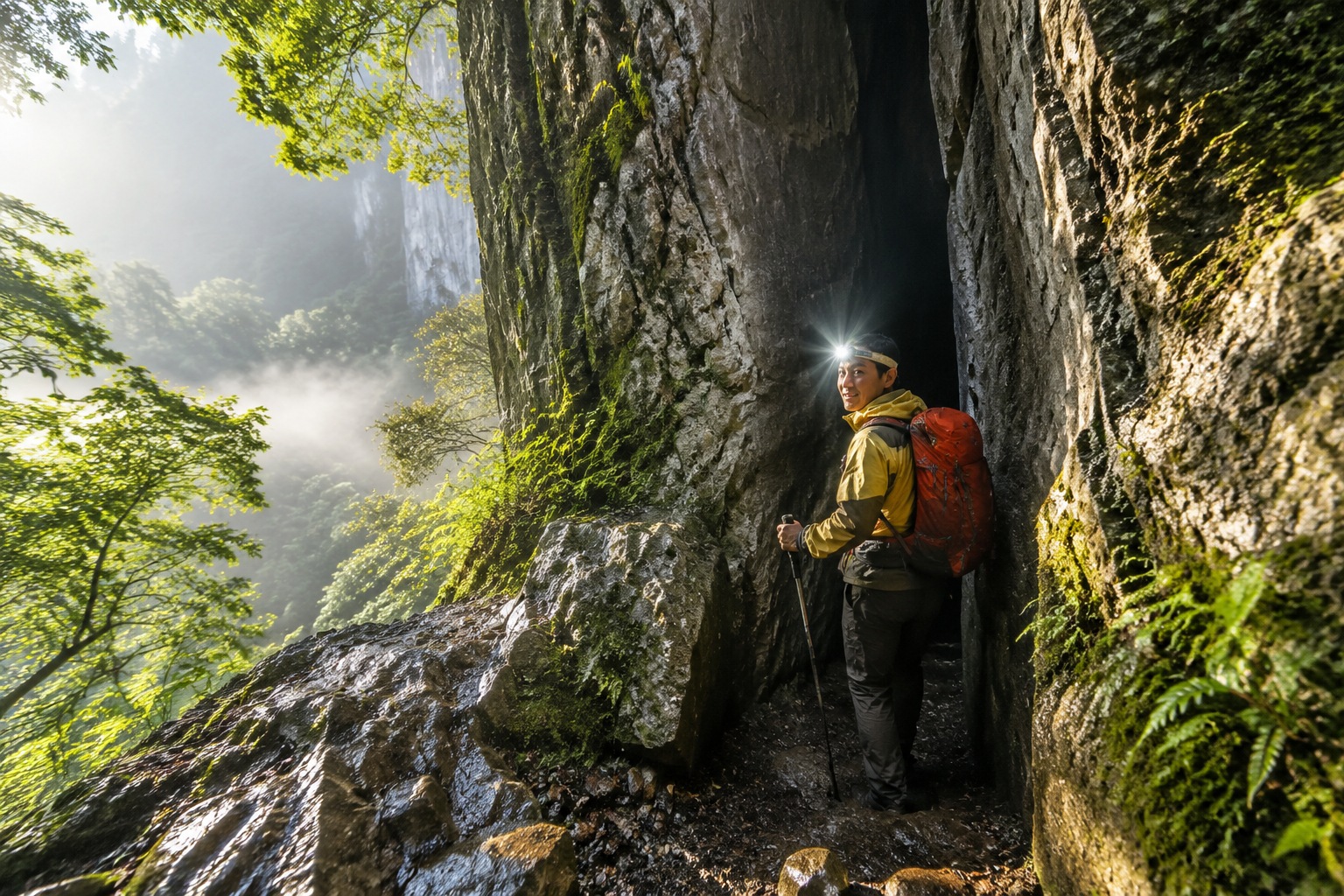

Morning at the Ticket Office
At seven in the morning, the ticket office at Enshi Grand Canyon was already bubbling with tourists. Flags and selfie sticks filled the square. I stood at the back of a line moving toward the ‘Cloud Dragon Rift’ entrance, when my phone buzzed. Liu Feng, a local hiking guide, had sent a short message: ‘Don’t go in. Turn left after the old bridge and walk until you see a yellow ribbon tied to a walnut tree.’
I slipped away, crossed the concrete plaza, and followed the bridge toward a cluster of farm houses. That decision led me to one of the most unusual trails I have walked in China: a narrow, undeveloped fissure that drops into the earth’s darkness, far from the crowds above.
The Crowded Icon and the Quiet Alternative
Enshi Grand Canyon, in western Hubei Province, is one of China’s most popular national parks. Every year, millions of visitors ride its cable cars and walk the glass-bottomed plank road suspended along a 100-meter-high cliff. They come for the ‘Grand Canyon of the East’ reputation, and they leave with postcard photos.
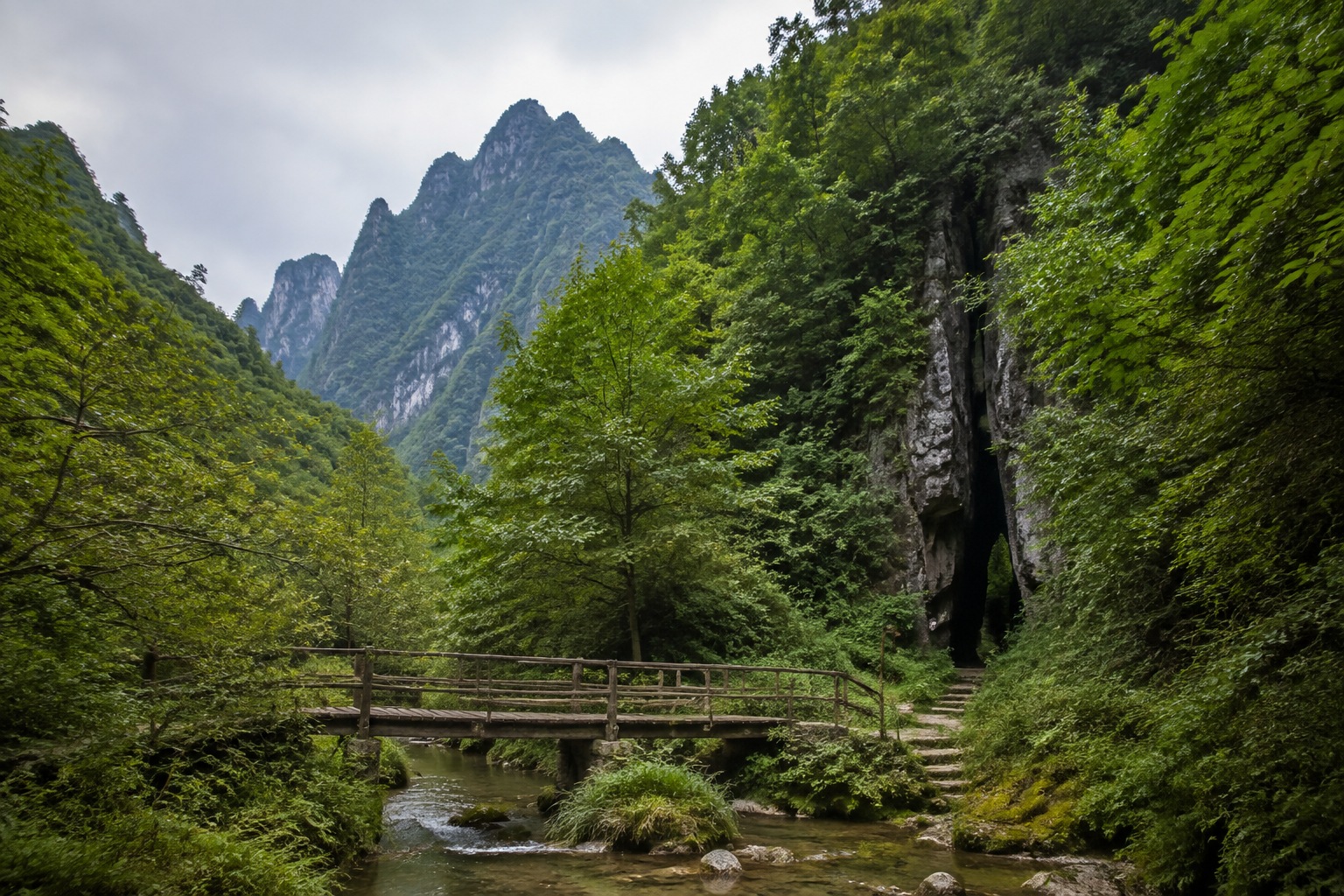
Few of them know that a few kilometers east, a hidden hiking route descends into the same karst landscape through a completely different entrance. The trail is not marked on official maps. It does not appear in park brochures. It starts behind an old family orchard in the village of Lvcongpo, about a 40-minute drive from the park’s main gate.
To find it, you need someone like Liu Feng.
Into the Earth: A Geology Lesson You Can Touch
Liu Feng is 45, with weather-beaten hands and a quiet voice. He used to farm corn and tea on the plateau above the canyon. For years, the only people who used this path were local villagers collecting medicinal herbs or checking water levels. Now, he leads a handful of small groups each week — never more than six at a time.
We left the orchard, pushed through waist-high ferns, and stopped at a narrow crack in the limestone. The opening looked like a wound in the ground, barely half a meter wide. Liu Feng turned on his headlamp and stepped inside; the air turned instantly cool and damp. Within minutes, the sun disappeared.
This is the ‘Heart of the Earth’ trail, a term Liu Feng coined for his own customers. The route follows an ancient underground watercourse, carved over millions of years by a river that still runs beneath the canyon. Water trickles down the rock walls, collecting in small pools that reflect the headlamp beams like polished glass.
One moment, the walls squeezed so close that my shoulders brushed against wet stone. Liu Feng stopped and pointed upward. A sliver of blue sky appeared about 80 meters above, like a thin thread of light. ‘The villagers call this the one-coin sky,’ he said. ‘You can only see a coin-sized piece of heaven.’
As we descended, the passage opened into a chamber about the size of a school gymnasium. Stalactites hung from the ceiling like frozen rain, and a faint rumbling came from a dark opening at the far end. ‘That’s the underground river,’ Liu Feng said. ‘During summer rains, you can’t stand here — the water fills the whole tunnel.’
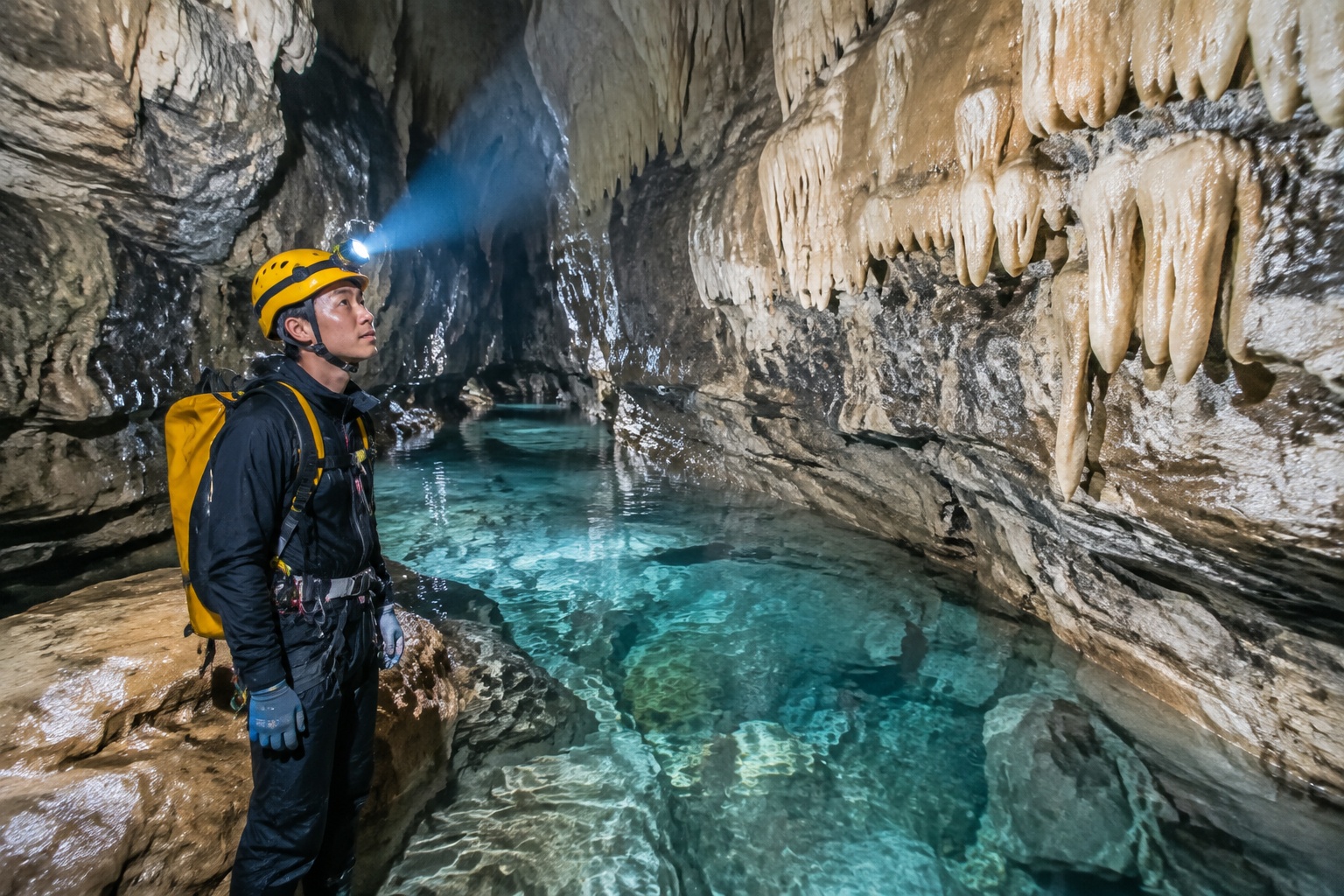
The geology on this path is more intimate than anything on the main tourist route. Where the official trail gives you distant views of cliffs, this one lets you place your palm on the wet limestone, tracing the ripple marks of an ancient seabed. Here, the canyon does not just stretch out before you; it wraps around you, weighs on you, and makes you aware of every breath.
Why This Trail Stays Empty
I asked Liu Feng why the local government hasn’t developed this path into another ticketed attraction. He laughed. ‘It’s too dangerous for regular tourists,’ he explained. ‘You need to climb down three steel ladders, your phone has no signal, and the path is often slippery. The cost of making it safe would be huge, and the return would be small. So they spend money on the cable car and the glass bridge — those sell tickets quickly.’
But there is also a quieter reason. This trail crosses land that belongs to several local families. Opening it as a national park attraction would mean resettling them or dividing profits. Instead, the villagers have learned to earn small amounts by guiding independent travelers. ‘We are not a company,’ Liu Feng said. ‘We are neighbors. We all know each other’s fields. If someone gets lost, we find them quickly.’
Liu Feng’s grandfather often used this route to reach the river when the rains had dried up the wells. They would climb down with a rope and a basket, fill the basket with water-soaked moss, and bring it back to keep vegetables cool in summer. ‘We never thought of it as a tourist place,’ he said. ‘It was just part of our backyard.’
That sense of community keeps the trail under the radar. And because no one has built stairs or installed handrails, the path has remained a genuine adventure. Liu Feng carries a list of safety rules in his pocket: no sandals, no large backpacks, no one under 12 years old. ‘I always bring two headlamps,’ he said. ‘Once a tourist’s lamp died in the middle of the second ladder. I gave him mine, and I used my spare.’
Practical Tips for the Heart-of-the-Earth Hike
If you want to walk this trail, here is some practical advice from my experience and from Liu Feng’s rules.
When to Go
March to May and September to November are ideal. In summer, rainstorms can cause flash floods inside the fissure; in winter, some sections freeze. Always check the weather forecast for the 48 hours before your hike — no rain, no mudslides.
What to Bring
- A headlamp, plus a spare — even if you think you won’t need it.
- Non-slip hiking boots with a good tread.
- A lightweight helmet (the local guide can provide one, but only for some guests).
- Gloves for gripping chains and ladders.
- At least 1.5 liters of water and some high-energy snacks.
- A small backpack, not a huge one — the narrow passages make a wide bag a nuisance.
Getting There
From Enshi city, take a bus or drive toward Yuanhua Village; then follow local signs to Lvcongpo. The trailhead is in a farmhouse courtyard. It’s best to arrange a guide in advance, often through a homestay or a local hiking community. Note that park entry tickets do not cover this trail — it is on the outside edge of the protected area.
Difficulty and Safety
The hike is moderately challenging. You’ll climb three vertical ladders (the longest about eight meters), squeeze through narrow passages, and cross slippery rocks near the underground river. Expect two to four hours of walking depending on group speed. Do not hike this path alone. The route is unmarked, and the terrain is unpredictable. Listen to your guide’s instructions, particularly near the ladders and the water. Keep your phone in a sealed waterproof case, as humidity is near 100%.
Finally, leave no trace. Every piece of trash that drops into the fissure becomes part of a very hard cleanup.
The Return to the Surface
After four hours underground, we emerged through another crack in the plateau, blinking in the afternoon sun. The trail had taken us not in a loop but straight through the mountain, from the orchard to a secluded valley where a small stream met the daylight. There was no one in sight. The only sounds were water and wind.
In a country where epic landscapes are often packaged and crowded, this hidden path feels like a piece of the past. It is not easy, and it is not for everyone. But for those willing to follow a local farmer into the dark, the Heart of the Earth offers something increasingly rare: a direct, unmediated encounter with China’s wild geology.
That evening, Liu Feng invited me back to his home for tea. He pointed to the smoke rising from the chimney of a distant hut. ‘A few years ago, that hut would have been full of people gathering herbs. Now we meet tourists instead. But the path itself has not changed. The mountain is generous — it just doesn’t want to be rushed.’
Start the discussion at forum.chinacomes.com