
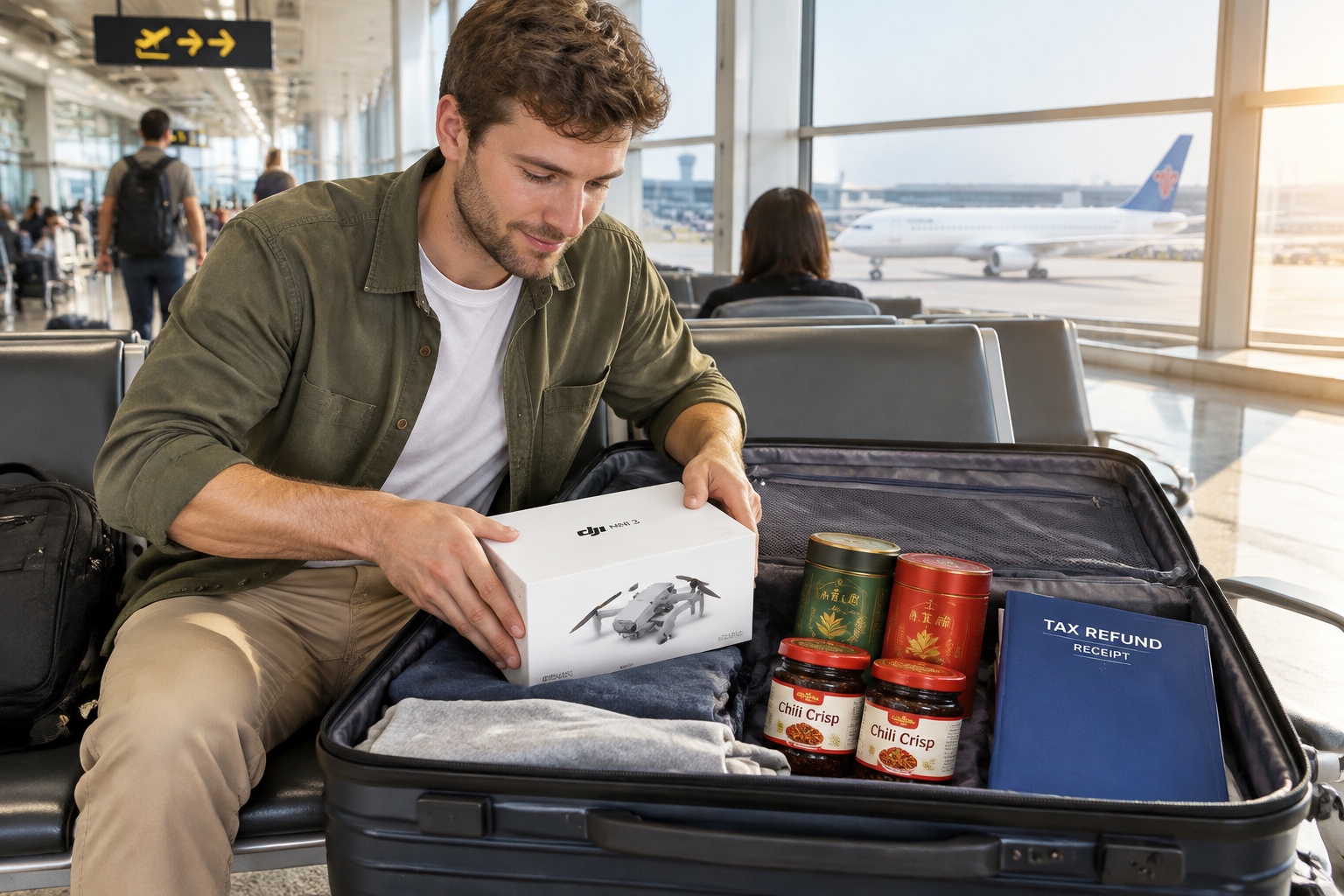

A suitcase opens at the tax refund counter
At the departure tax refund counter in Shanghai Pudong airport, Chen Yu has learned to read suitcases. The clerk asks the usual question — any liquids, batteries, or drones? — and a Spanish traveler named Lucia unzips hers on the counter.
On top are two tins of Longjing tea, a Pop Mart blind box, three jars of chili crisp, a Xiaomi robot vacuum in its box, and a DJI Mini drone that has never been flown. Her receipts are in a clear plastic folder. Chen does not blink. A few years ago, she says, the queue was perfume, silk scarves and airport tea sets. Now it is electronics, snacks and things people saw in a friend’s apartment.
Lucia is not a gadget blogger. She is a nurse from Valencia on a ten-day trip that started in Shanghai, went west to Hangzhou and then south to Shenzhen. She bought the drone for her brother, the vacuum for herself, the tea for her mother, and the chili crisp because a colleague told her it makes plain rice interesting. Her suitcase is not a list of souvenirs. It is a receipt for the kind of China she encountered.
Why the suitcase changed
For a long time, the classic foreign tourist purchase in China was small, light and symbolic: tea, silk, a chopstick set, a painted fan. Those things still sell. But the economics of a trip have changed.
China’s visa-free transit policy now allows eligible travelers to stay for up to 240 hours — ten days — and the effect is visible in itineraries. In the year to late 2025, China recorded 40.6 million foreign arrivals, up 27.2% year on year. The average stay for visa-free travelers rose from 2.1 days in 2019 to 4.7 days. About 72% moved between cities, and six in ten visited more than one province. Longer trips mean more time in malls, supermarkets, electronics stores and friends’ homes. Buying happens after seeing, not just at the airport.
That shift matters for what goes into the bag. A ten-day trip gives a visitor time to notice that the robot vacuum in the hotel corridor is a Chinese brand, that the delivery rider’s phone is a Huawei, that the coffee shop’s camera is a DJI. The souvenir economy has moved closer to daily life.
A drone beats a silk scarf
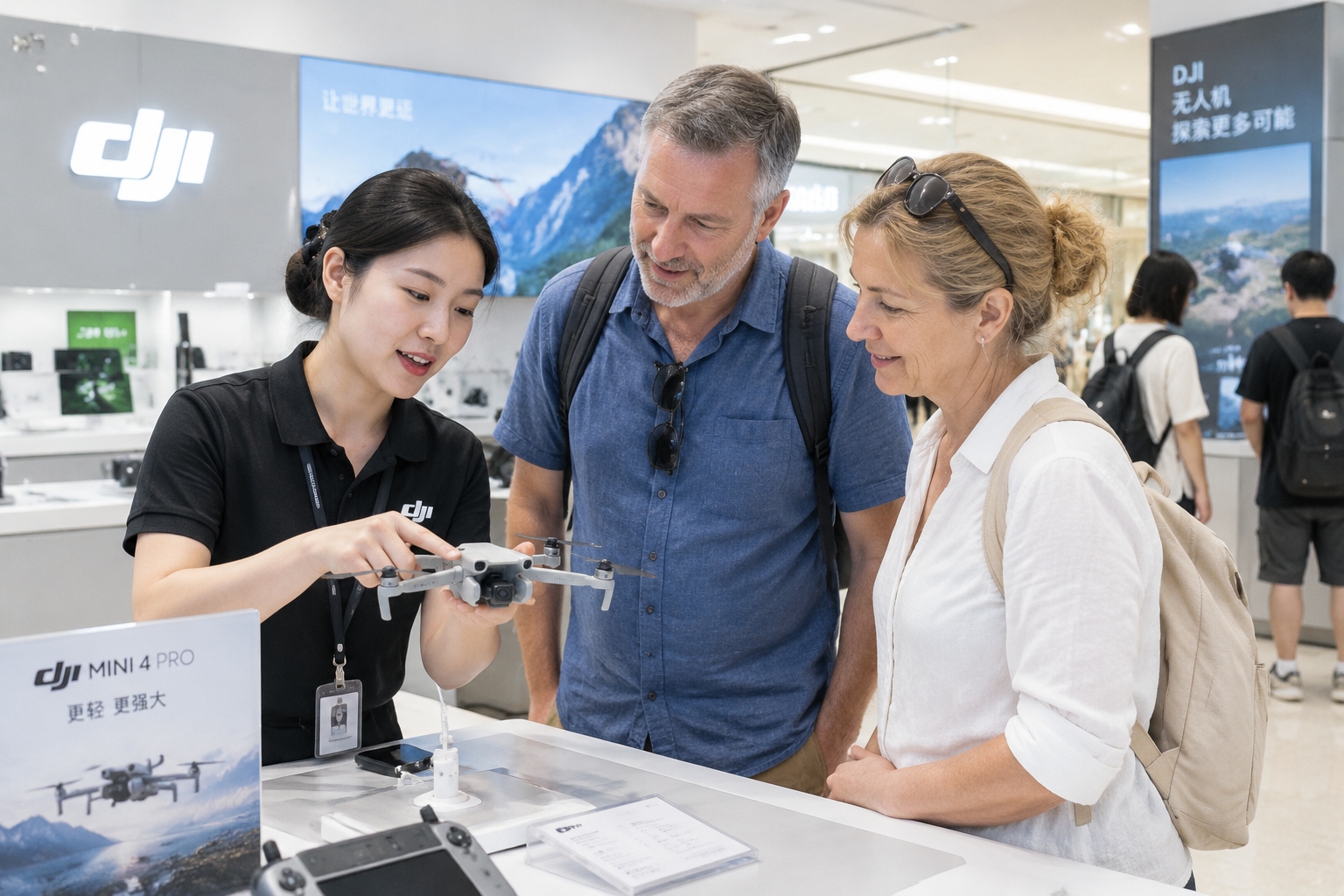
At a DJI counter in a Shenzhen mall, Liu Wei has a routine. She asks where the customer will fly, shows the weight of the Mini series, and explains that many models are designed to be easy to carry. A German tourist wants to know if the app works in German. A French couple asks whether the warranty is valid at home. Liu pulls out the global version and lets them hold it.
The price on the tag is 1,799 yuan for a DJI Mini 4K, about $250. For a European shopper, that is not a wild luxury purchase; it sits somewhere between a good pair of headphones and a weekend hotel. If the store participates in the departure tax refund scheme, a tourist can get back roughly 11% on standard 13% VAT goods — about 198 yuan, or $27, before any handling fee. The refund is not the reason to buy. It is the reason to stop hesitating.
Down the corridor, a Xiaomi store sells robot vacuums, electric toothbrushes and smart watches. A mid-range robot vacuum can cost 1,500 to 2,500 yuan. A Pop Mart blind box costs 69 to 99 yuan. A jar of Lao Gan Ma chili crisp costs 10 to 15 yuan. The price range is wide, and so is the meaning. A drone is a high-value purchase that needs a warranty conversation. Chili crisp is an impulse buy that fits in a corner of the bag.
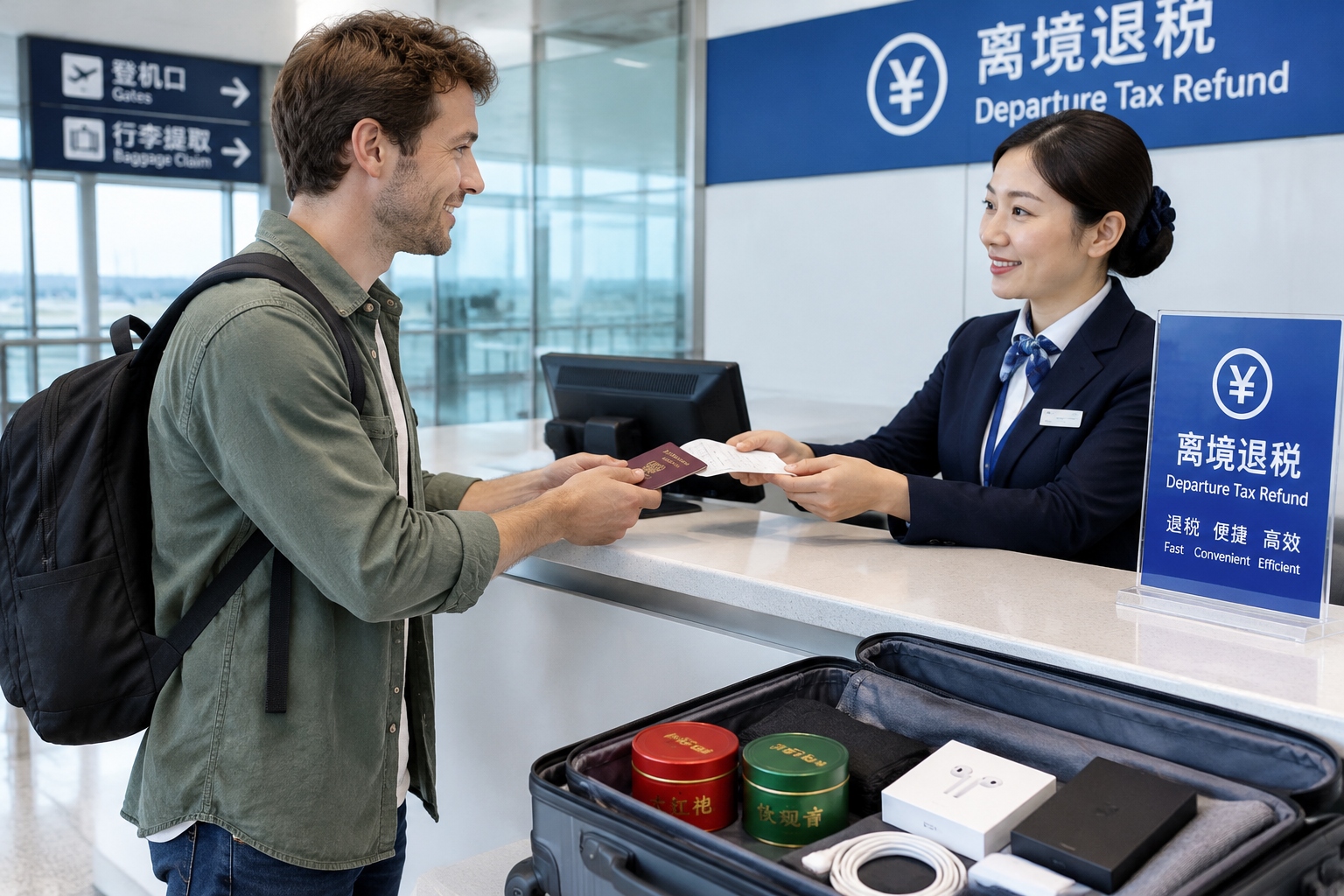
The tax refund counter is where the story becomes paperwork
Tax refunds are not automatic. At participating stores, a foreign visitor shows a passport, spends at least 200 yuan in many places after the 2025 expansion, and gets a refund form. Some stores offer an instant refund to a credit card; otherwise the traveler takes the form, receipts and unused goods to the airport, gets customs verification, and receives the money later. The goods must leave China within 90 days. The refund is often 11% on goods with 13% VAT and 8% on goods with 9% VAT, with a handling fee deducted. Not every shop participates, and food is not usually the paperwork purchase.
The paperwork explains a small detail in the departure hall: tourists are not only carrying things; they are carrying folders. A missing receipt can turn a relaxed purchase into a twenty-minute search through a suitcase. A drone battery may need to be in carry-on luggage. A robot vacuum may be checked in, but the customs officer may want to see it. The process is more orderly than it sounds, but it is still a process.
It also feeds back into spending. In the first three quarters of 2025, the number of departure tax refund claims rose 229.8% year on year. More than 60% of refund money was spent again during the trip, according to official data cited by Chinese media. The refund often goes back into the same suitcase: another tea set, a second blind box, a better case to carry the drone.
Food is still the emotional purchase
The high-tech purchases get the attention, but food does the emotional work. In Hangzhou, a British teacher named Emma buys two boxes of Longjing tea after a visit to a tea farm. She does not know much about the grades, so the seller lets her smell three batches and explains the difference between an everyday tea and a gift tea. She spends 300 yuan on the everyday box and 800 yuan on the gift box. The tea is light, easy to pack and comes with a story she can tell at home.
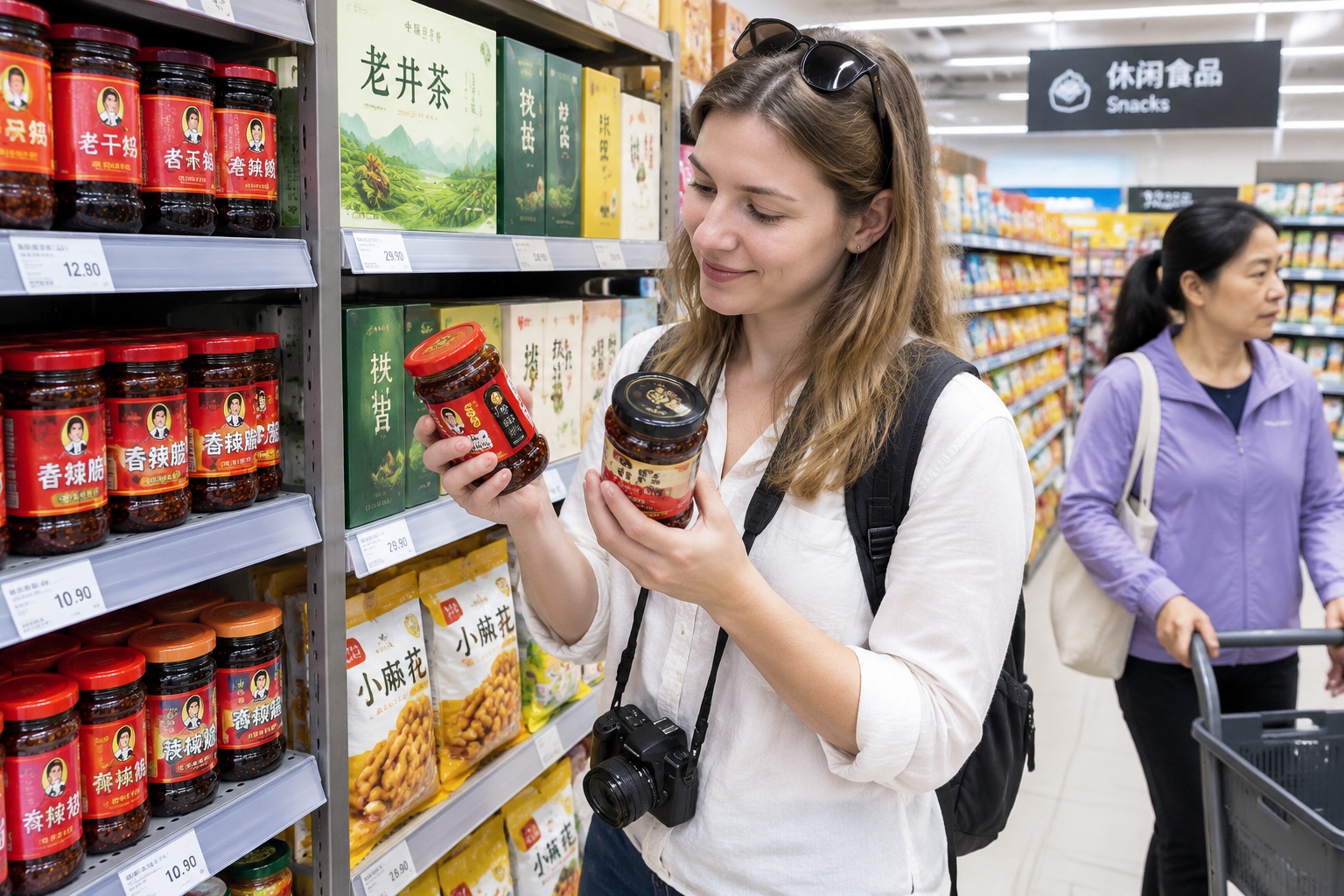
In a Shanghai supermarket, a Canadian couple compares chili crisp brands. One jar is 12 yuan. They buy four, plus packets of instant noodles and a bag of dried mushrooms. The purchases are not exotic to the Chinese shoppers around them. That is the point. A foreign tourist is now buying the same things a Chinese family buys on a Tuesday night.
What Chinese shoppers see
For locals, this is not a national pride parade. It is retail. A young office worker in Shanghai uses a Xiaomi vacuum because it is affordable and the replacement parts are easy to find. Her father likes DJI because the software is stable. A student buys a Pop Mart figure because it is cute, not because it is a symbol of China. When tourists buy the same products, Chinese shoppers mostly see another customer in the queue.
That ordinariness is the real story. Chinese domestic brands have become competitive in categories where foreign brands once set the standard: drones, robot vacuums, smartphones, e-bikes, cosmetics and snacks. Fast product cycles, a huge home market and fierce online competition pushed prices down and features up. A tourist is not discovering a secret. They are walking into a market that Chinese consumers already use every day.
Not every purchase is a triumph
There are limits. A drone bought in China may need a global version for an English app and local warranty service. A robot vacuum may have a Chinese plug and a manual that assumes a Chinese home layout. Some items are not cheaper after the refund, especially imported luxury goods. In tourist markets, counterfeit risk still exists, which is why official stores and receipts matter. The tax refund queue can be slow. The suitcase can become heavier than expected.
Those frictions are part of the picture. The foreign tourist shopping in China is not a cartoon consumer with a fistful of cash. They are comparing prices on a phone, asking about voltage, and wondering whether the drone will clear customs at home. The purchase is practical, not patriotic.
What the suitcase says
Back at Pudong, Lucia repacks. The tea goes in the middle, wrapped in clothes. The chili crisp goes in a plastic bag. The drone stays in its box, with the receipt folded inside. The robot vacuum is already checked in, and she is carrying the tax refund form in her passport holder.
Her suitcase is a small map of a changing travel economy. Tea still travels. Silk still travels. But so does a drone, a vacuum, a blind box and a jar of chili crisp. The question for many visitors is no longer what cheap thing can I buy in China. It is which part of daily life here do I want to take home — and can I fit it in the bag?
Start the discussion at forum.chinacomes.com