
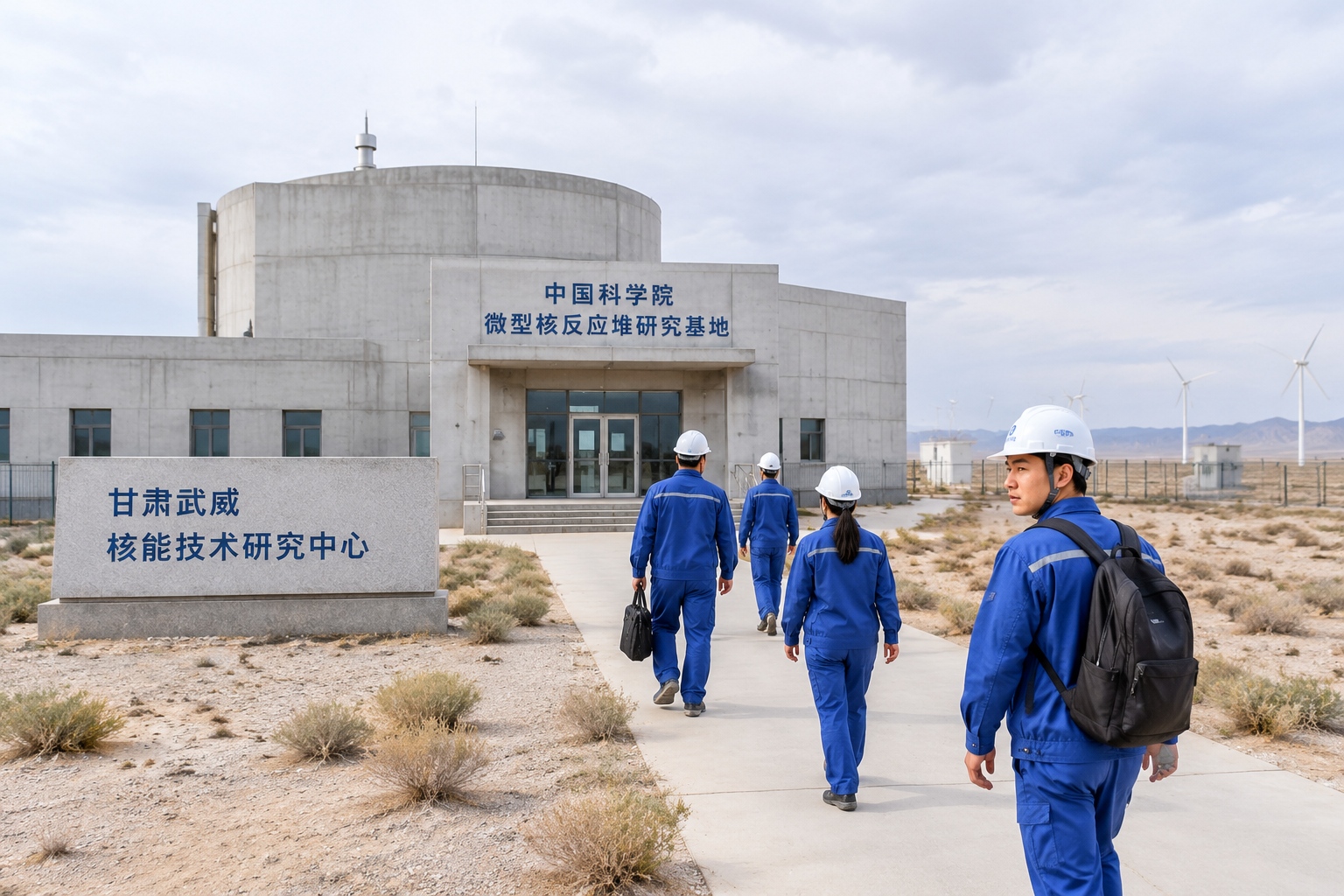

A reactor in the Gobi that runs on hot salt
In the flat, dry country outside Wuwei, in China’s Gansu province, a concrete building sits behind a security fence. It does not look like a power station. There is no giant cooling tower, no turbine hall shaking the ground. Inside, engineers watch a loop of fluoride salt at roughly 650°C. The salt is not just a coolant. The fuel is dissolved in it. When the reactor is running, the liquid itself is the core.
That is the simplest way to picture China’s experimental thorium molten-salt reactor, known as TMSR-LF1. It is a test machine, not a commercial electricity plant. Its significance is that it has moved a peculiar idea out of the lab and into a working facility: a reactor that uses liquid fuel and aims to convert thorium into a fissile material, uranium-233.
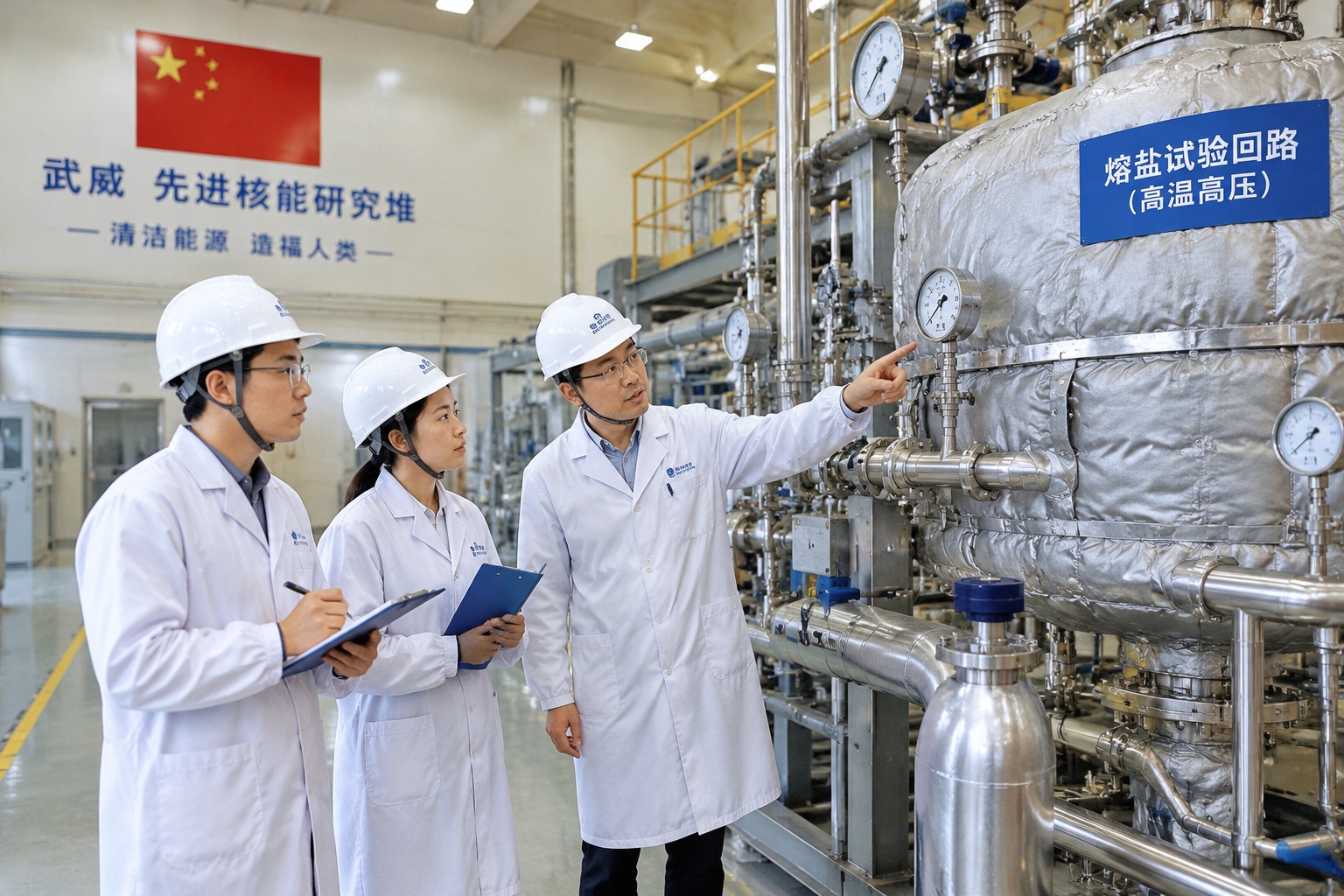
Chinese researchers have reported that the project has reached a key commissioning milestone: thorium-232 in the salt has absorbed neutrons and produced uranium-233. That is what “thorium-to-uranium conversion” means in practice. It is not a new kind of fusion, and it is not a perpetual-motion machine. It is nuclear physics, done in a very difficult chemical environment.
What “thorium-to-uranium conversion” actually means
Thorium-232 is fertile, not fissile. On its own, it cannot sustain a chain reaction. But when it absorbs a neutron, it becomes thorium-233, which quickly decays into protactinium-233, which after about 27 days decays into uranium-233. Uranium-233 is fissile. It can split, release energy, and emit more neutrons. Those neutrons can keep the reaction going and convert more thorium.
In a conventional reactor, this happens in solid fuel rods, mostly with uranium. In a molten-salt reactor, the fuel is mixed into a hot fluoride salt. The salt carries the heat, and the fuel moves with it. That design opens the possibility of continuous processing: cleaning out fission products, separating protactinium, and feeding in more thorium. It also creates hard engineering problems, because the salt is hot, corrosive, and radioactive.
The Chinese experiment uses enriched uranium as a starter fuel. Thorium is the target. The reactor is designed to show whether the thorium-uranium step can be managed in a flowing salt system, not to prove that thorium electricity is cheap today.
A test reactor is not a commercial power plant
The TMSR-LF1 is a 2-megawatt thermal test reactor. That is tiny. A commercial nuclear unit such as China’s Hualong One produces about 1,000 megawatts of electricity. The Wuwei machine is a test bed for materials, chemistry, pumps, instruments, and control systems. It may not send power to the grid. Its job is to make the unknowns visible.
This distinction matters. Nuclear projects move through stages: experimental reactor, demonstration reactor, commercial reactor. Each stage answers different questions. An experiment asks, “Can the physics and chemistry work?” A demonstration asks, “Can it run reliably at a larger scale?” A commercial plant asks, “Can it be built, licensed, and operated at a cost someone will pay?” China’s thorium program has reached the first stage with a working test reactor. It has not reached the third.
The Chinese Academy of Sciences launched its thorium molten-salt program in 2011. The Wuwei project was built in the Gobi as a compact, land-based test. China’s nuclear regulator issued an operating license in 2023, and the reactor has since moved through commissioning. The recent conversion milestone is best read as a laboratory result inside a reactor system: important, but not the same as a commercial fuel cycle.
Why thorium attracts attention
Thorium is more abundant than uranium in the Earth’s crust, and it is often found alongside rare-earth minerals. China’s rare-earth industry produces thorium-bearing residues, which makes the resource question interesting, though not automatically easy. The metal is not “free” just because it is abundant. It has to be separated, purified, handled, and regulated.
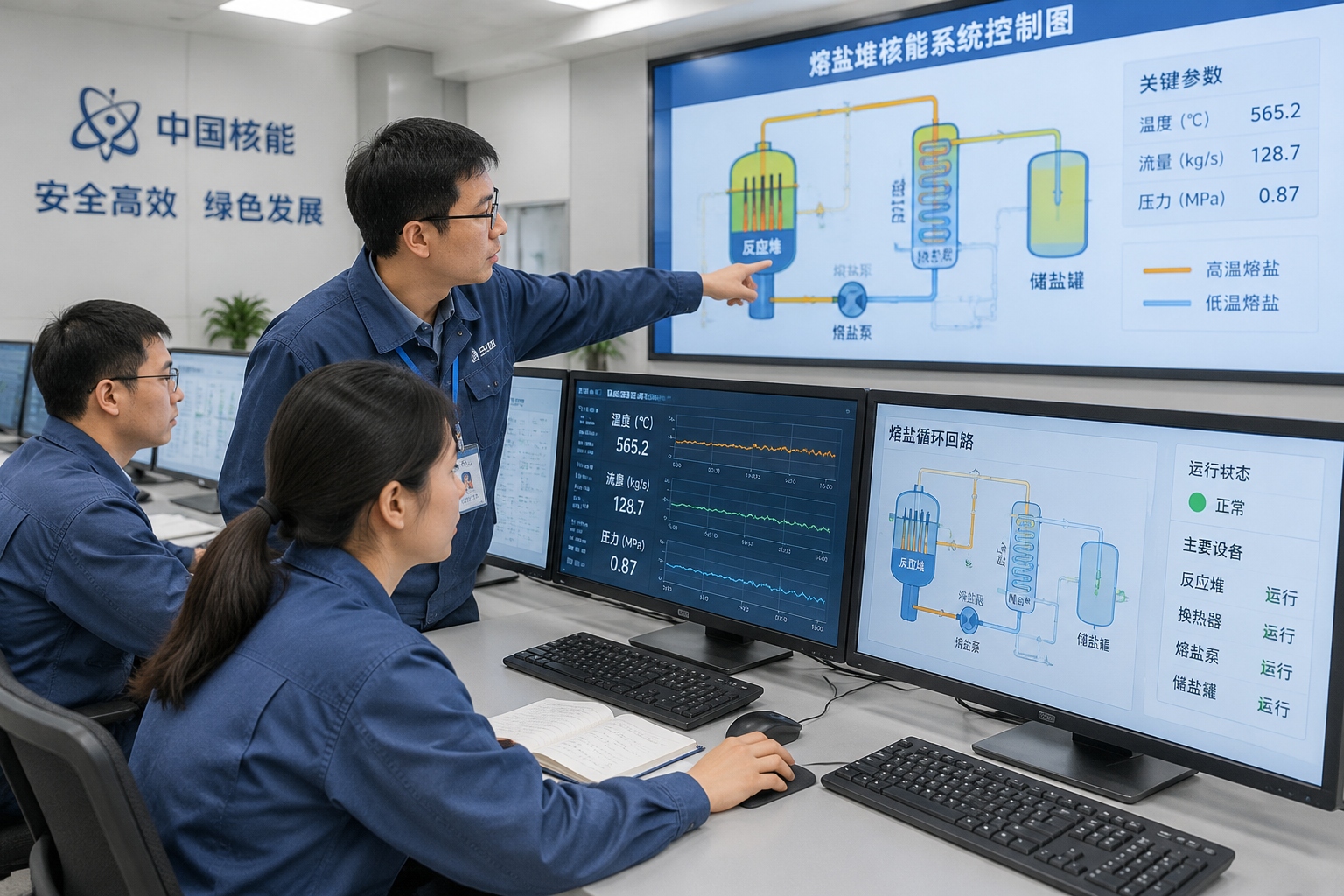
Molten-salt reactors also have safety features that appeal to engineers. The fuel salt operates at low pressure, so the core does not contain the same kind of high-pressure water inventory as a pressurized-water reactor. A freeze plug, a salt plug kept solid by cooling, can drain the fuel into a dump tank if temperatures rise. Passive cooling can remove decay heat. These are useful engineering ideas. They do not make a reactor “meltdown-proof” in everyday language, and they do not remove the need for containment, training, and emergency planning.
On waste, the picture is mixed. A thorium cycle can produce fewer long-lived minor actinides than a once-through uranium cycle, depending on the design and how the fuel is processed. But fission products remain radioactive for centuries, and uranium-233 can be contaminated with uranium-232, which emits hard gamma radiation. That makes handling harder and gives the material a self-protecting feature, but it does not make proliferation concerns disappear.
Uranium-233 is weapons-usable. Any fuel cycle that produces it needs safeguards, accounting, and physical protection. Thorium is not a proliferation-free fuel. It is a different fuel with a different set of safeguards problems.
The hard parts: corrosion, chemistry, and regulation
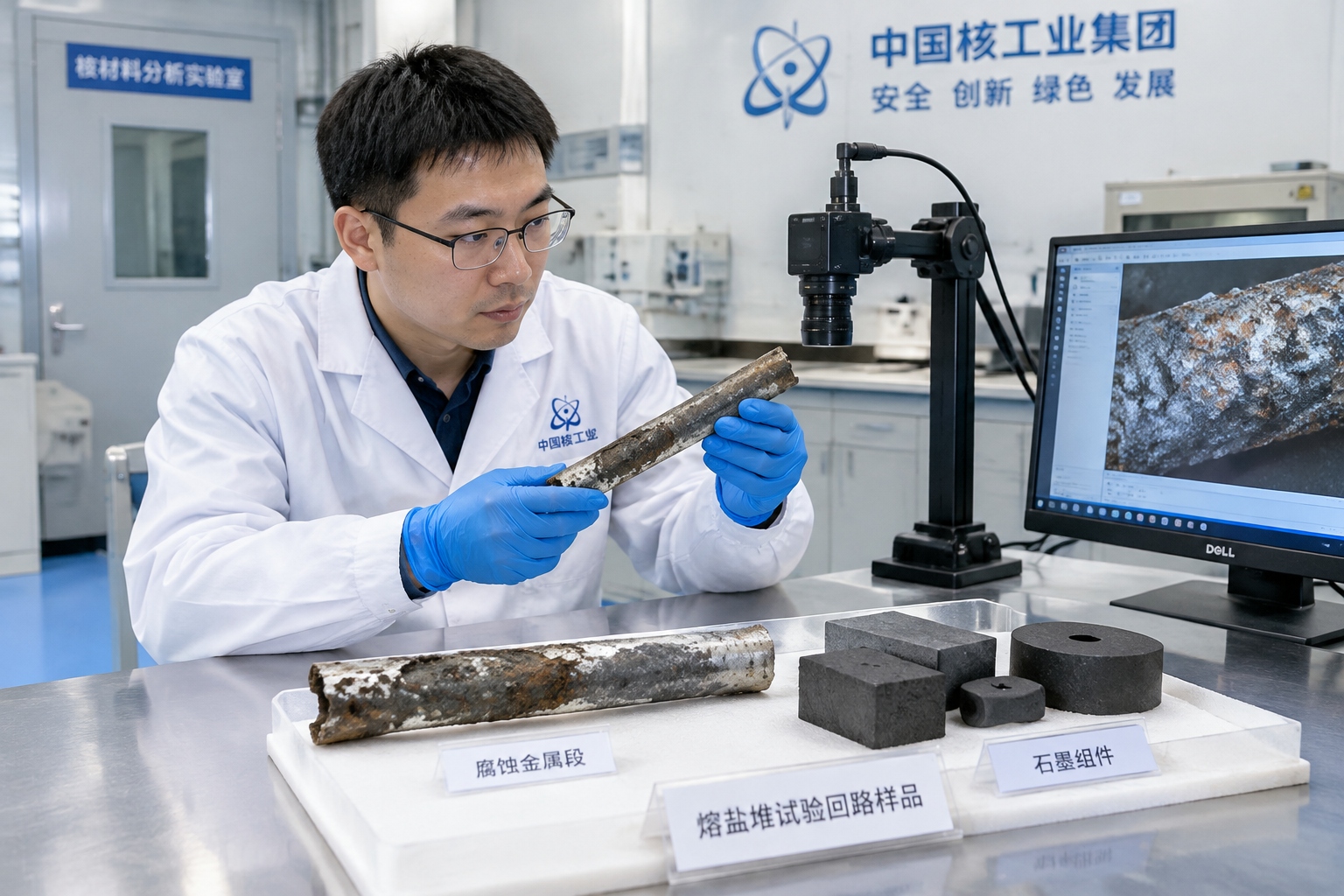
The most demanding problem is materials. Molten fluoride salt at 650°C or higher attacks many metals. Nickel alloys such as Hastelloy-N were developed for molten-salt experiments in the 1960s, but they still need careful control of chemistry. Tellurium can embrittle metal. Graphite components can change over time. Pumps, seals, valves, and sensors must work in a radioactive, high-temperature liquid. Maintenance cannot be done by opening a hatch and reaching in.
Online processing is another challenge. To keep the thorium cycle working, engineers must remove fission products that absorb neutrons and manage protactinium-233. If protactinium is left in the salt, it can absorb neutrons before it decays into uranium-233. Separating it is a radiochemical task, not a simple filter change. The equipment must be remote, reliable, and licensed.
Regulation is a third constraint. Most nuclear rules were written for solid-fuel, water-cooled reactors. A liquid-fuel reactor needs different assumptions about source term, containment, and accident analysis. China’s regulator has had to develop a path for the Wuwei test reactor. Other countries would need to do the same. That takes years, not months.
Cost is the least visible question. No one knows what a commercial thorium molten-salt plant would cost, because none exists. The test reactor can show whether the chemistry is controllable. It cannot show whether the electricity would be cheap. That depends on construction, licensing, fuel processing, and operation at scale.
What the Chinese experiment means for readers outside China
For global nuclear energy, the interesting point is not that China has found a “miracle fuel.” It is that a major nuclear country is spending real money on a second lane of reactor chemistry. Most of the world’s power reactors use solid uranium fuel and water cooling. China itself is building large pressurized-water reactors. The thorium molten-salt project is a side bet, not a replacement.
If the experiment works, it could widen the fuel base for nuclear power and create options for countries with thorium resources. It could also produce knowledge about high-temperature salts, corrosion-resistant alloys, and remote fuel handling. Those lessons may matter even if thorium reactors remain a niche.
The Wuwei reactor is small, and its recent milestone is a step in a long engineering process. That is exactly why it is worth watching. It shows a country willing to fund an unusual nuclear idea through the unglamorous stage: hot salt, brittle metal, paperwork, and years of testing.
Start the discussion at forum.chinacomes.com