


Three city names on a piece of paper
At Zhengzhou Xinzheng International Airport, the first shuttle into town leaves a little after six. Two travelers from Barcelona are waiting for it with backpacks and a sheet of paper. On the paper: Luoyang, Kaifeng, Anyang. Buddhist grottoes, a Song-dynasty capital, oracle bones. Not one of those names would appear on the itinerary their parents might have booked thirty years ago, which would have said Beijing, Xi’an, Shanghai, and then the airport.
The figures behind that sheet of paper are not small. In the first year of China’s 240-hour visa-free transit policy, ports across the country recorded 40.6 million foreign arrivals, 27.2% more than the year before; use of the policy itself jumped 60.8%. By the first half of 2026, visa-free entries made up the clear majority of foreign visitors.
The more interesting number is time. Average stay for visa-free visitors went from 2.1 days in 2019 to 4.7 days. 72% crossed city lines; six in ten crossed provincial ones. Flight bookings from Spain at one point ran eight times higher than the previous year, from Italy four times. Airlines noticed before hoteliers did, adding and restoring capacity to cities that are not called Beijing or Shanghai.
A 2.1-day stay buys a photo of the Great Wall and a meal near the Bund. A 4.7-day stay buys a train ticket.
The fine print that redraws the map
Here is the part that surprises almost every European who reads a headline about the policy and books a flight. The 240 hours are not a ten-day pass to anywhere in China. Each entry port comes with a defined area — often a single province, sometimes a cluster of them — and you are expected to stay inside it.
For readers used to Schengen, this is a different mental model. A Schengen visa does not care which town you sleep in. In China the stamp in your passport draws the map you are allowed to travel on. Enter through Zhengzhou and the permitted area is Henan: more than enough for Luoyang’s caves and Kaifeng’s night market, not enough for a sudden detour to Chengdu.
Travelers who get this wrong do exist. They are usually found at a railway station ticket window being politely told their destination falls outside the region, then re-planning a week over a cup of tea. The rule is not hidden — it is printed on the arrival form — but it rewards a kind of planning that a two-day coach tour never required.
In China, the station is the gateway
The other thing that makes the small-city route possible is less romantic: the train. China’s high-speed network now runs past 45,000 km, and the practical effect for a visitor is that secondary cities stop being remote. Zhengzhou to Luoyang takes about forty minutes. Luoyang to Kaifeng, under ninety. Journeys that would mean a rental car and a motorway toll in Europe are a seat reservation and a passport scan.
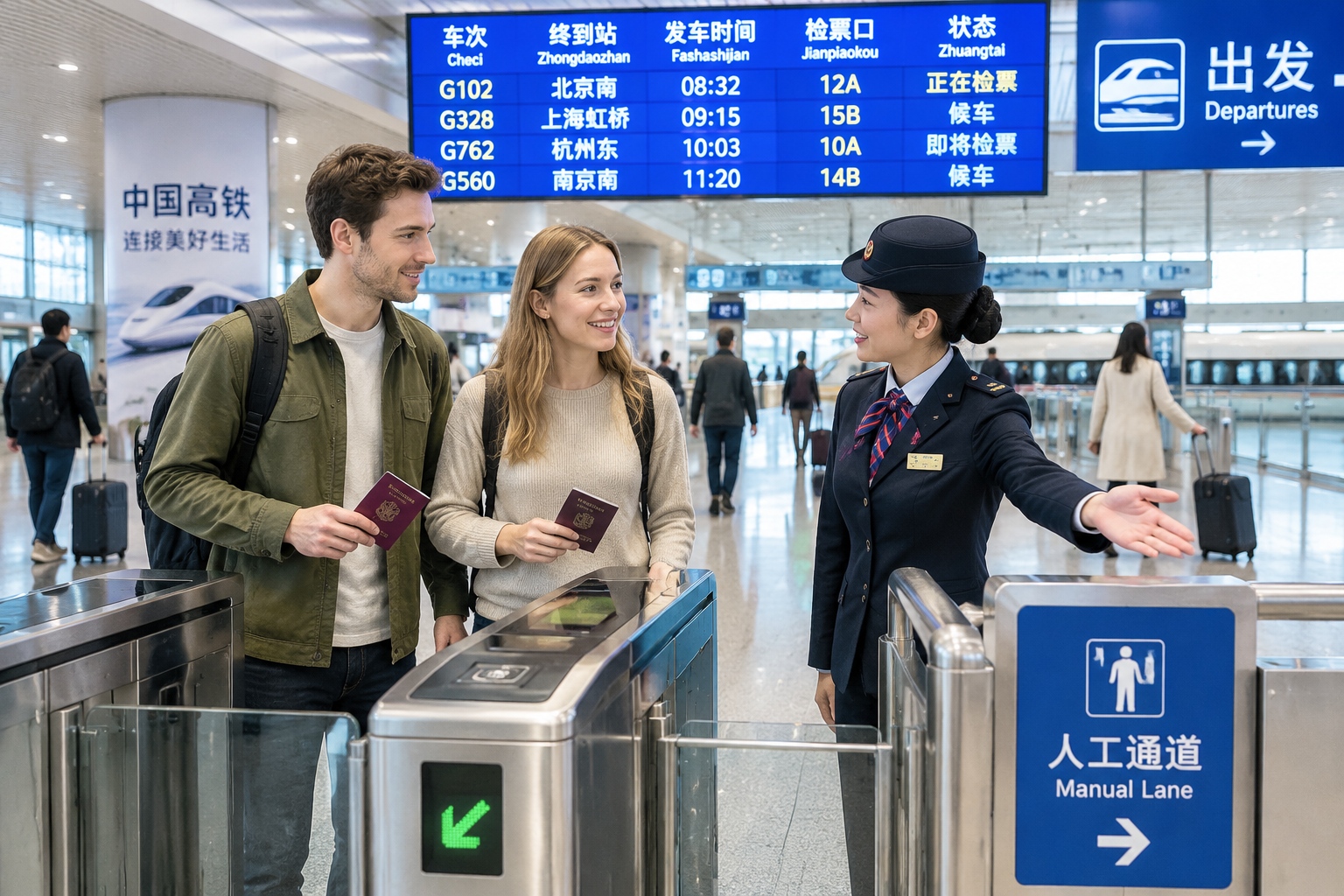
The stations are the culture shock, not the trains. A prefecture-level city of four million people will have a railway station the size of a European international airport, with security screening at the door, four floors of shops, and a departure board in Chinese with pinyin underneath. Announcements come in Mandarin, sometimes in English. Passport scanners at the gate read foreign passports; when one doesn’t, a staff member waves you to the manual lane.
The friction is in the buying. The official 12306 app has an English interface and accepts passport registration, but smaller stations may have only one or two machines that take foreign cards, and they are not always the ones near the entrance. The reliable route is the staffed counter, passport in hand, destination written in Chinese characters on your phone. Allow twenty minutes. Bring the passport you booked with — the ticket is tied to it, and a photo on a screen will not open the gate.
Getting from the station into town varies more. Larger secondary cities have metros with English signage and machines that take cards. Smaller ones have buses you will not decode on the first attempt, and taxi drivers who will not know your hotel’s name in English. Didi, the local ride-hailing app, has an English version and is the single most useful thing on a foreigner’s phone in a Chinese city that isn’t Shanghai.
Six-yuan noodles and a QR code
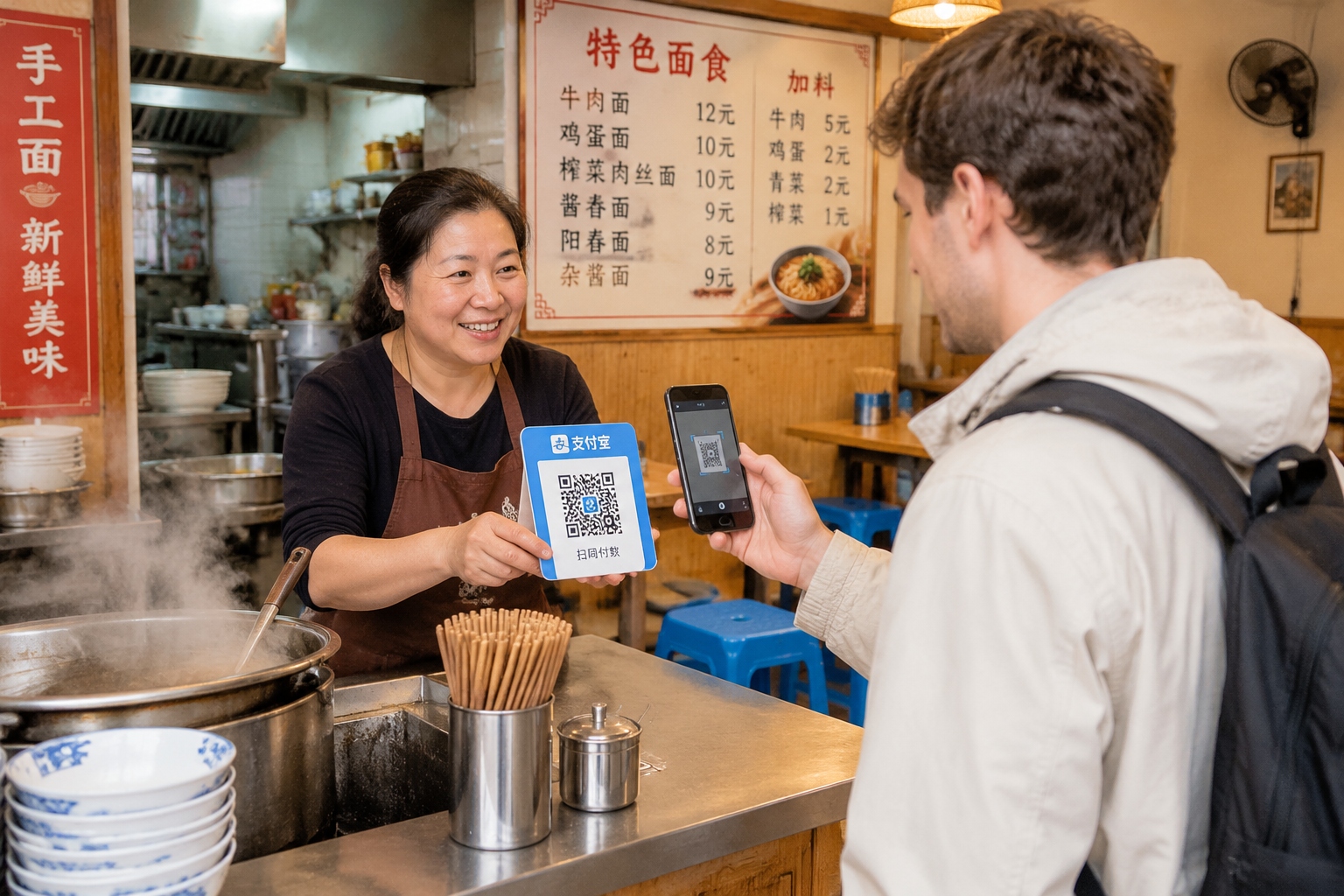
Payment is the topic every European asks about before leaving and stops worrying about by day two. Alipay and WeChat Pay both link to Visa and Mastercard now, and spending caps have been raised to levels no tourist will reach. In a convenience store or a chain restaurant, it simply works.
What trips people up is the small stuff. A noodle shop charging six yuan may be using a personal transfer code rather than a merchant one, and foreign cards sometimes fail on those. The shop has no obligation to accept a card, and is legally required to accept cash, but at seven in the morning it may not have change for a 100-yuan note. The graceful move is to ask, in whatever mixture of gestures works, and to keep twenty yuan in small notes for the first two days.
The second small shock is how far ordering has moved onto the phone. In a mid-range restaurant the menu is a QR code on the table, the order goes into a WeChat mini-program, and the bill arrives the same way. It is fast, it is paperless, and for someone who cannot read the menu it is a wall. Most places will produce a paper menu if you ask, and a waiter will often just tap your order into their own phone instead.
The language wall, and who climbs it
Europeans are used to arriving somewhere and guessing. Italian, Spanish, Portuguese — you can decode a menu, a road sign, a notice on a door. Chinese offers no such footholds, which is why the language gap in a small city feels different in kind rather than degree. Nothing is guessable, so everything depends on another person deciding to help.
That happens more often than guidebooks suggest. The pattern in a shop or a ticket office is usually the same: a blank second, a slightly panicked look, then someone is fetched — a younger colleague, a daughter on the phone, a customer who did a semester in Manchester. Translation apps do the rest, held out at arm’s length like a small animal.
Signage has improved faster than spoken English. Railway stations, airports, metro systems and major sights are bilingual by now. A family restaurant three streets off the main road is not, and does not need to be. A shopkeeper in Kaifeng once drew a map on the back of a receipt rather than explain a bus route, and it was more accurate than the app.
Why skip the capital at all
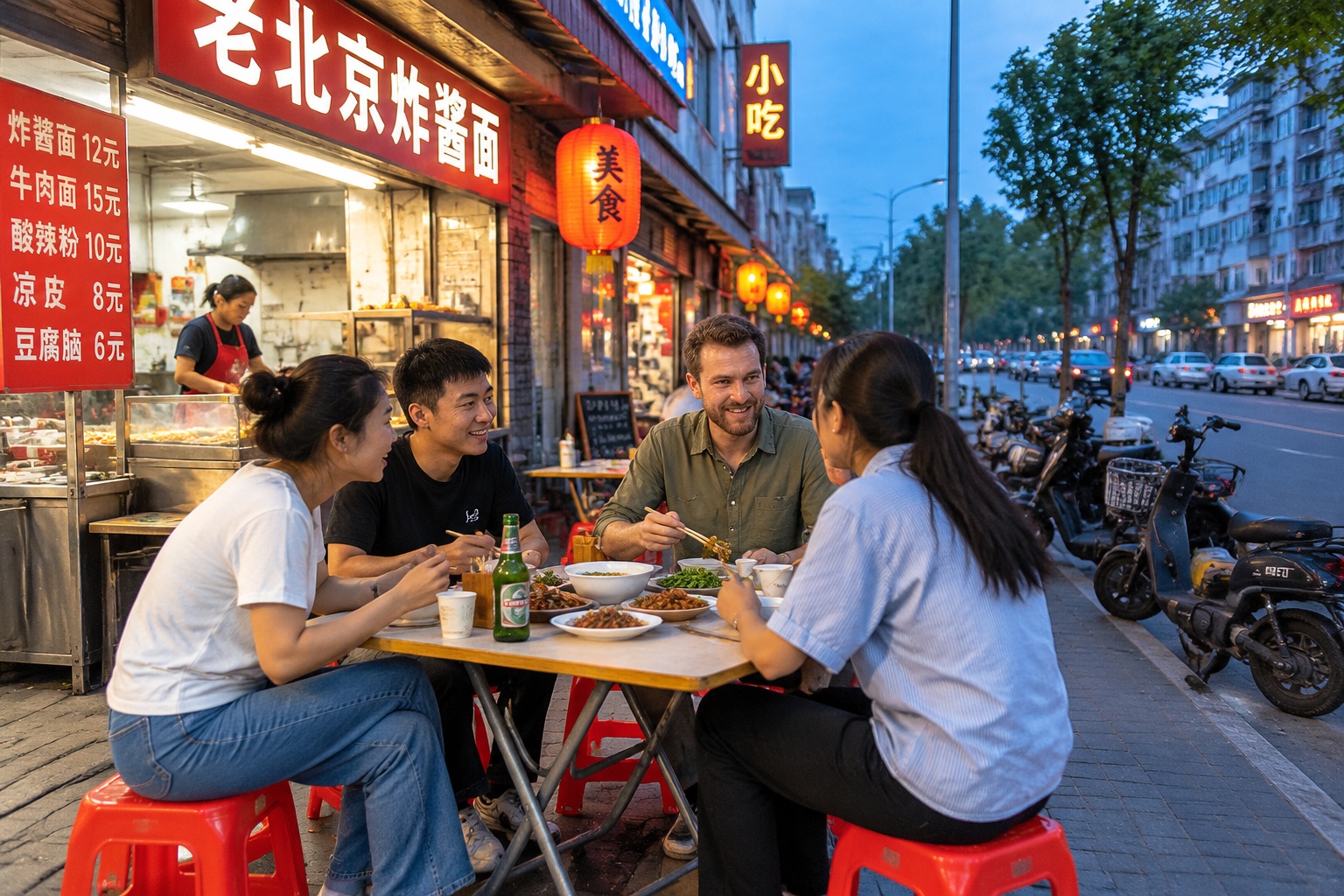
The honest answer is that the reason isn’t exotic. Europeans already do this at home. A German who has seen Berlin three times goes to Leipzig. An Italian who finds Florence unbearable in July goes to Bologna. The logic of the second city — cheaper, quieter, shorter queues, more likely to talk to you — transfers directly.
What China adds is scale and specificity. Jingdezhen in Jiangxi has been making porcelain for a thousand years and now hosts foreign ceramicists on long residencies. Yiwu in Zhejiang is the wholesale market behind a large share of the world’s small goods, and a genuinely strange place to spend two days. Quanzhou in Fujian was a Silk Road port before the phrase existed, and its food is its own argument. For a European traveler, regional cooking is not a niche interest; it is the main reason to leave the capital.

What still doesn’t work
Three frictions are worth naming, because they are the difference between a good trip and a wasted afternoon.
Hotels. Not every hotel in China is licensed to register foreign guests, and the ones that aren’t will decline you at the desk, politely and without much explanation. This is common among cheap business chains in smaller cities. Booking platforms increasingly flag it, and hostels and larger chains are safe. Check before you pay, not at eleven at night.
Reservations. Many attractions, including free ones, now require booking through a WeChat mini-program, sometimes days ahead, sometimes with a mandatory Chinese ID field that has no obvious answer for a passport. Some sites have added foreign-passport channels; others have not. Provincial museums are the usual bottleneck.
Maps. Google Maps is unreliable for anything beyond a rough shape of the city. Amap and Baidu Maps are accurate and mostly Chinese-only, with English modes that come and go. An offline screenshot of your hotel’s name and address in Chinese is worth more than any app.
None of this is a scandal. It is the ordinary tax on going somewhere that has not spent thirty years learning to be visited. The travelers who enjoy it most budget for one thing to go wrong per day, and treat the fixing of it as the actual travel.

The map is being redrawn by a timetable
The tempting story is discovery: Europeans have found a hidden China. The more accurate story is administrative and infrastructural. A visa rule extended the clock, a rail network shrank the distance, and a payment system that used to reject foreign cards stopped rejecting them. Three changes, none of them designed for tourism, and the tourist map moved.
Small cities are responding unevenly. Some now print English menus and stick ‘foreign cards accepted’ on the door. Others have not noticed and may not for years. That unevenness isn’t a flaw in the story; it is the story. A country this size does not modernize at one speed, and a traveler who lands in a city with one international flight a day can see both ends of it in the same afternoon.
The number to watch isn’t arrivals. It’s 4.7 days — the length of stay at which a visitor stops being a spectator and starts taking trains, getting lost, and asking a stranger to draw a map on a receipt.
Start the discussion at forum.chinacomes.com