
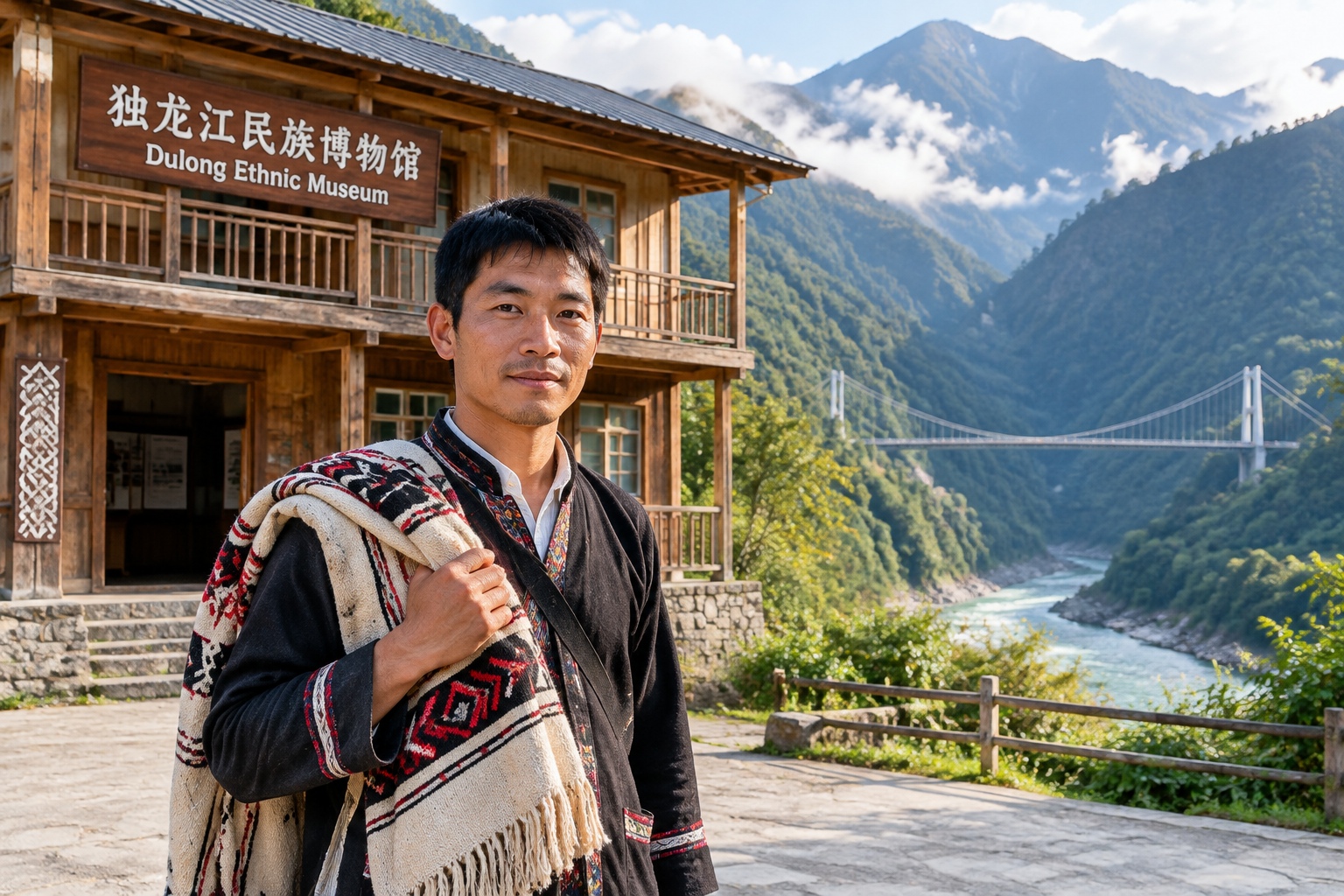

A Crossbow in a Quiet Village
When I first met Meng Wen, he was standing in the dim light of a wooden house in Kongdang village, holding a crossbow that had belonged to his grandfather. The weapon was worn smooth from decades of use, its string broken long ago. ‘When I was a child, everyone had one of these,’ he said. ‘Now, the only place you can see them is here.’
I had come to Dulongjiang Township in Yunnan province, deep in the mountains bordering Myanmar, to see the museum he had helped create — the first museum in this remote valley where the Dulong ethnic group, one of China’s smallest, has lived for centuries.
A Valley Wired to the World
The journey from the nearest city, Gongshan, took us more than three hours on a road that cut through walls of green. Once, the valley was one of the hardest places in China to reach. For years, villagers crossed the swift Dulong River on a single cable, hanging on with both hands as the spray soaked them. When heavy snow closed the mountain passes, the world outside simply vanished. In the 1990s, the first car road to the township was completed, but it was still blocked at least half the year. It wasn’t until 2014, when the Gaoligong Mountain tunnel was opened, that Dulongjiang got a road that stayed open all year. That same year, the township’s last cable-crossing was replaced by a bridge. In 2018, the Dulong people, numbering about 7,000 in this area, shook off absolute poverty — a milestone China’s official media celebrated widely.
Today, the valley has a new primary school, a health center, and even a small post office. Mobile phones work in most of the villages. Motorcycles bounce over paved roads. But the landscape still feels dramatically remote: clouds catch on the peaks, and the river turns a milky green in the rain. For a visitor, it is hard to imagine how people once survived here.

Learning to Read His Own People in Beijing
Meng Wen grew up in those years of isolation. He was among the first generation of Dulong children to attend school all the way through high school before leaving for the city. He studied ethnic minority history and anthropology in Beijing, eventually earning a doctorate. ‘I spent seven years in Beijing,’ he told me. ‘I lived in a modern apartment, walked across wide university campuses, and learned to read about my own people in books. The more I read, the more I understood what my grandmother meant when she said we were losing the old ways.’
It was in a university library, looking at old black-and-white photographs of Dulong people with facial tattoos, that he first thought about starting a museum. ‘These pictures were taken by outsiders — travelers, missionaries, anthropologists,’ he said. ‘There was almost nothing written by us, preserved by us. I wanted to change that.’ The tattoos, once given to women when they reached adolescence, were banned in the 1960s and are now a fading memory. No young woman has been tattooed in decades. Many other traditional practices — from hunting techniques to the annual festival of the “Strong Man” — are losing their context, even as younger Dulong people embrace smartphones and digital life.
The Museum Begins with Two Hundred Objects
After finishing his doctorate, instead of taking a job in Beijing, he moved back to Dulongjiang. ‘My supervisor thought I was making a mistake,’ he said, laughing. ‘He asked whether there was even enough for a museum in one small valley.’ But for Meng Wen, the decision felt like a natural step. He spent a year walking from village to village, visiting elderly residents, asking if they had any old objects they no longer needed.
‘I collected more than two hundred items,’ he said. ‘A broken loom, a leather vest made from a mountain goat, bamboo baskets woven in patterns I hadn’t seen since childhood, and even a pair of earrings made from silver and red coral that my grandmother wore at her wedding.’ He also recorded short videos of elders speaking in the Dulong language, storing them on a hard drive as a first step toward an oral history archive.
Not everyone was eager to part with their belongings at first. Jiang Aci, a woman in her seventies, hesitated for weeks before handing over a beautifully embroidered sash. ‘She said it was the only thing her mother left her,’ Meng said. ‘But eventually she said, “If the museum is for our grandchildren, I can let it go.” That is how we built trust — by explaining that the museum would keep their memories safe for the next generation.’ The village government cleared the use of a two-story wooden building next to the public square, and a local carpenter helped build simple glass cases from recycled wood. The museum opened in 2022, with no formal ceremony — just a small gathering of neighbors.
A Living Room for the Future
The museum itself is modest. On the first floor, a row of glass cases displays hunting tools, farming equipment, and cooking utensils. On the second floor, woven wool blankets in bright stripes known as Dulong carpets are draped on the walls, their colors as vivid as the surrounding landscape. A black-and-white photo of a tattooed woman hangs near a small sign describing the now-outlawed practice.
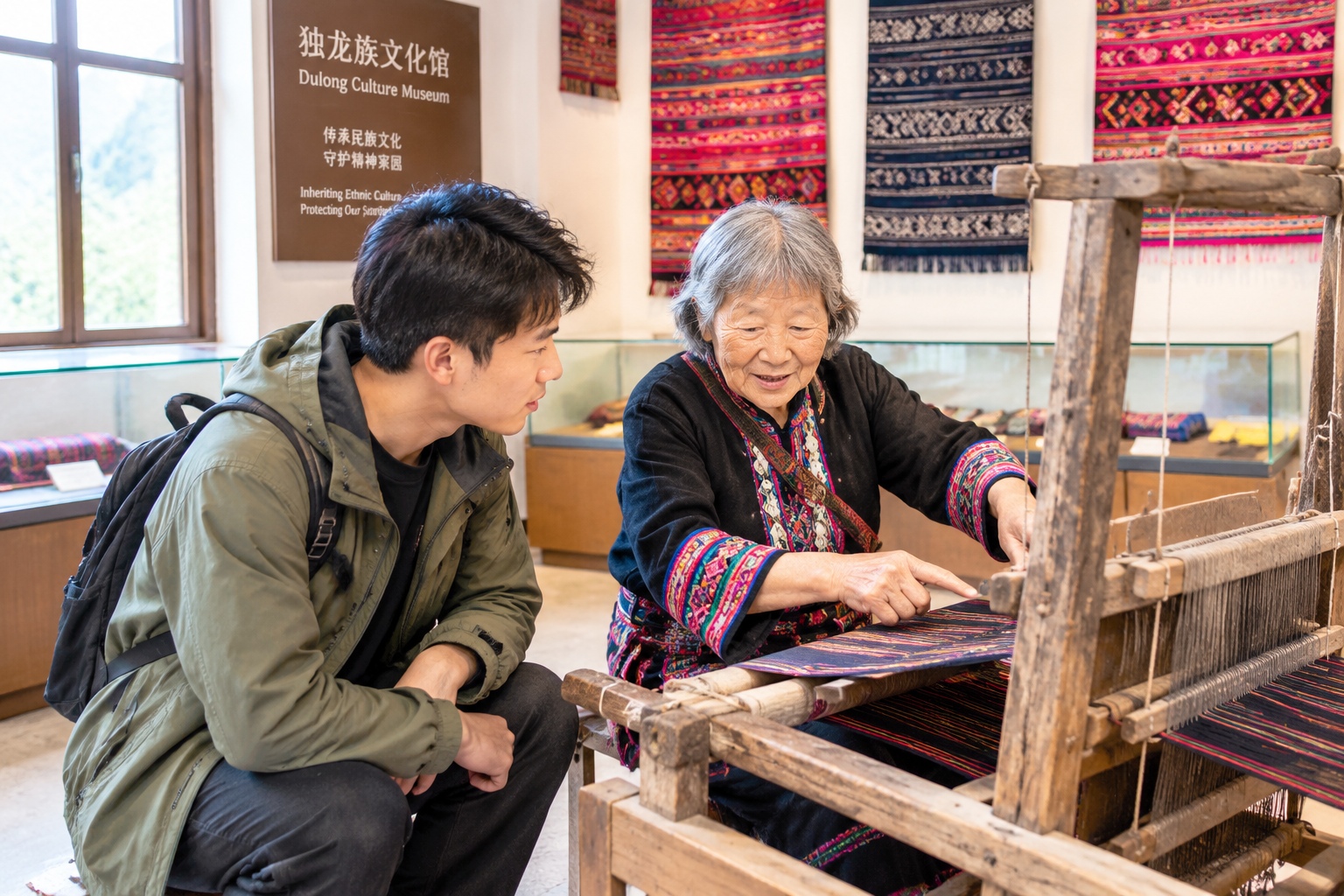
So far, the museum draws only a small number of tourists — the valley remains off-limits for foreign visitors without a special permit, and even domestic tourism is limited by the area’s carrying capacity. But its role in the village is far bigger than tourism. Local children come after school to look at the displays. Village women sometimes gather on the ground floor to weave together, their looms borrowed from the collection. ‘It’s not a temple for the past,’ Meng Wen said. ‘I want it to be a living room for the future.’
He now works at a cultural research center in Gongshan, visiting home whenever he can. He dreams of training young Dulong researchers, recording oral histories, and digitizing everything. But he’s also honest about the challenges: many young people have left for cities, and work in the fields and in tourism often pays better than studying old crafts. ‘You can’t preserve a culture by freezing it,’ he said. ‘You have to live with it, argue with it, make it relevant.’
The Road Home Is a Step Forward
In many ways, his journey reflects China’s broader story of rapid change and the quiet struggle to hold on to what matters. The Dulong River Valley is no longer isolated — mobile phones and motorcycles are common, and a new hospital and school have changed daily life. But the price of connectivity is that the old world recedes faster than anyone can document. Meng Wen’s museum is a small, local answer to that loss. It’s not a grand project, and it doesn’t pretend to have solved everything. It simply makes sure that when a child in Dulongjiang learns to read, they might also learn to listen to the story of the crossbow on the wall.
I asked Meng Wen what he would say to other young people from rural China who are thinking about going home. He thought for a moment, then smiled. ‘The road home is not a path backward,’ he said. ‘It’s the first step toward understanding where your future can begin.’
He had placed the crossbow back on its hook, carefully, as if setting a sleeping child into a bed. Outside, the afternoon sun broke through the valley mist, and for a moment the whole village looked like a place where time had become a circle rather than a line.
Start the discussion at forum.chinacomes.com