
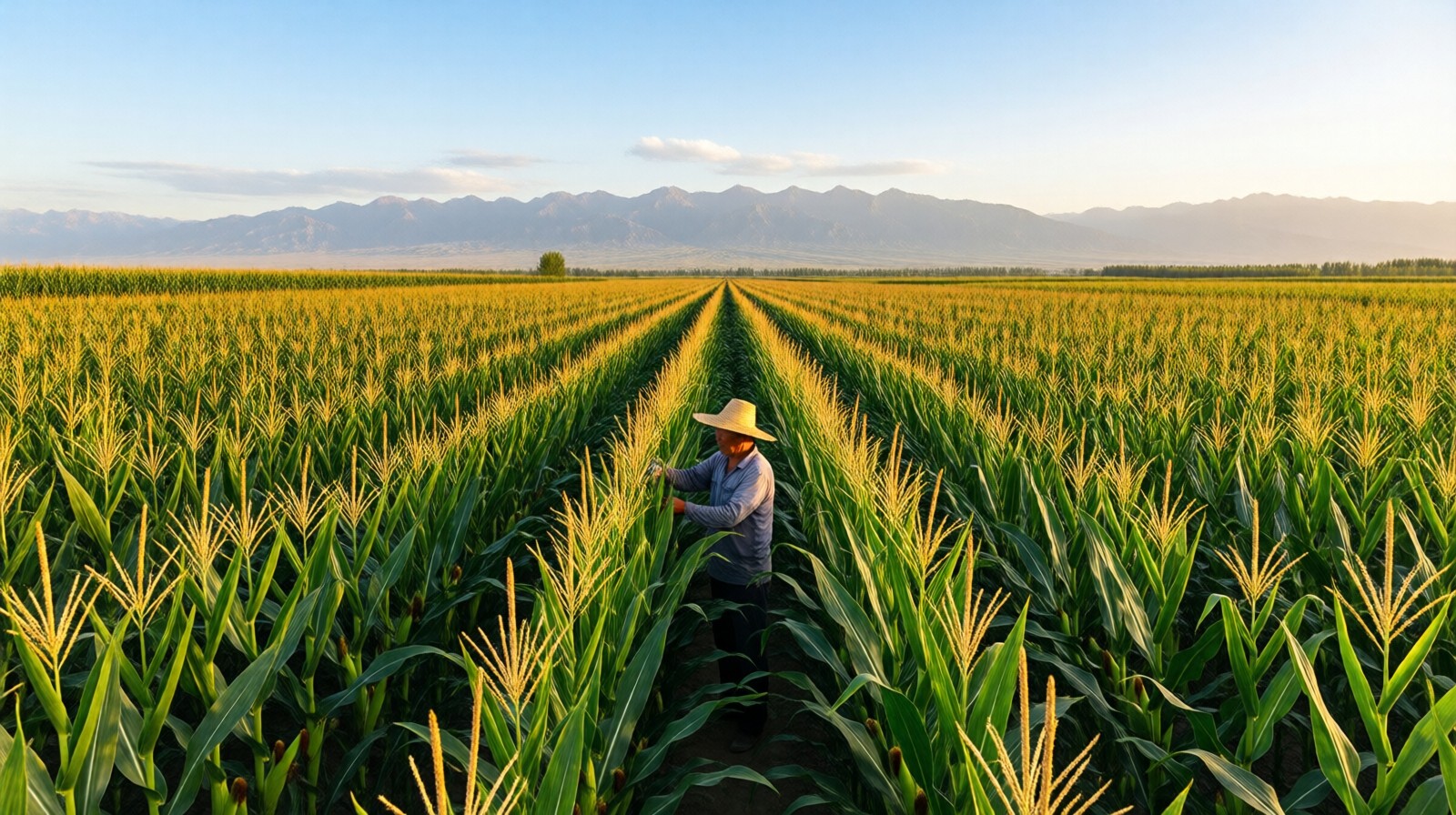

A Seed Field in Zhangye
On a late September morning, Zhang Wei bends over a row of waist-high corn plants in a field outside Zhangye, a city in northwest China’s Gansu province. He peels back a husk, checks the kernels, and nods. The crop is ready to be harvested—but these ears will not go to market as food. They will be dried, threshed, and sent to seed companies across China to plant next year’s cornfields.
Zhang Wei grows corn for seed, a specialized form of agriculture that turns the city’s flat, irrigated valley into one of the most important pieces of farmland in the country. The numbers are striking: about half of all hybrid corn seeds used in China come from Gansu, and more than a third of the national total comes from this small area around Zhangye.
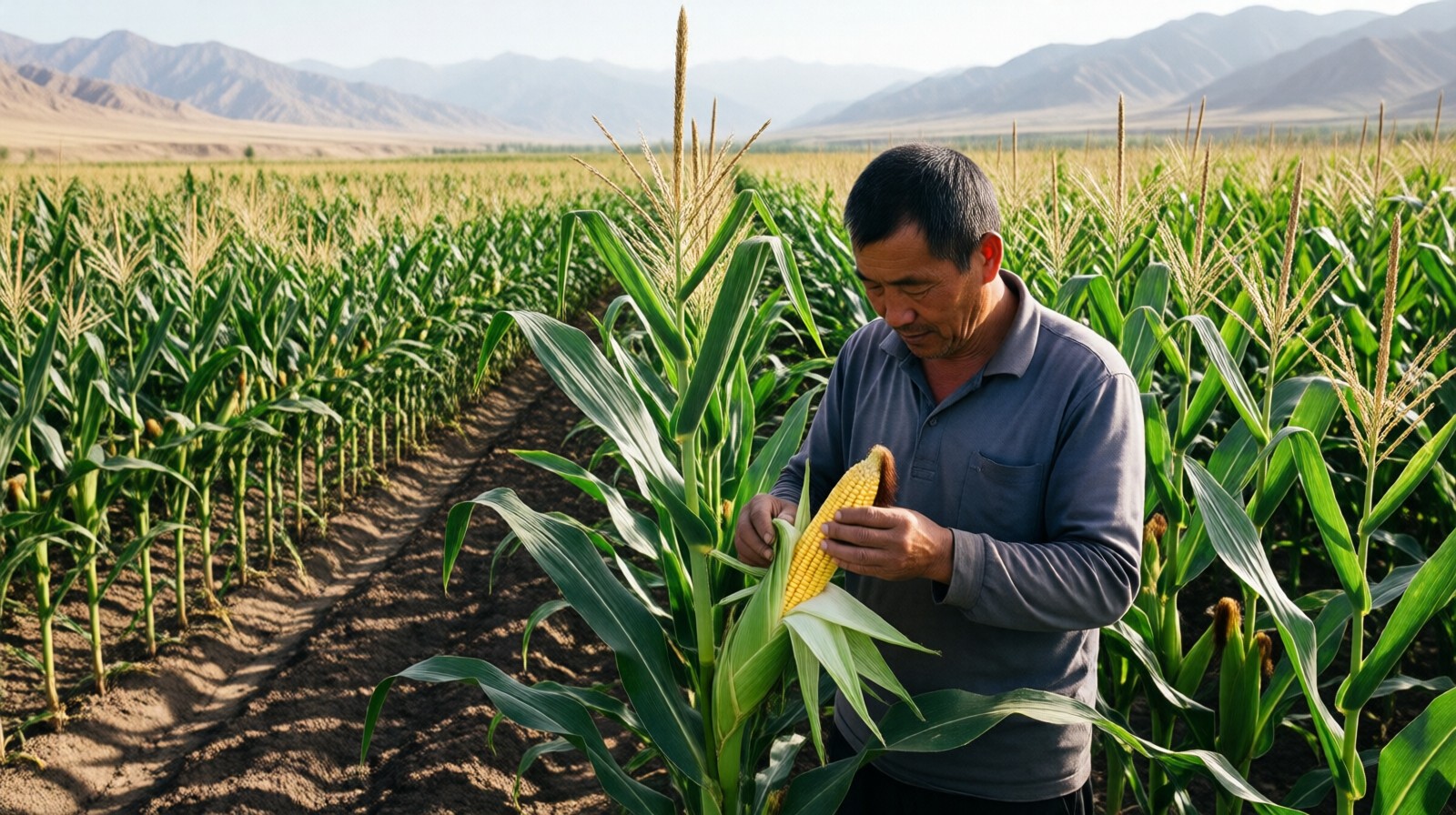
Why Gansu Wins the Seed Race
Seed production is not the same as ordinary grain farming. It demands precise control: fields must be isolated from other corn to prevent pollen contamination, irrigation must follow strict schedules, and weather conditions have to be just right. Gansu offers all of that in one package.
Located on the Silk Road corridor, the Hexi Corridor between the Qilian Mountains and the Gobi Desert has a dry climate, abundant sunlight, and a clear temperature difference between day and night. Rain is scarce, which is unusual for agriculture—but for seed growers, it is a blessing. Dry conditions reduce the risk of diseases and allow farmers to control water use entirely through irrigation. The Qilian Mountains provide meltwater that has been channeled into a network of canals for centuries.
This natural isolation makes Gansu ideal for producing hybrid seeds, whose genetic purity is essential. In spring, farmers plant male and female parent rows, and when the time comes, they pollinate the female plants by hand or with mechanical drives. The result is a high-quality seed that ends up in bags sold across China.
Decoding Corn Seed Production
For most outsiders, the phrase “corn seed” sounds like simply dried kernels. But hybrid corn seed is a manufactured product, the result of carefully crossing two inbred parent lines. Farmers plant female plants that are sterilized, so they will only produce seeds carrying the desired hybrid vigor. During the summer, workers move through the fields removing the tassels from the female plants—a job that must be done quickly and accurately.
In Gansu, this has become a village-level industry. Every spring, hundreds of thousands of seasonal workers are hired to plant, detassel, and harvest. The work is labor-intensive but well compensated. For many rural families, seed production pays two to three times more than growing ordinary corn or wheat.
Local governments and seed companies have invested heavily in mechanization over the past decade. In the fields around Zhangye, you can now see automatic planters that lay rows with precision, and modified machines that strip the tassels in a controlled way. Still, the final quality check depends on human eyes.
Half of China’s Corn Seeds, and Counting
The scale of Gansu’s seed industry is hard to overstate. In 2023, the province had roughly 1.6 million mu (about 107,000 hectares) of corn seed production fields, yielding around 700 million kilograms of seed. That accounts for more than half of China’s total corn seed demand, enough to plant over 5 million hectares of farmland.
Large Chinese seed companies, including Yuan Longping High-Tech Agriculture, and international players like Pioneer, have established seed processing plants in Gansu, drawn by the region’s reliability and infrastructure. Zhangye’s airport and railway connections allow seeds to be shipped to central China’s farming provinces within days.
The economic impact is visible in the towns and villages. New houses, paved roads, and clean schools have appeared over the last twenty years, largely funded by the seed trade. But the industry also creates pressure: land rents have risen, and farmers worry about water scarcity in a region already under climate stress.
Where Science Meets the Soil
Seed production is not just about growing; it is also about innovation. In Gansu, a growing number of research institutes and private companies are working on new corn varieties that can withstand drought, resist pests, and grow in different climates across China. The province’s seed labs are part of China’s broader effort to secure food supplies through better genetics.
One example is the Hexi Corn Seed Research Institute, which collaborates with universities in Beijing and Lanzhou. Scientists use molecular markers to select plants with desirable traits, cutting down the time needed to develop a new variety from a decade to half of that.
But the real strength of Gansu is the bridge between science and ordinary farmers. Extension agents walk the fields alongside peasants like Zhang Wei, teaching them how to adjust planting densities, manage soil fertility, and time irrigation. This combined approach—labor, land, and research—keeps the seed quality consistent.
Challenges and a Fragile Dependence
No industry is without problems. Gansu’s seed production relies heavily on water from the Qilian Mountains, but climate change is reducing the glacier reserves, and a growing population upstream is increasing demand. Over-extraction of groundwater has caused some farmland to subside in parts of the Hexi Corridor.
There is also a strategic concern. Because so much of China’s corn seed comes from a single province, any severe drought or plant disease in Gansu would have a ripple effect nationwide. The central government has begun building backup seed bases in other provinces, such as Xinjiang and Inner Mongolia, to reduce this dependence.
Still, for the foreseeable future, Gansu remains the undisputed center. Its combination of dry climate, flat land, and centuries of irrigation experience cannot be easily replicated. The seeds from Zhang Wei’s field will travel far and wide, quietly carrying the genes of China’s harvest.
Start the discussion at forum.chinacomes.com