
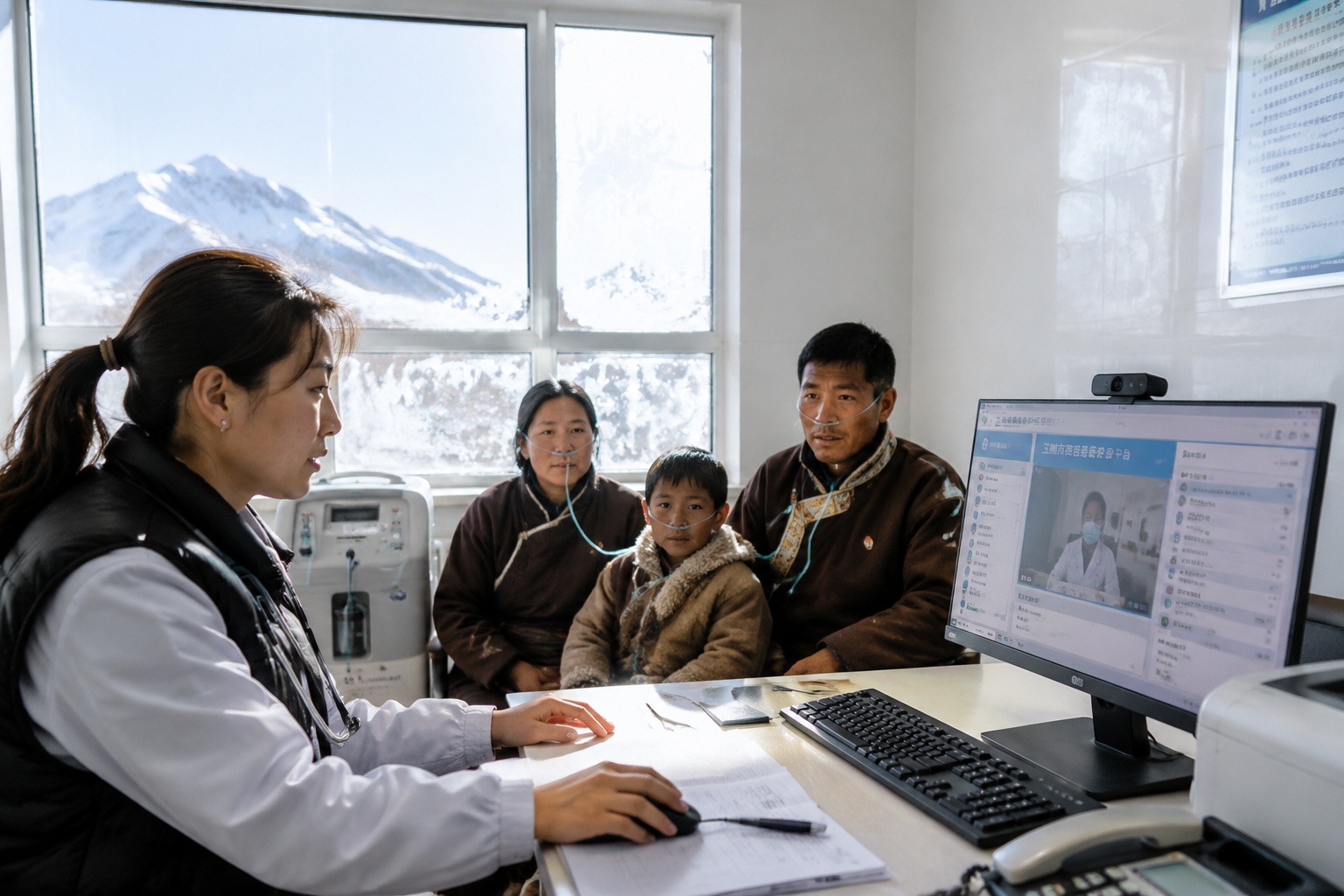

Morning in a High-Altitude Clinic
At 7 a.m. in Yushu, on the eastern edge of the Tibetan Plateau, Dr. Dorje pulls on a heavy jacket and steps outside. The sky is the color of pale steel, and the air is so thin that even a short walk to the hospital leaves her breathing a little faster. At 4,000 meters, altitude is not a number on a map; it is a daily weight on the chest.
The outpatient building is filled with people who share that weight. It is still cold, the heating barely keeping the rooms above 10 degrees Celsius. Inside the examination room, Dr. Dorje turns on a monitor and checks the telemedicine schedule. By 8:30, she will connect to a cardiologist in Beijing to review an ultrasound image taken the previous afternoon.
When Sickness Meant a Long and Dangerous Road
Until a few years ago, this kind of consultation was almost impossible. Yushu is a prefecture of grasslands and steep valleys, roughly 267,000 square kilometers, with about 400,000 people scattered across it. Many herders live far from the few county hospitals. In winter, a blizzard can block the only paved road for days.
Tsering, a 58-year-old herder who now lives near Qinghai Lake, remembers the old days clearly. “My father died of a heart attack when I was 12,” he said, sitting in a mobile clinic tent. “The nearest doctor was three hours away by motorbike. By the time he arrived, it was too late.”
Stories like Tsering’s shaped the image of plateau healthcare as a slot-machine gamble: you might survive, or you might not, and distance played a cruel part in the odds.
Oxygen-Rich Rooms and a Screen That Connects the World
That reality has been slowly giving way. The new Yushu Health Center, opened in 2021, has examination rooms equipped with oxygen concentrators, so patients with chronic obstructive pulmonary disease or altitude-related heart strain can breathe more easily while waiting for treatment. There is a dedicated imaging room with a CT scanner, a device that would have seemed impossible in this remote town a decade ago.
The most important piece of technology, however, is not the scanner itself. It is the network that connects it to specialists thousands of kilometers away. A 5G link, installed by China’s major telecom providers, carries high-resolution images and live video consultations from the plateau to hospitals in Xining, Chengdu, and Beijing.
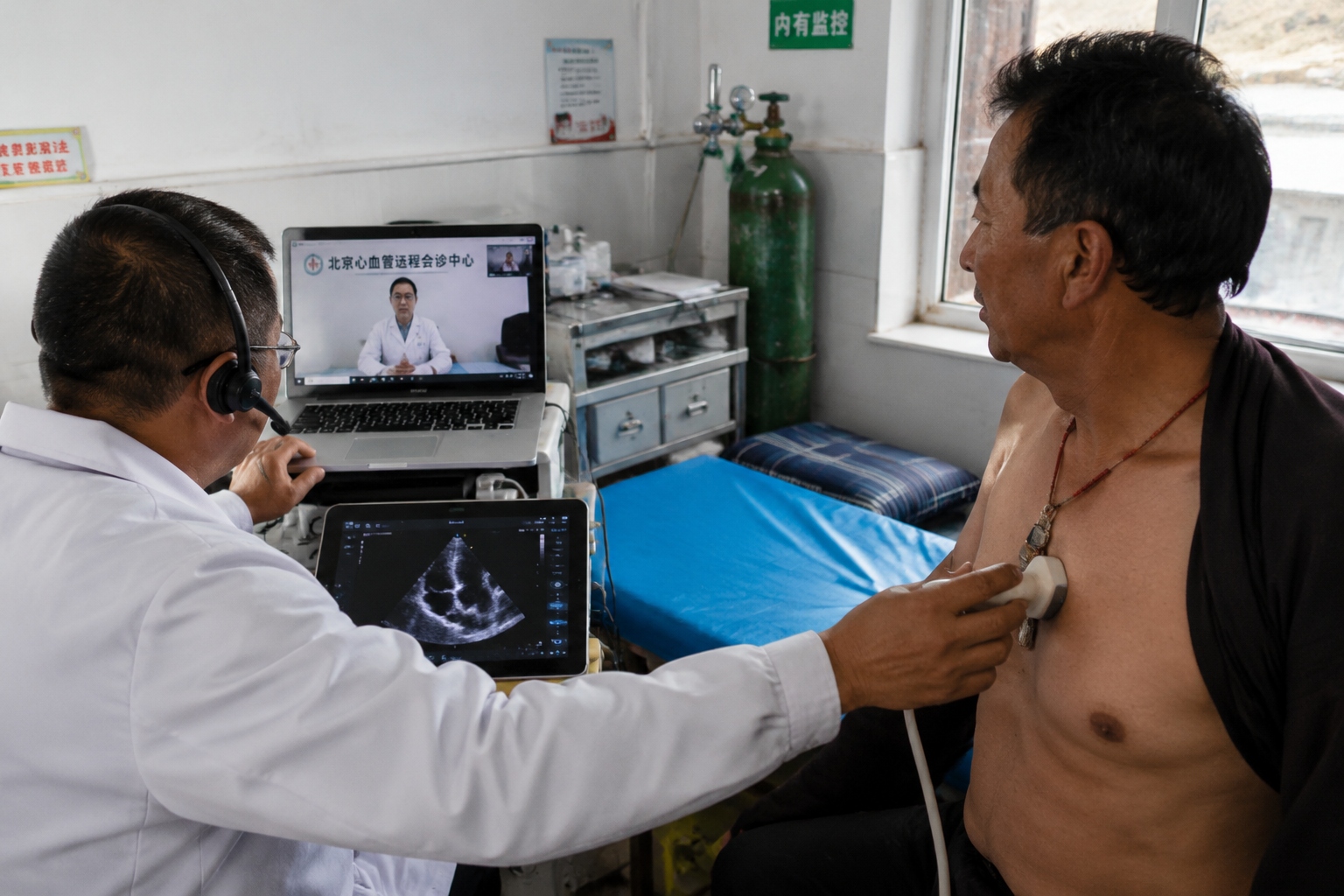
Dr. Dorje showed me how it works. A young herder was presenting with chest pain. The local technician had already performed an echocardiogram using a portable device. The images, about 8GB of data, were sent through the 5G network to a cardiologist at Fuwai Hospital in Beijing. Within 20 minutes, the specialist had reviewed the results, given a diagnosis of ventricular hypertrophy, and suggested a transfer to a lower-altitude hospital for surgical evaluation.
“Five years ago, this man would have had to drive seven hours to see any doctor, and hope that the clinic had the right equipment,” Dr. Dorje said. “Now he got a top-level opinion in less than half an hour. That is the new normal.”
Mobile Clinics and Drones: Care That Moves With the Herds
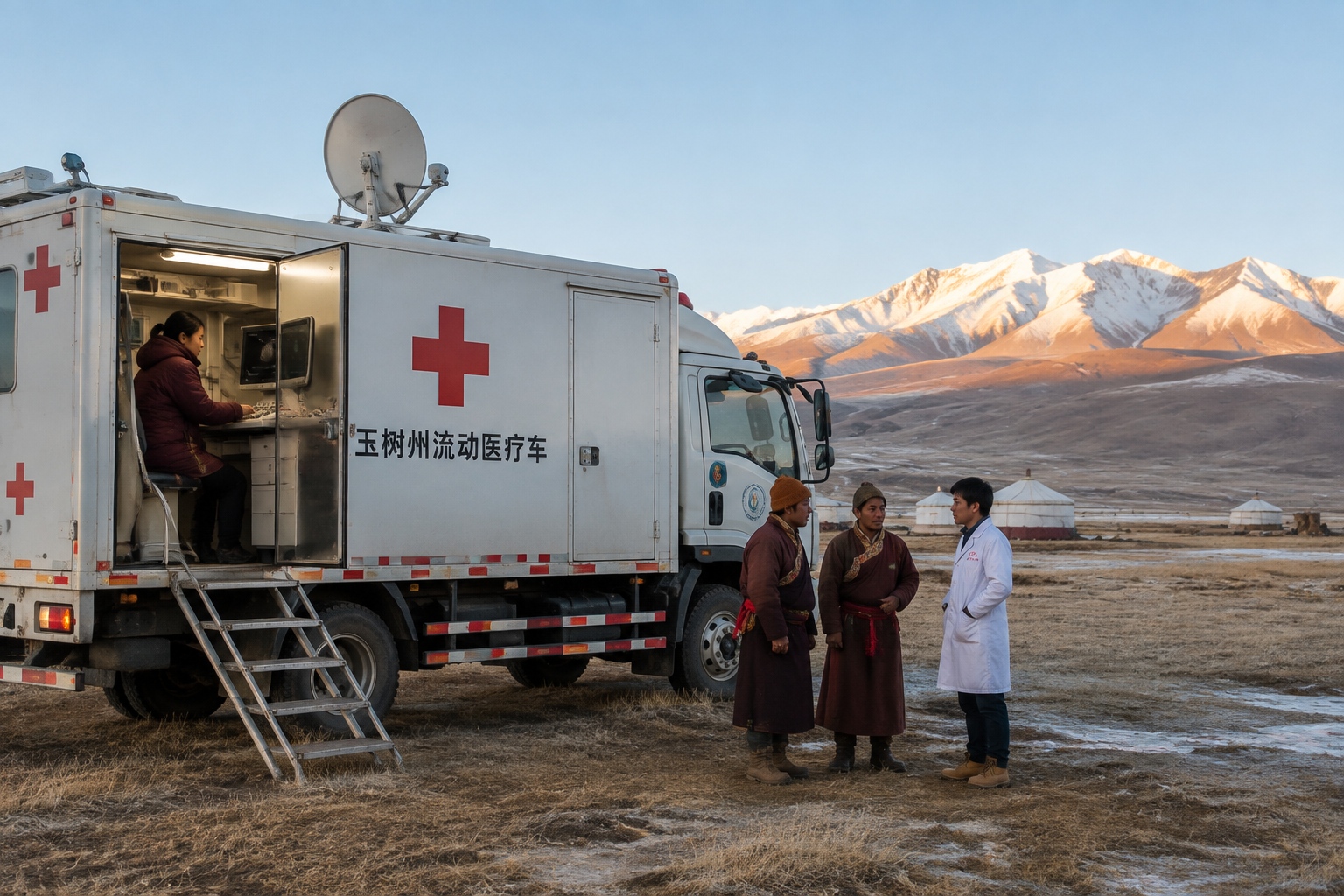
Technology has also made routine care more mobile. The Yushu health bureau runs a fleet of mobile medical trucks, each equipped with an ultrasound machine, a portable ECG, a blood chemistry analyzer, and a satellite uplink for telemedicine. These trucks follow a schedule across the grasslands, stopping at villages and seasonal herding camps.
On one such visit, I watched a nurse set up a portable vaccine fridge at the edge of a summer pasture. Children lined up for shots; their parents had walked from tents up to four kilometers away. This is part of a national push to ensure routine immunization coverage at the county level, even in remote habitations.
Drones have also found a role, not as gadgets but as transport of last resort. In 2023, a 15-kilogram package of insulin and antihypertensive drugs was delivered by drone from Yushu City to a clinic in a pastoral village, a route that takes 25 minutes by air and three hours by rough road. The program has since expanded to 12 villages, funded by a provincial health innovation budget.
These tools do not replace human hands. They extend them.
Local Doctors Who Know the High Grasslands
The most critical change, though, is not equipment. It is people. Yushu has been training a new generation of village doctors and community health workers who speak Khampa Tibetan and understand the herding lifestyle. Many are themselves children of herders.
Dorje, 29, grew up in a tent about 100 kilometers from Yushu City. After medical school in Xining, she returned to work at a township clinic. “I know what it is like to watch a relative carried down a mountain because of altitude sickness,” she said. “My own brother survived only because a mobile clinic reached our pasture when he was eight. That is why I came back.”
A national program, the Rural General Practitioner Training Initiative, provides subsidies for medical students from ethnic minority regions to study as full-time general practitioners. Over the past five years, Yushu has seen 130 students graduate and return, doubling the number of formally trained doctors in the prefecture’s primary care network.
“We still need specialists,” Dr. Dorje said, “but the foundation is becoming solid. A herder with pneumonia can now expect to see a competent doctor within a hour’s drive almost anywhere in Qumarleb county.”
New Births, New Hope
Maternal and child health is another area where the plateau has seen dramatic change. In 2010, the maternal mortality rate in Yushu was 151 per 100,000 live births, more than three times the national average. By 2022, that rate had fallen to 41, according to the prefectural health commission. The improvement comes from a combination of free prenatal checkups, a network of oxygen-equipped birthing centers, and a government-funded helicopter transfer system for high-risk pregnancies.
I met a young mother named Tashi who gave birth to a healthy son at a township health center. She had traveled 60 kilometers from her pasture for the delivery, a trip she made by pickup truck with her husband. “My mother gave birth outside, with only an older woman from the village to help,” she said. “I wanted a clean room. I wanted oxygen. I wanted a doctor who had seen a delivery before.”
Her son cried in her arms, his cheeks the same pink as the sky at sunrise. In this land of thin air, new life has finally found warmer hands.
The List of Challenges Remains Long
None of this means the plateau is suddenly easy. Specialist care is still scarce; for cancer treatment or complex surgery, patients must travel to Xining or beyond. The winter months still challenge logistics, and severe weather can ground even drones. Cultural barriers and language differences persist, especially for nomadic families who stay deep in the grasslands for months at a time.
Yet the direction is unmistakable. Three decades ago, the average life expectancy in Yushu was 60 years. Today, it is 73. The high-altitude health system is far from perfect, but it has stepped away from the old reliance on luck and distance.
As the sun set over the snow-capped peaks, Dr. Dorje closed her clinic for the day. She checked her phone one more time, confirming that the next morning’s telemedicine appointment with the Beijing cardiologist was still booked. “We are not invisible anymore,” she said, wrapping a scarf around her face against the cold wind. “This is the new normal up here.”
Start the discussion at forum.chinacomes.com