

A Match at Dusk
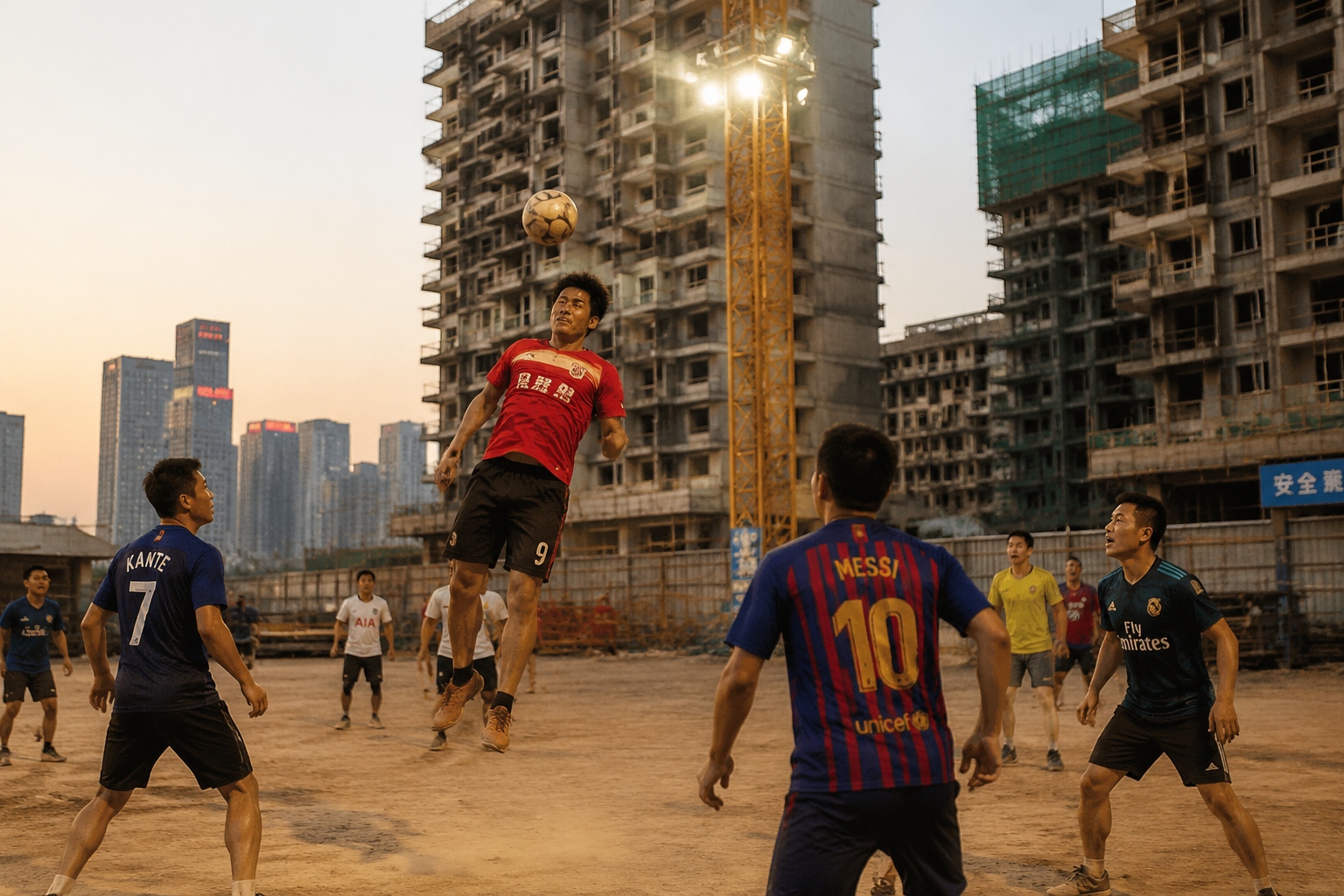
The whistle cuts through the smell of diesel and wet cement. On a dusty patch of ground between two half-finished apartment blocks, twenty men in mismatched jerseys chase a worn football. It’s 7 p.m. in Shenzhen, and the summer heat is finally fading. On the sidelines, dozens of workers sit on overturned buckets and steel pipes, shouting encouragement between drags of cheap cigarettes.
This is the finals of the “Community World Cup”—a football tournament organized entirely by migrant workers who build this city. The teams have names like “Sichuan Brothers” and “Steel Dragons.” The referee is a crane operator. The trophy is a plastic cup wrapped in gold tape. There is no grass underfoot, no sponsor logos, no live broadcast. Just eighteen men who have spent the last ten hours hauling steel and pouring concrete, now chasing a ball as if life depends on it.
The Men Behind the Game
China has roughly 300 million migrant workers—the largest mass movement of labor in human history. They pour concrete, weld steel frames, and lay bricks for the gleaming skyline. But most of them live in cramped dormitory containers or windowless rooms behind construction site hoardings. Known as “nongmingong,” they are essential but often invisible. Their evenings are rarely seen by the city they build.
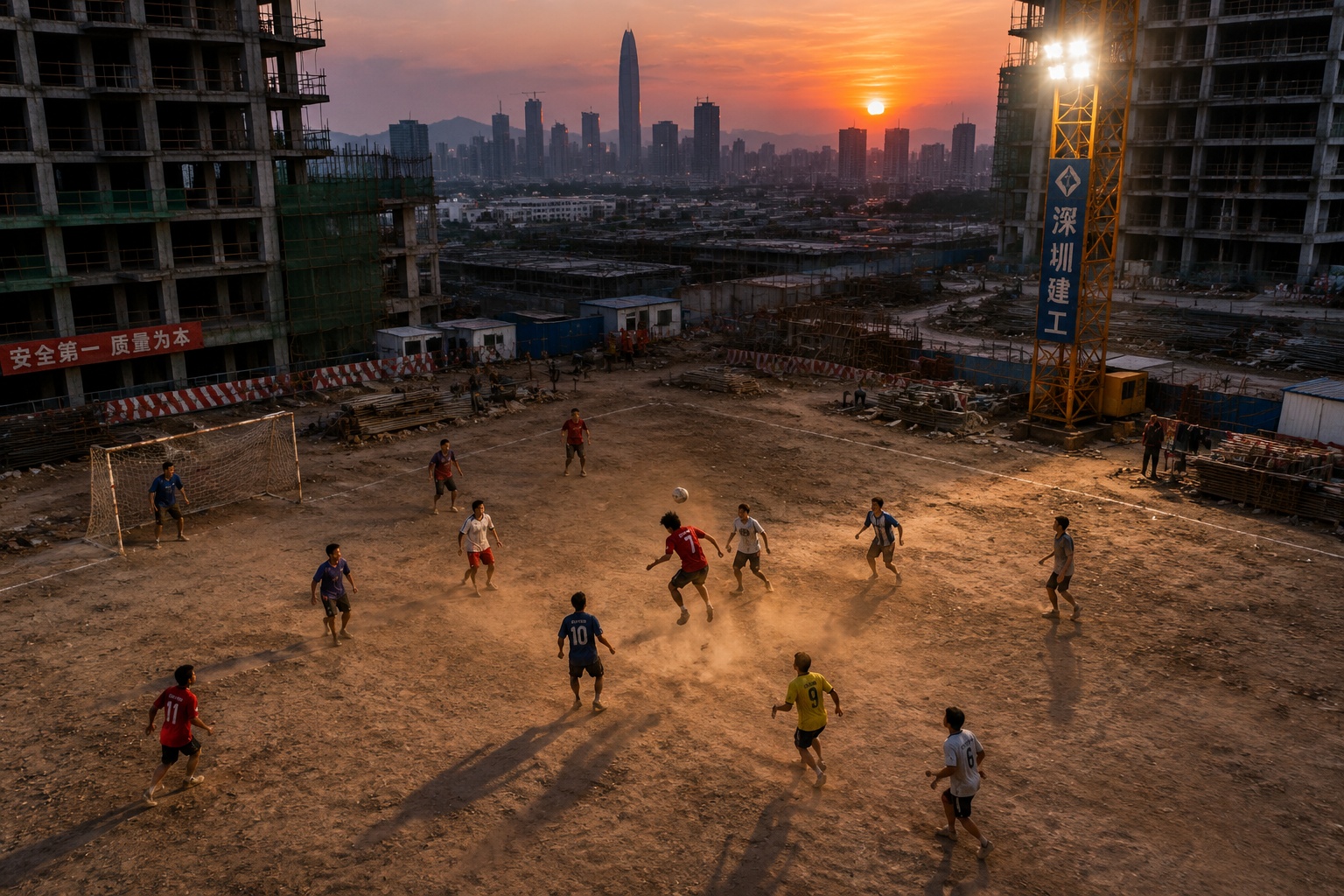
On Site 7, a typical residential development on Shenzhen’s outskirts, the workers share rooms of four to eight bunk beds. The walls are thin, the air smells of instant noodles and unwashed clothes. After an 11-hour shift starting at 6 a.m., most men just want to eat and sleep. But a growing number are doing something different: they pull on a faded jersey, tie their boots, and walk to a flat clearing behind the site’s office trailer.
That clearing is their stadium. The pitch is hard-packed earth, marred by potholes and scattered stones. Two steel pipes, painted white and half-buried in the ground, serve as goalposts. The lines are chalk dust sprinkled with labor. When there is no chalk, they use white stones.
How the Tournament Works
Started three years ago by a small group of workers from different provinces, the league now has 12 teams, each representing either a company or a hometown association. Matches are held after work, from 7 p.m. to 10 p.m., under floodlights borrowed from a nearby tower crane. There are no official registrations, no sponsors, no fees. Players contribute a few yuan each month to buy uniforms and medicine for scraped knees.
The rules are simple, adapted to the environment: no sliding tackles on the hard ground; a “two-touch” rule to keep the ball moving quickly. The matches last 40 minutes, divided into two halves. Teams are mixed by age and province—engineers, bricklayers, scaffolders, and cooks all play side by side. A standard football match uses 11 players, but here they sometimes play 7-a-side to fit the size of the pitch.
One of the founders, a 38-year-old scaffolder named Wang Qiang, told me: “We don’t have much in the city, but we have this. When we play, we are not just workers. We are Messi in our own group.” Wang, who has never been to a professional game, learned football as a child from a worn VHS tape. He now devotes his evenings to organizing the league—fixing fixtures, resolving disputes, and negotiating for the use of the floodlights with the site manager.
Goals Beyond the Pitch
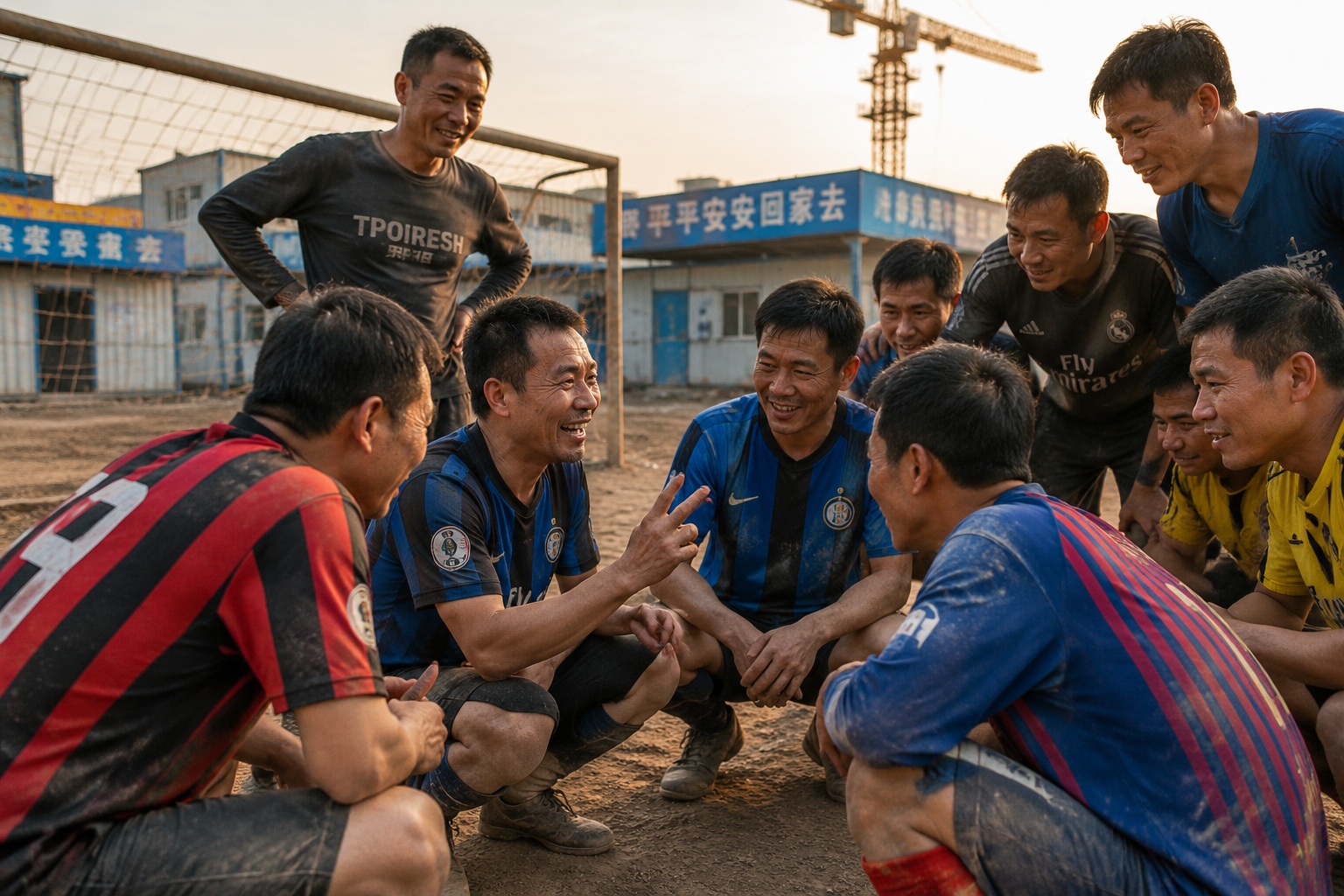
For many of these men, football is more than a game. It is a space to be human again—to feel the wind on their skin, to hear their own laughter, to be someone’s hero for a moment. In a life defined by hard physical labor and separation from family, the evening matches offer something rare: dignity.
“I talk to my son on the phone every night,” says Li Hua, a 42-year-old bricklayer from Anhui province. “He asked me what I do for fun here. I told him I play football. He laughed. He didn’t believe his old man could run. But look at me—I scored last week.”
The tournament has also created a sense of community that cuts across regional lines. In China, migrant workers often stick to groups from their own province—the Sichuan workers eat together, the Henan workers share housing. But on the pitch, rivalries are friendly, and newfound friendships bridge long-standing divides. Teams practice together, borrow players when someone is injured, and share food after matches.
“On the site, we are just labor,” says Zhou Ming, a 29-year-old electrician. “But here, we have names and faces. When someone passes me the ball, I’m not just a guy from the countryside. I’m a teammate.”
The Limits and Challenges
It’s not always easy to keep the dream alive. The pitch is often occupied by parked excavators or towers of steel rebar. Rain turns the field into a mud pit that cements itself to worn boots. Many players suffer from chronic injuries—aching knees, strained backs—yet they keep coming back.
There is also the constant shadow of uncertainty. Construction sites move on when a project is done, and so do the teams. Every few months, a player has to leave for another city, and the league loses a friend. But new workers arrive, filling the gaps and bringing fresh energy. “Our league is like a river,” one player says, “Always running, always changing.”
The bigger challenge is time. With 11-hour workdays and mandatory overtime in busy seasons, attending a match is a luxury. Some players arrive straight from the day shift, still wearing dusty work boots, and don’t have time to change. But they play anyway. “We save our energy for the game,” Li Hua laughs. “The bricks will still be there tomorrow, but tonight’s goal belongs to us.”
A Community of Their Own
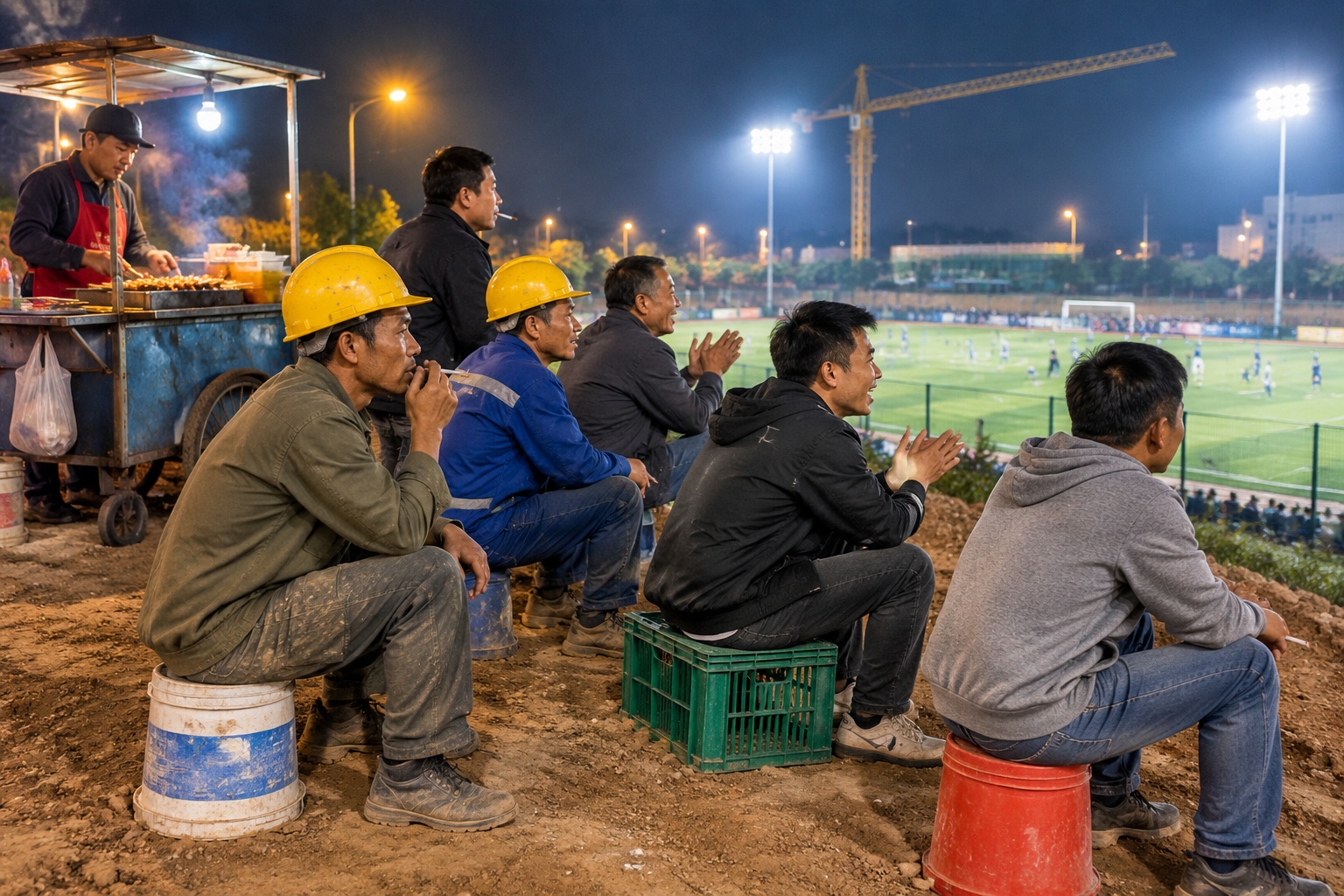
What started as a handful of friends kicking a ball has grown into a local ritual. On match nights, the sidelines swell with workers from nearby sites. They bring loudspeakers and phone chargers. They set up stools and share a bottle of beer. Some even place small bets on the outcome—usually a pack of cigarettes or a meal. A food vendor occasionally rolls up, selling skewers and cold drinks to the crowd.
The league has attracted the attention of a few local shopkeepers and even a young university student who volunteers as a photographer. She posts photos on social media, and the men are proud to see themselves documented. One photo, showing a goalkeeper diving for the ball, has been shared hundreds of times on WeChat. “We are not just ghosts in the city,” Zhou Ming says. “We are here. We laugh. We play. We exist.”
A Goal Worth Sharing
The sun has fully set now. The floodlights hum overhead, and the night air carries the smell of street food from a nearby vendor who has rolled up to sell skewers and cold drinks to the spectators. On the pitch, the final is tied 2-2. The ball falls to a middle-aged plumber, who volleys it into the top corner. The crowd explodes—shouts, whistles, and the clanging of a spoon against a metal bowl.
The winning team lifts their trophy—a plastic cup wrapped in gold tape—under the pale light. They take a group photo, arms around each other’s shoulders, faces dusty and gleaming. Tomorrow, they will return to their steel and concrete. But tonight, they are champions of their own World Cup.
For an outsider, this is a glimpse of a China that is often overlooked: not the shiny towers, but the people who build them, who have carved out a space for joy, community, and rebellion against invisibility—one evening match at a time.
Start the discussion at forum.chinacomes.com