

On a misty morning in the mountains
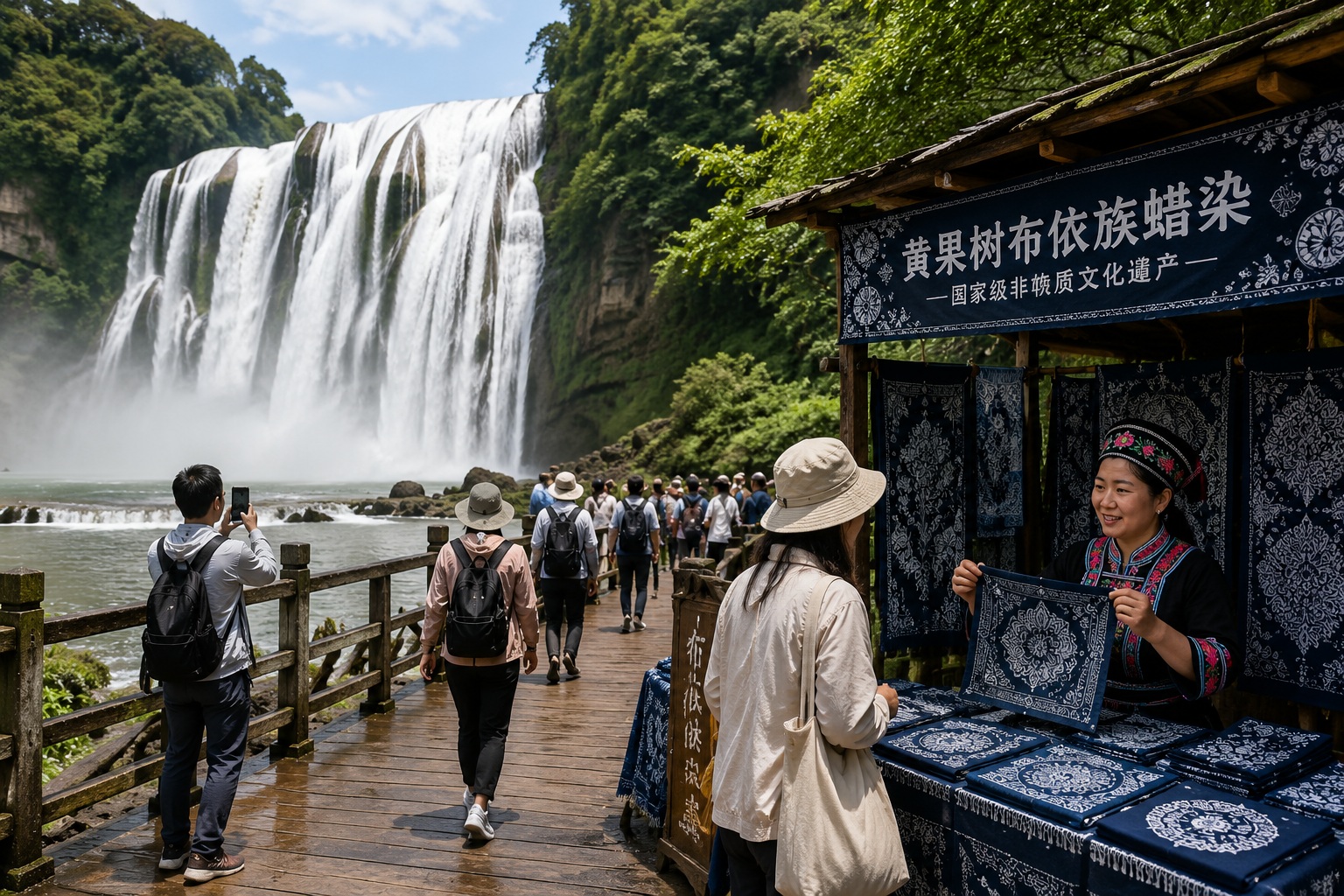
The Huangguoshu Waterfall in Guizhou province is loud before it is visible. The road curves through steep green hills, and then the sound of water takes over — a low, constant thunder that vibrates in your chest. By the time you reach the main viewing platform, the air is thick with spray and you can barely see the full fall for the crowds taking photos.
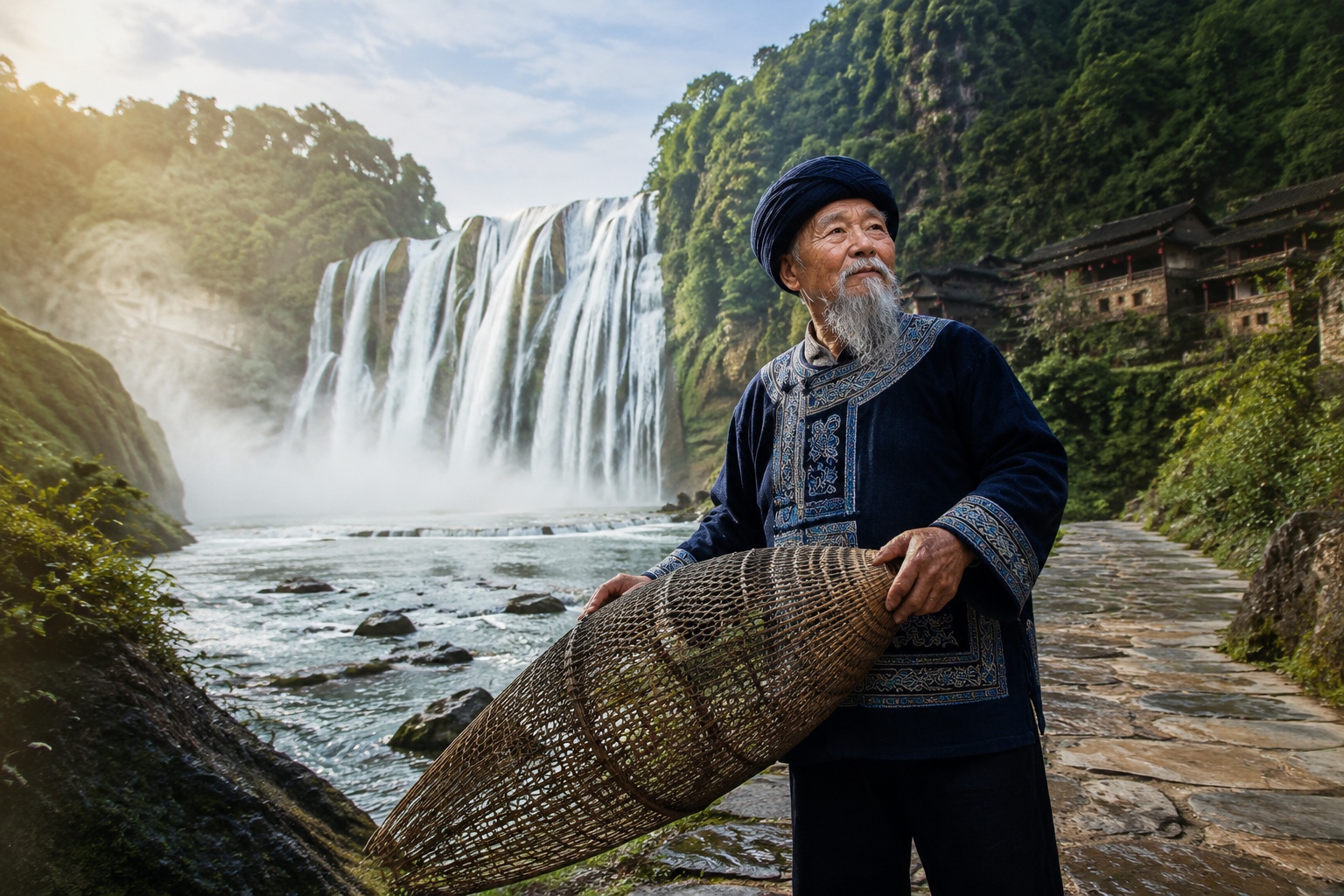
But if you turn away from the platform and follow a narrow path that climbs the opposite ridge, you’ll reach a small Buyi village called Huashao. That’s where I met Wang Guoyou, a 68-year-old man with a leathery face and hands that looked like they’ve spent decades around water. He was sitting on a stone step, repairing a bamboo fish trap.
“You came to see the waterfall?” he asked, not looking up. Then he smiled. “Everyone comes to see the waterfall. I’ve been listening to it every morning since I was born. It’s like a heartbeat.”
Who are the Buyi people?
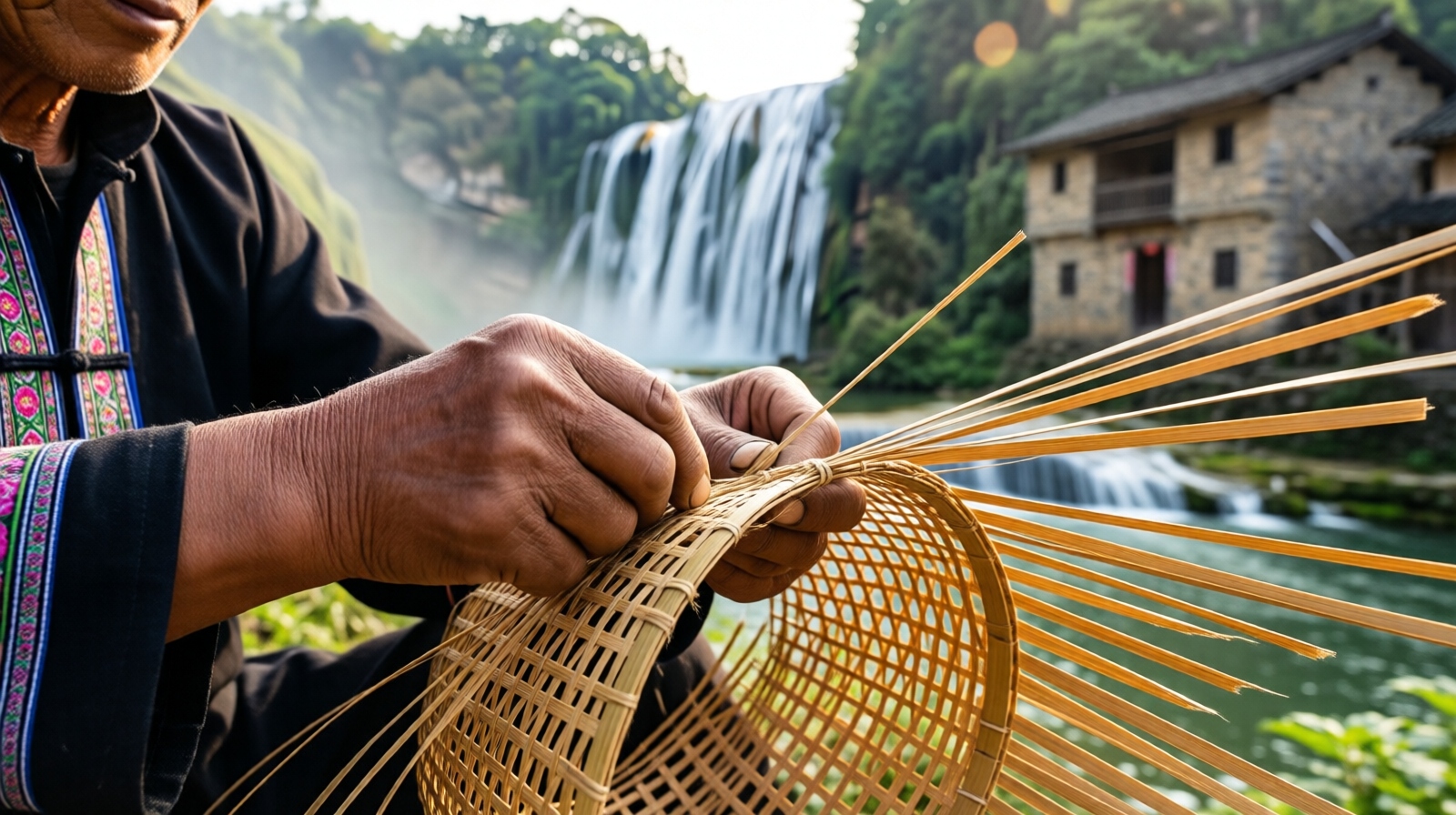
The Buyi are one of China’s 55 officially recognized ethnic minorities, with a population of around 2.9 million. They live mostly in Guizhou, Yunnan, and Sichuan, but their cultural heart is in the subtropical river valleys of Guizhou, where rice paddies climb up the slopes and water is everywhere. The Buyi have their own language, a rich oral tradition, and a reputation for batik fabric patterns that have remained unchanged for centuries.
Yet outside China, few people know them. They tend to stay out of the spotlight, unlike some other minority groups who attract more tourist activity. But their relationship with the Huangguoshu Waterfall — the largest waterfall in both China and Asia — is one of the most unusual and enduring cultural traditions you could encounter in this part of the world.
Wang explained it simply: “For us, the waterfall is not just a scenic view. It’s the place where the old stories begin. The Buyi have always believed that spirits live in the water — good ones, that bring rain and protect the crops. So when our ancestors settled here, they never chose to live far from the river. They faced the waterfall and made it part of their daily prayers.”
A village shaped by stone and song
Huashao is a collection of about 40 houses, all built with local slate. The roofs are covered with gray stone tiles that look like overlapping fish scales, and the walls are made of stone blocks so thick they keep the summer heat out and the winter chill away. The village is not a living museum; people still live here, hang laundry from window frames, and grow vegetables in small plots between the houses.
Walking through Huashao, I noticed that almost every household had some sign of a cultural tradition. On one porch, a woman was weaving a loom with narrow strips of white cloth. On another, a girl was practicing the Buyi flute while a rooster ran around her feet. Wang pointed to the village square, where a bonfire pit stands. “That’s where we sing the festival songs,” he said. “The whole village used to come. Now we are lucky if a few old people show up.”
The decline of traditional song and dance in minority communities is a common story in contemporary China. Young people move to cities for work and education, and the rituals that once bound the community together fade away. But something unexpected has started to happen in Huashao. The waterfall itself is bringing some of the young people back.
When the tourists came
Huangguoshu has been a major tourist destination for decades. The falls are 77 meters high and 101 meters wide, and in peak season, more than 100,000 people pass through the gates in a single day. That influx has created jobs — guiding, running guesthouses, selling souvenirs and food — but it has also changed the landscape. There are hotels, escalators, and even a cable car now, which some locals treasure but others lament for breaking the natural quiet.
For the Buyi, the arrival of tourism has been a mix of opportunity and pressure. The river that feeds the waterfall has been partially diverted for a hydroelectric station upstream, which means the volume of water flowing over the falls is no longer entirely natural. “I remember when the water was so high you couldn’t hear a person shouting next to you,” Wang recalled. “Now it depends on the season and how they release the water from the dam.”
This tension between conservation and development is familiar across China and beyond. The Buyi have had to decide how to make a living without completely losing the spirit of the place. Some older villagers resent the crowds and the noise. Others have embraced the chance to introduce their culture to visitors.
“When I was a boy, we used to fish in the river with bamboo traps like this,” Wang said, holding his half-finished trap. “Now we also fish for tourists — they think it’s interesting to watch us eat what we catch. But the real meaning of the trap is a lesson about patience. It is a craft that my father taught me, and his father taught him. I am the last one in my family who knows how to make it properly.”
The new guardians are younger than you think
Wei Lan, 26, grew up in Huashao but left at 18 to study tourism management in a city in Yunnan. For a few years, she worked in a hotel in Guangzhou. Then, in 2019, she received a phone call from her grandmother, who was ill. Wei returned to take care of her and ended up staying. That choice changed everything.
“The first night back, I couldn’t sleep. The waterfall was so loud — I had forgotten the sound. It was like being under a waterfall inside your head,” she said, laughing. “But the next morning, I walked to the same spot my grandmother used to take me to, and I saw the river through her eyes. I realized that I didn’t want the story of my people to end with her generation. I wanted to be part of keeping it alive.”
Wei now runs a small guesthouse with two guest rooms. She has also started a collective with other young villagers to sell batik cloth, organize folk music evenings, and lead “waterfall listening” tours. She doesn’t mimic the big tour agencies. Instead, she takes visitors down to a hidden bend in the river, where the sound of the falls is less overwhelming, and tells them legends in Buyi language before translating into Mandarin (and sometimes English).
“My grandmother told me stories about the dragon king who lives in the waterfall,” Wei explained. “She said if you listen carefully, you can hear him singing through the water. When I first told that to foreign visitors, they thought I was being poetic. But I wasn’t. I genuinely believe that this place has a voice, and you just have to be quiet enough to hear it.”
Wei is not the only young person to return. The village now has a few other returnees, some of whom learned traditional crafts from their grandparents, others who bring new skills like digital marketing or video editing. Their guesthouse cooperative has an account on Douyin (China’s TikTok), where they film short clips of river life. The channel has tens of thousands of followers, mostly Chinese urbanites who find the videos soothing.
So what does “guarding” actually mean today?
When I asked Wang whether he thinks the tradition is safe, he paused for a long time. “Safe? We are not safe from anything. The water is still there, but the world around us is changing. I don’t know what the waterfall will be like in 50 years. But I know this: the Buyi people are still here, and we still listen.”
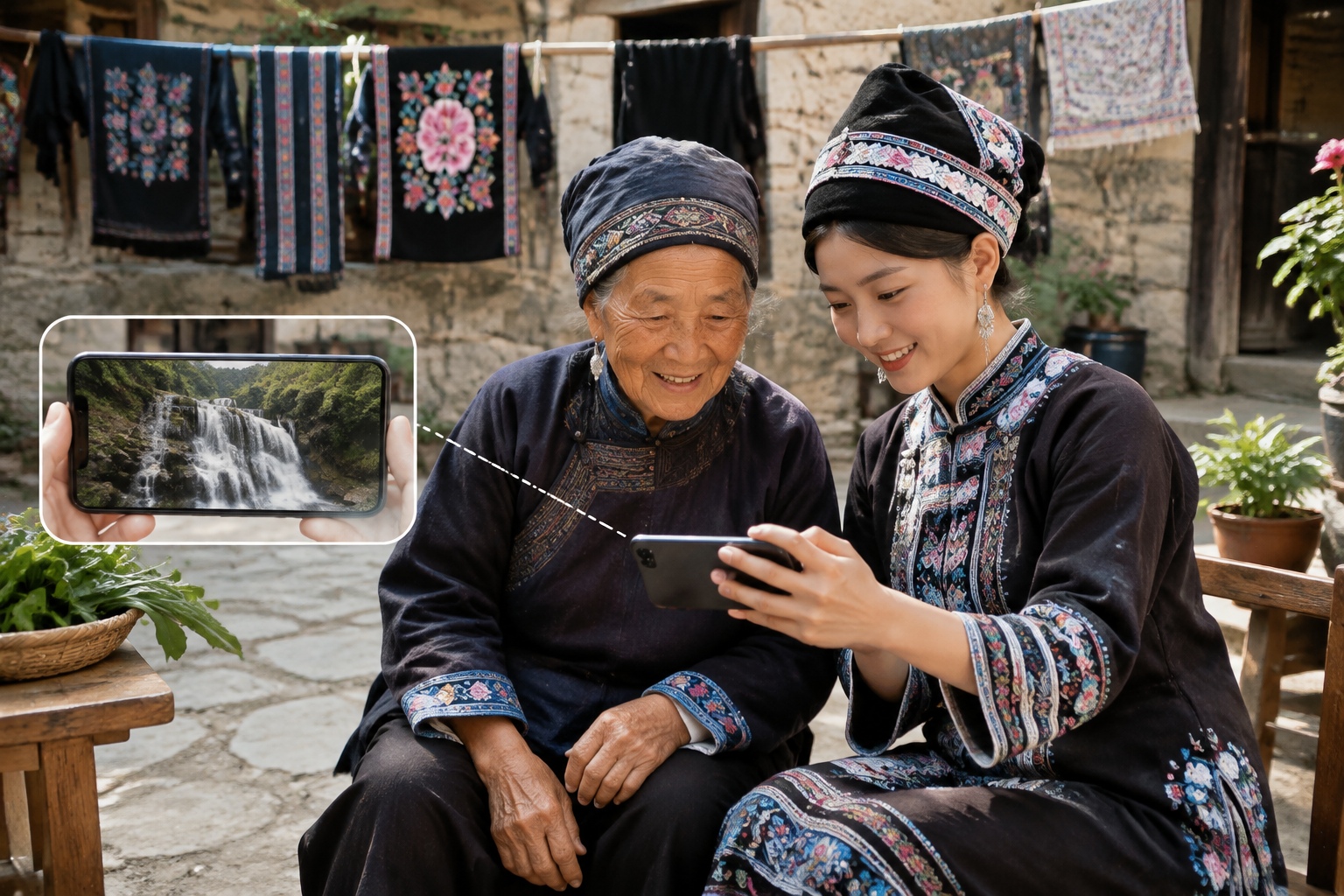
Wei has a more proactive view. For her, guarding the tradition doesn’t mean freezing it in time. It means allowing the Buyi culture to breathe, adapt, and connect with new audiences. She recently taught her grandmother to use a smartphone so she could watch videos of the waterfall from previous years, seeing how it changed with each season.
“My grandmother was scared of the phone at first,” Wei recalled. “But then I showed her a video taken on a rainy day, and she said, ‘That’s the waterfall I remember.’ Now she sometimes asks me to play it on repeat. It’s like she’s guarding the memory, and I’m guarding the story.”
If you want to understand, listen
The Huangguoshu Waterfall is often presented to tourists as a natural wonder, a place for selfies and sightseeing. But for the Buyi, it’s more than that. It’s a living book of history, a source of identity, and a shared heartbeat that connects generations. It has been that way for more than 500 years.
So, the next time you find yourself near a crowd of people staring at the great falling wall of water, take a step back. Walk the stone path to Huashao village. Find someone — maybe an old man repairing a fish trap, maybe a young woman starting a guesthouse — and ask them what the waterfall means to them. They might respond with a story about dragon kings, or about hydroelectric dams, or about a grandmother who taught her granddaughter to listen. All of those stories are part of the same river, flowing through time.
And if you listen carefully, you might just hear the voice that has been calling the Buyi for half a millennium.
Start the discussion at forum.chinacomes.com