
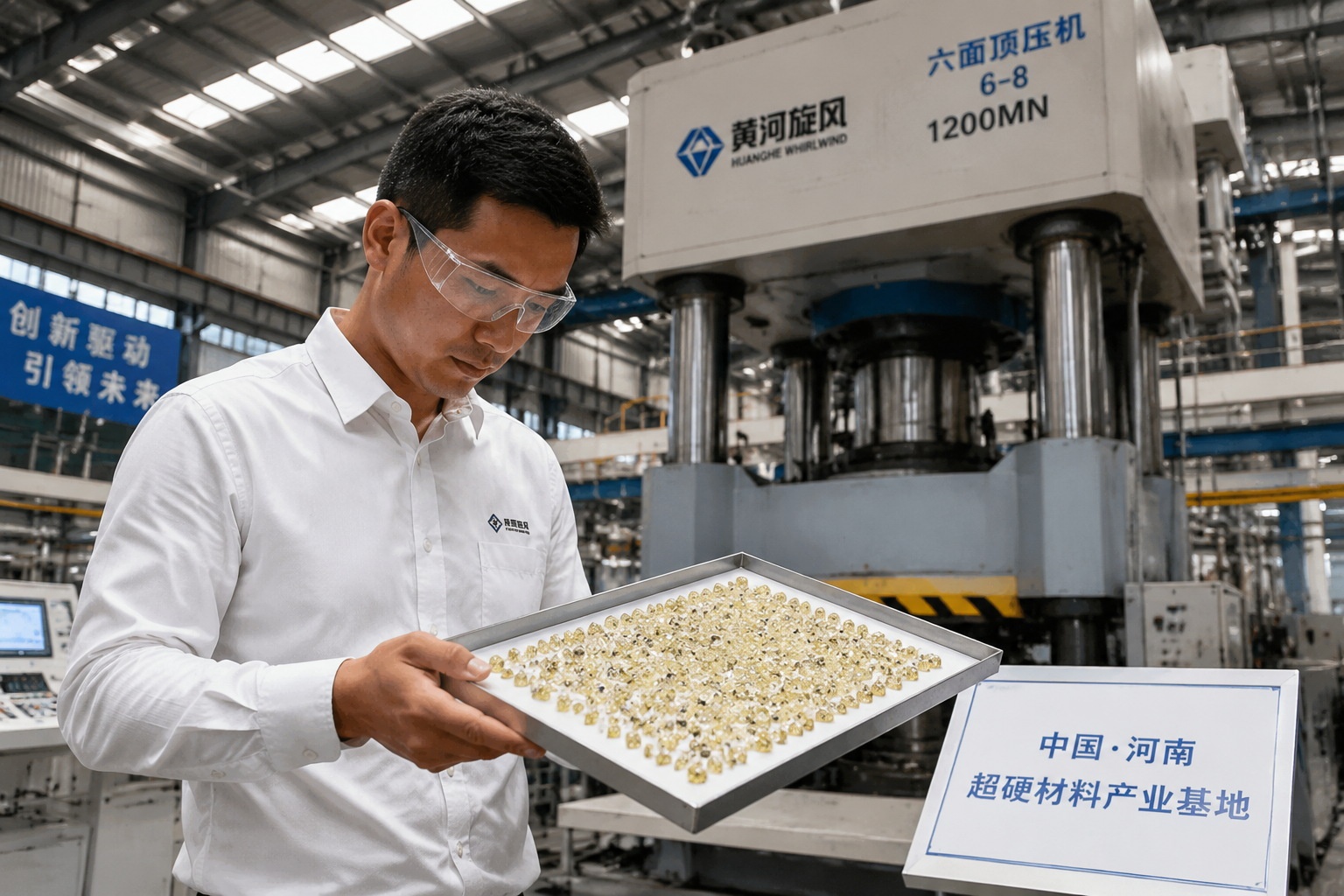

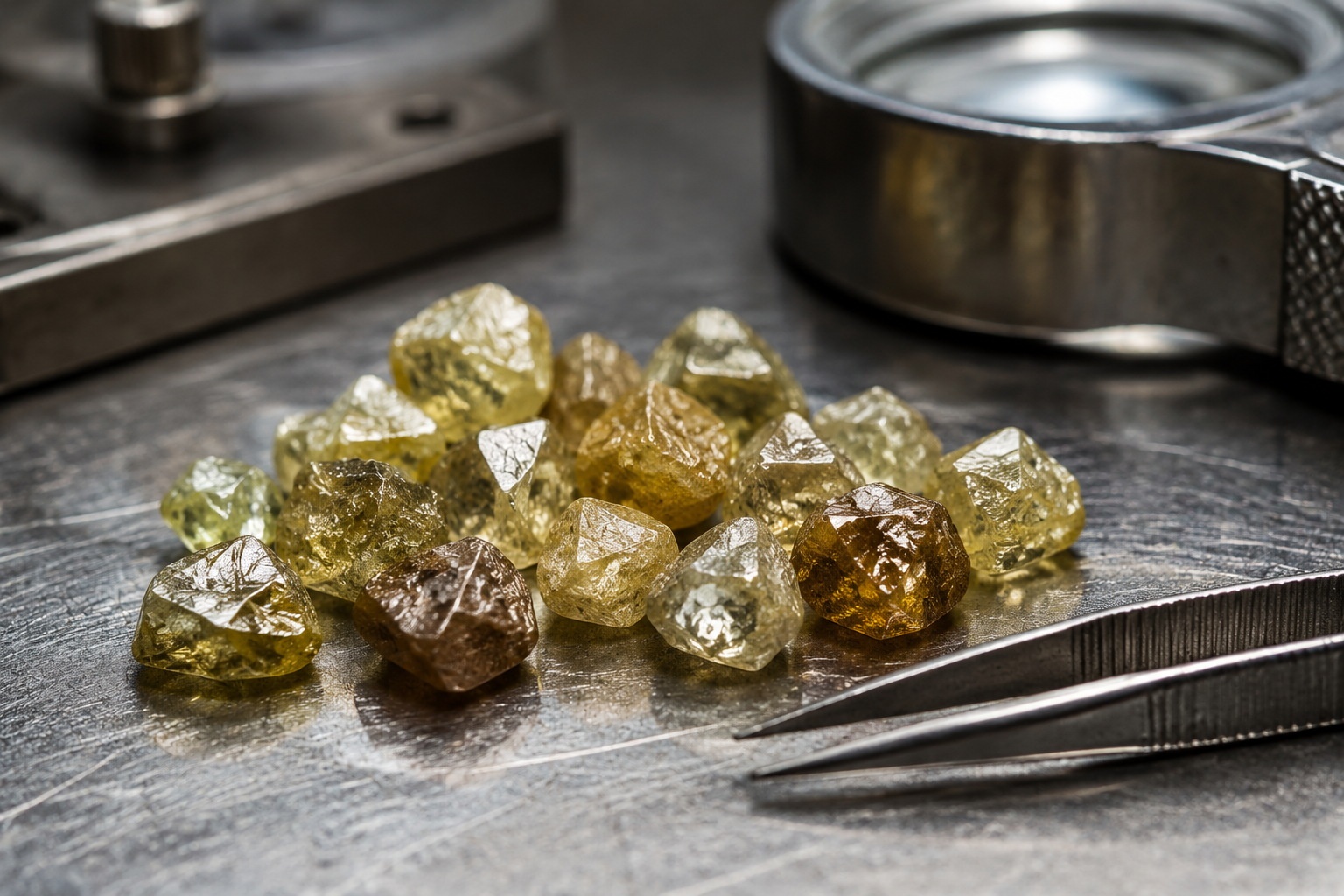
In a windowless workshop in Zhengzhou, the capital of Henan, a 30-meter-long hydraulic press silently works. Inside, graphite and a metal catalyst are subjected to a pressure 100 times greater than the deepest point of the ocean and a temperature above 1300°C. After a few hours, a small group of pale yellow crystals is removed and sent to the cutting room. They are synthetic diamonds, and they will be crushed into powder, embedded in saw blades, or polished into sparkling gemstones. This is not a niche operation. Zhengzhou and its neighboring cities form the most important diamond-producing region on Earth. According to industry reports, Henan accounts for nearly 80% of China’s synthetic diamond output, and China produces about 95% of the global total. In other words, roughly seven out of ten industrial diamonds worldwide are born in this province.
What Are Synthetic Diamonds?
To understand the significance, you need to know that synthetic diamonds are chemically identical to natural stones. They are not imitations. Unlike cubic zirconia or moissanite, which are diamond-like materials, synthetic diamond consists of pure carbon in a diamond lattice. That gives it the highest Mohs hardness of 10 and outstanding thermal conductivity. Industry uses this hardness every day. Diamond abrasives can cut through reinforced concrete, granite, and even steel. Diamond powder is used to polish semiconductor wafers and optical glass. But production is not simple. The two dominant technologies are HPHT and CVD. HPHT uses huge presses to recreate high-pressure conditions; CVD uses a vacuum chamber with carbon-containing gas to make diamond layer by layer. Henan’s strength is in HPHT, a technique that suits small- to medium-size crystals, while CVD is used for larger or high-purity crystals. Both are now present in the province.
How Did an Agricultural Province Become the Diamond Capital?
The root lies in state planning. In the early 1960s, Western countries had an embargo on high-tech equipment to China, including industrial diamonds. China needed a domestic supply for its construction and machinery sectors. In 1963, the government established a special research institute in Zhengzhou: the Zhengzhou Research Institute for Abrasives & Grinding, known as Sanmoyuan. The institute succeeded in making China’s first synthetic diamond in 1963 with a self-designed press. That breakthrough laid the foundation for a local ecosystem. The research institute later shared its know-how with state-owned factories, and as the economy liberalized, engineers and technicians left to start their own businesses. Today, Henan has thousands of related firms. Some, like Zhongnan Diamond and Huanghe Whirlwind, are among the world’s largest diamond producers by volume. They supply not only the Chinese market but also countries in Asia, Africa and Europe. Zhecheng County in Henan, in particular, has become a cluster of small factories producing abrasive materials, supporting thousands of jobs.
The Hard Supply Chain: Five Things You Should Know
1. Presses matter. The core equipment in HPHT production is a cubic press, a massive machine that can exert 60,000 tons of pressure. Henan not only uses these presses but also manufactures them. This gives local firms a huge cost advantage. A new press costs about $300,000, and each machine can run 24 hours a day for months.
2. Graphite and catalyst. Diamond synthesis uses high-purity graphite powder and metallic catalysts like iron or nickel. The quality of these raw materials determines the quality of the final crystal. Henan has dedicated suppliers that have learned to control impurities to the part-per-million level.
3. Sorting and crushing. Not every crystal comes out perfect. Factories sort diamonds by size and quality. Subpar ones are crushed into micron-sized powder for abrasives, while better ones are sold to toolmakers.
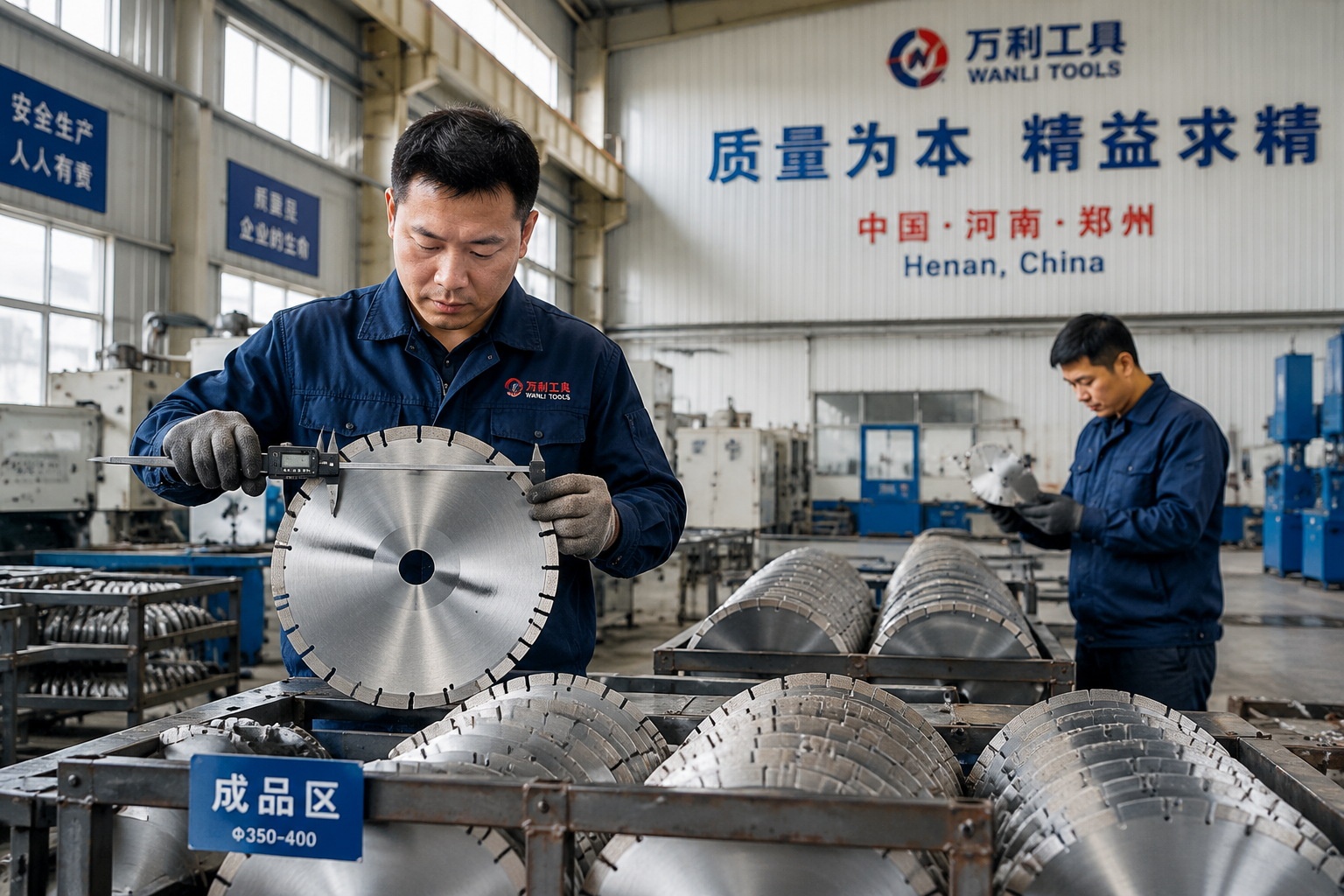
4. Tool making. The real value is often added downstream. Companies such as Henan Huanghe and Sino-Crystal Diamond make diamond saw blades, drilling bits, grinding discs, and wire saws used to cut solar silicon wafers. These products are shipped across the world. For instance, many South American and African countries import diamond-tipped tools from Henan for road construction and quarrying.
5. Gemstone cutting. The same rough diamonds that do industrial work can be graded as gem quality. Some are cut into round brilliant stones and sold as lab-grown jewelry to global brands. In 2022, lab-grown diamond jewelry sales in the United States jumped by more than a third, and a large share of those stones were finished in Henan.
When Diamonds Reach Your Everyday Life
You may think that industrial diamonds are far from you, but they are everywhere. They are used to cut granite countertops in your kitchen, to polish the smartphone screen you hold, and to drill water wells and oil wells. In fact, the rapid expansion of China’s infrastructure in the past twenty years created massive demand for diamond tools, and Henan delivered. The same tools now help build highways in Pakistan and metro systems in Indonesia. Moreover, diamond is an excellent heat-spreader. Some high-power laser and 5G base station components also use diamond as a heat sink. CVD-grown polycrystalline diamond is already used in a new generation of chip substrates for electric vehicles and industrial power equipment. Henan’s companies are actively investing in CVD technology to reach this higher-margin segment.
Market Data and Global Ripples
Let’s put some numbers. Global sales of synthetic diamond materials (excluding jewelry) were estimated at over $1.5 billion in 2023, with industrial diamond dominating. China’s share is about 70-80%. Among Chinese producers, Henan accounts for more than half of the national output value. The price of 1-carat rough synthetic diamond has fallen from about $4,000 in 2015 to under $1,000 today, partly due to Henan’s scale expansion. For lab-grown gemstones, the cost of a 1-carat polished stone is now about $500 to $800, compared to $4,000 to $6,000 for a mined diamond of similar quality. Because natural diamonds are limited by mining, synthetic diamonds will continue to dominate industrial use and increasingly play a role in jewelry, changing consumer expectations about rarity and value.

Challenges and Questions
With success comes complexity. The ongoing oversupply of industrial diamonds has pushed low-end products into price wars. Some small factories have closed, and even big players face shrinking margins. Another issue is energy. HPHT production requires a lot of electricity, which raises both costs and environmental concerns. To its credit, local governments are encouraging plants to use clean energy and upgrade equipment efficiency. But the most crucial challenge is how to move up the value chain. Making ordinary diamond is one thing; making large flawless CVD diamond crystals for semiconductors is another. It requires years of R&D, patient capital, and a workforce skilled in solid-state physics. Henan still has a long way to go compared to firms in Singapore, the United States and Japan, but it is making a serious push. Several provincial programs now fund research on diamond-based semiconductors. The dream of using diamond not only as an abrasion tool but as the ultimate chip material may still be years away, but the province is determined to be part of it.
Conclusion
When you hold a piece of granite, look at a diamond-blade drill, or perhaps even consider a lab-grown engagement ring, it is worth remembering that the journey of that tiny crystal may begin in Henan, in a large press humming under the dry plains of central China. The province has turned a fundamental material into an industrial force. That transformation did not happen overnight — it came from six decades of state strategy, local initiative, and a stubborn willingness to learn. It also shows that in the modern global economy, even the hardest material can be the most adaptable.
Start the discussion at forum.chinacomes.com