
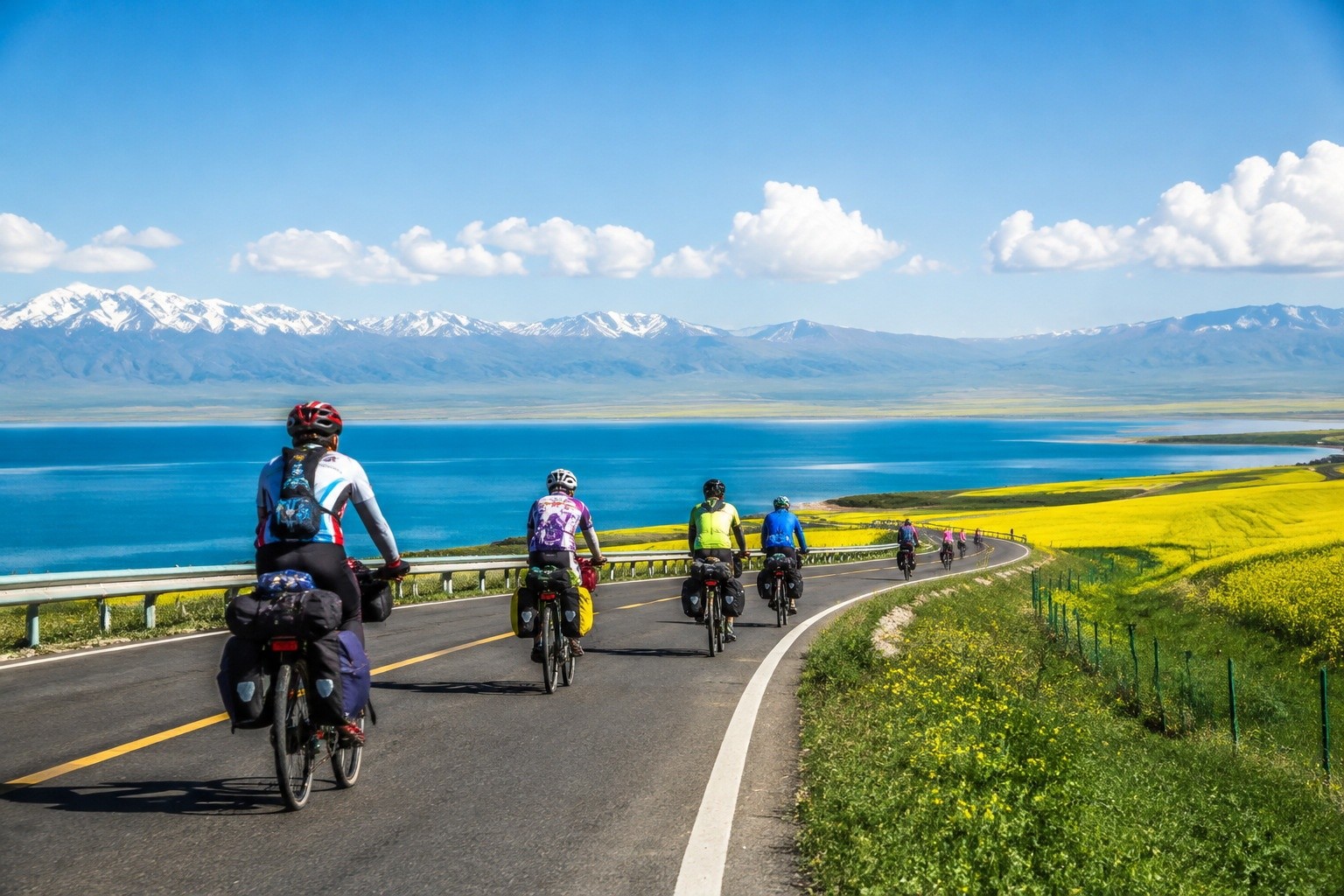

Every summer, the road around Qinghai Lake fills with cyclists. They come from Beijing, Shanghai, Guangzhou, and even overseas. They ride through high-altitude grassland, past yaks and sheep, and stop at small villages that look unchanged for centuries. But the villages have changed, and cycling has everything to do with it.
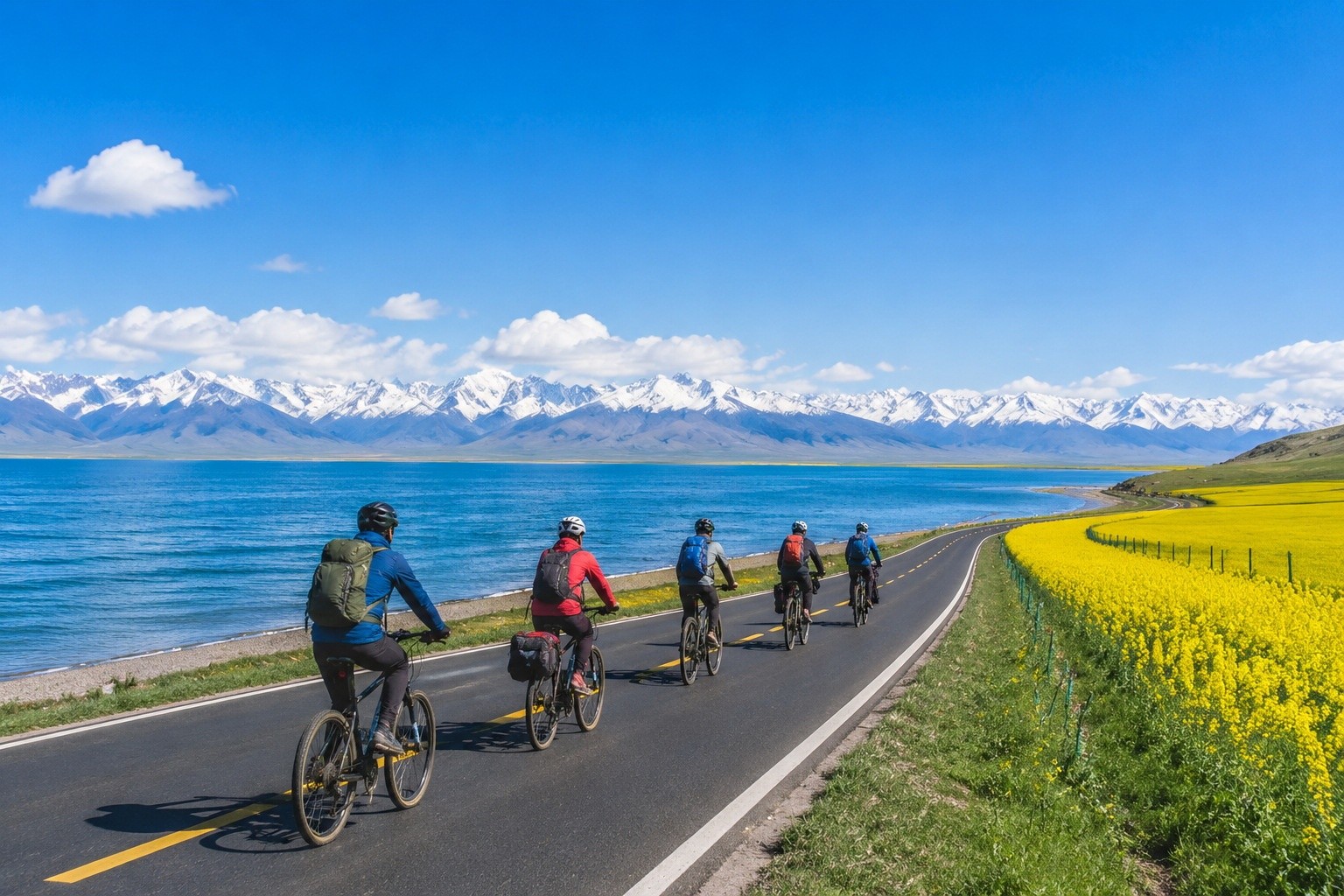
Where the Sky Meets the Grassland
Qinghai Lake is China’s largest inland saltwater lake, located about 150 kilometers west of Xining, the capital of Qinghai Province. At 3,200 meters above sea level, the lake sits on the northeastern edge of the Tibetan Plateau. It is so wide that across its widest point, the opposite shore disappears into the horizon.
Around the lake lies a 360-kilometer asphalt loop, often called the Qinghai Lake Loop. It is not a dedicated bicycle track, but the road is smooth, traffic is light for most of the day, and the scenery changes with almost every kilometer: quiet desert dunes, rolling green pasture, brilliant yellow rapeseed fields in July, and clusters of white stupas and prayer flags around Tibetan villages.
For a long time, the loop was a road for local herders and the occasional self-drive tourist. Then came social media. Beautiful photos of the “most beautiful cycling road in China” spread quickly. National and international races, including the Tour of Qinghai Lake, gave the route a competitive halo. Around 2015, the current cycling boom really began, and it has not slowed since.
Why a Bike (Not a Car) Changes Everything
Driving along the lake takes only one day. But cyclists stay for four or five, spending money on accommodation, food, repairs, and souvenirs. That is the core economics of sport tourism: speed slows down, and money spends longer.
Cycling is also easy enough for ordinary people. The loop’s altitude is challenging, but the route itself has no big climbs. With good hydration and a reasonable pace, most amateur riders finish the whole thing. It is an adventure, but not an expedition. This makes it popular with white-collar workers who want to write a “conquering the plateau” story for their WeChat moments.
For young Chinese professionals, cycling is also a status hobby. Posting a few photos of the loop on social media signals independence, resilience, and a connection to nature. It’s like doing a marathon, but with better views.
Villages That Turned into Rest Stops
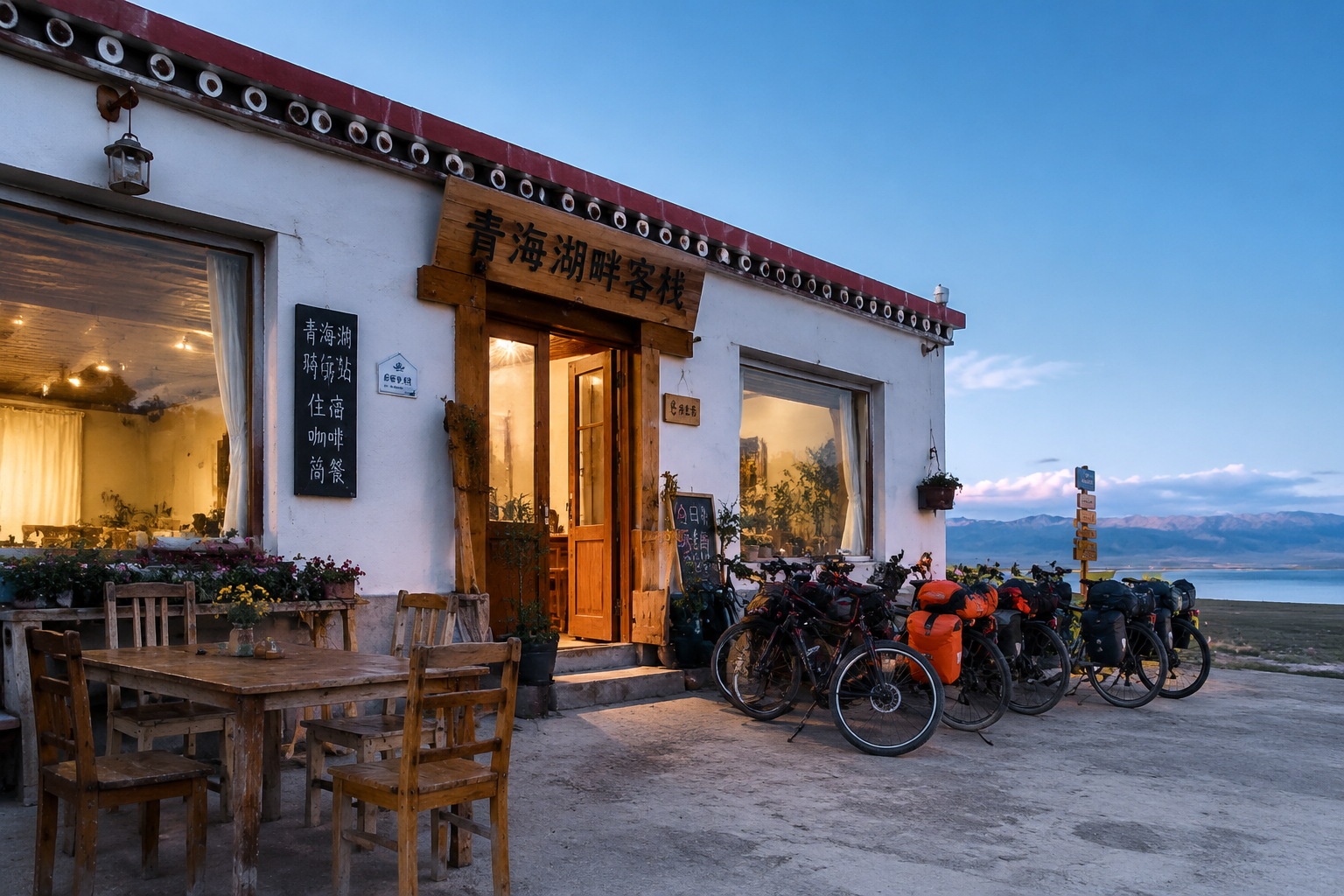
One of the most visible changes is in villages like Jiangxigou, Heimahe, and Gangca. These settlements were historically used by herders during seasonal moves. Today, they are tourist service hubs. Guesthouses have replaced yurts, and stables have become bicycle parking lots.
Take Dorje, a former herder in his forties, who runs a 12-room guesthouse with his wife and two cousins. In high season, every bed is booked from mid-June to mid-September. He offers three meals a day, mostly simple dishes: beef noodle soup, stir-fried vegetables, and rice. For breakfast, there are eggs, bread, and hot yak milk tea. He also rents bicycles, stocks tire repair kits, and even helps foreign riders print insurance papers. “I never expected to build a house from this,” he told me with a laugh. “But the bicycles brought the money, not the cattle.”
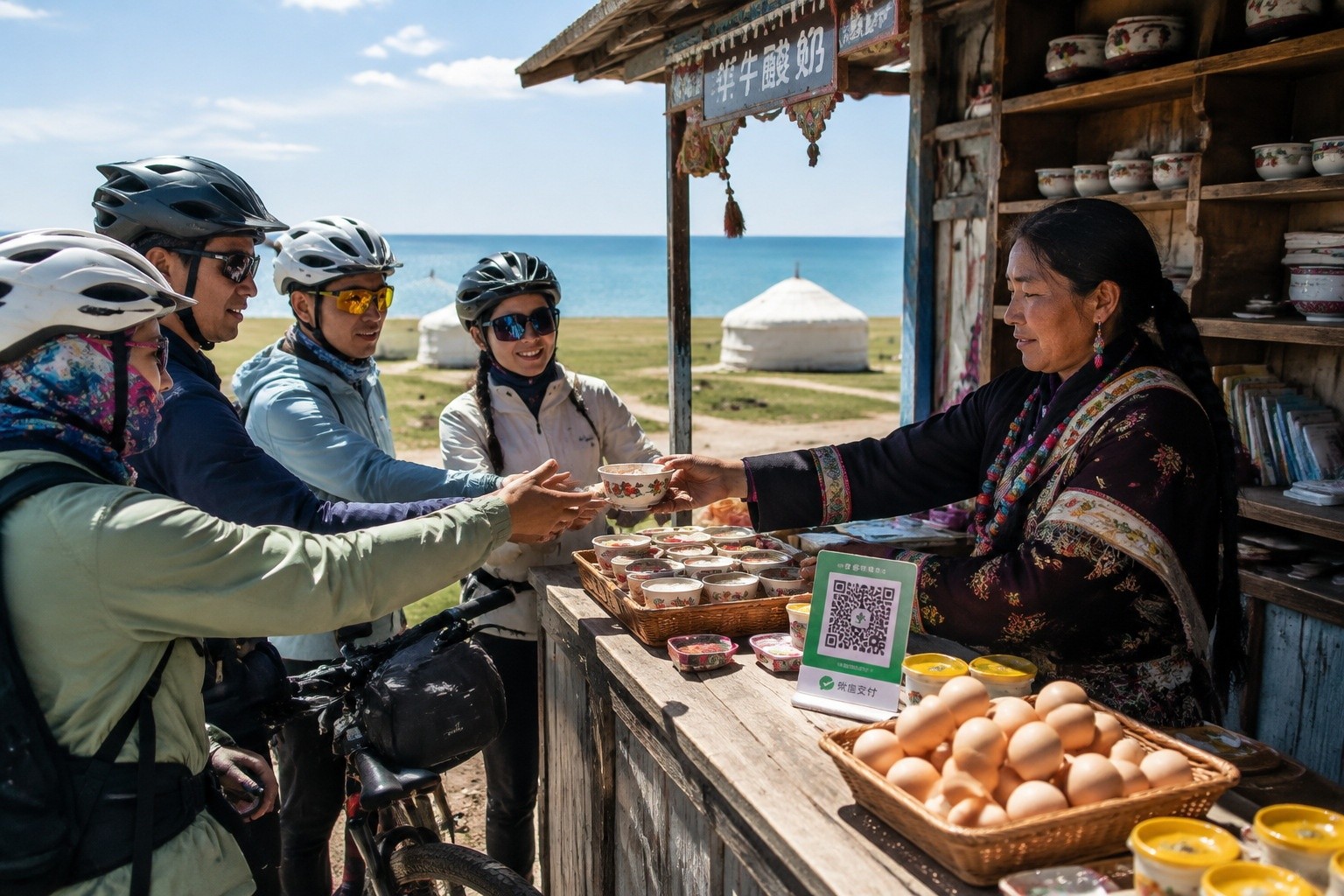
Across the loop, small roadside stalls sell local specialties. One of the most beloved is Qinghai yogurt, thick and sour, served with honey or white sugar. Another is qingke barley bread, a filling snack that cyclists love because it’s cheap and easy to carry. In some villages, you can find hand-pulled noodles — a skill brought by cooks from other provinces, now adapted with local toppings like yak meat. These simple foods form the daily fuel for hundreds of riders.
Cycling Fuel: The Roadside Tastes of Qinghai
Food is more than nourishment here; it is a bridge between visitors and hosts. Many riders admit they remember the yogurt more than any mountain view. The local specialty market also gives villagers a low-cost way to earn extra income without building big hotels.
One typical evening in Heimahe: a group of tired cyclists sits on low stools around a wooden table. The host brings a pot of steamed dumplings filled with yak meat and chives. The dumplings cost about the same as a takeaway meal in Beijing, but here they taste like a festival. When the bill comes, one rider pays by scanning the host’s WeChat code. The host checks the screen and immediately gives a thumbs-up. Small talk about tomorrow’s distance begins.
Digital Tools: From WeChat Pay to Live Weather Maps
None of this would run as smoothly without mobile technology. Even in the most remote roadside tent, you will see a plastic card with a QR code for WeChat Pay or Alipay. Riders carry almost no cash, and village businesses accept that as a default. This removes a huge barrier for small sales: you don’t need a card reader, a cash register, or even a bank account at the local branch. Just a phone and a QR code.
Navigation apps like Amap and Baidu Maps include the loop in their cycling routes, with altitude information and distance markers. Local WeChat groups share real-time updates about weather, roadblocks, and guesthouse availability. Some village businesses now even use short-video apps like Douyin to promote themselves. I watched a woman in Gangca film a short clip of her dumpling-making skills. She had more than 2,000 followers. Most of them were from other provinces, planning rides.
The same apps that help riders also help villagers. They can order bicycle parts online, learn bike mechanics through video tutorials, and even set up mini programs to take reservations. This digital layer makes a remote area feel connected, which lowers the entry barrier for first-timers.
The Catch: Seasonality and Environmental Pressure
It would be easy to make this story all sweet tea and downhill slopes. But the boom has a seasonal heartbeat. All the economic activity is packed into three or four months. From October to May, many guesthouses close; villagers return to animal husbandry or leave for nearby cities. That creates irregular income and makes it hard to invest long-term in quality or training.
There is also the environmental price. Qinghai Lake is not only a tourist asset; it is a protected natural reserve with a fragile alpine ecosystem. Litter, especially plastic bottles, is a growing headache. Unregulated camping has damaged grasslands. Water levels are stable, but water quality is a concern. Local officials and tourism associations are trying to introduce no-camping zones, raise fees for waste disposal, and organize “green cycling” events. But enforcement is uneven, and not every villager sees the urgency.
For travelers, the lesson is simple: the same road that lets you enjoy this beautiful lake also carries an obligation to keep it clean. Some cycling companies now include garbage bags with their rental packages, encouraging riders to carry out what they bring in.
A Bottom-Up Model for Rural Tourism
What can we learn from Qinghai Lake? In many parts of the world, rural tourism is planned from a central authority. Government builds a visitor center, developers construct hotels, and local people become employees. The lake’s loop is different. The road itself is state-built, but most commercial infrastructure emerged from the ground up, driven by demand and small-scale entrepreneurship.
Villagers still own the means of service: their homes, their food, their hospitality. This means more of the income stays within the community. It also means the character of the place isn’t completely replaced by international hotel chains. Cycling, by its nature, favors small-scale interactions. A cyclist needs a safe place to sleep, a hot meal, and a good repair shop — not a five-star resort.
This model has limits, of course. It creates intense pressure during a short season and little job security for the rest of the year. It also depends on the weather. But as other rural areas in China look for ways to expand tourism, the Qinghai Lake Loop offers a practical case study: serve, don’t replace.
One More Morning by the Lake
The last time I visited, I got up before sunrise. A group of riders was already on the road, their red taillights blinking like animal eyes in the morning mist. A woman in her sixties stood by a thermos, selling boiled eggs and yak milk tea to an early team. She didn’t have a menu, just a small wooden sign with one word: “Eggs. Tea.”
Underneath, someone had taped a QR code. She smiled when I asked how many guests she serves in a day. “Today the first egg went out at 5:30. The road is my shop.”
That is the kind of change that comes slowly, then all at once. It is also the most honest answer to the question “how does sports tourism affect a village?” Not in grand abstractions, but in one boiled egg at a time.
Start the discussion at forum.chinacomes.com