

The First Time You Face a Shanghai Trash Bin
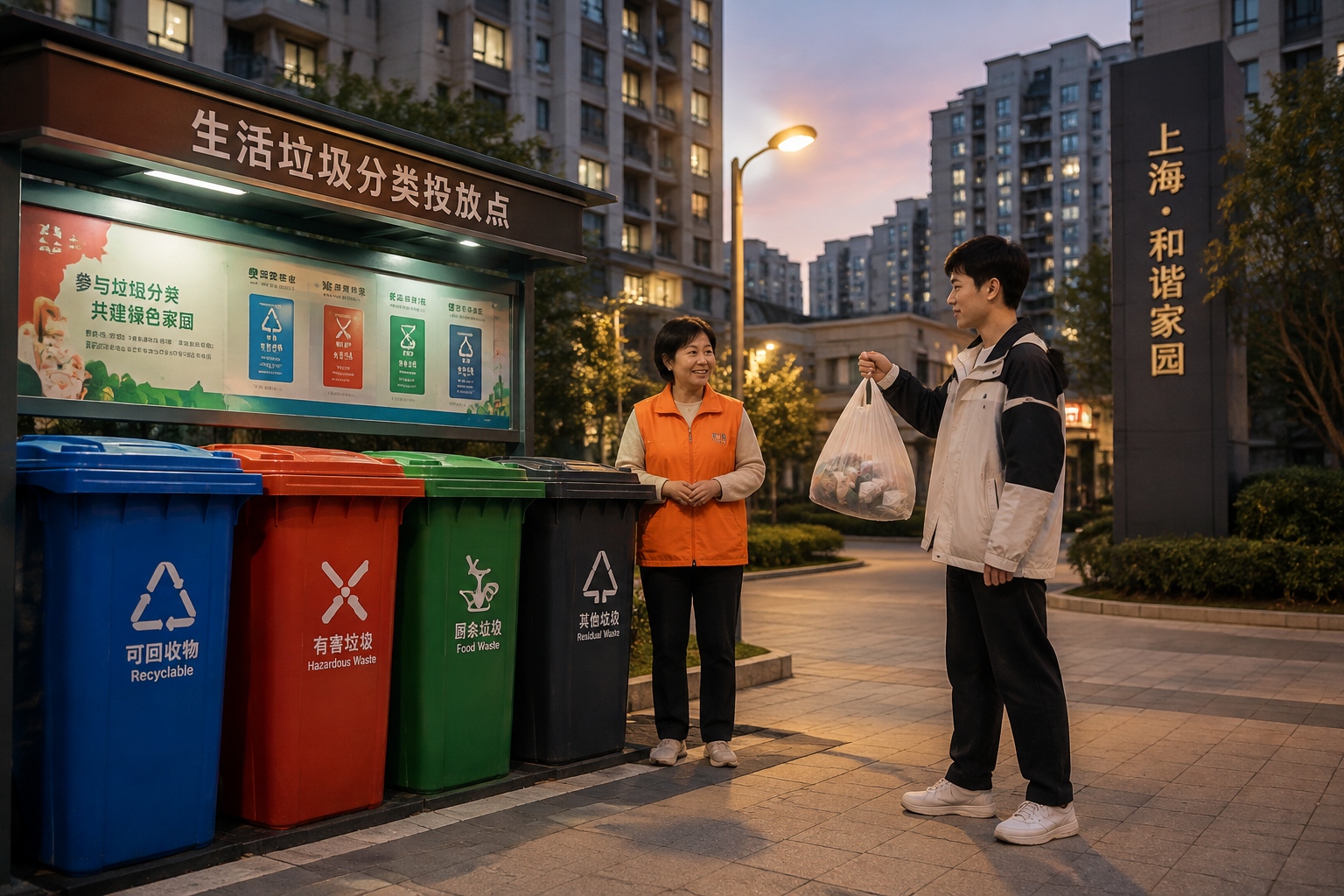
He, a young designer from California, moved to Shanghai last year. On his first evening, he stood in front of the waste bins in his residential compound, holding a half-eaten bowl of noodles and a milk carton. The bins were not the familiar green “Landfill” and blue “Recycle” cans. Instead, he saw four different colored containers marked with icons and Chinese characters. A friendly elderly woman in an orange vest approached and mimed opening the bag, pointing at the noodle residue. “Wet waste,” she said in Chinese, “and the carton goes to recyclables.” He learned his first lesson in Chinese waste sorting.
That scene is repeated across every major Chinese city. Since 2019, when Shanghai introduced mandatory garbage sorting, the rules have spread to Beijing, Guangzhou, Shenzhen, and dozens of other places. For newcomers, the system can seem intimidating, but it is actually quite logical once you understand a few basic principles.
Why China Made Garbage Sorting a Legal Duty
China generates about 200 million tonnes of municipal solid waste each year. For decades, most was sent to landfills or incinerators, often without much separation. As cities grew, the pressure on waste management became acute. The signal change came in Shanghai in July 2019, when the city made sorting compulsory under a new regulation. Individual violators can be fined up to 200 yuan (about $28), while companies face much heavier fines.
Other cities followed, each adapting the rules to local conditions. The core idea is to reduce landfill volume, increase recycling rates, and turn kitchen waste into usable resources such as biogas and fertilizer.
The Big Four: How Shanghai, Beijing, and Guangzhou Sort Their Trash
While exact names may vary, most Chinese cities use a four-bin system. Let’s use Shanghai’s terminology, which is the model many others copy.
| Category | Shanghai Term | What Goes In |
|---|---|---|
| Recyclables | 可回收物 (Kěhuíshōu wù) | Paper, cardboard, plastics, glass, metal, textiles – clean and dry. |
| Hazardous waste | 有害垃圾 (Yǒuhài lājī) | Batteries, light bulbs, paint, chemicals, expired medicine, mercury thermometers. |
| Household food waste | 湿垃圾 (Shī lājī) | Food leftovers, fruit peels, vegetable scraps, tea leaves, eggshells – anything that decays quickly. |
| Residual waste | 干垃圾 (Gān lājī) | Everything else: tissues, ceramics, disposable diapers, packaging with food residue, cat litter, etc. |
Beijing uses “kitchen waste” (厨余垃圾) instead of “wet waste,” and “other waste” (其他垃圾) instead of “dry waste.” Guangzhou calls it “food waste” (餐厨垃圾). The sorting principle is the same.
For an American reader, a quick comparison with New York City helps. New York generally separates trash (landfill), metal/glass/plastic recycling, paper recycling, and increasingly, compost for organics. China’s wet waste is roughly similar to compostable organics, but the big difference is that China requires you to put organic kitchen waste into the designated bin without mixing it in a plastic bag. You are usually asked to empty the bag, or “break the bag,” and then toss the plastic bag into residual waste. That detail often surprises newcomers.
You Can’t Throw Anytime You Want: Fixed Drop-Off Hours
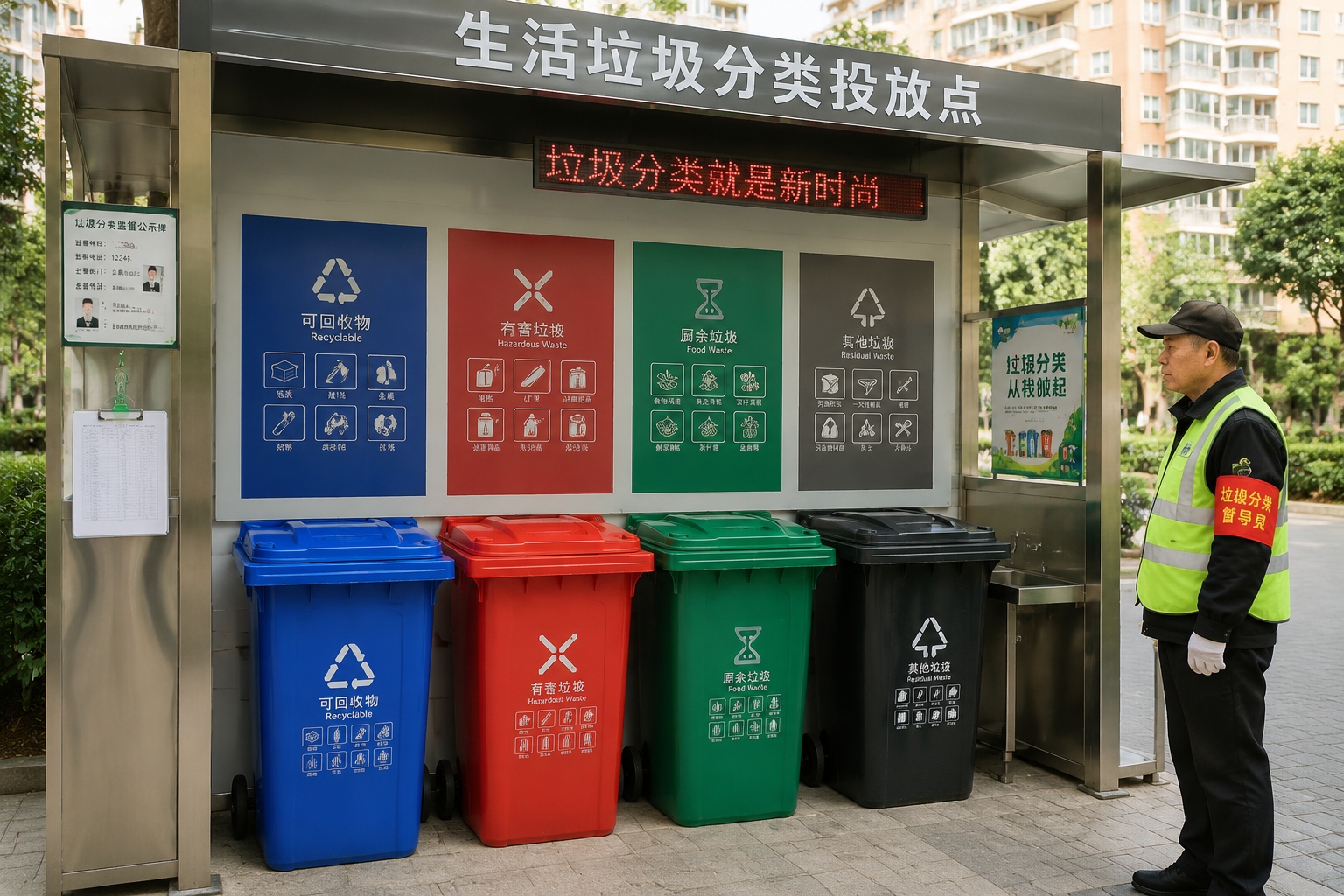
In many Chinese residential compounds, waste bins are not always accessible. Instead, there are designated drop-off points open only during fixed hours, typically early morning (7:00–9:00) and evening (18:00–20:00). This is called “定时定点” (dìngshí dìngdiǎn, fixed time, fixed point).
The idea is to have bins removed from the ground floor to avoid odor and flies, and to encourage residents to develop a sorting habit. For example, in a typical Shanghai compound, you’ll see a neat station with four or five colored bins behind a small shelter, and it is locked outside the hours. If you miss the window, you must hold your trash until the next slot or take it to a nearby centralized station that stays open longer.
For office workers, this can be a challenge. Many families simply schedule their trips around work: they take out the trash in the morning on the way to commute, or after dinner in the evening. Some neighborhoods for expats and high-end apartments have 24-hour bins, but they are the exception.
The Eyes on the Street: Community Supervisors and Social Pressure
During those two-hour windows, you will likely see a volunteer or a hired worker standing beside the bins. These “supervisors” (督导员) check whether your garbage is correctly sorted. They may even poke their gloved hands into your bag to inspect the contents. If you have mixed recyclables with kitchen waste, they will politely – or firmly – ask you to do it again right there.
This often surprises foreigners, who may feel treated like children. But the supervisors are not there to humiliate you; they are trying to build a habit in a country with 1.4 billion people. A 2020 survey by the Shanghai government found that over 90% of residents now sort their waste correctly, a huge jump from the first few months. That dramatic change relies on this friendly but persistent nudge.
Your New Best Friend: Apps and Smart Bins
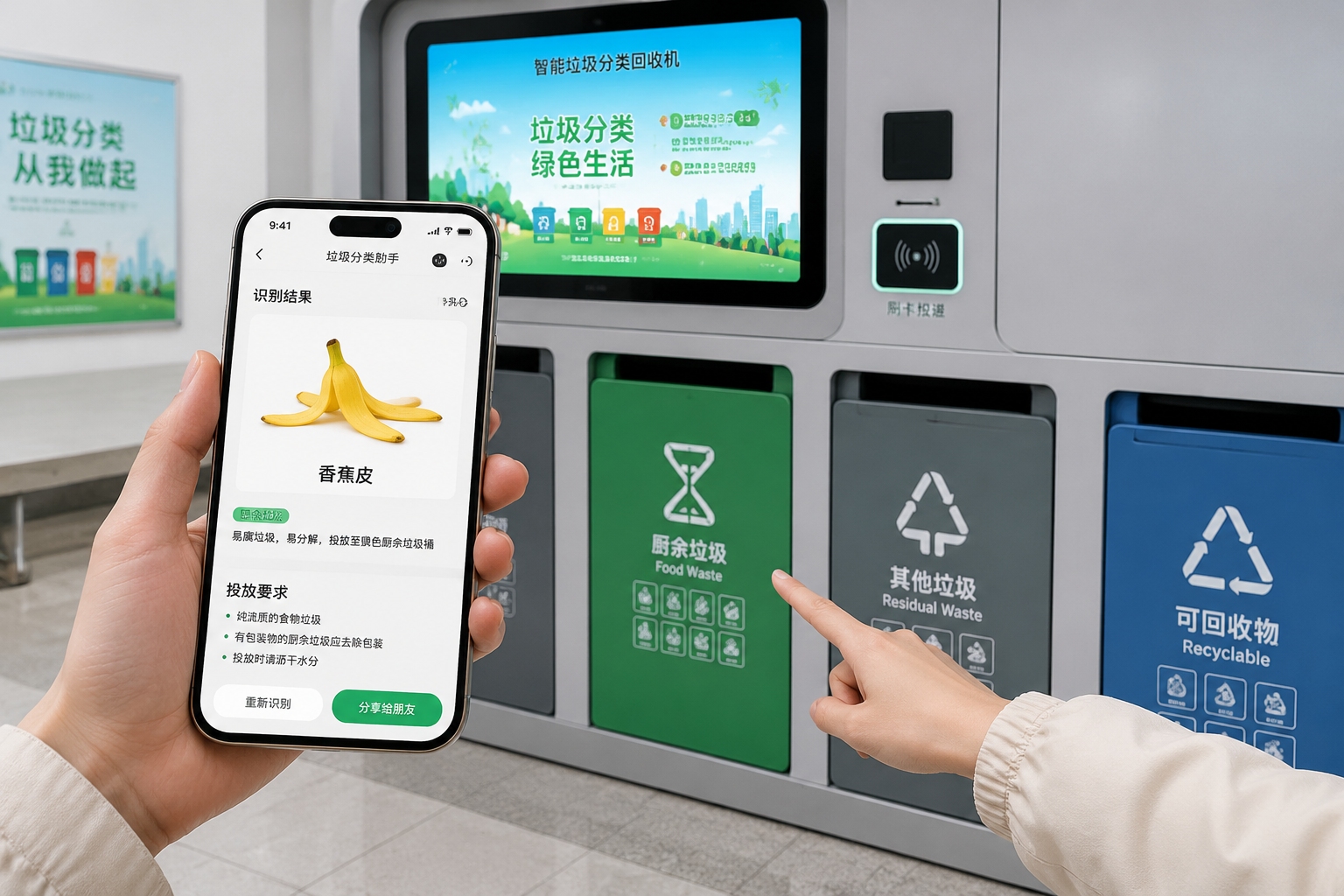
If you’re unsure which bin to use, technology has your back. Many city governments run mini-programs inside WeChat, China’s universal messaging platform. For example, the WeChat mini-program “Shanghai Greening” or the “Garbage Sorting Guide” lets you type or scan a photo of an object and it tells you the correct category. There’s also a voice recognition feature – you simply say “banana peel” and the app responds.
Smart bins are also spreading. In Beijing’s Chaoyang District, some bins have facial recognition and grant points to registered households. Residents can exchange points for small daily items like soap or plastic bags. In Hangzhou, a set of “smart recycling machines” automatically weighs your recyclables and immediately transfers money to your Alipay account. These gadgets make sorting feel less tedious and more rewarding.
What Happens If You Sort It Wrong?
Legally, Shanghai’s regulation allows a fine of 50 to 200 yuan for individuals who mix waste incorrectly. Beijing has a similar range. In practice, enforcement focuses on education. The supervisors will correct you at the bin, and they rarely call the urban management officer to write a ticket. Fines are usually issued to businesses caught dumping large quantities of unseparated waste.
That does not mean you can ignore the rules. In well-managed compounds, repeated violations can be reported to the HOA (the residential property committee), which may display your building number or even refuse to renew your rental? That last part is rare, but housing managers can make your life inconvenient. The social pressure is often stronger than a fine.
Practical Advice for Getting It Right as a First-Timer
Here’s a simple checklist to help you adapt.
- Download a local sorting app or WeChat mini-program. Search “垃圾分类” plus your city name, and you will find an official guide.
- Learn the basic four categories. In most cities it’s recyclable, hazardous, food/kitchen, other. Use a mnemonic: “Pigs can eat it” means wet/kitchen waste; “Pigs cannot eat it, selling scraps helps” means recyclable; “Pigs will die if they eat it” means hazardous; “Pigs won’t eat it anyway” is residual.
- Take extra care with food waste. Always empty the plastic bag into the kitchen bin, then throw the bag into residual waste. Rinse containers before putting them into recyclables.
- Respect the drop-off hours. If you miss the window, find the nearest 24-hour centralized collection point. A quick map search on Amap or Baidu Maps will show “可回收物交投点” (recyclable collection points).
- Watch what your neighbors do. They are the best teachers. Follow their lead and you’ll get the hang of it within a week.
Garbage Rules Are Good for You and the City
After living in China for a year, He now sorts his trash without thinking. He even uses an app to identify tricky items. He says the habit has changed how he consumes – he buys less packaged food and carries his own bag for groceries. Waste sorting may seem like a small civic duty, but it pushes people to think about resources in a smarter way. And the more you do it, the more natural it feels – just another rhythm of city life in modern China.
Start the discussion at forum.chinacomes.com