

Morning at 3,800 Meters
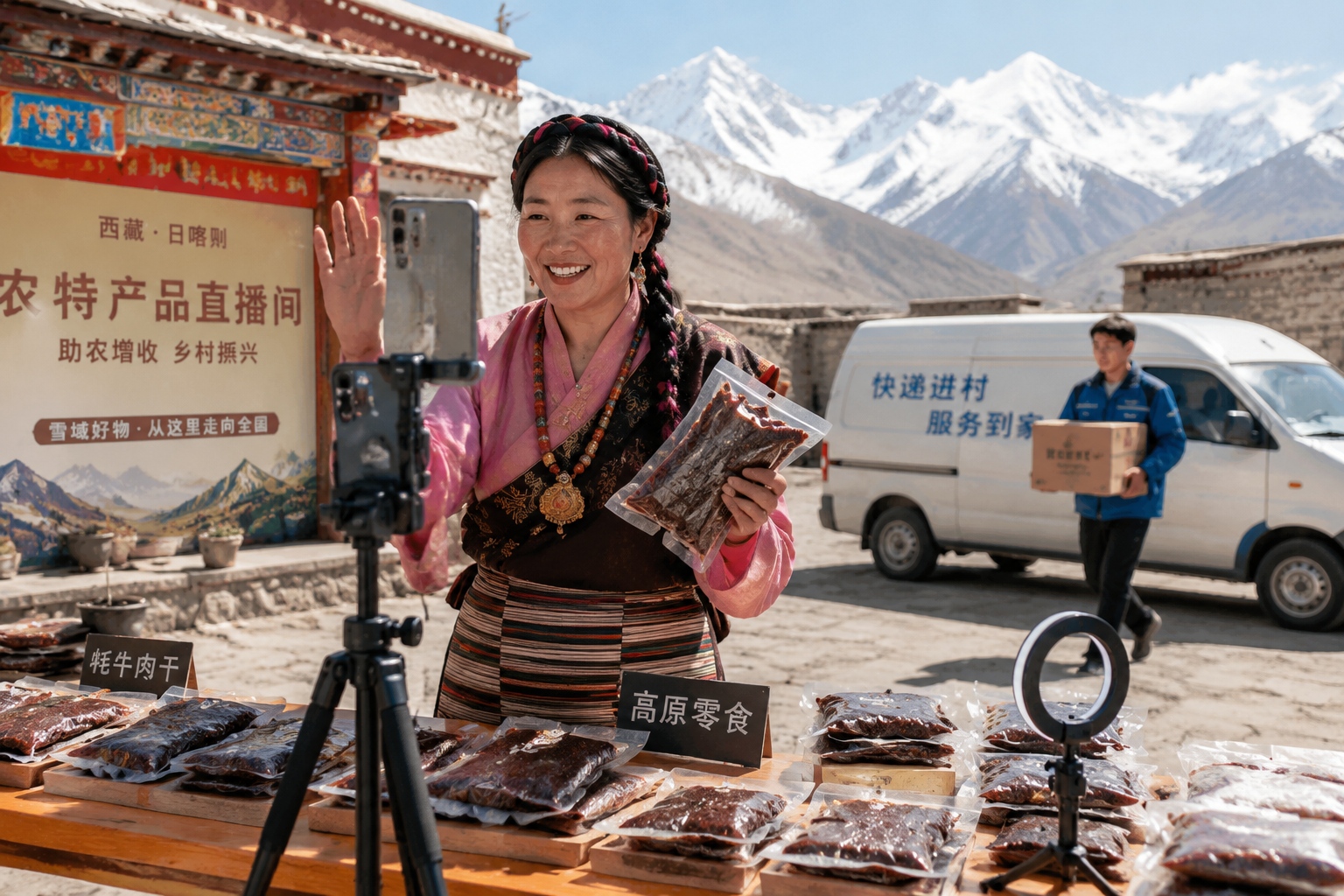
Let me set the scene: It’s 9 a.m. in Shigatse, and the air is thin and cold. The sun is climbing over the snow-capped Nyenchen Tanglha mountains, and in the courtyard of a small Tibetan house, Tsering Droma is warming up for her daily livestream. She’s adjusting her pink apron, checking the ring light, and frowning at the pile of vacuum-packed yak meat on the table next to her.
‘Good morning, everyone! Welcome back to the plateau!’ she starts, in a cheerful tone mixed with a Tibetan accent. ‘Today, I’m going to show you the difference between air-dried and smoked yak meat. But first, tap the little shopping cart icon to grab today’s special deal.’
About 30 meters away, a white van pulls up. A young man in a blue uniform gets out. It’s Wang Qiang, Han Chinese, 28, from Anhui province. He’s there to pick up the meat that will be shipped to customers in Shanghai, Guangzhou, and even Beijing.
This scene is happening in hundreds of places across China, but there’s something special about this one. It’s a small, daily collaboration between a Tibetan herder and a Han Chinese delivery driver — a partnership that’s become a symbol of how everything is changing on this high plateau.
Why Shigatse? A Quick Geography Lesson
Shigatse is not a place most foreigners know. It’s the second-largest city in the Tibet Autonomous Region, about halfway between Lhasa and the Everest Base Camp. At 3,800 meters above sea level, it’s higher than Cusco, Peru, and about twice the altitude of Denver. For centuries, its people have herded yaks, grown barley, and traded goods along the ancient Silk Road that crossed the Himalayas into Nepal.
But the traditional way of selling yak meat — by carrying it to a local market and haggling over a wooden table — had a limit. There were only so many buyers in town. And if you had a surplus, you had to rely on chance.
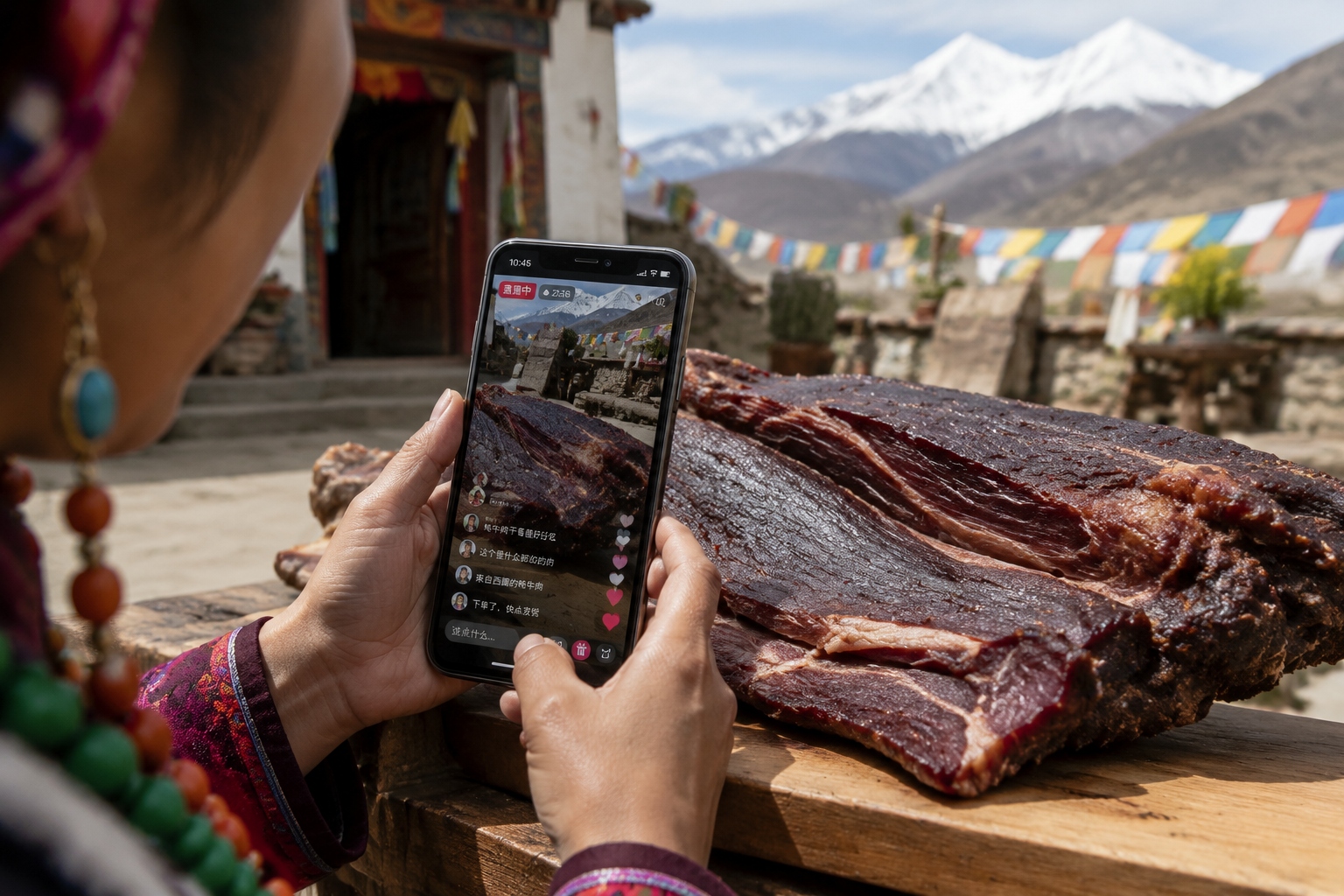
That changed with the arrival of full mobile coverage and high-speed internet. In 2018, the Chinese government expanded the Express Delivery Project to cover more rural and remote areas. By 2022, all counties in Tibet had postal and express delivery coverage. And with the rise of livestream commerce on Douyin (China’s version of TikTok), even a small herder in Shigatse could speak directly to millions of consumers.
‘The internet doesn’t care about altitude. It puts us all in the same market,’ Wang says. That may sound like a slogan, but for Shigatse, it’s been a game-changer.
Yak Meat Goes Live
So, what does a typical live session look like?
Tsering sets up her phone on a tripod in her courtyard, with the snow-capped Himalayas as her backdrop. She doesn’t have a professional studio or bright lights — just a ring light she bought for 60 yuan and a pile of freshly dried meat.
She talks directly to the camera, switching between Tibetan and Mandarin. Sometimes she forgets a Mandarin word and laughs. ‘The customers seem to like that,’ she says. ‘They say I’m authentic.’
Her streams are part cooking show, part product demo, part travel vlog. She’s been known to walk over to the yak pen and show her audience the source of the meat. ‘This one is named Dorjee. He’s a bit grumpy, but he’s delicious,’ she says, pointing to a dark-haired beast that looks anything but amused.
The sales numbers are real. On a good day, she can move more than 100 kilograms of meat. That’s roughly 200 orders, each packed in insulated foam boxes with ice packs to keep the meat fresh on its two-day journey across the country.
The Delivery Guy Is Han — and That’s Fine
Wang Qiang’s job is to make sure that journey goes smoothly. He started working as a courier in Shigatse three years ago, after moving from Anhui with a friend who wanted to see Everest. ‘I didn’t expect to stay,’ he laughs. ‘But the salary is decent, and the mountains get in your blood.’
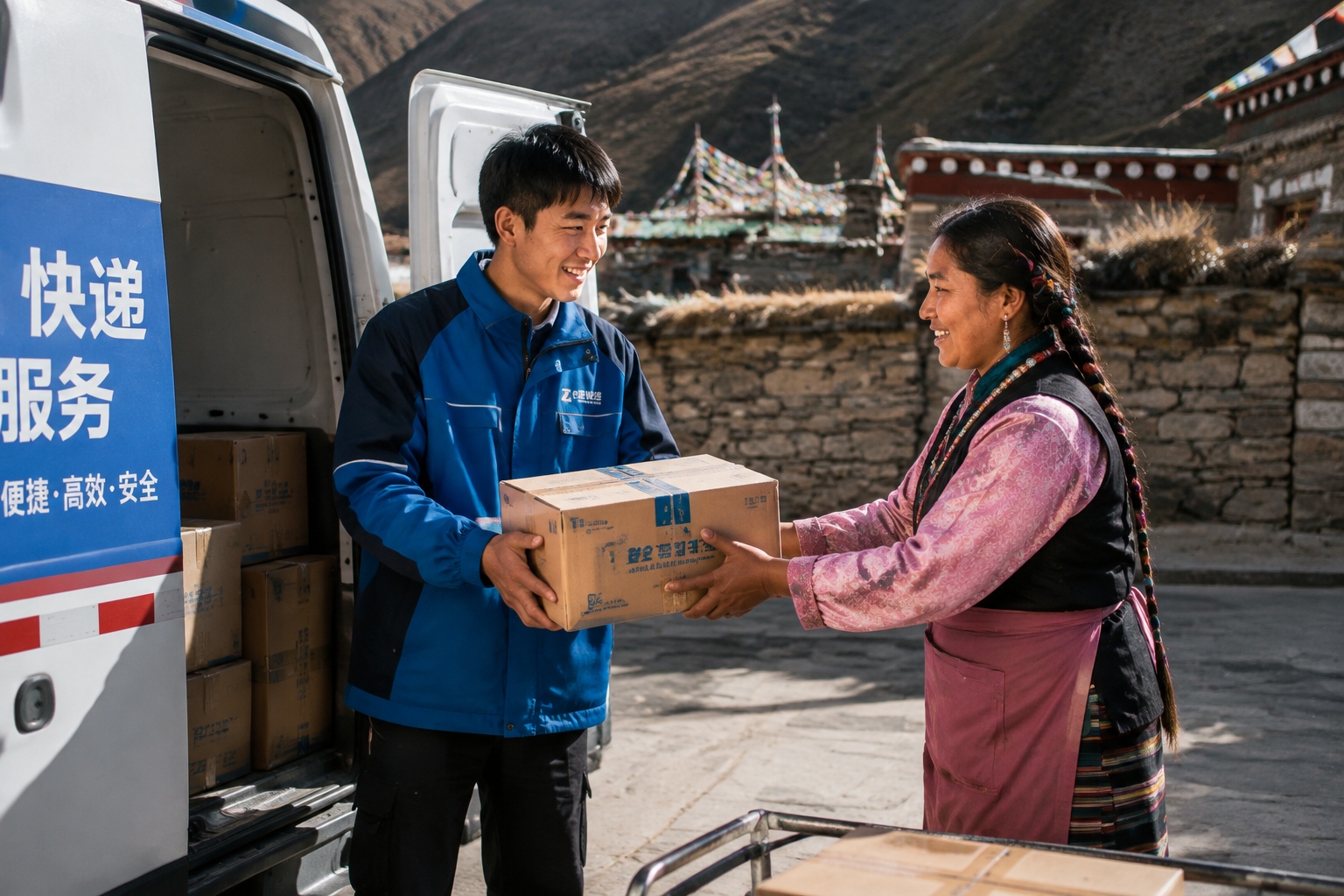
Every day at around 2 p.m., Wang pulls up to Tsering’s courtyard to collect the day’s orders. They have a simple routine. Tsering brings out the boxes, already labeled and taped. Wang reviews the addresses and makes sure each box is insulated and sealed. Sometimes he gives her advice on packaging.
‘She’s a natural saleswoman, but packaging was a new field,’ Wang says. ‘I taught her about vacuum sealing and ice packs. In the beginning, she used plastic bags, and you can imagine how that went.’
The playful banter between them is a constant. Tsering teases him for his poor Tibetan — he can say ‘Tashi delek’ and ‘Tuk-tuk’ (thank you) — and he teases her for her Mandarin grammar. But it’s friendly, and it’s built on mutual respect.
‘We don’t talk about big ideologies,’ Tsering says. ‘We talk about the weather, the price of cardboard, and whether the highway pass is open. That’s real life.’
The Bigger Picture: E-commerce Meets the Tibetan Plateau
Tsering and Wang are part of a bigger trend. According to official data, online retail sales in Tibet have grown by more than 20% every year for the past five years. In 2023, the annual e-commerce transaction volume in the region was estimated at around 8 billion yuan (roughly $1.1 billion). While that’s small compared to China’s coastal provinces, it’s a huge leap for a region with just 3.6 million people. More importantly, a growing chunk of that total comes from farm products like yak meat sold directly to consumers through livestreams.
The Chinese government has invested tens of billions of dollars in Tibet’s transport and logistics network over the past decade. The Lhasa–Shigatse railway, which opened in 2014, brought new connections. By 2024, a new highway through the Himalayas further shortened delivery times. However, last-mile logistics in remote counties still face challenges. For a package to reach a village like Tsering’s, the cost can be three times what it would be in Shanghai.
Still, the numbers are encouraging. In 2023, over one million parcels were shipped from Tibet directly to consumers, a number that has been expanding rapidly since 2018. The vast majority of those were agricultural products.
When Reality Kicks In: Snow, Costs, and Competition
Of course, selling yak meat from a high-altitude town isn’t all sunshine and smooth logistics. Tsering and Wang are frank about the difficulties.
Winter storms are a constant threat. In December 2021, a blizzard closed the road between Shigatse and Lhasa for three days. Tsering had to issue refunds for more than 50 orders. ‘It’s frustrating, but you can’t control the weather. You can only control your preparation,’ she says.
Cost is another issue. Vacuum-packaging machines, insulated boxes, ice packs — they all add up. Tsering said she spent an extra 5,000 yuan last year on packaging materials. Still, she’s willing to pay more for quality because it pays off in positive reviews.
Competition is also heating up. More and more Tibetan families are starting their own online stores. To stand out, Tsering focuses on her unique story: her family’s 30-years of yak herding, the fact that their yaks are left to graze freely on alpine meadows, and her honest, unpolished charm. ‘People buy a piece of our life, not just meat,’ she says.
Wang also notes the pressure. ‘Delivery timings are strict. If you’re late, you get a fine. But it’s the same everywhere.’ He shrugs.
A Cup of Butter Tea and a Working Friendship
It’s late afternoon now. Wang’s van is full, and he’s about to head back to the sorting center in town. Tsering brings out two cups of butter tea, hot and salty, loaded with yak butter and bricks of tea.
They sit on the low wall that separates her courtyard from the dusty street.
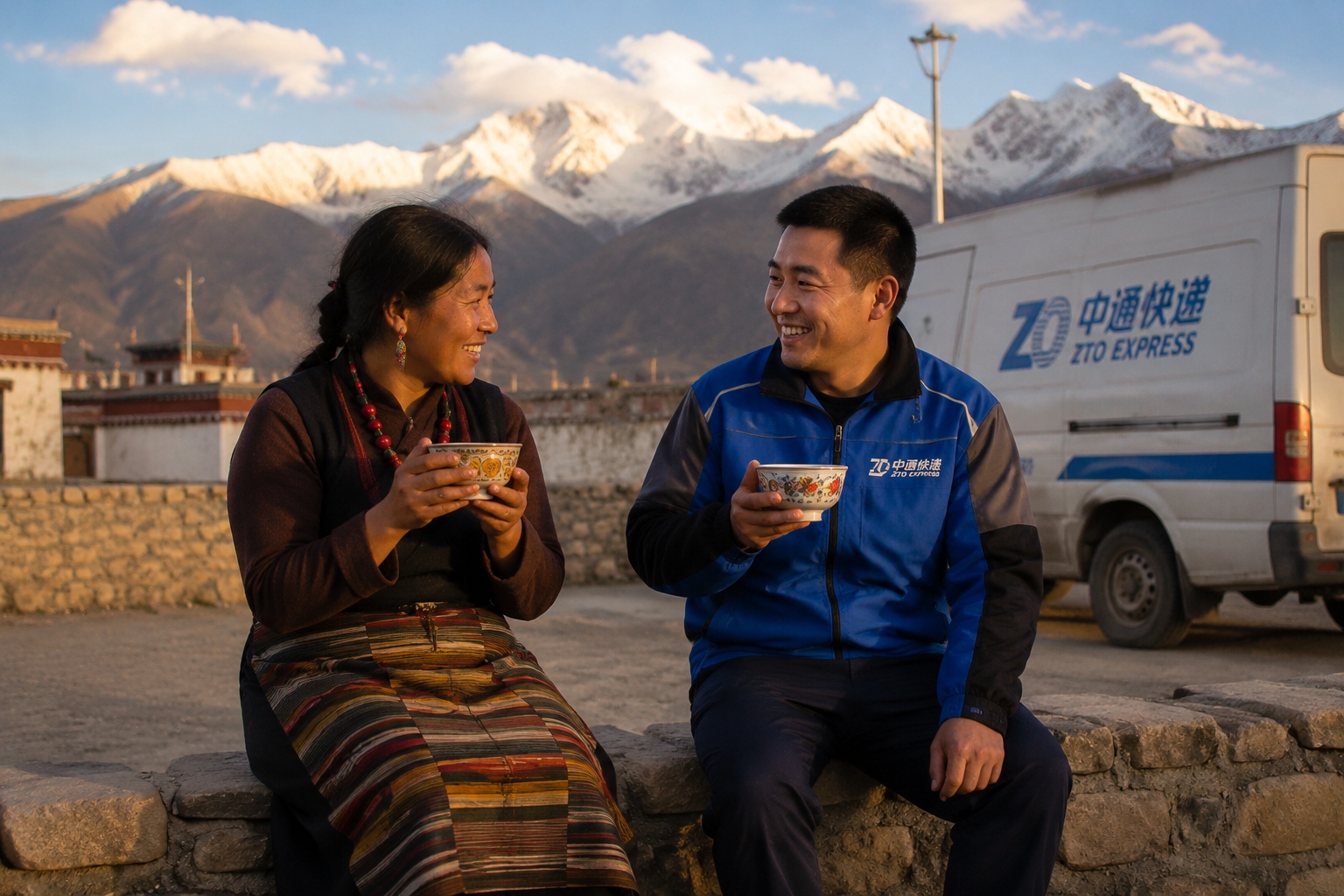
‘Xiao Wang, when are you going to try my momos?’ Tsering asks, referring to the steamed dumplings that are a favorite across Tibet.
‘Soon,’ Wang says. ‘Maybe after the Chinese New Year rush.’
‘You better come before I get too busy to cook,’ she teases.
They are an unlikely pair: a Tibetan woman in a traditional apron and a Han Chinese man in a blue courier uniform. But thanks to a smartphone, an e-commerce platform, and a mutual willingness to figure things out together, they’ve built a working friendship that spans Everest.
In Shigatse, the new Silk Road is paved with asphalt and fiber optics. And for one afternoon, it smells like dried yak meat and butter tea.
Now, that’s a story worth sharing.
Start the discussion at forum.chinacomes.com