

A Sunday Morning in Shanghai’s Matchmaking Corner
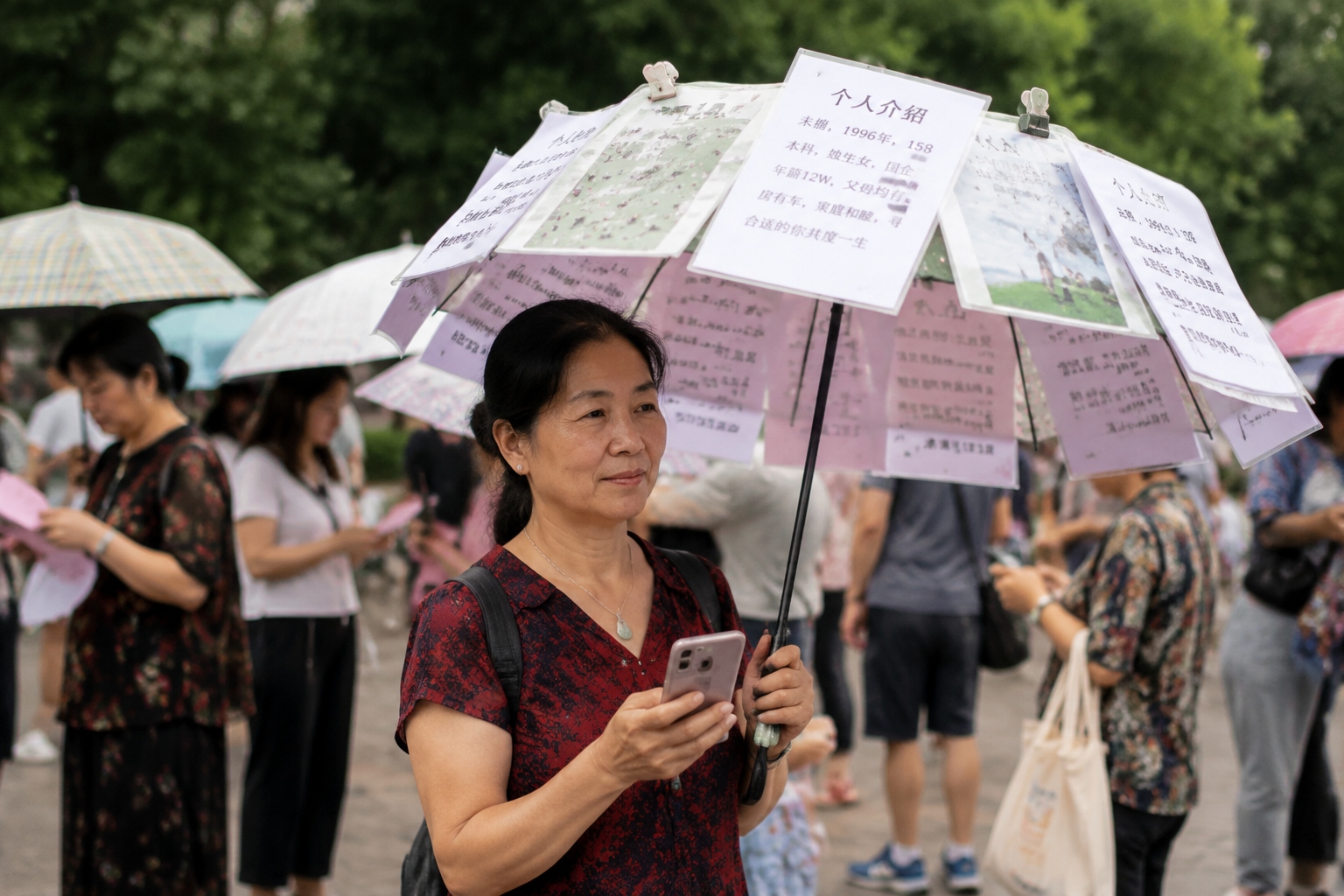
On a bright weekend in People’s Park, a retired auntie unfolds a sheet of paper and pins it to an umbrella. The paper lists a young woman’s age, height, education, salary, and a single request: “Find a trustworthy man.” For decades, this park corner was where Shanghai parents exchanged details about their unmarried children, hoping to find a good match through an old-fashioned network.
But today, this auntie also has a second ritual. After lunch, she pulls out a smartphone, logs into an app called Jiayuan, and swipes through profiles as if browsing a catalogue. Her daughter, a 29-year-old accountant, has no idea that her mother is actively messaging potential suitors on her behalf. This scene, repeated in millions of households across China, is the new face of matchmaking—one where parental anxiety has found a digital outlet.
From Park Umbrellas to Cloud Algorithms
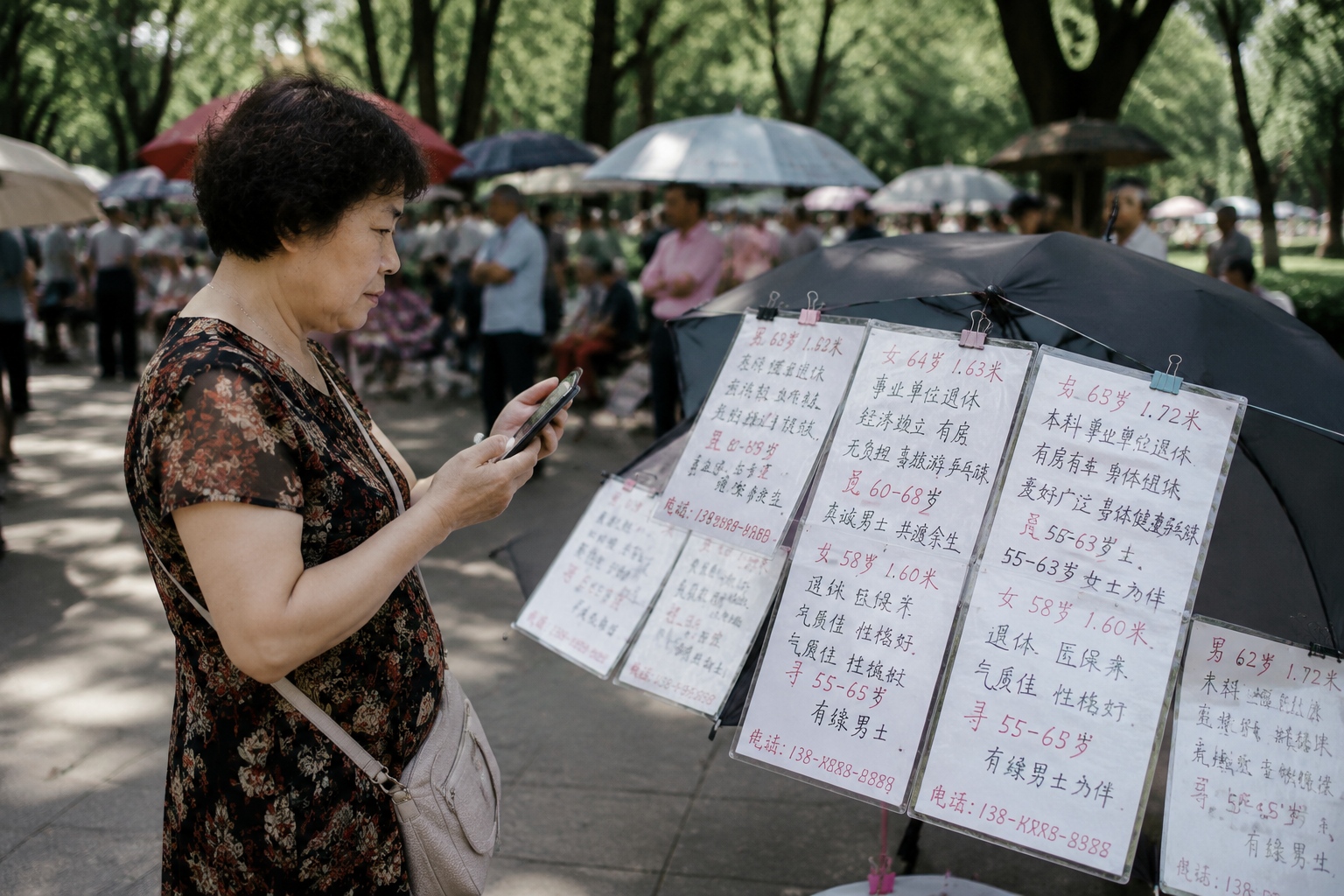
China’s traditional matchmaking scene has evolved. The crowded matchmaking corners in parks like Shanghai’s People’s Park or Beijing’s Zhongshan Park are still alive, but they now compete with online platforms that promise wider reach and smarter matching. Sites like Jiayuan.com (founded 2003) and Zhenai.com (founded 2005) were pioneers in this space. They started as websites where members could search for partners, and later added mobile apps, live streaming, and offline storefronts that offer “red lady” (hongniang) services.
How These Platforms Work
Registration is more serious than a typical dating app in the West. Users must provide ID card numbers, education backgrounds, and often prove their marital status. That’s because these platforms position themselves as services for “serious matchmaking,” not casual hookups. The core feature is algorithmic matching: you fill out a long questionnaire about your age, income, house ownership, and even star sign, and the system recommends candidates who fit your criteria. Then there is the human touch—a paid “red lady” who screens profiles and arranges offline meetings. This mix of cold computation and warm human intervention makes Jiayuan and Zhenai distinct from Western apps like Tinder or Bumble, where users are left to their own judgement.
Why Parents Are the Real Power Users
If you are from a Western country, you might find it strange that parents, not their children, are often the most active users of these platforms. In the United States, dating happens on your own schedule and usually without family involvement. In China, marriage is traditionally a family affair. The Confucian ideal of filial piety means parents feel responsible for their children’s future happiness—especially if the child enters their late twenties, which many Chinese still consider “late for marriage.”
This social pressure is visible in the language of these platforms. Terms like “leftover women” (shengnü) and “late-marrying men” (shengnan) carry a stigma that has not disappeared despite modernization. Parents respond by taking action. They learn to download apps, create profiles for their adult children, and even attend offline events hosted by the platforms. One Beijing father, a retired engineer, told me that he has spent over 8,000 yuan (about $1,100) on red lady services for his son. “My son is busy with work,” he said. “He doesn’t have time to look. Someone has to do it for him.”
How Parents Navigate the Digital Environment
It’s not always smooth. Many parents struggle with smartphone interfaces, but the platforms have designed features for them. Jiayuan, for instance, offers a “parent mode” where parents can view profiles and contact matches, while the child’s approval is required for the final meeting. This kind of design is a clever translation of the old park corner—where parents evaluated potentials first—into the digital language of buttons and notifications.
Young People: From Resistance to Pragmatism
For many young Chinese professionals, the idea of their parents handling their love life is initially humiliating. “My mom registered me without telling me,” says 27-year-old Xiao Mei, a sales manager in Shenzhen. “I was angry, but then I thought, why not? My job keeps me 12 hours a day. The only guys I meet are at work.” Xiao Mei’s story is common. Young people might roll their eyes at their parents’ enthusiasm, but they also recognize the practicality. With intense workweeks, small social circles, and high costs of living, online matchmaking offers a way to meet a willing partner without the luck of a bar encounter.
Over time, resistance turns into pragmatism. Many singles quietly log into Jiayuan on their own, upload a decent photo, and fill out the questionnaire with the same seriousness they would give a job application. The platforms, after all, are full of people who want the same thing: a stable marriage. A 2022 survey by a Chinese market research firm found that over 60% of users aged 25-35 approved of using online matchmaking as a legitimate way to find a spouse. That doesn’t mean they are desperate—it means they are realistic.

The Uncomfortable Side of Cloud Matchmaking
But the cloud has its shadows. Jiayuan has repeatedly made headlines for security and ethics issues. In 2019, CCTV exposed that some “red lady” services were using long-term membership fees to pressure clients into paying more, with promises of meeting “perfect matches” that never materialized. There have also been reports of fake profiles and information leaks. A 2020 lawsuit revealed that a user’s personal information—ID, phone number, even the fact that they had signed up—was sold to third parties for marketing purposes.
The platforms have responded to these criticisms. They now require more stringent identity verification, and they have introduced a “payment cap” to limit how much users can spend on premium services. Still, the effectiveness of these platforms is hard to measure. The companies claim high success rates, but independent studies are scarce. One commonly cited statistic is that over 300 million people have registered on Chinese matchmaking websites since 2003, but no one knows how many actually found love. The transparent answer is that matchmaking is not a precise science; nor is love.
What makes this market resilient, despite these problems, is the deep human need it serves. In a society where the marriage rate has fallen and many young people delay marriage, the family’s role as a safety net becomes more visible. The platforms are not the cause of parental anxiety—they are a coping mechanism.
Tech and Emotion: What This Means for Chinese Society
The rise of Jiayuan and Zhenai is not just a business story. It mirrors three major shifts in China: population mobility, urbanization, and changing family expectations. Rural families now have members scattered in different cities; traditional matchmakers, who once knew every young person in a village, no longer exist. Online platforms fill this gap with data, not kinship. At the same time, urban life has made it harder to meet people naturally. A 2021 report by the Chinese Academy of Social Sciences found that over 35% of urban singles say they lack opportunities to meet potential partners. Technology, in this case, becomes the new matchmaker.
But the difference from Western dating apps remains striking. In the West, apps like Tinder emphasize individual choice and often encourage a casual, self-directed search. In China, the emphasis is on family compatibility, financial stability, and the intention to marry quickly. That is why parents are so involved. They are not interfering—they are participating in a system that has always been collective. The digital platform merely makes that participation more visible.
From Anxiety to Understanding
There is a softer story beneath the business models. Behind every profile, there is often a parent who just wants to see their child settled. And behind every young person’s eye-roll, there is usually a quiet understanding that their parents love them deeply. In many families, the journey through online matchmaking becomes a way for both generations to communicate about what they truly value in a partner.
Take the auntie in Shanghai. After weeks of helping her daughter navigate Jiayuan, she realized she didn’t know how to measure “suitability.” The algorithm could sort by income and age, but not by a shared sense of humor or kindness. In the end, she asked her daughter to join an offline event together, and the negotiating married the old world and the new. “I used to think I had to choose for her,” she said. “But now I see that I can only open the door. She has to decide what kind of person she wants to walk in with.”
This is the quiet transformation happening across China: the digital cloud is not replacing family bonds. It is giving them a new canvas. Parents will keep worrying, and young people will keep searching, but the search is no longer lonely. It’s a shared mission, a generation’s call to find a tolerable balance between tradition and change—and perhaps, just perhaps, find love along the way.
Start the discussion at forum.chinacomes.com