
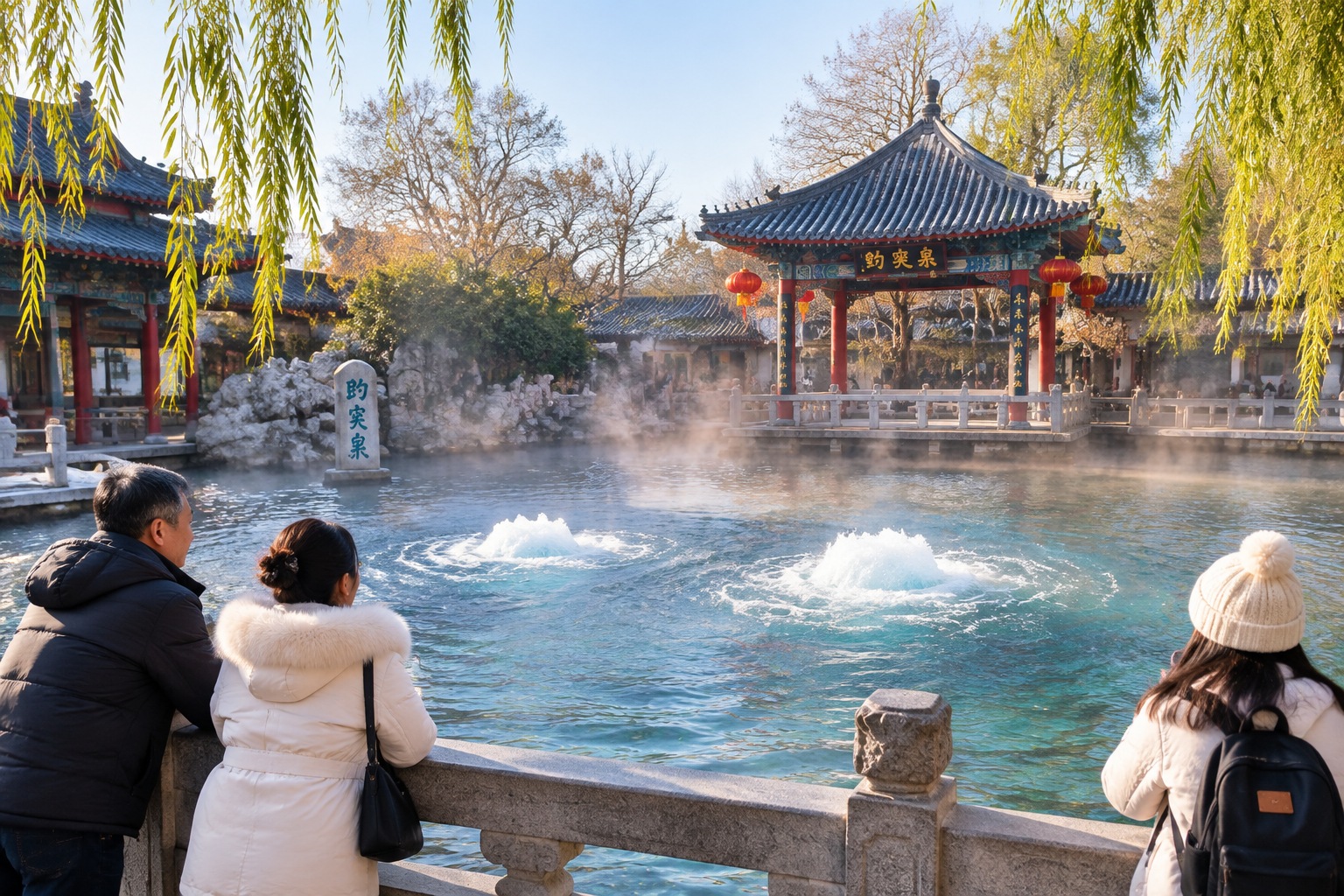

6:45 a.m. at the West Gate of Baotu Spring
It is a few minutes before seven, and the pool is steaming. Baotu Spring keeps roughly 18°C (64°F) all year round — warm in January, cool in August — so on a frosty morning the entire surface breathes. The people leaning on the stone railing are not really looking at the water. They are standing inside the cloud it makes.
Three jets rise from the pool floor, close together, from about two meters down. They twist, fold into one another, break into a white crown, and start again. In a wet year the tallest one punches half a meter above the surface and you can hear it from the gate. In a dry year the three of them barely trouble the water. Either way, the pool never goes still.
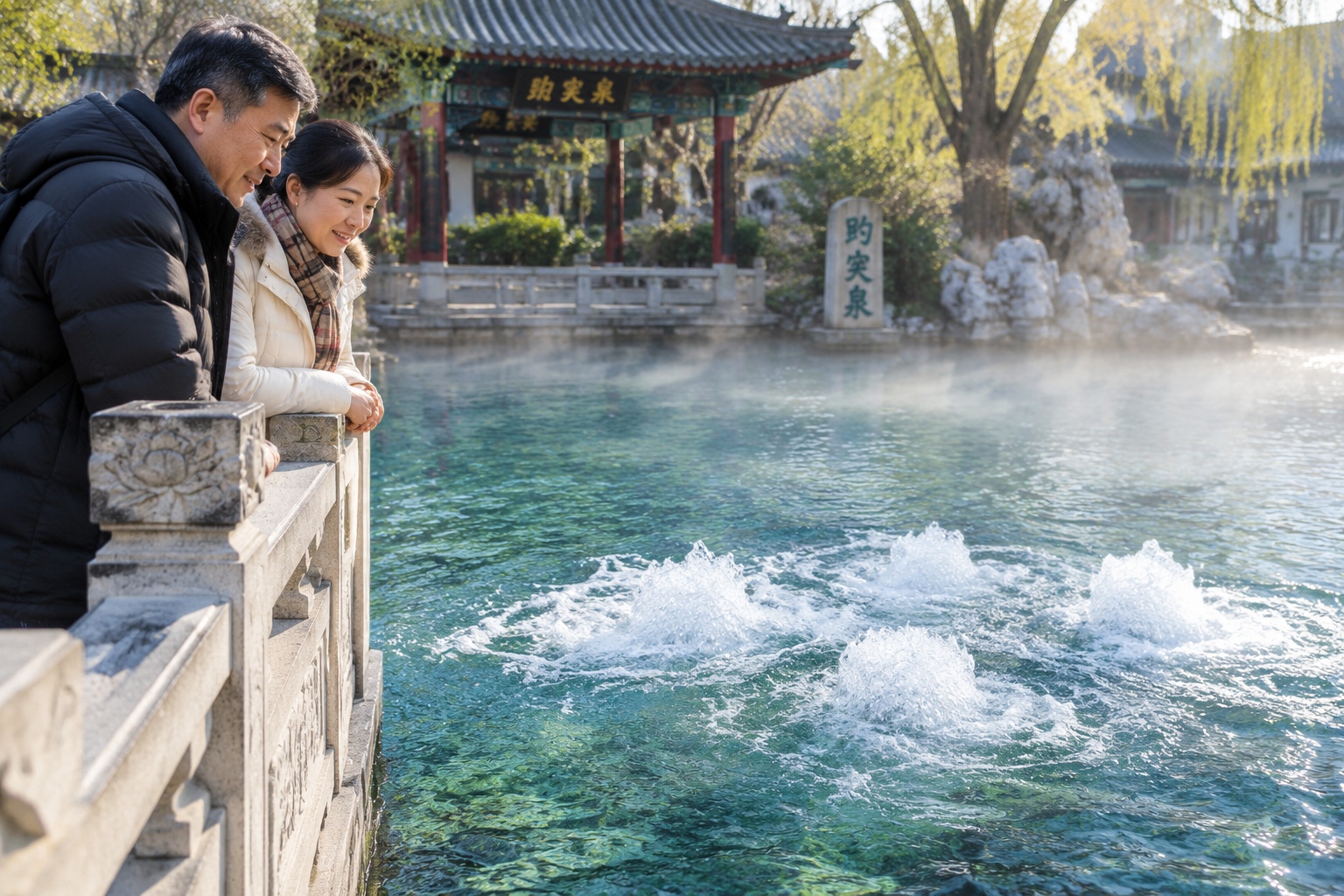
Why Anyone Calls It the No.1 Spring Under Heaven
China has more than one “number one spring.” Zhenjiang, in Jiangsu, claims the title. So does Lushan in Jiangxi. Jinan’s version rests on two things: an emperor’s opinion, and a stubborn refusal to stop.
The story is that the Qianlong Emperor, travelling south through Shandong in the 18th century, tasted this water and declared it the finest under heaven — then had jars of it carried along for the rest of the journey. That is court politics as much as hydrology. The better argument is geography. Jinan sits on a faulted limestone basin; rain falling on the hills south of the city sinks into the rock, travels underground, and is pushed back up through cracks in the city itself. Inside the city limits there are 72 named springs. Baotu is the biggest, and the only one of China’s celebrated springs that churns in the middle of a working city, a ten-minute walk from office towers and a shopping mall.
Locals Don’t Just Watch the Spring. They Check Its Numbers.
Jinan publishes the water level every day, in meters above sea level, measured at a gauge beside the pool. People read it the way people elsewhere read the weather forecast. Below 28 meters, the newspapers start using the word “warning.” Below 27.60, and the three jets are in real danger of stalling.
That has happened. Through the 1980s and 1990s, as the city pumped groundwater for factories and a fast-growing population, the spring went quiet again and again. Its longest recent silence lasted more than 500 days. It came back on 6 September 2003 and has flowed without a break since — which is why a daily number in a local newspaper still matters here.
Guanlan Pavilion, Luoyuan Hall, and a Thousand Years of Visitors
The best place to stand is Guanlan Pavilion — the name means “watching the waves” — built during the Ming dynasty and set almost directly above the three jets. From its edge you look down into the churn, close enough to feel the spray in a strong year.
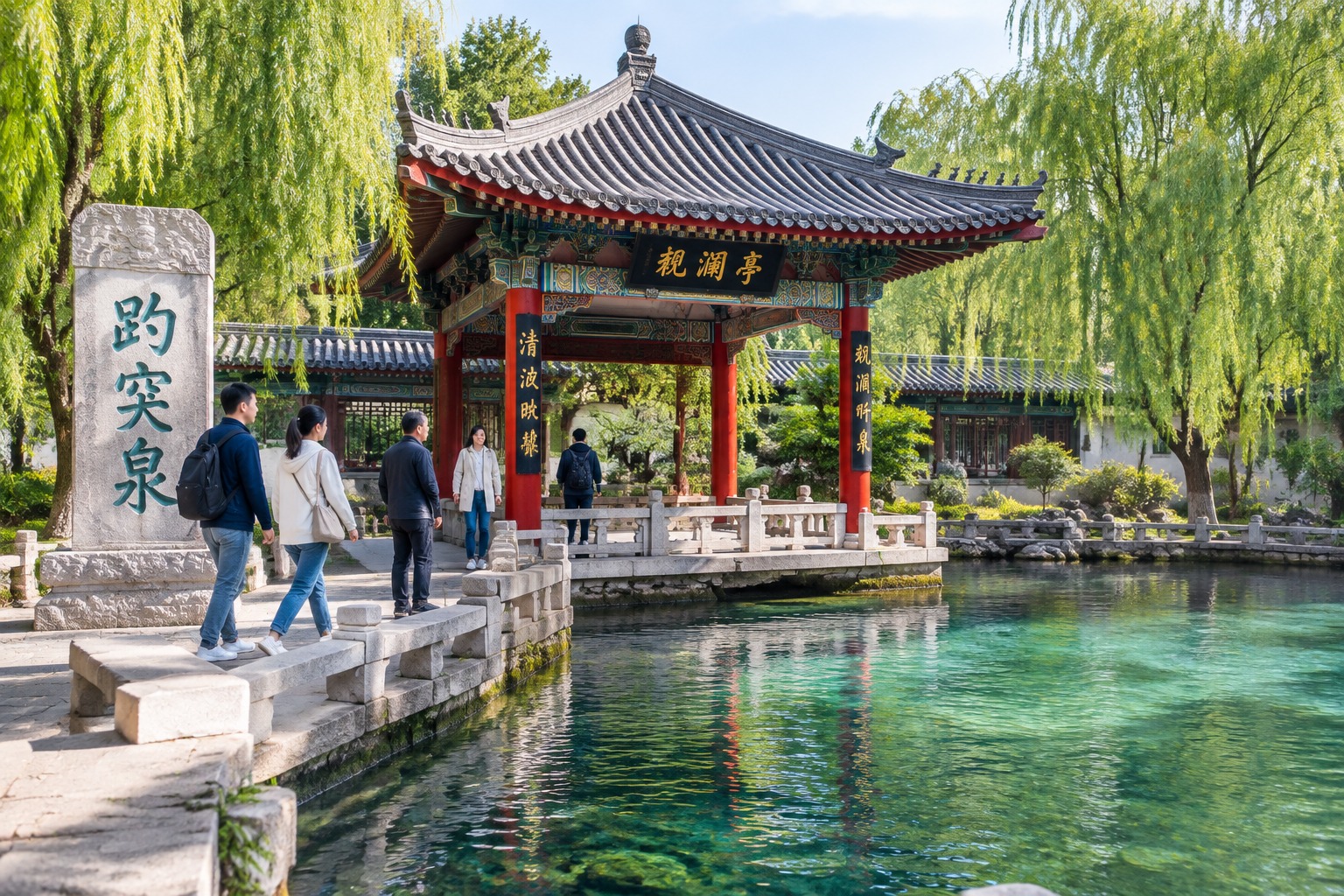
Behind the pavilion is Luoyuan Hall, first built in the Song dynasty, when the writer-official Zeng Gong governed this region and turned a rough spring site into something closer to a designed landscape. Two imperial steles stand in front of it, one carved by the Kangxi Emperor and one by his grandson Qianlong, facing each other across the courtyard.
A few steps away, past a smaller spring called Shuyu, is a memorial hall for Li Qingzhao, the Song dynasty poet born in this region. Her verses are memorized by every Chinese schoolchild. The fact that her memorial shares a park with the city’s most famous spring says something about how Jinan sees itself: not primarily as a manufacturing city, though it is one, but as a place where water and poetry happen to have the same address.
The Bucket Brigade: How Spring Water Gets Into Kitchens
Walk 20 minutes east along the moat and you reach Black Tiger Spring, where three stone tiger heads pour water into the canal. There is no ticket booth here and no opening hours.
From about five in the morning, people arrive with 10-liter jugs, 20-liter barrels, and the occasional handcart. They queue, fill, cap, and carry it home on the bus.
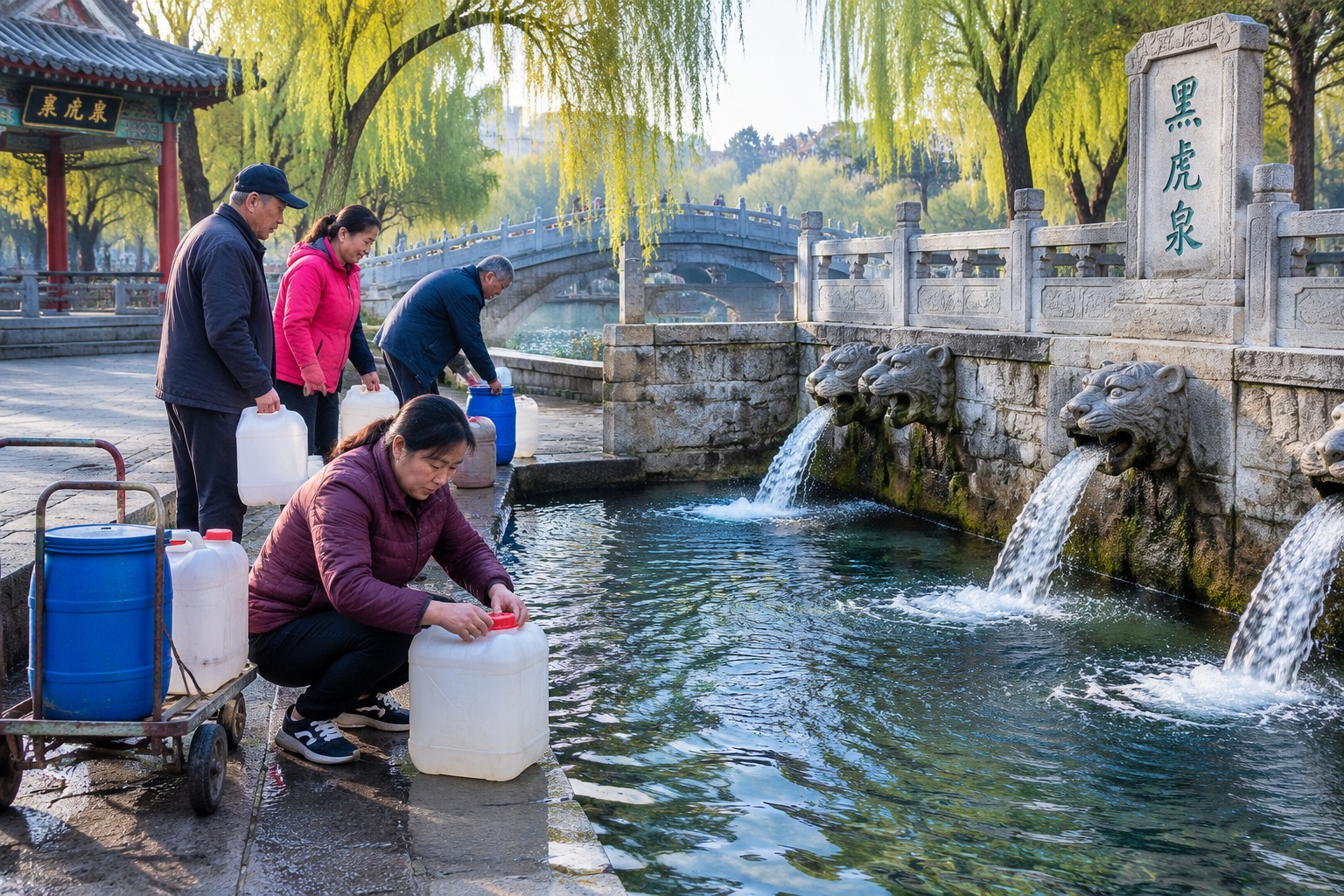
They are not doing it for a photograph. Jinan’s tap water and its spring water are different things, and residents can taste it. The spring water is mineral-rich but soft on the tongue; locals say it makes tea rounder and rice sweeter. Along the same moat, the city has installed free spring-water drinking taps. Push a button, fill your bottle, walk on.
Two Yuan a Bowl
In the alleys around Quancheng Square and along the old lanes north of the park, you can still buy a big bowl of jasmine tea brewed with spring water for about two yuan — under a dollar. It comes in a plain white bowl with no ceremony attached, and it is the best thing to drink in the city.
Quancheng Square: The City’s Living Room
Ten minutes’ walk south of the spring, Quancheng Square opened in 1999 and immediately became the place where Jinan performs its own nickname — Spring City. At its center stands a 38-meter blue sculpture built in the shape of the Chinese character 泉, which means spring.
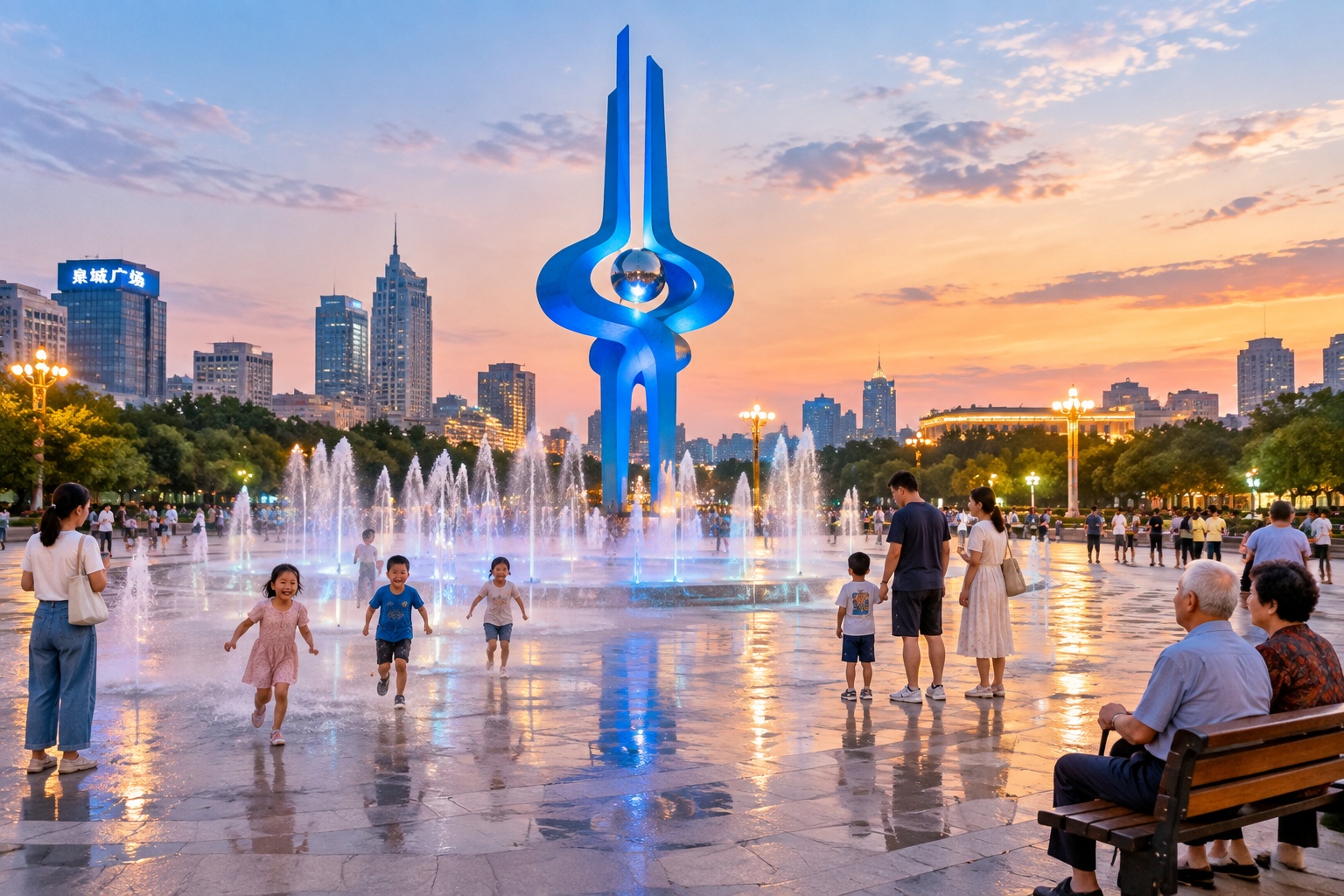
The square is large and mostly flat, and that is the point. Kites in the afternoon. A musical fountain show after dark in summer, with children running through the spray. Older men doing slow tai chi at dawn; square dancers arriving with speakers around seven. Along one edge runs a colonnade of 12 statues of figures from Shandong’s past, from Confucius to the 12th-century poet Xin Qiji. Beneath it all, a shopping mall and a supermarket stay open late. Nobody organizes the square. It simply absorbs whatever the city feels like doing that evening.
Old Streets Where the Water Runs Past the Door
The part of Jinan that surprises visitors most is not the park. It is the residential lanes north of it — Qushuiting Street, Baihuazhou, and the alleys around the Prince’s Pool — where spring water runs in open channels beside the houses, under small stone bridges, past willow branches that trail into the current.
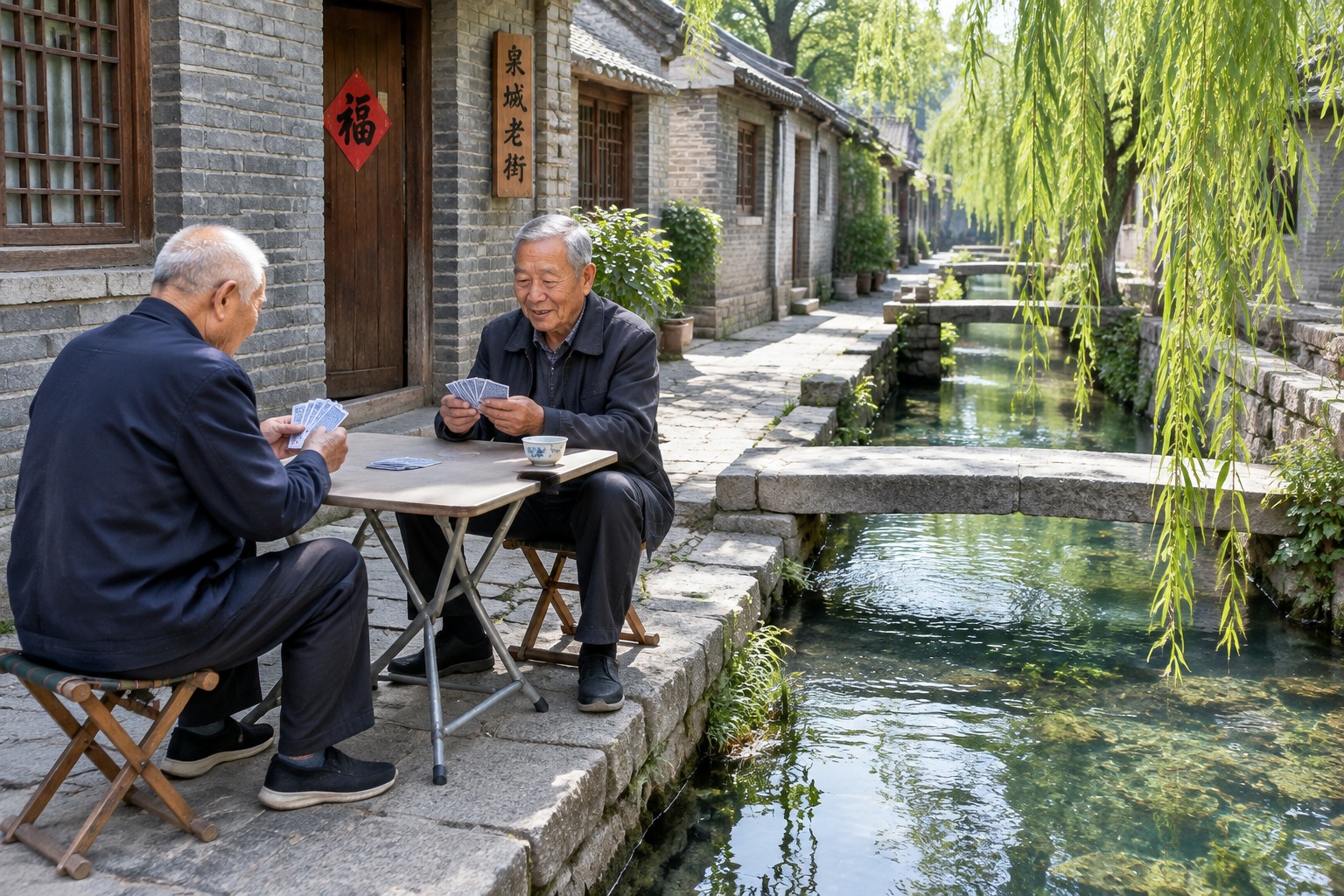
Families have lived along these channels for generations. Old men play cards at folding tables set up inches from the water. In summer, a free outdoor pool on the moat is filled with the same spring water and is open to anyone who shows up.
If You Go
Baotu Spring Park charges 40 yuan (roughly $5.50) for entry and opens at 7 a.m. Early morning beats midday: fewer tour groups, more mist, and you get to watch the regulars at their routines. Black Tiger Spring, the moat, Quancheng Square, Daming Lake and the old lanes are all free.
Come in autumn, ideally after a rainy stretch. That is when the gauge climbs, the jets stand tall, and half the city seems to know the exact number by heart.
What the Spring Is Really Measuring
There is a reason this pool gets so much attention in a country with no shortage of scenic spots. It is a public thing that can be lost. The water level is not scenery; it is a ledger of how the city uses what lies under it — how much it pumps, how much it builds, how much rain the hills to the south receive. When the spring is loud, Jinan is doing something right. When it goes quiet, everyone notices.
So the three jets keep turning, in a park in the middle of a city of nine million people, and people keep leaning on the railing before work to watch them do it. It is not a monument. It is more like a neighbor.
Start the discussion at forum.chinacomes.com